The Day One Little Word Brought My Grandson to Tears
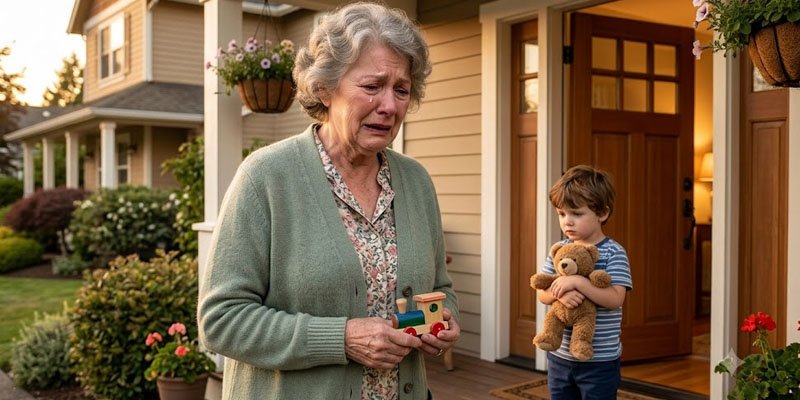
I still remember the first time my grandson looked up at me with those bright, curious eyes and called me by my first name.
He wasn’t even three yet—a bundle of endless energy with cookie crumbs on his cheeks and a plastic dinosaur clutched in one tiny hand. Grinning proudly, he looked straight at me and chirped, “Linda!” as though he had just handed me the greatest gift in the world.
At first, everyone laughed.
How could we not?
My son, Jason, smiled and gently corrected him. My daughter-in-law, Nora, crouched beside him and said warmly, “That’s Grandma, sweetheart.”
The moment the word left her lips, everything changed.
His smile disappeared. His little face crumpled, and without warning, he burst into heartbreaking sobs. He dropped his dinosaur, covered his ears with both hands, and cried as though the word itself had frightened him.
Jason immediately scooped him into his arms while Nora rubbed his back, whispering over and over, “It’s okay. Nobody is going to make you say it. You’re safe.”
We assumed it was nothing more than a toddler having a difficult moment.
Children react to the strangest things, after all.
What none of us realized was that this was only the beginning of a mystery that would stay with us for nearly a year.
A Year of Questions
As the months passed, one thing never changed.
My grandson adored me.
Whenever I came to visit, he would race across the room with open arms, eager to show me his newest drawing or tell me about the “super-fast” cars in his picture books. We’d build blanket forts, read bedtime stories, bake cookies, and laugh until our cheeks hurt.
But every single time, he called me only one thing.
“Linda.”
“Hi, Linda!”
“Look what I made, Linda!”
“Love you, Linda!”
His voice overflowed with affection, yet every time I heard my own name, a tiny ache settled inside my heart.
Long before he was born, I had dreamed about becoming “Grandma.”
To me, it wasn’t just a title.
It represented warm hugs, bedtime stories, Christmas mornings, homemade cookies, scraped knees, little hands wrapped around mine, and the special kind of love that only grandparents understand.
Instead…
I was simply Linda.
Everyone assured me it wasn’t personal.
“He’ll grow out of it.”
“It’s adorable.”
“Don’t worry so much.”
Nora corrected him only those first few times. After seeing how upset he became, she never pressured him again.
At first, I admired her patience.
Eventually, however, doubt quietly slipped into my heart.
I hated myself for thinking it, but I couldn’t help wondering…
Did Nora secretly want her own mother to be the only “Grandma”?
Was she encouraging him to call me Linda instead?
The thoughts embarrassed me because Nora had never given me any reason to question her.
She always treated me with kindness.
She checked on me after doctor’s appointments.
She sent me pictures of my grandson dressed up for Halloween.
She welcomed me into their home as though I truly belonged.
Still…
The hurt lingered.
The Conversation That Changed Everything
One Sunday evening, after a comforting family dinner of pot roast and mashed potatoes, we were cleaning the kitchen while Jason entertained our grandson in the living room.
Earlier, our little boy had laughed so hard at one of Jason’s silly animal impressions that milk had come out of his nose.
The whole house still felt warm with laughter.
When it was time for me to leave, he hugged my waist tightly.
“Bye, Linda!”
I kissed the top of his head and smiled.
Then, gathering my courage, I followed Nora into the kitchen.
“Nora,” I asked softly, “can I ask you something?”
She nodded.
“Why don’t you ever really correct him anymore?”
She froze.
Only for a second.
When she turned around, tears were already filling her eyes.
“Please,” she whispered. “Please don’t ask him to call you Grandma.”
Her answer stunned me.
Without thinking, I blurted out the fear I’d been carrying for months.
“Did you teach him not to?”
The pain on her face answered before her words did.
“No,” she said quietly. “Linda…I promise I didn’t.”
“Then why?” I asked.
“Why is he so terrified of that word?”
She glanced toward the living room where our grandson happily chatted with his toys.
Then she looked back at me.
Her voice barely rose above a whisper.
“Because he believes grandmas leave forever.”
A Child’s Misunderstanding
Months earlier, an elderly woman in their neighborhood had passed away.
She was everyone’s favorite grandmother—the sweet lady who sat on her porch handing out popsicles during the summer.
Our grandson knew her.
He waved whenever they walked by.
When she died, he noticed the sadness surrounding her home.
Like every curious child, he started asking questions.
Somewhere during those conversations, he overheard an adult say,
“Grandmas leave forever.”
Those words were meant to explain death.
Instead, they became something entirely different inside a three-year-old’s mind.
He believed the word “Grandma” itself made people disappear.
So he stopped calling me Grandma.
Not because he didn’t love me…
But because he loved me too much to risk losing me.
I slowly lowered myself into a kitchen chair as tears filled my eyes.
All those months, I had believed he was rejecting me.
In reality…
He was trying to protect me.
“He calls you Linda,” Nora said gently, “because he thinks that’s the only way to keep you here.”
Before I could respond, we heard a tiny voice from the living room.
“Grandmas leave forever.”
We found him sitting on the carpet, lining up his toy animals.
He wasn’t talking to us.
He was simply repeating the rule he believed about the world.
Pointing at a little stuffed bear, he added solemnly,
“Aunt May said that when Mrs. Patterson died.”
Untangling His Fear
Aunt May is my elderly aunt—a gentle woman who always smells like lavender and wears soft knitted cardigans.
I could easily imagine her trying to comfort someone after Mrs. Patterson’s passing.
I could also imagine how a little boy, quietly listening nearby, misunderstood what he’d heard.
I sat beside him on the rug.
“Sweetheart,” I asked softly, “who told you that?”
“Aunt May.”
“Did she say it to you?”
He shrugged.
“She was talking,” he answered. “I heard her.”
So we began carefully untangling the fear that had lived inside his heart for nearly a year.
“Can I tell you something about names?” I asked.
He climbed into my lap.
I brushed my fingers through his curls.
“You know,” I smiled, “if I call you Pumpkin, you won’t turn into a pumpkin.”
A tiny smile appeared.
“And if I call Daddy Captain Dinosaur…”
Jason interrupted dramatically from across the room.
“I certainly hope not.”
Our grandson giggled.
“So,” I continued, “the word Grandma is just another name for a very special kind of love. It cannot make me disappear. It cannot make me leave.”
He looked up at me carefully.
“But Mrs. Patterson was a grandma.”
“She was,” I nodded. “And she died because she was old and sick—not because people called her Grandma.”
He turned toward Nora.
She nodded through her tears.
Finally, he looked back at me.
“So…you won’t go away if I say it?”
I wrapped my arms around him.
“Never because of that,” I promised. “Not ever.”
He rested his forehead against mine.
For a long moment, he stayed completely still, gathering enough courage to test the word that had frightened him for so long.
Then, barely louder than a whisper, he said,
“Grandma?”
My heart broke and healed all at once.
“Yes, sweetheart,” I answered, my voice trembling.
A smile slowly spread across his face.
“Hi, Grandma.”
In that beautiful little moment, every ounce of hurt I’d carried over the past year disappeared, replaced by overwhelming gratitude.
The little boy I thought had been refusing to call me Grandma had actually been doing everything he could to keep me in his world forever.
A Visit and an Apology
A week later, I found myself standing at Aunt May’s front door. When she opened it in her soft house slippers, concern immediately crossed her face the moment she saw mine. As soon as I explained what our grandson had overheard that day, she covered her mouth with one hand and slowly lowered herself into a chair.
“Oh, Lord,” she whispered, her voice shaking. “Did I really say that?”
I reached over and gently squeezed her hand.
“You were only trying to explain something far too complicated for a little child to understand,” I told her. “He heard the words, but he couldn’t possibly grasp the meaning behind them.”
Tears filled her eyes almost instantly. She apologized once, then again, crying harder each time. I believed every single apology because I knew her heart. I wasn’t angry anymore.
By then, I could finally see the whole story for what it truly was—a family trying to explain love and loss with the only words they knew, while a small child quietly listened from the hallway and stitched together his own frightening conclusion.
Sometimes we wound the people we love without ever intending to. Not because of cruelty, but because of misunderstandings. Because words spoken with love can still be misunderstood by ears too young to understand them.
What Our Family Learned
Today, my grandson almost always calls me “Grandma.”
Every now and then, especially when he’s tired, upset, or overwhelmed by big emotions, “Linda” slips out before he even realizes it. I never correct him.
Now I understand exactly what that little slip means.
It’s simply the fading echo of a fear that once felt enormous to him but is slowly becoming smaller with every passing day.
We treat those moments gently, almost like caring for a tiny seedling that needs patience to grow.
Whenever he calls me “Grandma,” I smile just a little brighter so he can see that everything is safe and steady.
And whenever “Linda” slips out instead, I answer with exactly the same warmth, because I want him to know that my love never depends on a single word.
Children don’t learn security through lectures.
They learn it by watching the people who love them keep showing up, again and again.
The adults learned something important too.
Nora and I finally had an honest conversation about how silent hurts can quietly grow into stories that were never true.
She admitted that she and Jason had worried pushing him to call me “Grandma” might only make his fear worse.
I admitted that I’d been feeling left out and, without realizing it, had allowed my hurt feelings to become unfair assumptions about her.
We both apologized.
We forgave each other.
Families aren’t built because people never misunderstand one another.
They’re built because people choose to tell the truth, listen with compassion, and forgive when love asks them to.
The Moment I Had Been Waiting For
Not long ago, my grandson came bursting through my front door, full of excitement.
“Grandma! Grandma! Where are you?” he shouted as his little voice echoed through the hallway.
I stepped out of the kitchen just in time for him to throw himself into my arms so enthusiastically that I had to grab the wall to keep us both from falling over.
Beaming with pride, he held out a crinkled piece of paper.
“I made this for you,” he announced.
It was covered in colorful swirls, a dinosaur, three blue circles, and a person with bright purple hair who may or may not have been me—assuming I’d suddenly decided to reinvent myself.
Across the top, in Nora’s neat handwriting, were the words my grandson had proudly dictated:
ME AND MY GRANDMA.
I quietly excused myself and slipped into the bathroom.
Then I cried.
Not from sadness.
From joy.
Sometimes the blessings we’ve been waiting for don’t arrive with loud celebrations or dramatic moments.
Sometimes they arrive softly, wrapped inside a child’s drawing and spoken in a tiny voice.
And when they finally reach your hands, your heart opens wider than you ever imagined possible.
If Your Grandchild Says Something That Hurts
If you’ve ever felt a little sting because your grandchild called you something unexpected, I wish we could sit together over a warm cup of tea while I shared this story with you.
Children don’t always understand the meaning behind the words adults use.
And adults don’t always recognize the fears children quietly carry inside their hearts.
Between those two truths is a place where patience can perform remarkable miracles.
Ask gentle questions.
Offer calm reassurance.
Allow love to be more important than any title, at least for a little while.
If a child clings to a name you weren’t expecting, remember that it may not be rejection at all.
It may simply be their small heart trying to protect something precious—a hope, a fear, or the desperate wish to never lose someone they love.
With time, tenderness, and honest reassurance, children slowly discover that love doesn’t disappear because someone says a different word.
Instead, love becomes stronger, steadier, and safer.
A Final Thought I Treasure
These days, whenever I hear my grandson call me “Grandma,” I don’t hear only a title.
I hear the courage of a little boy who faced a frightening misunderstanding and slowly learned that the people who love him aren’t going anywhere.
And on the rare occasions when “Linda” slips out instead, I hear something different.
I hear the gentle echo of a little heart that once believed using my first name might somehow keep me safe forever.
Either way, my answer is always the same.
I open my arms.
Because I am his.
And he is mine.
No name could ever change that.
Sometimes I find myself wondering:
What’s the most innocent thing a child in your life has ever said that turned out to carry a much deeper meaning?
Every time I think about that question, it brings me back to gratitude—for second chances, for patient conversations, and for the quiet, beautiful way families always seem to find their way back to one another.