Part 1
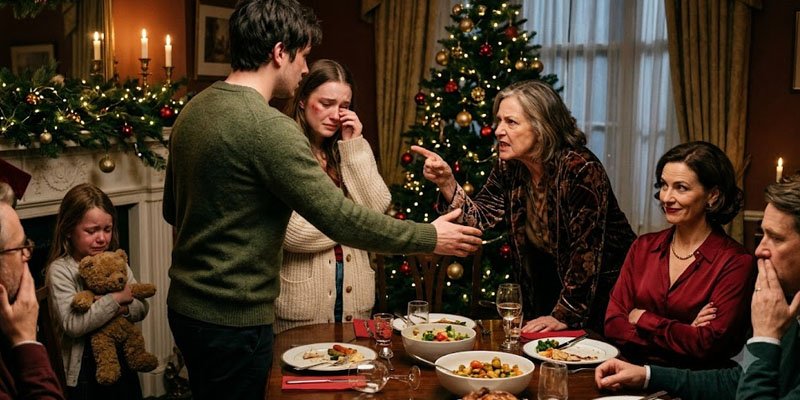
Christmas dinner fell apart over an argument that should have ended in the kitchen with the overcooked green bean casserole.
Instead, it exploded at the dinner table.
My sister-in-law, Vanessa, had mastered the art of insulting people without ever raising her voice. At thirty-eight, polished, wealthy, and married to a successful dentist, she carried herself like kindness was something money could buy. For six years, my wife Emily had quietly endured Vanessa’s endless little remarks.
Vanessa slowly lifted her wineglass and smiled.
“You really do make everything into a production,” she said. “I guess that’s what happens when you grow up surviving on coupons and bitterness.”
The room instantly fell silent.
Emily didn’t look furious.
She looked tired.
Completely tired.
“If you’re going to insult me,” she said calmly, “at least be honest about it.”
My mother, Margaret, gently laid down her fork.
“Emily,” she warned, “don’t start.”
Emily looked directly at her.
“I didn’t start anything. I’m just done pretending it’s acceptable for Vanessa to humiliate me in front of my daughter.”
Our seven-year-old daughter, Lily, sat beside me in her little red Christmas dress, clutching her glass of milk with both hands. Her frightened eyes moved around the table, searching for one grown-up who still made her feel safe.
Vanessa laughed quietly.
“Oh, come on,” she said. “Your daughter hears worse than this at school.”
Emily slowly stood.
“No,” she replied. “She hears worse in this house.”
That’s when everything changed.
My mother rose from her chair.
She never needed to yell to control a room. A single look was usually enough.
But that night, there was something unfamiliar in her face.
Without another word, she stepped toward Emily and slapped her across the face so hard the crystal chandelier above us seemed to tremble.
Lily gasped.
A bright red mark immediately spread across Emily’s cheek.
Then Mom leaned forward and whispered with icy cruelty,
“You’ll always be trailer trash. Take your daughter and get out.”
Time seemed to stop.
I looked at my mother.
Then at Emily, standing perfectly still with tears filling her eyes, refusing to let them fall.
Finally, I looked at Lily.
Her tiny hands were trembling.
I didn’t argue.
I didn’t shout.
I didn’t ask my mother how she could strike the woman who helped rebuild my life after my father died—the woman who was raising her only granddaughter.
Instead, I stood.
“Lily,” I said quietly, “go get your coat.”
Mom stared at me.
“Daniel—”
I held her gaze.
“No.”
One word.
That was all it took.
While Emily comforted Lily upstairs in the guest room, I packed our bags.
My brother Mark stepped into the hallway.
“Don’t make this bigger than it already is,” he said.
I zipped the suitcase closed.
“She hit my wife.”
“She’s still Mom.”
I looked him straight in the eye.
“Emily is my family.”
Snow drifted through the glow of the porch lights as the three of us walked out the front door.
No one tried to stop us.
The next morning, my mother’s name appeared on my phone.
She was crying.
Part 2
My phone vibrated across the small motel nightstand.
Emily was still asleep, facing the wall, while Lily rested beside her, curled beneath the blankets. The room smelled of disinfectant, old carpet, and the cinnamon rolls the motel staff had placed in the lobby for breakfast. Outside, cars rolled through wet slush beneath a gray Christmas morning sky.
Mom was calling.
Again.
I watched the screen until it stopped ringing.
Seconds later, a voicemail arrived.
Then another call.
Then a text.
Daniel, please answer. I have to explain.
I sat quietly on the edge of the bed, my bare feet against the cold carpet.
A familiar feeling settled over me.
It wasn’t guilt.
It was years of conditioning.
After Dad passed away, I was only twenty-four.
Mom completely unraveled, and I convinced myself it was my responsibility to hold everything together.
I filled out insurance paperwork.
Fixed things around her house.
Drove her to doctor’s appointments.
Calmed her down after arguments she had started.
Apologized to relatives she had offended.
Somewhere along the way, I confused loyalty with accepting endless emotional blows.
Then Emily came into my life.
She worked double shifts at a neighborhood diner while finishing nursing school.
She drove an old Honda with a cracked mirror.
She always carried extra granola bars because she worried someone else might need one.
She grew up in a trailer outside Tulsa with a mother who disappeared for days and a stepfather who gambled away what little money they had.
She never hid any of it.
She wore her past with quiet honesty instead of shame.
My mother never accepted that.
At first, the insults sounded polite.
“Oh, Emily, we use cloth napkins.”
“Didn’t anyone teach you how to pronounce that?”
“Daniel always imagined marrying someone ambitious. I suppose kindness will have to do.”
Emily answered every insult with grace.
She baked casseroles.
Remembered birthdays.
Drove Mom to physical therapy after her hip surgery.
Never missed inviting her to Lily’s school events.
Still…
Nothing was ever enough.
I opened Mom’s voicemail.
Her voice shook with tears.
“Daniel… sweetheart… I’m so sorry. I couldn’t sleep. I don’t even know what happened. Vanessa was upsetting everyone, emotions were high, and Emily was being disrespectful. I never should have slapped her. Please call me. Christmas shouldn’t end like this.”
I played it again.
Not because I needed to hear it twice.
Because I wanted to hear what she wasn’t saying.
There it was.
I’m sorry… but.
Emily was disrespectful.
Christmas was ruined.
Even while apologizing, she still blamed Emily.
She still couldn’t simply say,
I was wrong.
Emily stirred awake.
“Was that your mom?”
I nodded.
“What did she say?”
I handed her my phone.
She listened without changing expression.
When it ended, she quietly returned it and looked toward the window.
The bruise on her cheek had darkened.
Seeing it made my stomach twist.
“I’m not going back,” she said.
“You won’t.”
“And Lily isn’t going back either.”
“She won’t.”
She searched my face carefully.
She was looking for the version of me who always sacrificed himself to keep everyone else happy.
Instead, I reached for her hand.
“I should’ve stopped this years ago.”
She squeezed my fingers.
Then she answered honestly.
“Yes.”
“You should have.”
The words stung.
But they were true.
And somehow, hearing the truth felt like finally waking up.
By nine that morning, Mom had called six more times.
Vanessa sent one text.
You’re really ruining Christmas because Emily can’t handle a joke?
I deleted it without replying.
A few minutes later, Mark called.
“Daniel,” he said, “Mom’s a complete mess.”
“Morning to you too.”
“Don’t start with the sarcasm. She knows she made a mistake.”
“Does she?”
“She was humiliated.”
“He assaulted my wife in front of my daughter.”
Mark let out a slow sigh, as if I were the one creating unnecessary drama.
“You know how Mom is,” he said. “She gets emotional.”
I answered without hesitation. “Lily gets emotional when she drops her ice cream. She doesn’t slap people.”
“Come on,” he replied. “It was Christmas.”
“That stopped being an excuse the second she hit Emily.”
The line went silent.
After a long pause, Mark spoke again, lowering his voice.
“So you’re really choosing Emily over Mom?”
I glanced toward the motel bed where Emily and Lily were finally asleep. My wife and daughter had spent the night in a motel because my own family had made them feel unsafe in a house filled with Christmas lights and holiday decorations.
“I’m choosing the family I’m responsible for,” I answered.
Mark hung up without another word.
Around noon, I sent my mother a single message.
Do not contact Emily. Do not contact Lily. I will reach out when I’m ready. Before we have any conversation, you owe Emily a genuine apology without excuses. You also owe Lily an apology for what she witnessed. Until then, we need distance.
She replied almost immediately.
I’m your mother.
I answered with only one sentence.
And Emily is my wife.
Then I turned my phone off.
That afternoon we checked out of the motel and drove home while snow drifted gently across the highway. Lily slept nearly the entire trip with Emily’s scarf tucked beneath her chin. Emily stared quietly out the passenger-side window, lost in thought.
When we finally pulled into our driveway, our small house felt warmer than it ever had before. The porch light glowed softly. Lily’s handmade paper snowflakes still covered the front window. Even the crooked plastic reindeer leaning sideways in the yard—because I had never fixed its stake—felt comforting.
Inside, we made grilled cheese sandwiches and tomato soup before settling onto the couch to watch an animated movie. Lily curled up between us beneath a blanket.
About halfway through the film, she looked up and quietly asked,
“Is Grandma mad at me?”
Emily closed her eyes.
I paused the movie and knelt in front of our daughter.
“No, sweetheart,” I said gently. “Grandma made a bad choice. None of this is your fault. Adults are responsible for their own actions.”
“She told Mommy to leave.”
“I know.”
“And then we left.”
“Yes.”
“Are we bad?”
Emily reached over and squeezed my shoulder.
“No,” I told Lily. “We left because nobody is allowed to hurt Mommy. Nobody gets to scare you. Not even Grandma.”
She thought carefully before asking,
“Can people say they’re sorry?”
“Yes,” I replied. “But saying sorry only matters if they truly understand what they did.”
She nodded with surprising seriousness before leaning against Emily once more.
Later that night, after Lily had gone to bed, Emily and I sat together at the kitchen table. Under the yellow light above us, the bruise on her cheek had darkened.
“I don’t want revenge,” she whispered. “I just want this to stop.”
“It will.”
“How?”
I stared at my silent phone before answering.
“By refusing to pretend everything is normal.”
Part 3
Three days passed before I finally turned my phone back on.
Within seconds it exploded with notifications.
Seventeen missed calls from Mom.
Nine from Mark.
Four from Aunt Carol.
Two from Vanessa’s husband, Rob.
Message after message filled the screen.
Mom’s texts appeared first.
I’m sick over this.
You know I love Emily.
You’re breaking my heart.
Your father would be ashamed of you.
That final message hurt the most.
For years, my father’s memory had become Mom’s favorite weapon whenever I resisted her.
Your father would’ve fixed the porch by now.
Your father would never let me spend Thanksgiving alone.
Your father believed family always comes first.
But Dad had also taught me countless other lessons.
He taught me to check the tire pressure before long drives.
To pay my debts quickly.
To never raise a hand in anger.
He loved Mom deeply, but he had never been blind to who she could become.
Near the end of his battle with cancer, when his voice had become little more than a whisper, he grabbed my wrist and quietly said,
“Don’t let grief turn you into somebody else’s furniture.”
At the time, I didn’t understand what he meant.
Now I finally did.
Aunt Carol left a voicemail that sounded more like a speech than genuine concern.
“Daniel, it’s your aunt. Your mother is absolutely devastated. Yes, she made a mistake, but Emily needs to understand our family has always spoken passionately. We’re emotional people, not cold ones. You can’t cut everyone off over one slap.”
One slap.
As though violence somehow became acceptable because it happened only once.
Mark’s messages were even harsher.
Vanessa’s getting blamed for everything.
Mom hasn’t eaten.
You need to come over.
This is childish.
I almost answered that last text.
Instead, I called the family therapist Emily’s friend had recommended.
Her name was Dr. Rachel Klein.
Her earliest appointment was two weeks away.
When I explained that our daughter had watched her grandmother physically assault her mother, the receptionist found a cancellation for Friday.
That appointment changed more than I expected.
Dr. Klein’s office occupied a quiet brick building between a dentist’s office and a tax preparation business. Soft chairs, calming artwork, and tissue boxes sat throughout the waiting room.
Lily stayed with our neighbor, Mrs. Alvarez, while Emily and I attended together.
Emily spoke first.
She calmly described years of subtle insults.
How Mom constantly corrected her.
How Vanessa mocked her.
How nobody celebrated her nursing graduation.
How Mom referred to Emily’s childhood as “unfortunate circumstances” with the same detached tone people use when discussing stains on old furniture.
As I listened, guilt settled heavily inside me.
Not because I had never noticed.
Because I had noticed—and convinced myself it wasn’t serious.
Mom’s just old-fashioned.
Vanessa’s insecure.
They don’t mean it.
Just ignore it.
Dr. Klein looked at me and asked,
“What did you usually do when those things happened?”
I stared down at my hands.
“I usually changed the subject.”
Emily quietly looked away.
Dr. Klein never criticized me.
Somehow, that made the realization even more painful.
She simply said,
“A family system often protects the loudest person by asking everyone else to stay quiet. When someone finally refuses, the system begins treating that refusal as the real problem.”
I wrote those words down.
Before we left, we created a clear plan.
No in-person visits with Mom until she sincerely apologized to Emily.
No contact between Mom and Lily until Lily felt safe and Emily agreed.
No conversations with relatives who minimized what had happened.
Most importantly, there would be no private phone calls where Mom could cry to me without accepting responsibility.
Later that day, I sent another message.
Mom, I’m willing to have one phone conversation with you on speaker while Emily is present. The only purpose of the call is for you to apologize directly to Emily and acknowledge what happened in front of Lily. There will be no blaming Emily, Vanessa, alcohol, stress, Christmas, or grief. If you can’t do that, the conversation will end immediately.
She didn’t respond for four hours.
Finally, one word appeared.
Fine.
No warmth.
No regret.
Just reluctant agreement.
We scheduled the call for Saturday morning at ten.
Emily sat beside me on the couch.
Lily was in her bedroom happily building a Lego veterinary clinic.
I placed the phone on speaker.
Mom answered after the very first ring.
“Daniel,” she said, her voice trembling.
“Emily’s here too,” I replied.
Silence.
Then she quietly said,
“Emily.”
Emily folded her hands in her lap.
“Margaret.”
Mom took a breath.
“I’m sorry Christmas became so ugly.”
I closed my eyes.
Emily remained silent.
Mom continued.
“I shouldn’t have slapped you… but you have to understand, I felt attacked inside my own home.”
I reached toward the phone.
Mom quickly interrupted.
“No, wait, Daniel. Please.”
“The condition was no excuses,” I reminded her.
“I’m trying.”
“Then try again.”
Another long silence followed.
When Mom finally spoke again, her voice had softened.
“I’m sorry I slapped you, Emily. I’m sorry I called you trailer trash. I’m sorry I told you to take Lily and leave. I should never have done any of those things.”
Emily’s eyes filled with tears, but her voice stayed calm.
“Thank you for saying that.”
Mom began crying.
“I just want my family back.”
Emily looked at me.
I answered carefully.
“Mom, an apology is only the first step. It doesn’t erase what happened.”
“What else do you want from me?”
That was the real question.
Not What do you need?
Not How can I repair the damage?
Only,
What else do you want from me?
I chose my words carefully.
“We need you to understand that this wasn’t just one bad moment. You and Vanessa have treated Emily poorly for years. I allowed far too much of it, and that part is my responsibility. But it ends now.”
Mom’s crying grew louder.
“So now I’m abusive?”
“I said exactly what I meant.”
“I’m your mother, Daniel.”
“I know.”
“I raised you.”
“I know.”
“I sacrificed everything for you and Mark.”
“And none of those sacrifices gave you the right to hit my wife.”
She let out a hurt, disbelieving laugh.
“I can’t believe you’re talking to me like this.”
Emily gently placed her hand over my wrist, grounding me.
I took a steady breath.
“We’re taking a break from family visits,” I said. “There won’t be a second Christmas celebration. We won’t be coming for New Year’s. Please don’t stop by our house unexpectedly. After some time has passed—and after you’ve truly reflected on what happened—we’ll decide what comes next.”
“You’re keeping my granddaughter from me.”
“We’re protecting our daughter from being around adults who call her mother trash.”
Mom stopped crying.
The silence turned cold.
“So this is Emily’s doing,” she said.
Emily flinched.
Something inside me finally locked into place.
“No,” I said. “This is mine.”
Mom hung up.
For the next week, the family machine switched on.
Aunt Carol posted something vague online about forgiveness and how “young people throw away family too easily.” Vanessa commented with a heart. Mark texted that I had humiliated Mom and made her blood pressure spike. Rob, Vanessa’s husband, sent a strange message asking if we could “keep legal language out of family matters,” which told me Vanessa was starting to fear consequences.
Emily posted nothing. She went to work. She packed Lily’s lunches. She went to the school winter concert and clapped when Lily sang “Jingle Bells” half a beat behind everyone else. She lived with the quiet dignity that had always frightened my mother more than any argument.
Then, on January 3rd, Mom came to our house.
I saw her car pull up while I was taking down the porch lights. She stepped out in a camel coat, hair perfect, sunglasses hiding her eyes even though the sky was cloudy.
My stomach tightened.
Emily was inside helping Lily with a puzzle.
I climbed down the ladder and met Mom halfway up the walk.
“This is not a good time,” I said.
“I need to see my granddaughter.”
“No.”
Her mouth tightened. “Daniel, don’t embarrass me in the front yard.”
“I’m not inviting you in.”
She glanced toward the window. “Lily! Grandma’s here!”
I stepped in front of her.
“Do not call for her.”
Mom took off her sunglasses. Her eyes were red, but her expression was furious.
“You have changed,” she said.
“Yes.”
“She did this to you.”
I shook my head. “Emily didn’t change me. She waited for me to grow up.”
Mom’s face collapsed, but no tears came this time. “You’re cruel.”
“No. I’m late.”
Behind me, the front door opened.
Emily stood there with Lily partly hidden behind her leg. Lily’s eyes were wide.
Mom softened her voice instantly. “Lily, sweetheart.”
Lily didn’t move.
Emily said, “Margaret, you need to leave.”
Mom stared at her like furniture had spoken. “I was talking to my granddaughter.”
“Our daughter,” Emily said.
That small word, our, changed the air.
Mom looked to me, waiting for correction.
I said, “You heard her.”
Lily peeked around Emily. “Grandma, you scared me.”
Mom’s face shifted. For the first time since Christmas, something like recognition passed across it.
“Oh, honey, I didn’t mean to.”
Lily’s voice was tiny. “You hit Mommy.”
Mom swallowed.
“Yes,” she said.
“And you said she was trash.”
Mom closed her eyes.
Emily’s hand rested gently on Lily’s shoulder, but she did not speak for her. Neither did I.
Lily said, “Mommy is not trash.”
The street stayed quiet except for a distant snowblower.
Mom opened her eyes. “No. She is not.”
Lily nodded once, then stepped back behind Emily.
Mom looked older then. Not fragile. Just smaller than the version of her I had carried in my head.
“I should go,” she said.
“Yes,” I replied.
She returned to her car without another word.
For several months, that was the last time we saw her.
January turned into February. February became March. Life did not become easy overnight, but it became simpler. Emily laughed more in our kitchen. Lily stopped asking whether Grandma was angry. I started therapy on my own and learned that peace felt uncomfortable when you had been raised to mistake it for abandonment.
Mark didn’t speak to me until Easter.
He called while I was mowing the lawn.
“I talked to Vanessa,” he said.
“Okay.”
“She admitted she said some things at Christmas.”
I turned off the mower. “Some things.”
“She says Emily has always looked down on us too.”
I almost laughed. “Emily spent six years trying to be accepted by people who treated her like a stain.”
Mark exhaled. “I didn’t see it that way.”
“No. You didn’t want to.”
He was quiet for a long moment.
Then he said, “Mom’s seeing someone.”
“A doctor?”
“A counselor. Pastor recommended her first, but Mom wanted someone outside church.”
That surprised me.
“She told me not to tell you,” Mark added.
“Then why are you telling me?”
“Because I think she’s actually trying. And because Vanessa is mad about it.”
That second part made me believe the first.
In May, a letter arrived.
Not a text. Not a voicemail. A letter in Mom’s slanted handwriting, addressed to Emily.
Emily left it on the kitchen counter for two days before opening it. When she finally did, we read it together.
Emily,
I have written this several times and thrown it away because every version sounded like I was still trying to defend myself.
I slapped you. I humiliated you. I attacked your childhood because I knew it was the easiest place to hurt you. That was cruel.
You did not deserve it. Lily did not deserve to see it. Daniel did not overreact by leaving. He did what a husband and father should do.
I have told myself for years that I was protecting my family from someone who did not belong. The truth is uglier. I resented you because Daniel became less available to manage my feelings after he married you. I called that disrespect. It was not. It was his life.
I am ashamed of what I said about where you came from. You have shown more strength, patience, and generosity than I wanted to admit.
I do not expect forgiveness. I am asking for the chance, eventually, to make different choices consistently enough that you and Lily can feel safe around me.
Margaret
Emily cried then.
Not loudly. Not like someone breaking down. Like someone finally setting down something heavy enough to leave marks.
I held her.
“What do you want to do?” I asked.
She wiped her face. “Nothing yet.”
So we did nothing yet.
That became our rule. We did not rush healing to make guilty people comfortable.
In June, Emily agreed to meet Mom briefly in Dr. Klein’s office. Lily did not come. I sat beside Emily, not between her and my mother.
Mom looked nervous. She wore no jewelry except her wedding band. Her hands trembled slightly as she folded them.
She repeated much of what she had written, but this time she had to say it while Emily watched her.
Emily listened.
Then she said, “I need you to understand something. You didn’t just insult me. You taught my daughter, for a moment, that love can turn into humiliation without warning. That is what I cannot allow.”
Mom nodded. “I understand.”
“I don’t know if you do yet.”
Mom accepted that. That mattered.
“There will be no unsupervised time with Lily,” Emily continued. “Not for a long while. Maybe not ever. There will be no comments about my background, my clothes, my job, my parenting, or my family. If Vanessa insults me again and you stay silent, we leave.”
Mom’s eyes flickered at Vanessa’s name, but she nodded again.
“And if you ever put your hands on me or anyone in my house again,” Emily said, “there won’t be another conversation.”
“I understand,” Mom whispered.
Dr. Klein asked Mom what she had heard.
Mom repeated the boundaries, not perfectly, but honestly enough.
Afterward, in the parking lot, Mom did not try to hug Emily. She did not ask to see Lily. She only said, “Thank you for meeting me.”
Emily said, “We’ll see.”
It was not forgiveness.
It was a door left unlocked, not opened.
Summer passed in careful steps.
Mom sent Lily a birthday card in August. It said, “I love you and I am proud of you.” No guilt. No request. No “Grandma misses you so much.” Just love without hooks.
Lily read it twice and asked, “Can I draw her a picture?”
Emily looked at me. I looked at Emily.
“That’s up to you,” Emily told her.
Lily drew a purple cat wearing roller skates and wrote, “Thank you for the card.”
In October, we met Mom at a park for thirty minutes. Emily chose the place. I stayed near Lily. Mom brought no gifts, which was good because gifts had always been one of her favorite ways to buy silence.
She sat on a bench while Lily showed her how far she could jump from a tree root. When Lily fell and scraped her palm, Mom stood by instinct, then stopped and looked at Emily.
Emily went to Lily first.
That restraint told me more than any apology.
By Thanksgiving, we were ready for a small dinner. Not at Mom’s house. Not with Vanessa. Not with Aunt Carol and her speeches about forgiveness.
At our house.
Mom arrived with sweet potatoes and a store-bought pie. She asked where to put her coat. She complimented Emily’s table without sounding surprised that it looked nice. She asked Lily about school. When Lily said she wanted to be a veterinarian and an astronaut, Mom said, “That sounds like a lot of studying,” then caught herself and added, “But you are very determined.”
Emily noticed. So did I.
Halfway through dinner, Mark arrived alone.
I opened the door and found him standing there in a navy sweater, holding a bottle of sparkling cider.
“Vanessa isn’t coming,” he said.
“Was she invited?”
He smiled weakly. “No.”
Emily appeared behind me.
Mark looked at her. “I owe you an apology.”
The room behind us seemed to stop.
He continued, “I minimized what happened. I made it about Mom being upset instead of you being hurt. I’m sorry.”
Emily studied him. “Thank you.”
He nodded. “And Vanessa has some work to do before she’s welcome around my family too.”
That was new.
Later, while Lily forced everyone to play a board game with rules she invented and changed whenever she started losing, Mom helped Emily clear the plates.
From the dining room, I watched Mom pick up a serving spoon and say quietly, “You have a beautiful home.”
Emily replied, “Thank you.”
Mom looked around the kitchen, at the school calendar covered with stickers, the chipped mug full of pens, and the photo of Lily missing two front teeth.
Then Mom said, “I’m sorry I spent so long refusing to see it.”
Emily did not answer immediately.
At last, she said, “I am too.”
That was all.
But it was real.
Christmas came again.
This time, we did not go to Mom’s house.
We woke up in our own home. Lily ran downstairs at 6:12 in the morning and screamed because Santa had eaten the cookies. Emily made coffee. I burned the first batch of pancakes and blamed the pan, which fooled nobody.
At noon, Mom came for lunch. Mark came too. Vanessa did not.
There was no dramatic reunion. No swelling music. No speech beside the Christmas tree.
There was only Mom handing Emily a wrapped gift with both hands.
Emily opened it carefully.
Inside was a framed photograph from Lily’s school play two years earlier. Emily stood beside Lily in the picture, crouched in her nurse scrubs, smiling with tired eyes while Lily held a paper star. I remembered that day. Mom had come, then complained afterward that Emily looked “messy” in the photo.
Now Mom said, “I found it in a drawer. I used to see everything wrong with this picture. Now I think it may be one of the best pictures I have.”
Emily’s lips parted slightly.
Mom added, “You looked tired because you had worked all night and still came for Lily. I should have admired that.”
Emily looked down at the picture. Her eyes filled, but she smiled.
“Thank you,” she said.
Lily leaned over the frame. “I remember that star. It ripped in the car.”
“We taped it,” I said.
“With dinosaur tape,” Lily added proudly.
Everyone laughed.
It was small. Ordinary. Almost boring.
That was what made it precious.
A year earlier, I thought family meant surviving whatever happened at the table because blood and history demanded it. I thought peace meant silence. I thought my job was to stand in the middle and take blows from both sides until everyone else felt better.
I was wrong.
Family was not the house where you were expected to swallow disrespect with dessert. It was not the comfort of the loudest person. It was not pretending cruelty became tradition because it happened more than once.
Family was Emily’s hand finding mine under the table.
It was Lily feeling safe enough to correct her grandmother during a card game.
It was my mother learning, late but not too late, that an apology without change was only performance.
And it was me understanding that leaving Christmas dinner had not broken the family.
It had shown us which parts were already broken.
The rest of our lives did not become perfect. Vanessa stayed distant. Aunt Carol still posted dramatic quotes online. Mark and I rebuilt slowly. Mom sometimes slipped into old habits, then caught herself, apologized, and tried again.
Emily forgave in pieces, carefully, on her own timeline.
Lily grew less afraid.
And every Christmas after that, we hosted dinner in our own home with one rule written plainly in the quiet confidence of how we lived:
No one stayed where love required humiliation.