My son treasured one anonymous birthday envelope more than his cake or presents. Then, on his eighteenth birthday, the letter inside changed everything.
I never thought an ordinary white envelope could make me feel uneasy about my own son’s birthday.
The first one showed up when Adrian turned six.
No glitter.
No stickers.
No return address I recognized.
Just our address written in neat, deliberate handwriting. Inside was a simple birthday postcard with a cartoon balloon on the front and five dollars folded so neatly it looked freshly pressed.
That was all.
No name.
No explanation.
No hint.
At the time, I brushed it off.
Children get unexpected birthday mail. Relatives living far away remember late. Older people forget to sign cards. Life can be chaotic.
I was a single mother struggling to keep the bills paid and food in the pantry, so I had no time or energy to investigate five dollars and a cheap postcard.
Then it happened again the next year.
Another plain envelope.
Another basic birthday card.
Another small bill tucked inside.
By the third year, Adrian had made it part of his birthday routine.
“Check the mailbox, Mom.”
“It is seven in the morning,” I told him.
“What if they got here early?”
“Mail doesn’t work like magic.”
He smiled.
“What if mystery mail does?”
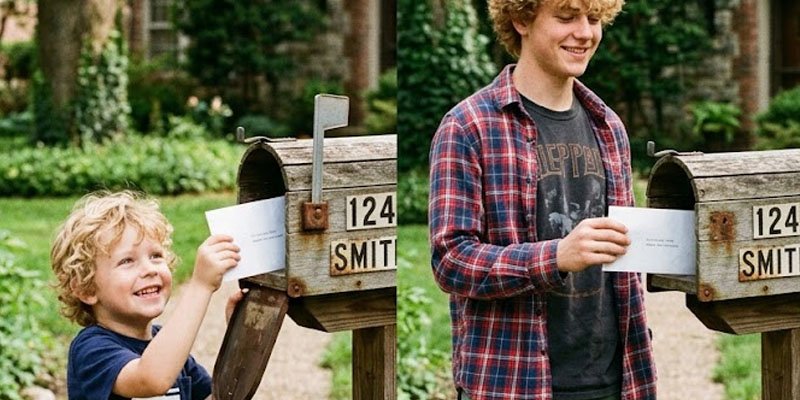
I can still picture him standing on his toes beside the front window, waiting for the mail truck as if everything depended on its arrival.
Not the cake.
Not the presents.
Not the friends who would come later.
Only that envelope.
And somehow, every single year, it arrived.
Sometimes there were five dollars.
Sometimes ten.
When he turned eleven, there was a twenty-dollar bill, and Adrian reacted as if royalty had personally reached out to him.
“Oh, this is getting serious now,” he said, staring at the bill. “My secret person is getting richer.”
I laughed, but by then, the mystery had begun to bother me too.
I examined the postmarks.
Studied the handwriting.
Held the envelopes up to the light like someone in a low-budget detective movie.
I asked my mother.
My sister.
I even called an old friend and joked, “If you’re the strange person sending my kid birthday money, just admit it so I can stop wondering.”
Nobody knew anything.
Or at least, nobody confessed.
Adrian adored the mystery. I hated it.
Not because it ever seemed threatening.
It never did.
It felt deliberate.
Almost caring.
That was what made me uncomfortable.
Someone remembered my son every year through this odd little tradition while deliberately keeping enough distance to remain anonymous.
It felt like a hand hovering at the very edge of our lives.
When Adrian turned thirteen, he opened that year’s envelope at the kitchen table while I prepared pancakes.
He took out the card, read it, then looked at me with narrowed eyes.
“What?” I asked.
He tilted his head.
“Are you behind this?”
I laughed. “Behind what?”
He held up the card.
“These. Every year. Is this one of your strange mom things?”
“I am insulted that you think I could maintain that kind of consistency.”
He did not laugh right away.
Instead, he looked down at the card again.
Then he asked quietly, “Could it be my dad?”
That hurt more than I expected.
Adrian’s father was not some heartbreaking lost love.
He was not a man kept away from us by circumstances beyond his control.
He was a man who vanished the moment being responsible became inconvenient.
He never met Adrian.
Never sent him a gift.
Never asked for a photograph.
Some years, I wasn’t even certain he remembered that I existed, let alone that he had a son.
So I gave him the same answer I always used whenever that subject came a little too close.
“Sweetheart, your father doesn’t know where we live.”
Adrian’s expression dropped a little, and I immediately regretted what I said next.
“And even if he did, I’m certainly not expecting him to earn Father of the Year through anonymous birthday mail.”
That got a small laugh out of him.
I pushed his pancakes closer.
“Maybe it’s an old teacher. Maybe one of my friends is being strange. Or maybe you’re involved in some very cheap spy operation.”
He smiled, but only slightly.
Then I made the joke I wish I hadn’t.
“Besides, there’s money inside these envelopes. Your father would never do that.”
This time, Adrian actually laughed.
But only briefly.
Then his eyes returned to the card, and he fell silent.
After that, we stopped discussing the mystery out loud.
The envelope simply became another part of his birthday.
Like the candles.
Like the pictures.
Like me trying not to become emotional every year as my little boy grew taller, his voice grew deeper, and he drifted farther from the child who once asked me whether worms had mothers.
Then last week, Adrian turned eighteen.
I had a strange feeling before I even woke him that morning.
Maybe it was because eighteen feels different.
Permanent.
Official.
Adult.
As though one chapter is ending whether you are prepared for it or not.
The night before, I stood in the kitchen icing the cake he had specifically requested “not to look emotional,” carrying a strange ache in my chest that I couldn’t explain.
The envelope arrived that morning.
Same size.
Same plain white paper.
Same precise handwriting.
Adrian spotted it on the table and gave me that familiar childhood smile.
For one brief second, I could see the six-year-old boy again.
“There it is,” he said quietly.
He picked it up and turned it over.
“Open it,” I said.
“You sound nervous.”
“I’m always nervous.”
“About my birthday card?”
“About everything. I raised you.”
He laughed, then slipped his finger beneath the flap.
I remained at the counter, pretending to wash dishes that were already perfectly clean.
He pulled out the card.
Then something else.
A folded letter.
That was different.
I froze.
Adrian unfolded it.
The color disappeared from his face so quickly that it scared me.
“Adrian?”
He read it once.
Then a second time, much more slowly.
“Baby, what is it?”
He looked at me with an expression I had never seen on his face before.
It wasn’t exactly fear.
It wasn’t exactly sh0ck.
It was something deeper.
As though a missing piece of a puzzle had suddenly fallen into place, and he didn’t like the picture it created.
“It’s not the usual message,” he said.
My stomach sank.
He gripped the paper tighter.
“Mom… I know who sent them.”
The entire room seemed to fall unnaturally silent.
Even the refrigerator sounded far away.
I stepped closer.
“Who?”
He swallowed.
“The letter is signed.”
My voice came out barely above a whisper.
“Signed by who?”
He lowered his eyes to the bottom of the page.
“Thomas.”
The name meant absolutely nothing to me.
I reached out my hand.
Adrian paused before finally handing me the letter.
It read:
Adrian,
If you are reading this, then you are eighteen, which means I have kept my promise for as long as I was supposed to.
First, happy birthday.
“Second, I owe you the truth, or at least enough of it for you to decide if you want to know more.”
“Please go to Merrick and Rowe on Fulton Street and ask for the envelope that was left there in your name. They have been instructed to hand it over once you officially become an adult.”
“You don’t know me in the way you may believe you do. But I knew someone who cared for you very deeply.”
“I hope that, in some small way, these birthdays helped you know that someone remembered you.”
“Take care, son.”
Thomas.
I read it twice.
Then once more.
“Take care, son.”
Adrian had focused on those words too.
“You understand why I thought it might be my dad, right?”
Of course I understood.
A man’s full name.
A letter waiting at a law firm.
A secret that had continued through eighteen birthdays.
It sounded exactly like something an absent father might arrange when he wanted forgiveness without ever having done the work of being a father.
Something bitter rose inside me.
“He has some nerve,” I said.
Adrian looked up. “So you think it’s him?”
“No,” I replied too quickly.
Then I added, “I don’t know.”
He sank heavily into one of the kitchen chairs.
“What if it is?”
I looked at my son, legally an adult for only a few hours, yet suddenly looking twelve years old again.
I knew I had two choices.
I could brush it aside and tell him to forget the whole thing.
Or I could confront it alongside him.
So I took the chair across from him.
“Then we find out.”
We drove there that afternoon.
For most of the journey, Adrian switched between nervous talking and long stretches of silence.
“What if he’s dead?”
“He signed the letter.”
“That doesn’t mean he’s still alive.”
“Please don’t make this more dramatic than it already is.”
He gazed out the window.
“What if he wants to meet me?”
My hands tightened around the steering wheel.
“Then you decide what you want to do.”
“What would you do?”
The honest answer was that I would shut the door in his face.
But Adrian wasn’t me.
This was his life as well.
So I said, “I would find out the truth first.”
The law office was on the second floor of an old brick building downtown.
The receptionist had one of those soothing voices that could make even the worst situation sound like a routine dental appointment.
“Name?” she asked.
“Adrian.”
She typed something into her computer, looked at him, and then stood.
“One moment.”
When she came back, she was carrying a large sealed envelope with his name written across the front.
My heart began pounding.
Adrian took it in both hands.
“Would you like a room?” she asked softly.
I frowned.
“A room?”
She nodded carefully.
“Mr. Merrick thought you might want some privacy.”
That disturbed me more than anything else so far.
We followed her into a small conference room.
A wooden table.
Two chairs.
A box of tissues sitting off to the side, as though someone already knew what kind of conversations took place there.
Adrian sat down.
I stayed standing because I had the strange feeling that if I sat, I might not be able to stand again.
He broke the seal.
Inside was another envelope, older and faintly yellowed around the edges.
Several folded letters.
And on top, a typed note from the attorney.
Mr. Adrian Walker,
Enclosed, as instructed years ago by my late client Harold Walker, are personal letters to be delivered to you upon your eighteenth birthday. Mr. Thomas Bell handled the annual correspondence and gifts at your grandfather’s request.
If you have questions after reading these materials, I am available.
Sincerely, James Merrick
Adrian’s head jerked upward.
“My grandfather?” he said.
The floor suddenly seemed to move beneath my feet.
Harold.
My father.
I lowered myself into a chair before I even realized I was doing it.
Dad had passed away when Adrian was still a baby.
Cancer.
Quick and merciless.
Toward the end, he could barely lift his head, yet every single day he would still ask me, “How’s my boy?” as if Adrian were the most important person in the world.
Adrian had barely known him at all.
He had pictures.
A handful of memories I had told him.
And a wooden toy truck my father had carefully sanded by hand before he became too sick to complete the matching train set.
My hands were trembling by the time Adrian opened the first letter.
It was my father’s handwriting.
There was no mistaking it.
Adrian unfolded the page carefully and began reading the words aloud.
“If you’re reading this, kiddo, then I missed far more of your life than I ever wanted to.”
“I’m sorry for that before anything else.”
He paused, cleared his throat, and began again.
“Your mother has always been stronger than people give her credit for. You may not understand that yet, but someday you will. She carried you before you were born, and she’ll keep carrying you in a hundred different ways afterward. I hate having to leave her to do this without me.”
I pressed my hand over my mouth.
Adrian’s voice grew increasingly unsteady.
“I asked my friend Thomas to help me with something after I’m gone. I wanted you to have one little reminder every year that someone was thinking about you. Not enough to spoil you. Just enough so that on your birthday, regardless of what else life was throwing at you, you would know someone remembered you.”
Adrian blinked several times.
“I knew I wouldn’t be there to watch you grow up. I knew there would be school pictures I’d never see, birthdays I’d never get to cheer for, and probably a day when you would wonder who was still standing in your corner. I couldn’t bear the thought of you ever believing you had been forgotten.”
“So Thomas agreed to mail you a card every year. The money is small because this was never about the money. It was about remembering you.”
A broken sound came from Adrian.
Half laugh.
Half sob.
I could hardly catch my breath.
There were three additional letters, each written during a different point in my father’s illness.
One described baby Adrian sleeping with a frown on his face “like he’s already disappointed in the state of the world.”
Another told Adrian never to judge his mother by the worst day of her life because she loved deeply enough to break herself apart.
The last letter had been written closest to the end.
His handwriting trembled across the paper.
“I’m asking Thomas not to tell your mother.”
“Not because I want there to be secrets between you, but because she already has enough grief ahead of her, and I don’t want her counting down these cards as another loss. Let this be a kindness without a burden. Let it stay light until you’re old enough to carry the truth.”
“By then, I hope the mystery made you smile.”
“By then, I hope your mother has laughed more than she has cried.”
“By then, maybe you will both understand that love can continue showing up long after someone is gone.”
Adrian placed the letter down and stared silently at the table.
By then, I was openly crying.
Messy tears.
Shaky, breathless tears.
The kind that sting as they fall.
“I thought…” I began, but I couldn’t finish.
Because what exactly had I believed?
That some stranger had been hovering at the edge of our lives.
That maybe Adrian’s absent father had finally found a conscience and expressed it through birthday mail.
That I had raised my son alone, surrounded only by the people who were physically there.
All those years, it had been my father.
Or, more precisely, it had been my father’s love continuing through someone who cared enough to keep his promise.
Adrian quickly wiped his eyes, almost as though he felt embarrassed, even though there was no one else in the room.
“So Thomas isn’t my dad.”
I managed a wet, almost ridiculous laugh.
“No, honey.”
He looked again at the signature on the attorney’s note.
“He was Grandpa’s friend.”
I nodded.
“Did you know him?”
I searched my memory.
Then suddenly, I remembered.
“Tom Bell. Oh my God.”
I leaned back.
“He used to visit our house when I was little. He and Grandpa used to go fishing together. He wore those terrible brown suspenders and always cheated whenever they played cards.”
Adrian smiled despite the tears in his eyes.
“You forgot about him?”
“I forgot a lot of things after your grandfather died.”
That was true, too.
Grief had wiped entire rooms from my memory during that time.
I was pregnant.
Frightened.
Then suddenly, I was a mother.
And then I was doing everything by myself.
The years became a blur, and some names vanished along the way.
After a moment, Mr. Merrick gave a soft knock before stepping inside.
He was older, with kind eyes, and carried himself with the careful composure of someone familiar with people’s most difficult moments.
“I’m sorry to interrupt,” he said. “Thomas passed away six months ago. He wanted to make sure the final letter still made its way to you.”
Adrian looked up.
“He died?”
Mr. Merrick nodded.
“He came here personally to confirm the delivery instructions. He spoke very warmly about your grandfather.”
I finally managed to speak.
“Why did he keep this from me for all these years?”
The lawyer paused.
Then he said, “Your father was very particular about that. He believed the cards would mean more if they felt like an uncomplicated kindness instead of something connected to grief. He was afraid that if you knew, you would spend every birthday grieving him rather than enjoying your son.”
It sounded exactly like something my father would have said, and somehow that made me cry even harder.
Adrian asked, “So Thomas never wanted anyone to know he was responsible?”
“No,” Mr. Merrick replied. “He once told me, ‘I was only holding the ladder for a friend.’”
That sentence completely broke me.
When we eventually got back to the car, neither of us turned the key.
Adrian carefully held the letters in his lap.
“Mom,” he said quietly, “did Grandpa really worry that I would feel forgotten?”
I turned toward him.
“I think he was afraid of what he was leaving behind.”
Adrian looked straight through the windshield.
“For years, I thought maybe it was Dad. I feel stupid now.”
“You’re not stupid.”
“I wanted it to be him sometimes.”
That hurt.
Not because I was offended.
Because I understood exactly why.
Children can grow up around someone’s absence, but they still build parts of themselves around that empty space.
“I know,” I said.
He lowered his eyes toward the letters.
“This is better, though.”
I swallowed.
“Yeah?”
He nodded.
“Yeah. Because now I know someone who actually loved me remembered me every single year.”
We drove home with the letters resting between us.
That evening, we laid them all across the kitchen table.
The same table where Adrian had opened those strange envelopes year after year.
The same place where he had once asked whether I was secretly sending them.
The same place where he had wondered if they came from his father.
Now the truth was spread out before us in my father’s handwriting.
There was one last note inside the lawyer’s envelope that Adrian had overlooked earlier.
A brief message from Thomas.
“Harold asked me to stop after your eighteenth birthday. He said that by then you would be a man and wouldn’t need a mystery to understand that you were loved. I don’t know whether he was right, but I do know this: he talked about you before you were even able to answer him. You were loved before you were born, and you were loved every year afterward.”
“Happy birthday, Adrian.”
“Tom.”
Adrian read it twice before handing it to me.
“He sounds like Grandpa’s kind of person.”
“He was,” I said. “Stubborn enough to keep a promise for that many years.”
Adrian gave a faint smile.
“Sounds familiar.”
Around midnight, with half the cake already eaten and neither of us having many tears left, Adrian asked, “Do you think Grandpa would be upset that you never knew?”
I shook my head.
“No. I think he’d be relieved that it worked.”
He glanced toward the old envelopes we had kept tucked away in a drawer.
I had never thrown any of them out.
Some part of me had always known they meant something.
“I used to think the mystery was the best part,” he said.
“And now?”
He looked at me, his eyes still red and his face tired with the unmistakable look of an adult, yet somehow every age he had ever been was still there.
“Now I think the best part is that he figured out a way to stay.”
I had nothing wiser to say than the truth.
“Me too.”
So that is what was really behind the envelopes.
For twelve years, I believed some anonymous person was quietly reaching into my son’s life.
I wondered whether it was guilt.
Regret.
Some old shadow from the past trying to buy its way into our memories a few dollars at a time.
I was wrong.
It was love.
Steady love.
Deliberate love.
Silent love.
The kind that never asks for applause.
The kind that keeps a promise year after year without demanding recognition.
The kind that understands a child rarely needs enormous gestures as much as he needs to know that somewhere, somehow, someone remembers him.
Yesterday, Adrian carried all the old cards upstairs to his room.
I stood in his doorway.
“You know you’re officially an adult now. I can legally start annoying you in a much more respectable manner.”
He rolled his eyes.
“Please don’t destroy the emotional ending.”
I laughed.
“Too late.”
He glanced at the stack in his arms, then looked back at me.
“I think I’m going to frame one.”
“One of the cards?”
“No.”
He touched the first letter.
“Grandpa’s first one.”
That almost made me cry all over again.
Before I could leave, he called after me.
“Mom?”
“Yeah?”
“Thanks for coming with me.”
Do you think keeping a secret like that for so many years was an act of kindness or a mistake?