My stepfather had been in my life since I was four. After my mother passed away, he remained by my side and became the only father I had ever genuinely known. Then, just hours before he died, he gripped my hand and whispered, “I’ve lied to you your entire life.” He gave me an address, and what I found there changed the way I understood both my childhood and the man who had raised me.
“The pancakes were always shaped like stars,” I told the nurse.
She was gently pulling the thin blanket higher over Frank’s legs, carefully working around the tubes running beneath his hospital gown.
“Even when I was 35, married, and bringing my own daughter over for breakfast, he’d still take out that absurd little metal cutter.”
Frank opened his eyes.
For most of the afternoon, he had kept them closed, his breathing shallow and irregular, but now his eyes fixed directly on me.
For a moment, I expected to see that familiar crooked smile.
Instead, tears began forming in his eyes.
I leaned closer to the bed.
“Dad?”
His lips moved, but no sound emerged.
“Are you hurting?”
He shook his head.
The nurse looked at the monitor, then gently placed a hand on my shoulder.
“I’ll give you both a little privacy.”
After she left, I picked up the damp cloth from the bedside table and carefully rested it against Frank’s forehead.
“You know, those pancakes weren’t even that good,” I said, trying to pull him back toward the memory. “They were always burned around the tips.”
A quiet breath escaped him, almost resembling a laugh.
“You ate them anyway,” he said.
“Of course I ate them. I was scared you’d make me eat oatmeal if I complained.”
Frank married my mother when I was four.
At first, I refused to call him anything.
Not Frank.
Not Dad.
Nothing.
Whenever he asked if I wanted toast, I would simply point toward the bread.
Whenever he offered to read me a bedtime story, I would vanish beneath the blankets.
My biological father had disappeared before I was old enough to remember him, and somehow, even at four years old, I had already learned not to trust men who showed up carrying luggage.
Frank never tried to force himself into my life.
He learned that I liked strawberry jam spread all the way to the edges of my toast.
Whenever thunderstorms came, he would sit in the hallway outside my bedroom because I refused to let him come inside.
And every Sunday morning, he made apple pancakes, using an old metal cutter to turn them into stars.
One morning, almost three months after he married my mother, I wandered into the kitchen and accidentally called him Dad.
Frank dropped the spatula.
Neither of us said anything about it.
He simply placed the pancake with the least-burned edges onto my plate.
Five months later, my mother died.
A brain aneurysm took her so unexpectedly that my last ordinary memory of her was a conversation about whether I had put my shoes away.
Our home was soon crowded with relatives.
They spoke in hushed voices in the hallways, looking toward Frank whenever they thought I wasn’t watching.
“He isn’t her real father.”
“Her aunt could take her.”
“He’ll want to move on.”
The night after the funeral, I curled up beneath the kitchen table, my knees pressed against my chest.
Frank found me there shortly before sunrise.
Without asking what I was doing there, he lowered himself onto the floor beside me.
“Are you leaving?” I whispered.
His expression shifted as though my question had physically wounded him.
“No.”
“Everybody leaves.”
“I won’t.”
“Promise?”
Frank reached beneath the table and held out his little finger.
“I promise.”
And he kept that promise.
Years later, Frank was the one who walked me down the aisle.
When my daughter was christened, he stood beside me, one hand carefully supporting her head, as though I might somehow drop her even though I was 32 years old.
Whenever I asked about the life he had lived before meeting my mother, he always gave me the same answer.
“The important part began when you came along, sweetheart.”
I had always taken those words as an expression of love.
It had never crossed my mind that they might also be concealing something.
Frank’s health started deteriorating shortly after his 78th birthday.
At first, he was simply more tired than usual.
Then he started losing weight.
Soon came the medical tests, specialists, and those carefully chosen explanations doctors use when they already know how the story is going to end.
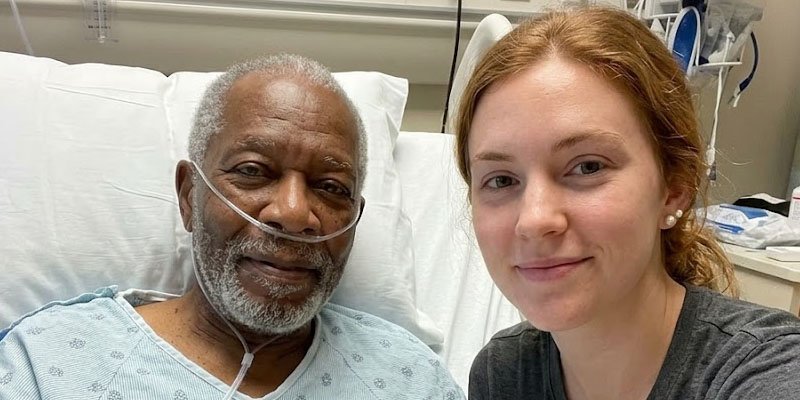
During his last week, I slept in a vinyl chair beside his hospital bed.
Every change in his breathing woke me.
I became familiar with every sound coming from the machines around him.
On his final night, the doctor asked me to step outside into the hallway.
“It may only be a few hours, Rosalie.”
I nodded because I knew that trying to speak would make me completely fall apart.
When I went back into the room, Frank appeared to be asleep.
I sat down in the chair and slipped my hand beneath his.
Suddenly, his fingers closed tightly around my wrist.
Hard.
“Promise me you’ll hear me out before you hate me,” he said without warning.
I froze.
“I could never hate you.”
His hand felt cold against mine.
“I’ve lied to you your entire life.”
I tried to smile. “Dad, you’re exhausted. Let me get the nurse.”
“My mind is clear.” His grip tightened. “Everything you believe about your childhood, about who I am… is incomplete.”
My heart began pounding faster.
“What are you talking about?”
“I need you to learn the truth before I die, even though someone begged me to take it with me to the grave.”
Questions flooded my mind faster than I could sort through them.
Was my biological father still alive?
Had Frank hidden letters from me?
Had there been another family?
Was there an entire chapter of his life I had never known about?
With shaking fingers, Frank reached underneath the blanket and pulled out a folded sheet of paper.
He placed it in my hand.
“Go there. Now.”
“I can’t leave you.”
“You have to.” Tears vanished into the gray stubble along his jaw. “Please, Rosalie.”
He had not spoken my name that way since I was a little girl.
I leaned over the bed.
“Tell me yourself.”
Frank closed his eyes.
“Some truths need another voice.”
Those were the final words he ever said to me.
A nurse rushed in when the monitor began chirping.
She checked his pulse and then adjusted the oxygen.
“He is still with us,” she said. “But he may not wake again.”
I stepped into the hallway and unfolded the paper.
In the middle was a single address written in Frank’s unsteady handwriting.
It was less than twenty minutes away from the home where he had raised me.
For a moment, I thought about throwing it into the trash.
Whatever was waiting at that address could not possibly be more important than the man dying in the room behind me.
Then I remembered the expression in his eyes.
It had not been the fear of dying.
It had been the fear that I would never truly understand him.
I drove through almost empty streets, both hands gripping the steering wheel tightly.
By the time I reached the address, I had already imagined nearly every kind of betrayal.
A secret wife.
A stranger waiting to tell me that Frank had never truly wanted me.
An elderly woman opened the door.
Her hair was silver, her eyes were a washed-out blue, and the moment she saw me, one hand flew to her mouth.
She looked at me as though someone who had been dead had suddenly appeared on her doorstep.
“Rosalie,” she whispered.
I inhaled sharply, causing her to take a step backward.
“Who are you?”
“My name is Caroline.”
“How do you know me?”
She looked past me toward the darkened street.
“Frank called last month. He could barely speak. He said you might come here someday.”
“Might?”
“He hoped he would find the courage to send you.”
She opened the door wider.
“I think you should come inside.”
Every part of me wanted to turn around and hurry straight back to the hospital.
Instead, I stepped inside.
“Tell me what Frank lied about.”
Caroline said nothing.
She walked across the kitchen and pulled open a drawer beside the stove.
Inside was a collection of metal cookie cutters.
Hearts.
Flowers.
Animals.
Apples.
And one small star.
My breath caught in my throat.
It looked exactly like the star-shaped cutter Frank had used every Sunday throughout my childhood.
“Where did you get that?”
Caroline carefully picked it up.
“It belonged to Frank.”
“No. His is at my house.”
“He had two, dear,” she said.
Underneath the cutters lay an old photograph.
Caroline lifted it and handed it to me.
A little girl stood beside a kitchen table, smiling broadly over a plate piled high with star-shaped apple pancakes.
She looked to be about five years old.
Frank stood behind her.
He was younger.
Thinner.
And wearing a kind of joyful smile I had never seen in any other photograph of him.
“Who is she?”
Caroline’s voice shook.
“Her name was Miley.”
Something about the room suddenly felt as though it were closing in around me.
“Frank was married before he met your mother,” Caroline explained. “Miley was his daughter.”
My fingers tightened around the photograph.
“Where is she?”
Caroline lowered her gaze.
“She died when she was five.”
The stillness that followed somehow made those words hurt even more.
“There was an accident at a lake. It happened so quickly. Frank blamed himself, even though there was nothing he could have done.”
I sank into a chair when my legs stopped being able to hold me.
“Why didn’t he tell me?”
“After Miley died, his marriage fell apart,” Caroline said. “He withdrew from everyone. He stopped returning my calls. We had been best friends. He put away every photograph, every toy, every little thing that reminded him he had once been a father.”
My eyes went back to the tiny star-shaped cutter.
“The pancakes.”
“He made those for Miley.”
Caroline took the chair across from me.
“Then one morning, after he married your mother, you climbed into his lap and fell asleep against his chest. When you woke, you asked him if he knew how to make pancakes in the shape of stars.”
“I don’t remember that.”
“You were only four.”
She placed the cutter gently on the table between us.
“He called me that afternoon. He was crying so badly that I could barely make out what he was saying. He told me he had made the pancakes. He said he had spoken Miley’s name out loud for the first time in years and, somehow, he hadn’t broken down.”
I held tightly to the edge of the table.
“He didn’t give you something that belonged to his daughter,” Caroline continued. “You gave him a way to remember her without feeling as though the memory would destroy him.”
Tears blurred everything around me.
“Then what was the lie?”
Caroline looked toward the window.
“After your mother died, Frank loaded up his truck.”
My stomach sank.
“He was going to leave?”
“He came here the night after the funeral. He said your aunt could raise you. He said staying would be selfish.”
“Selfish?”
“He was frightened.” Caroline’s voice broke. “He told me, ‘Every time Rosalie laughs, I hear Miley. Every time she runs toward the street, I stop breathing. I can’t survive burying another daughter.’”
A crushing pain spread across my chest, making it hard to breathe.
“He promised me he would stay.”
“He made that promise after he came here, dear,” Caroline whispered.
She reached across the table and placed her hand over mine.
“He sat in this kitchen until morning. He kept repeating that he wasn’t strong enough to love another child.”
“What did you tell him?”
“I told him not to walk away simply because he was afraid of loving you. I told him to stay because he already loved you.”
A broken sound came from my throat.
It wasn’t quite a sob.
It wasn’t quite anything else.
“He went home that morning,” Caroline continued. “Before you woke up, he unloaded the truck. He thanked your aunt for staying with you. Then he crawled beneath the kitchen table and promised you he would never leave.”
I covered my mouth with both hands.
That promise had shaped almost everything I believed about my childhood.
For my entire life, I had imagined Frank making that promise without hesitation.
I believed he stayed because I was the person who needed him.
“He almost left me,” I said through uneven breaths.
“Yes.”
Caroline did not soften the truth.
“But he came back,” she whispered.
“Why did he hide it?”
“Because he never wanted you to think you were responsible for keeping him alive, dear.” Tears gathered in her eyes. “He knew what it meant for a child to carry an adult’s grief. He would never place that burden on you.”
I remembered every occasion when Frank had told me, “You gave me a reason to keep going.”
I had always thought it was simply something loving parents said.
Now I understood that he had meant it literally.
“He let me believe he was the one who saved me.”
Caroline squeezed my hand.
“He did save you.” Then she smiled through her tears. “But you saved him, too.”
I drove back to the hospital with Miley’s photograph resting on the passenger seat.
Every traffic signal seemed impossibly slow.
I needed Frank to know that I finally understood.
I needed him to know that learning the truth had not weakened my love for him.
It had shown me how much that love had cost him.
I hurried from the parking lot toward his floor.
The nurse stood outside his room.
The look on her face stopped me before she could finish.
“I’m sorry, ma’am… your father…”
I pushed past her.
Frank lay exactly as I had left him.
But the room was completely silent now.
There was no oxygen rushing.
No difficult breathing.
No machine counting down the time he had remaining.
I took his hand and pressed it against my cheek.
“You should have told me,” I whispered.
Tears fell onto his cold fingers.
“You should have let me thank you, Dad.”
The nurse quietly placed a small plastic bag beside me.
“These were his personal belongings.”
Inside were Frank’s keys, his watch, and the worn brown wallet I had watched him carry for as long as I could remember.
I opened it.
Behind his driver’s license was an old, faded photograph.
Miley stood beside a kitchen table, a plate of star-shaped apple pancakes in front of her.
The edges were softened from years of being touched.
Behind that picture was another one.
It showed me at five years old, grinning as I held up a crooked pancake with one completely blackened point.
There was nothing written on the back of either photograph.
Frank had carried both his daughters with him every single day.
He had never tried to replace Miley with me.
He hadn’t loved me because he had forgotten her.
He had chosen to love me while knowing exactly what losing a child could do to someone.
That night, I went home.
My daughter was waiting for me at the kitchen table.
“Is Grandpa coming back?”
I sat down beside her.
“No, sweetheart.”
Her face crumpled.
I wrapped my arms around her and held her until the worst of her tears had passed.
Then I opened the drawer beside our stove.
Near the back was Frank’s old star-shaped cutter, scratched and darkened from decades of Sunday breakfasts.
I combined flour, eggs, milk, cinnamon, and chopped apples in a bowl.
My daughter watched as I poured the batter into the little metal star.
“Why did Grandpa always make them shaped like this, Mom?”
I looked at the two photographs sitting beside the stove.
“Because someone taught him that love can remember one person and still have room for another, sweetheart.”
We sat together at the kitchen table.
My daughter took a bite of one of the pancakes and smiled.
For a single moment, her laughter filled the room.
It was the same kind of laughter that had once frightened Frank.
And the same laughter that had eventually taught him not to run.
When breakfast ended, I placed the star-shaped cutter beside the stove.
It would still be there the next Sunday.
And every Sunday that followed.
Not because the grief had disappeared.
But because love had finally grown large enough to carry it.