
At 8:47 on a Friday morning, my daughter Clara watched as her teacher tossed two weeks of carefully completed work into the classroom rubbish bin.
Inside her blue folder was a report about her father, Staff Sergeant Ben Reed, and his military working dog, Scout.
Clara had interviewed her father, verified every detail with care, and spent three evenings sketching Scout with colored pencils.
However, her teacher, Ms. Harrow, refused to believe that the story could possibly be true.
She threw the folder into the bin, wrote a sentence on a yellow sticky note, and instructed my eight-year-old daughter to read it out loud.
“I apologize for giving the class information that I could not prove.”
Clara’s hands shook as she read the sentence.
“Speak louder,” the teacher directed. “The whole class needs to hear you.”
My little girl repeated the words as all twenty-two of her classmates watched.
She did not cry.
Instead, she quietly returned to her desk and sat there, convinced that telling the truth had somehow become something she needed to apologize for.
What Ms. Harrow did not realize was that my husband had already been granted permission to return early from his military training.
The next morning, he would walk through the school entrance in his Marine Corps uniform.
Scout would accompany him.
However, everything had started two weeks earlier with a routine assignment for third graders.
Clara arrived home from school carrying a worksheet titled REAL-LIFE HERO REPORT.
The directions were straightforward. Each student needed to choose someone they personally knew who helped others, interview that individual, describe their work, and add a drawing.
The best submissions would be featured on a classroom bulletin board known as the Hero Wall.
Clara immediately knew whom she wanted to write about.
Her dad.
And Scout.
That evening, while I was making spaghetti, she walked into the kitchen carrying the worksheet.
“Mommy, I already know who I want to choose as my hero.”
I smiled at her.
“Grandma Jo? She’s been volunteering at the food bank for years.”
Clara shook her head.
“No.”
“What about Mrs. Alvarez? Remember when she rescued that cat?”
“Mommy.”
I turned to face her.
Her face was glowing with pride, and I already knew what she was going to say.
“Daddy and Scout.”
My husband, Ben Reed, served in the United States Marine Corps as a staff sergeant. His assignment involved working alongside a specially trained Belgian Malinois named Scout.
We lived in Oceanside, California, close to Camp Pendleton. Many of Clara’s classmates had parents who worked at the military base, but she felt especially proud that her father had a four-legged partner.
Scout was much more than a regular family dog.
He had been trained to detect dangerous materials and support his handler during military missions. His alert technique involved remaining completely still when he identified something significant.
Ben often reminded Clara that Scout’s responsibilities demanded exceptional discipline.
Our daughter absolutely adored him.
Whenever she visited the kennels during approved family events, she patiently waited for Ben’s permission before going near Scout.
“Remember, Clara-bug,” Ben would remind her. “Scout is on duty. Always ask before approaching him.”
Clara would then hold out her hand, allowing Scout to sniff it before she scratched behind his ears.
A small, light-colored scar sat just above his right ear.
Ben had once told her that Scout had received the scar during a training exercise involving a fence. A veterinarian had treated the injury, and Scout had made a full recovery.
Clara found the story fascinating.
Therefore, when the assignment was announced, she had absolutely no doubt about whom she wanted to interview.
There was just one problem.
Ben was stationed at a remote training location and would not return home for another three weeks.
“You’ll need to interview Daddy through video calls,” I explained.
Clara nodded with determination.
“I can do that.”
“The connection might not always work properly.”
“Then I’ll ask my questions really quickly.”
I laughed.
We sat down together at the kitchen table and put together a list of questions.
What was Scout’s role?
How could he detect dangerous objects?
How did he communicate with Ben?
What was the hardest part of their job?
And what was one special thing about Scout that most people did not know?
The following evening, Clara called her father.
Their first attempt was almost a complete failure.
Ben’s face froze on the screen, his voice kept breaking up, and the call disconnected twice.
“Daddy, I can’t hear you!”
He laughed despite the terrible connection.
“Wait a second, Clara-bug. I’m going to find a stronger signal.”
Eventually, he called again from outside a tent, where the connection was a little better.
“All right, reporter. What’s your first question?”
Clara immediately grabbed her pencil.
“What do you do with Scout?”
Ben explained that he and Scout operated as a team. Scout relied on his extraordinary sense of smell to identify things people could not detect, while Ben studied Scout’s behavior and made decisions according to their training.
Clara carefully recorded every detail.
When Ben began explaining Scout’s passive alert technique, she interrupted him.
“How do you spell passive?”
He slowly spelled the word while I helped her write it correctly.
Next, she asked him what he considered the most difficult part of his work.
Ben paused to think.
“Trusting Scout completely,” he replied.
Clara looked puzzled.
“Why is that difficult?”
“Because Scout sometimes detects things that I can’t see. When he alerts me, I have to trust what he’s been trained to do, even when everything looks perfectly normal to me.”
She wrote down his answer exactly as he had said it.
Over the following week, they conducted several additional interviews.
Clara learned about kennels, certifications, training drills, and the people who looked after military working dogs.
She found out that Scout had to pass regular evaluations to prove that he could perform his duties.
She also discovered that, despite his serious responsibilities, he absolutely adored tennis balls.
However, her most exciting discovery came during one of their final calls.
“Daddy, tell me something about Scout that nobody at school would know.”
Ben smiled broadly.
“There’s an old military tradition that working dogs are regarded as one rank above their handlers.”
Clara stared at the screen in disbelief.
“So Scout has a higher rank than you?”
“That’s the tradition.”
She gasped.
“Does that mean Scout is your boss?”
Ben burst out laughing.
“Some days, he definitely behaves as though he is.”
Clara laughed so hard that she nearly tumbled out of her chair.
Then she wrote in huge letters:
SCOUT OUTRANKS MY DAD.
She added a star beside the words.
For the next several evenings, our dining table turned into Clara’s personal research station.
She organized her notes, practiced reading her paragraphs aloud, and carefully checked the technical vocabulary her father had taught her.
During another video call, Ben went through her work.
He noticed two minor errors and helped her correct them.
Clara took both corrections seriously.
“My teacher says reports about real people have to be accurate,” she explained.
Ben smiled.
“She’s right. There’s no need to make anything sound bigger than it is. Just explain the truth correctly.”
I helped Clara type the finished report and print it at the library.
Afterward, she spent three evenings working on her drawing of Scout.
She used tan and black pencils to shade his coat, carefully outlined his pointed ears, and included the pale scar above his right ear.
When she showed me the finished picture, I nearly burst into tears.
It looked just like him.
She slipped the report and drawing into a blue folder and attached a title page.
MY REAL-LIFE HERO: STAFF SERGEANT BEN REED AND MILITARY WORKING DOG SCOUT.
The evening before her presentation, Clara placed the folder beside her bed.
She was so excited that she checked it twice during the night to ensure it was still there.
Thursday was finally presentation day.
Several students presented before her.
One child spoke about a parent who repaired helicopters.
Another described a grandfather who volunteered as a firefighter.
A third talked about a crossing guard who helped children reach school safely.
Ms. Harrow praised their efforts and chose several reports to display on the Hero Wall.
Then she called Clara’s name.
My daughter walked to the front of the classroom with her blue folder in her hands.
She had rehearsed her introduction so many times that she hardly needed to glance at her paper.
“My real-life hero is my dad, Staff Sergeant Ben Reed. He serves in the Marine Corps, and his partner is a Belgian Malinois named Scout.”
She raised her drawing for everyone to see.
Several children leaned forward in their seats.
“Wow!”
Clara smiled.
She started explaining how Scout detected dangerous materials and communicated with his handler.
Before she could finish the first section, however, Ms. Harrow interrupted her.
“Stop right there.”
Clara raised her eyes.
The teacher walked over and extended her hand.
“Can I look at your report?”
Clara handed her the folder.
Ms. Harrow examined the pages slowly.
She read several technical expressions aloud.
“Explosive detection. Passive alert. Kennel master. Certification.”
Then she arrived at the paragraph describing Scout’s honorary rank.
Her expression became stern.
“Clara, who prepared this report?”
“I did.”
“Are you sure about that?”
Clara looked bewildered.
“Yes, ma’am.”
Ms. Harrow raised the report.
“These are not words that most eight-year-olds would know.”
Clara nodded.
“I didn’t know them before. Daddy explained them when I interviewed him.”
“And your father told you that a dog outranks a Marine?”
“It’s an old tradition.”
The teacher took off her glasses.
“Clara, did you get this information from the internet and copy it?”
“No.”
“Did an adult write this report for you?”
“No. Mommy helped me type it, and Daddy checked the facts. But I wrote it myself.”
Clara reached into her pocket.
“I brought my interview notes. Do you want to see them?”
She unfolded several sheets filled with pencil writing, corrections, and little drawings.
Ms. Harrow barely looked at them.
“Anyone can write notes, Clara.”
My daughter attempted to explain once more.
“But I really did talk to Daddy.”
The teacher returned to her desk, opened a drawer, and took out a red marker.
In front of the entire class, she wrote two huge words across Clara’s title page.
NOT VERIFIED.
Then she shut the folder.
“This report will not be included on our Hero Wall. We cannot display information as fact without supporting evidence.”
Clara stood motionless.
A boy near the back of the classroom whispered that she had made up the story.
Someone laughed.
Ms. Harrow returned the folder to her.
“Go back to your seat, please.”
My daughter walked back to her desk and concealed the report so nobody could see the red writing.
She said very little for the remainder of the day.
When I picked her up from school, I could tell immediately that something was wrong.
Usually, Clara climbed into the car eager to tell me every detail of her day.
That afternoon, she quietly buckled her seat belt.
“How did your presentation go, sweetheart?”
“Fine.”
I watched her in the rearview mirror.
Clara never gave me a one-word answer like fine.
Normally, she would spend twenty minutes telling me everything that had happened.
I waited until we arrived home before following her into her bedroom.
She sat on her bed with the blue folder open across her lap.
The red words caught my attention immediately.
NOT VERIFIED.
I sat down beside her.
“Clara, can you tell me what happened?”
She told me the entire story.
The interruption.
The questions.
The accusation that someone else must have written her report.
The red marker.
And the laughter from her classmates.
Eventually, her voice began to tremble.
“Mommy, I told the truth. Daddy told me that the truth was enough, but my teacher said it wasn’t.”
I wrapped my arms around her.
“You worked really hard, sweetheart. We’ll find out what happened and figure out how to make things right.”
That evening, after Clara had gone to bed, I sent Ms. Harrow a message through the school’s parent portal.
I explained that Ben was indeed a Marine Corps military working dog handler and that Scout was his assigned partner.
I offered to provide photographs, official records, and an opportunity for the teacher to speak directly with Ben.
I also described how deeply the incident had upset Clara.
I kept my message polite because I assumed the problem had resulted from a misunderstanding.
Then I sent it.
What I did not know was that Ms. Harrow would see the message preview the following morning and dismiss it without reading the full explanation.
She had been a teacher for twenty-six years, and an earlier incident involving a student’s exaggerated report had apparently made her distrustful.
Instead of checking Clara’s information, she decided to use my daughter as an example.
That Friday morning, following the announcements, Ms. Harrow stood before the class.
“Today, we’re going to talk about honesty.”
She walked toward Clara’s desk.
“Clara, please bring your Hero Report to me.”
For a brief moment, my daughter felt hopeful.
She thought the teacher must have read my message.
Perhaps her work would finally be added to the Hero Wall.
She handed the folder to Ms. Harrow with both hands.
Instead, the teacher raised it so the entire class could see the red words.
She told the students that Clara had submitted information she was unable to prove.
Then she walked across the room and dropped the folder into the trash can.
Clara watched it fall among pencil shavings and discarded sheets of paper.
She was unable to move.
The teacher returned to her desk, wrote a sentence on a yellow sticky note, and handed it to her.
“Come to the front and read this aloud.”
Clara slowly rose from her chair.
Her hands were shaking.
She lowered her eyes to the note.
I apologize for giving the class information that I could not prove.
She whispered the sentence.
Ms. Harrow instructed her to repeat it more loudly.
Clara obeyed.
Then she returned to her seat.
She refused to cry in front of her classmates.
However, the blue folder she had spent two weeks preparing was still lying in the rubbish bin.
Clara thought about it repeatedly throughout the day.
She knew the school custodian emptied the classroom bins after the students left.
Unless she retrieved her report, it could be gone forever.
When the final bell rang, she deliberately took her time packing her backpack.
She waited until the hallway was almost empty before returning to Room 3B.
The classroom door stood open.
Ms. Harrow had already gone.
Clara walked over to the wastebasket and knelt beside it.
She spotted the corner of her blue folder beneath a heap of pencil shavings.
Reaching inside, she carefully pulled it free.
The folder was bent out of shape.
Gray smears covered its cardboard surface.
A piece of chewing gum was stuck to the back.
Her drawing of Scout was creased, and a dark pencil streak crossed his chest.
Still, the small scar she had drawn above his ear remained visible.
Clara tried to smooth the paper using her sleeve.
Then she heard a voice from the doorway.
“Is everything all right, young lady?”
She turned around quickly.
Mr. Okafor, the school custodian, was standing beside his cleaning cart.
Clara held the folder tightly.
“I’m not taking anything that belongs to somebody else. This is my report.”
He glanced at the folder.
Then he looked at the wastebasket.
Finally, he looked at her face.
He did not ask her to explain herself.
Instead, he knelt beside her and offered to help clean the gum off the cardboard.
While he worked, he noticed her drawing.
“That’s a Belgian Malinois, right?”
Clara’s eyes widened.
“How did you know?”
“Those ears and that face are pretty distinctive.”
He pointed to the pale mark above Scout’s ear.
“Is that a scar?”
Clara nodded.
“He got it during training.”
Mr. Okafor smiled.
“He sounds like a hardworking dog.”
Once he had cleaned the folder as best he could, he handed it back to her.
“Look after this carefully, Clara.”
She lowered her eyes.
“It’s ruined.”
He shook his head.
“The paper might be damaged, but that doesn’t mean the truth written inside has changed.”
Clara pressed the folder against her chest.
Then she thanked him and hurried outside.
I had been waiting in the school pickup line for over ten minutes.
When Clara finally appeared, I noticed she was holding something tightly against herself with both arms.
The moment she climbed into the car, I recognized the blue folder.
It was bent and covered in dirt.
“What happened?”
She looked down at it.
“Ms. Harrow threw it away.”
I stared at her.
“What?”
“She threw it away in front of everyone. Then she made me read an apology.”
I struggled to find the words.
“An apology for what?”
“For saying things I couldn’t prove.”
She swallowed.
“She made me read it twice because I wasn’t speaking loudly enough the first time.”
I drove out of the pickup line and parked beneath a tree.
Then I turned to face my daughter.
“Clara, can I see your folder?”
She handed it to me.
I examined the damaged picture, the bent pages, and the red writing across the title.
I thought about the careful message I had sent the previous evening.
I had offered documentation.
I had offered to arrange a conversation with her father.
Yet somehow, by the following morning, my daughter’s work had been thrown away.
Clara watched my face.
“Mommy, are you angry with me?”
I shook my head immediately.
“No, sweetheart. I’m not angry with you.”
“But you look upset.”
“I am upset, but it has nothing to do with anything you did.”
I handed the folder back to her.
“We’re going to call Daddy tonight.”
At 8:02 that evening, we set my phone on the kitchen table.
Clara sat beside me, holding the blue folder in her lap.
When Ben appeared on the screen, he smiled.
“There are my girls! How did your big presentation go?”
Clara remained silent.
Ben noticed right away.
“Clara-bug? What’s going on?”
I gently gestured toward the folder.
“Show Daddy, sweetheart.”
She raised it toward the camera.
Ben leaned closer to the screen.
His smile gradually faded.
“What happened to your report?”
Clara held the folder nearer to the phone.
“Can you read the red writing?”
He squinted at it.
“Not verified?”
Then she showed him the yellow sticky note.
I explained the entire incident.
I told him how the teacher had questioned Clara’s research, dismissed her interview notes, thrown her folder away, and forced her to apologize before her classmates.
I did not exaggerate a single detail.
I simply explained what Clara had told me and showed him the evidence.
Ben listened without interrupting.
When I finished, his face became completely still.
For several seconds, he said nothing.
Then Clara looked at him.
“Daddy, are you angry with me?”
His expression softened immediately.
“No, baby. You haven’t done anything wrong.”
She lowered her eyes.
“But she said I wasn’t telling the truth.”
Ben took a deep breath.
“You worked hard. You asked questions. You checked your facts. You told your teacher exactly what you had learned.”
Clara’s chin began to tremble.
“You told me the truth was always enough.”
Ben looked at her for a long moment.
“Sometimes the truth needs someone to help others understand it,” he replied.
Then he turned toward me.
“What time does the school open tomorrow?”
I told him.
“And who is the principal?”
“Dr. Anjali Patel.”
He slowly nodded.
“Let me make a few calls.”
I worried that he might be planning to confront the school.
“Ben, please don’t do anything reckless.”
He shook his head.
“I’m not going to threaten anyone or create a scene. I’m going to deal with this the right way.”
Then he turned back to Clara.
“Leave your folder on the kitchen table tonight, okay?”
“Why?”
He gave her a gentle smile.
“Because I may need to look at it myself.”
After ending the call, Ben contacted his supervisor, Gunnery Sergeant Tom Delacroix.
He explained the situation and asked for permission to leave the training site ahead of schedule.
He also asked whether he could bring Scout to Clara’s school for an official educational demonstration, provided the school granted approval.
Several calls and procedures still needed to be completed.
However, later that evening, Ben received permission for an early release and a possible school visit.
At 9:01 p.m., my phone rang again.
Clara was supposed to be upstairs preparing for bed.
Instead, she sat on the staircase in her pajamas, listening to the conversation.
I answered the call using speakerphone.
“Lauren, is Clara still awake?”
I smiled slightly.
“She’s sitting on the stairs pretending she isn’t.”
“Clara-bug, come over here.”
She hurried downstairs.
Ben appeared on the screen, standing beside his truck.
Behind him sat Scout’s travel crate.
A familiar black nose appeared between the bars.
Clara gasped.
“Daddy! Is that Scout?”
Ben laughed.
“It sure is.”
A short bark came through the phone.
For the first time in two days, Clara smiled.
“Where are you going?”
“Home.”
She stared at the screen.
“What?”
“Scout and I have been released early. We’re driving back tonight.”
“Really?”
“Really. And tomorrow morning, we’re coming to your school.”
Clara covered her mouth.
“But my teacher…”
Ben gently cut in.
“She wanted evidence, right?”
Clara nodded.
“Then we’re going to bring her something she can see for herself.”
He turned the camera toward Scout.
The dog’s ears stood straight up.
Above his right ear was the same small, pale scar Clara had drawn with such care.
“Your report was about Scout,” Ben said. “Tomorrow, he can help you finish telling his story.”
Ben drove throughout the night.
He arrived home shortly before sunrise.
Clara had barely slept, and when she heard the truck pull into the driveway, she ran toward the front door.
I followed close behind.
Ben had barely stepped out of the truck when Clara rushed into his arms.
He lifted her off the ground and held her tightly.
“I thought you were supposed to be asleep, Clara-bug.”
“I tried!”
He laughed quietly and kissed the top of her head.
Then he pulled me into a hug.
For a long moment, the three of us stood together on the porch.
A familiar bark interrupted the moment.
Clara immediately turned around.
“Scout!”
Ben smiled.
“Remember the rules?”
She nodded.
“Ask permission first.”
Ben opened the crate, and Scout stepped outside.
He stretched, looked around, and calmly approached Clara after Ben gave his approval.
She extended her hand.
Scout sniffed it.
Then he lowered his head beneath her palm.
Clara began to cry.
She gently wrapped her arms around his neck and buried her face in his fur.
For two days, she had worked so hard to stay brave.
Now, with her father home and Scout beside her, she finally let herself cry.
At 7:05 that morning, Ben called Principal Patel.
He introduced himself, explained what had happened in the classroom, and described the official military working dog demonstration his unit had authorized.
He asked whether the school would allow him to visit Clara’s classroom.
He also made it clear that he wanted the school to review how his daughter’s assignment had been treated.
Dr. Patel listened attentively.
Then she asked him a question.
“Staff Sergeant Reed, did your wife send Ms. Harrow a message through our parent portal on Thursday evening?”
“Yes, ma’am.”
There was a brief pause while she checked the records.
“I can see the message,” she said.
She explained that the teacher’s account had displayed a preview of the notification before classes began on Friday morning, but the complete message had never been opened.
Ben fell silent.
“So the information was available?”
“Yes,” Dr. Patel replied. “And I intend to investigate why it wasn’t reviewed.”
She then agreed to meet with us at the school.
“Please bring Clara’s report,” she said. “I would also be happy to discuss the demonstration.”
We arrived shortly before eight o’clock.
Ben was dressed in his Marine Corps uniform.
Scout wore his working harness and stayed calmly beside him.
Clara held her damaged blue folder against her chest as we approached the entrance.
Several children stopped and stared.
A few whispered excitedly.
Others pointed at Scout.
Clara looked anxious.
“Daddy, everyone is staring at us.”
Ben squeezed her shoulder.
“That’s all right, sweetheart. We’re here to tell the truth.”
Near the school office, we passed Mr. Okafor.
He immediately recognized Scout.
Then he noticed Ben’s uniform and Clara’s blue folder.
He gave my husband a small, respectful nod.
Ben nodded back.
We later discovered that Mr. Okafor had once worked with military dogs himself.
Principal Patel was waiting outside her office.
She greeted us courteously before crouching down beside Clara.
“Could I see your report?”
Clara hesitated, then handed it to her.
The principal opened the folder and examined the pages carefully.
She noticed the red writing.
The creases.
The pencil smudges.
Then she reached the drawing of Scout.
She looked down at the actual dog.
Her eyes moved toward the pale scar above his ear.
For several seconds, she remained silent.
Then she handed the folder back.
“Clara, this is wonderful work. I’m very sorry it was treated this way.”
My daughter looked at her without saying anything.
Dr. Patel continued.
“What happened to your report should never have happened.”
She explained that she would address the staff issue separately and asked Ben whether he was ready to conduct the classroom demonstration.
He nodded.
“Yes, ma’am.”
Together, we walked down the hallway toward Room 3B.
Clara held my hand.
Ben followed with Scout walking quietly beside him.
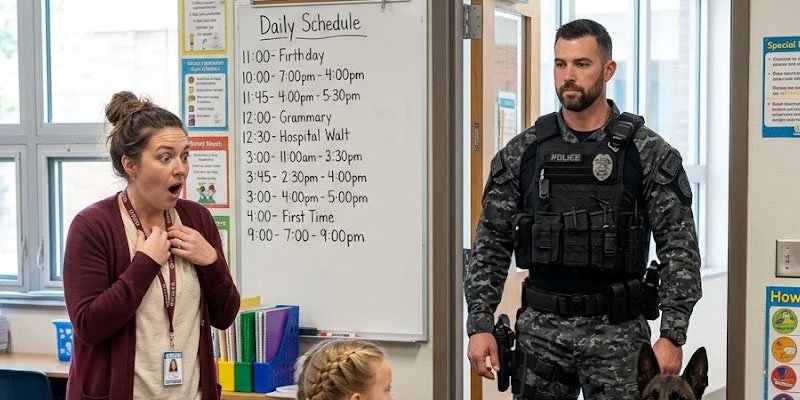
When we entered the classroom area, Ms. Harrow was standing near the whiteboard.
Her back was turned toward the door.
One of Clara’s classmates noticed us first.
“IT’S SCOUT!”
Every child turned around.
Ms. Harrow looked toward the entrance.
First, she saw the principal.
Then she noticed me.
Next, she saw Clara holding her blue folder.
Finally, her eyes settled on the Marine standing beside a Belgian Malinois.
The marker slipped from her hand.
It rolled across the floor.
Nobody bent down to retrieve it.
Principal Patel stepped forward.
“Good morning, Ms. Harrow. We have an approved educational demonstration for the class today.”
She gestured toward my husband.
“This is Staff Sergeant Ben Reed and his military working dog, Scout. I believe Clara has already told you about them.”
Ms. Harrow stared at the dog.
Her eyes shifted toward the pale scar above his right ear.
Then she looked at Clara.
Ben stepped into the classroom.
“Good morning, ma’am. My name is Ben Reed. Scout is my working partner, and Clara is my daughter.”
He spoke in a calm voice.
There was no anger in his tone.
No accusation.
Yet the entire classroom had fallen silent.
Ms. Harrow attempted to speak.
“Staff Sergeant, I…”
Ben interrupted gently.
“If you don’t mind, there’s something I’d like to ask before we start.”
She swallowed.
“Of course.”
He turned toward Clara.
“I’d like my daughter to finish the presentation she worked so hard to prepare.”
Clara looked up at him.
“Really, Daddy?”
He smiled.
“Absolutely.”
She slowly walked to the front of the classroom.
It was the same spot where she had been forced to read the sentence on the yellow sticky note.
The same whiteboard stood behind her.
The same Hero Wall remained on the back wall.
And the same children who had witnessed her humiliation were now looking at her father and Scout.
Clara opened her damaged folder.
At first, her hands trembled.
Then she looked toward Ben.
He nodded reassuringly.
She took a deep breath.
“My real-life hero is my dad, Staff Sergeant Ben Reed. He works as a Marine Corps military working dog handler, and his partner is a Belgian Malinois named Scout.”
She raised her drawing.
Ben calmly guided Scout into a sitting position beside her.
The children gasped.
“That’s exactly the same dog!”
“Look at his ear!”
“She even drew the scar!”
Clara smiled.
Then she continued reading.
She described Scout’s training, his responsibilities, and the way he used a passive alert to communicate when he detected something important.
She talked about the kennels, the certifications, and the unique bond between a handler and his dog.
With each sentence, her voice became more confident.
When she reached the funny story about Scout’s love of tennis balls, the class laughed.
This time, nobody was laughing at her.
They were enjoying what she had written.
Then Clara reached the part she liked best.
She looked toward Ms. Harrow.
“There’s an old tradition that military working dogs are considered one rank higher than their handlers. That means Scout outranks my dad.”
The classroom became quiet.
Every student turned toward Ben.
He smiled.
“It’s a tradition that reminds handlers how valuable these dogs are and how much respect they deserve.”
Then he glanced down at Scout.
“So yes, according to that tradition, Scout is my boss.”
As though he understood the joke, Scout let out a short bark.
The classroom burst into laughter.
Clara was beaming.
She lowered her eyes to the final paragraph of her report.
“My dad says the hardest part of his job is trusting Scout, even when he can’t see what Scout has detected. He says being a good handler means trusting his partner enough to investigate. That’s one of the reasons I believe he’s a hero.”
She closed the folder.
The room became silent once again.
Ben turned his face away for a moment.
I could see tears welling in his eyes.
Beside the whiteboard, Ms. Harrow was crying too.
The demonstration lasted nearly forty-five minutes.
Ben demonstrated how Scout performed a controlled search using an approved training aid.
He explained that Scout did not have to bark or dig when he located a target.
Instead, he simply sat down to indicate where it was.
When Scout successfully completed the demonstration, Clara called out immediately.
“Passive alert!”
Ben laughed.
“That’s exactly right.”
The children cheered.
They asked questions about Scout’s training, his food, his favorite toys, and his daily schedule.
Ben answered every question patiently.
At the end, the students were allowed to approach Scout individually under Ben’s supervision.
Clara stood proudly beside her father.
“Remember,” she reminded her classmates, “you need to ask before petting him.”
When the demonstration finished, Ms. Harrow walked to the front of the classroom.
She held her reading glasses in one hand.
Her fingers were trembling.
“Class,” she began, “there is something important I need to tell you.”
The children grew quiet.
She turned toward Clara.
“Two days ago, I told everyone that Clara had included information in her report that was not true.”
She paused.
“I marked her work as unverified. Then I threw it away and made her apologize.”
Her voice shook.
“I was wrong.”
Clara stood quietly beside Scout.
Ms. Harrow continued.
“Clara worked very hard. She interviewed her father, corrected her mistakes, and brought notes showing how she had prepared her report.”
She took a breath.
“I should have checked the information before accusing her of inventing it. Her mother even offered to provide documentation, and I failed to review it properly.”
Then she knelt beside my daughter.
“Clara, I’m truly sorry. You did not deserve to be treated that way.”
Clara studied her for several seconds.
Then she reached into her pocket.
She took out the yellow sticky note.
The very same note she had been forced to read aloud.
She held it out to her teacher.
“You can have this back.”
Ms. Harrow took it.
She stared at the sentence she had written.
Then she folded the note and slipped it into her pocket.
Before we left, she asked Clara if she could see the folder.
My daughter hesitated.
Eventually, though, she handed it over.
Ms. Harrow walked to her desk and picked up a green pen.
Beneath the red words NOT VERIFIED, she wrote a new statement.
VERIFIED IN PERSON BY STAFF SERGEANT BEN REED AND MILITARY WORKING DOG SCOUT.
Then she added another sentence:
Everything in this report is true.
She carried the folder to the Hero Wall and pinned it in the center.
The students applauded.
Clara simply stood there, staring at her report.
The blue folder remained bent.
The pencil marks were still visible.
And the red words could still be seen above the green writing.
“Are you going to cover up the red part?” she asked quietly.
Ms. Harrow shook her head.
“No. I believe it should stay. People need to understand that adults can make mistakes, too.”
After the demonstration, Principal Patel arranged a private meeting with Ben, Ms. Harrow, and me.
Clara spent that time in the library with Mr. Okafor, who showed her an old photograph of a military dog he had once known.
During our meeting, Dr. Patel explained that she had examined the records and would launch a formal investigation into how the incident had been handled.
She also offered to transfer Clara to another third-grade classroom for the remainder of the school year.
We agreed.
Ms. Harrow did not object.
For a long time, she sat quietly, staring at her hands.
Eventually, she asked whether she could explain something.
She emphasized that she was not trying to excuse her behavior, but wanted us to understand why she had reacted so strongly.
She told us that her own father had spent years telling stories about military accomplishments that later proved to be false.
When the truth emerged, she had been publicly embarrassed as a teenager.
The experience had made her deeply distrustful of stories that sounded extraordinary.
“When Clara said a dog outranked a Marine,” she admitted, “my first thought was that someone had made the story up.”
Ben listened without speaking.
Then he replied.
“I’m sorry you had to go through that.”
She nodded.
“But Clara isn’t your father,” he continued. “She’s an eight-year-old girl who worked hard on an assignment. She deserved to have her information checked before anyone accused her of lying.”
Ms. Harrow lowered her gaze.
“I know.”
Ben looked at Scout, who was lying quietly near his feet.
“My work depends on paying attention when Scout alerts me to something I can’t see. I don’t automatically assume every alert is correct. I investigate it. Your students deserve that same consideration.”
The teacher wiped her eyes.
“I understand.”
After the school completed its review, Ms. Harrow was reassigned to a role outside the classroom.
Clara moved into Mr. Hughes’s class.
He was a friendly young teacher who wore colorful bow ties and enjoyed making his students laugh.
On her first day, he asked Clara if she wanted to present her Real-Life Hero Report again.
She shook her head.
“I already presented it. It’s on the Hero Wall if anyone wants to read it.”
He smiled.
“That’s fair enough.”
The report remained on the classroom bulletin board for the rest of the school year.
Other students stopped to look at it.
Some admired Clara’s picture of Scout.
Others read the red and green writing and asked what had happened.
But Clara no longer felt embarrassed by the folder.
She felt proud of it.
About a month later, a handwritten letter arrived at our house.
It was addressed to Miss Clara Reed.
My daughter was delighted because she had never received such a formal-looking envelope before.
She opened it at the kitchen table while Ben sat nearby drinking coffee.
The letter came from Ms. Harrow.
She apologized once again and explained that the experience had made her reconsider how she evaluated information and how important it was to listen carefully before reaching conclusions.
She encouraged Clara to continue writing, keep learning, and never lose the courage to tell the truth.
At the bottom, she had added a short postscript.
Please tell Scout thank you. I understand that he outranks everyone.
Clara read the letter twice.
Then she handed it to Ben.
He read it slowly.
“What do you think?” he asked.
Clara thought about the question.
“I think she was frightened.”
Ben looked surprised.
“Frightened?”
Clara nodded.
“Just like I was when she made me read that note. I was scared, so I said something that wasn’t true. She was scared of being tricked, so she didn’t check.”
She paused.
“I don’t think being scared makes someone a bad person. But it’s not okay to be unkind just because you’re scared.”
Ben looked at her for a long moment.
Then he smiled.
“That’s a very wise thing to understand at eight years old.”
Clara shrugged.
“I’ve been thinking about it.”
She carefully folded the letter and placed it inside her blue folder.
When the school year ended, she brought the report home.
Four small holes marked the corners where it had been pinned to the Hero Wall.
The cardboard was still creased.
A dark mark remained across Scout’s drawing.
I offered to help her print a fresh copy.
She shook her head.
“No, Mommy.”
“Why not?”
“Because it wouldn’t be the original anymore.”
I did not argue with her.
Two years went by.
Clara turned ten.
And Scout finally retired from military service.
He was seven years old, and although he still enjoyed training, his body was beginning to show the effects of years of demanding work.
Ben was offered the opportunity to adopt him.
We accepted without hesitation.
On a Tuesday afternoon in October, Ben drove home with Scout in the same truck he had used two years earlier when he returned from training to visit Clara’s school.
Our daughter was waiting on the porch.
When Scout climbed out, she immediately noticed that his muzzle was beginning to turn gray.
His pointed ears, however, still stood upright.
And the familiar pale scar remained above his right ear.
Clara approached him slowly.
She held out her hand.
“Hi, Scout. May I pet you?”
Ben laughed.
“Sweetheart, he’s retired now. He’s part of our family.”
Clara looked at him seriously.
“I know. But I’m still going to ask.”
Scout sniffed her hand.
Then he lowered his head beneath her palm, just as he had when she was younger.
That evening, after dinner, I found Ben and Clara sitting on her bedroom floor.
Scout was resting comfortably between them.
Clara had opened the old blue folder.
She was looking at the title page.
The red words were still there.
NOT VERIFIED.
Directly underneath them was the correction written in green ink.
VERIFIED IN PERSON.
Ben looked at her.
“Do you ever think about that day?”
She nodded.
“Sometimes.”
“Does it still make you sad?”
Clara traced the crease in the cardboard with her finger.
“I used to think it was the worst day of my life.”
“What about now?”
She considered his question.
“Now I think it’s one of the most important things that ever happened to me.”
Ben waited for her to continue.
“Because I learned that people might not believe you, even when you’re telling the truth. But that doesn’t mean you should stop telling it.”
She glanced down at Scout.
“And I learned that sometimes you need other people to help you prove what you already know.”
She began listing everyone who had helped her.
Mr. Okafor, who had rescued her folder.
Mateo, who believed her when most of the other children did not.
Her mother, who contacted the school.
The principal, who listened to her.
And her father, who had driven through the night with Scout.
Then she looked up at Ben.
“Daddy, remember what you told me? The truth was enough. It just needed help getting through the door.”
Ben smiled.
“I remember.”
Clara rested her head against his shoulder.
“I think that’s what heroes do. They help the truth get through.”
Ben put his arm around her.
Between them, Scout released a long, contented sigh.
He no longer needed to search for dangerous materials or carry out military assignments.
At last, he was home.
And on the bedroom floor beside the little girl who had once written a report about him, he rested peacefully with the family who loved him.
Eventually, Clara closed the blue folder and carefully returned it to her dresser.
She never replaced it.
She never erased the red words.
She never fixed the crease.
To her, those marks had become part of the story.
Her report had started as a school assignment about her father and his dog. In the end, however, it taught her something far more meaningful: courage does not always mean proving someone else wrong. Sometimes, courage means continuing to tell the truth, even when nobody believes you at first.




