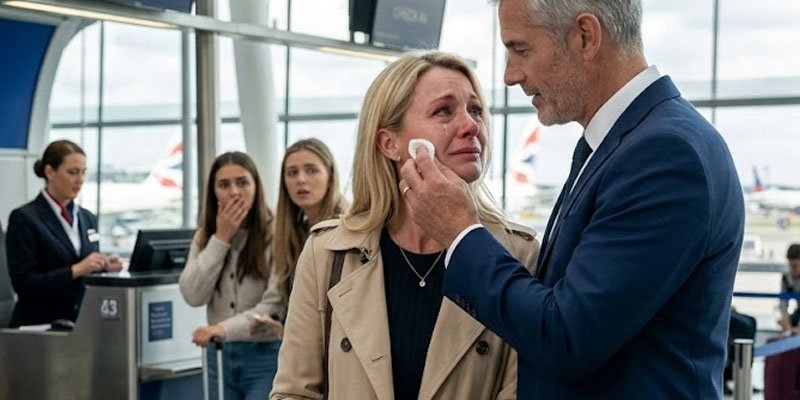
“If you refuse to give that seat to your sister, I’ll knock that attitude out of you right here in front of everyone.”
Your father’s voice booms across the Delta check-in area, loud enough that every nearby traveler hears him.
The line goes quiet.
People clutching passports and rolling suitcases glance over. A mother stops comforting her crying toddler. A businessman lowers his phone. Even the airline staff pause for a moment, sensing that something has gone terribly wrong.
Public humiliation has a way of demanding an audience.
You are Valeria Castaneda, thirty-two years old, running on less than four hours of sleep after finishing a brutal consulting project in San Diego. You drove through the night to Los Angeles International Airport because your mother insisted this would be the family’s “healing vacation.”
Paris.
Five nights beside the Seine.
A dream trip your younger sister, Daniela, had proudly shown off on social media for weeks—as though she had paid for every dollar herself.
She hadn’t.
You bought the plane tickets.
You paid the baggage fees.
You covered the travel insurance.
You reserved the airport transportation.
You placed the hotel deposit.
You purchased the museum passes.
You even booked the expensive dinner your mother insisted Daniela deserved after graduation.
Every expense had come from your bank account.
The only thing you claimed for yourself was a single upgrade.
Using your own airline miles.
Just one.
After years of surrendering the biggest slice of cake, the better bedroom, the newer computer, your emergency savings, your credit, countless family bills, medical expenses, and even part of Daniela’s graduate tuition, you wanted one thing.
One peaceful flight.
One chance to stretch out, sleep, and let someone else take care of you for once.
Then the airline agent smiles.
“Ms. Castaneda, your Delta One upgrade has cleared for your flight to Paris.”
For one glorious second, every muscle in your body relaxes.
It isn’t about luxury.
It’s relief.
A lie-flat seat.
A blanket.
A hot meal you didn’t cook.
Nine uninterrupted hours where nobody asks you to solve a problem, pay another bill, fix another crisis, or sacrifice one more piece of yourself.
Then Daniela turns.
“What do you mean she got upgraded?”
The agent maintains her professional smile.
“The upgrade is attached to Ms. Castaneda’s SkyMiles account.”
Daniela lets out a sharp laugh.
“No, that should be mine. I’m the graduate. This whole trip is for me.”
Your mother, Carmen, grabs your arm hard enough to hurt.
“Valeria,” she whispers through clenched teeth, “don’t start this. Give your sister the seat.”
You slowly look at her hand gripping your sleeve.
Then at your father, Rafael, whose face is already darkening with anger over a conflict that exists only because someone finally told him no.
“No.”
The word surprises even you.
Small.
Steady.
Dangerous.
Daniela stares in disbelief.
“Are you serious?”
“Yes.”
“You don’t even appreciate nice things.”
A tired smile almost escapes your lips.
“That’s probably because I’m usually the one paying for everyone else to enjoy them.”
Your mother gasps as though you’ve committed some unforgivable offense.
Your father steps forward.
Without another warning, his hand swings.
CRACK.
The slap echoes across the terminal.
Your head jerks sideways.
Heat explodes across your cheek.
For a heartbeat, the entire airport seems to freeze.
The Delta agent goes still.
The people waiting behind you stop pretending not to watch.
Even the conversations around the terminal seem to disappear.
Your father lowers his hand slowly.
“For once,” he growls, “learn some respect.”
No one comes to your defense.
Your mother doesn’t reach for you.
Daniela doesn’t look shocked.
She smiles.
“You deserved that.”
Your fingertips rise to your burning cheek.
It hurts.
But beneath the sting, something far deeper finally breaks free.
Not anger.
Not sadness.
Clarity.
For years, they praised your strength whenever they needed money.
They called you bitter whenever you set boundaries.
They labeled you dramatic whenever you admitted they had hurt you.
And the moment you refused to sacrifice yourself for Daniela again…
Your father slapped you in the middle of an airport.
You lower your hand.
Look each of them in the eye.
Then quietly say,
“No.
I didn’t deserve that.”
Your father snorts.
“Don’t make this worse.”
Instead of answering him, you turn calmly toward the airline agent.
“Please cancel their tickets.”
Silence crashes over the counter.
Even the sound of the baggage conveyor seems unnaturally loud.
Your mother blinks.
“What?”
The agent hesitates.
“Ma’am?”
You slide your passport and credit card across the counter.
“The reservations under Carmen Castaneda, Rafael Castaneda, and Daniela Castaneda. I paid for all three tickets. Please cancel them.”
Daniela laughs nervously.
“You can’t do that.”
You meet her eyes.
“I absolutely can.”
Your father’s confidence begins to crack.
“You wouldn’t dare.”
There it is.
The belief your family has built their entire lives around.
You wouldn’t dare stop paying.
You wouldn’t dare say no.
You wouldn’t dare make them face consequences.
You wouldn’t dare choose yourself.
For thirty-two years, that assumption has controlled every decision you made.
Not anymore.
You face the agent once again.
“Please process the cancellation.”
Her eyes drift briefly to the bright red mark spreading across your cheek.
Then to your father’s still-raised hand.
Something changes in her expression.
She begins typing.
“Since you’re the purchaser and these fares are refundable, I can return the funds to your original payment method.”
Your mother grips the edge of the counter.
“No. Wait. Valeria, stop being ridiculous.”
Daniela’s confidence evaporates.
“Mom…?”
Your father suddenly looks uncertain.
You remain perfectly calm.
“And please remove their checked luggage from the reservation as well.”
The agent nods.
“Of course.”
Daniela lunges toward the counter.
“No! She’s being insane! This is my graduation trip!”
You finally turn toward your sister.
“It was your graduation trip while I was paying for it.”
A pause.
“Now it’s your lesson.”
Her face twists with fury.
“You jealous witch!”
Your mother snaps,
“Valeria, enough! You’re punishing everyone because your feelings got hurt.”
You stare at her.
“My father just slapped me across the face in the middle of an airport.”
She immediately lowers her voice.
“Don’t say it like that.”
You blink.
“How exactly should I say it?”
She glances nervously at the growing crowd.
“You know how he is.”
Somehow, those four words hurt even more than the slap.
Because you do know.
You know your father becomes violent the moment someone challenges him.
You know your mother spends her life excusing that violence.
You know Daniela has learned to benefit from it.
You know every role each of you has been expected to play.
And today…
You’re done performing.
Before anyone can speak again, airport security arrives.
The airline agent must have quietly called them.
Two officers approach with calm, professional expressions.
“Is everything alright here?” one asks.
Your father transforms instantly.
His shoulders relax.
His voice softens.
His expression becomes almost sympathetic.
“Just a family misunderstanding,” he says. “My daughter is a little emotional.”
The oldest trick in the book.
Appear reasonable.
Make the woman who was hurt look unstable.
But your cheek is still bright red.
And this time…
There are witnesses.
Before you can answer, the Delta agent speaks.
“He struck her across the face.”
Your father’s head snaps toward her.
“I did not hit her,” he says sharply.
“I corrected my daughter.”
The officer’s expression hardens immediately.
“No, sir,” he replies.
“You assaulted her.”
Daniela folds her arms and mutters,
“She was disrespecting him.”
If you’d like, I can also rewrite it in a more cinematic, bestselling novel style with even stronger pacing and emotional impact.
The second officer met her gaze.
“That doesn’t make assault legal.”
The word settled over the terminal like a heavy weight.
Assault.
Your mother’s face drained of color.
Your father went unnaturally still, as if he’d forgotten how to breathe.
Inside you, something shifted.
It wasn’t fear.
It was the startling relief of hearing a stranger finally give a name to what your family had spent years minimizing.
The officer turned toward you.
“Ma’am, would you like to file a report?”
Your mother’s voice broke into a desperate whisper.
“Valeria… don’t.”
Daniela leaned closer, her words sharp with panic.
“Don’t ruin Dad’s life over one slap.”
One slap.
As though that single strike was the entire story.
As though it hadn’t been built upon years of humiliation, manipulation, guilt, and sacrifice.
Years of paying bills.
Covering debts.
Giving away your savings.
Apologizing for pain that was never yours to carry.
Every moment had led here.
To this exact second.
You looked directly at your father.
Beneath his anger was something new.
Fear.
But even now, he was waiting for you to surrender.
Like you always had.
You inhaled slowly.
“Yes,” you said.
“I’d like to file a report.”
Your mother gasped as though you’d driven a knife through her heart.
Daniela burst into tears.
Not because you’d been slapped.
Because the vacation was falling apart.
Your father took one furious step toward you.
The officer immediately stepped between you.
“Sir. Stay where you are.”
The Delta agent quietly handed you your boarding pass.
Delta One.
Seat 3A.
The very seat they’d tried to take from you.
You wrapped your fingers around it.
At that moment, your phone began vibrating nonstop.
Bank notifications.
Hotel confirmations.
Travel alerts.
The Paris itinerary.
You opened the app.
Your mother noticed the screen instantly.
Her entire tone changed.
Sweet.
Gentle.
Manipulative.
“Valeria,” she pleaded, “let’s all calm down. We can talk about this after the flight.”
You met her eyes.
“There isn’t a flight for you.”
The color disappeared from her face.
“You can’t leave us here.”
You gave a quiet shrug.
“Watch me.”
Daniela angrily wiped away her tears.
“I already posted everything! Everyone knows we’re going to Paris!”
A tiny smile tugged at your lips.
“That sounds embarrassing.”
For the first time in years…
Daniela had absolutely nothing to say.
While officers guided your father aside for questioning, your mother hurried after them, whispering frantically.
Daniela remained frozen in the middle of the terminal, clutching her designer carry-on, suddenly looking much smaller without someone else’s wallet carrying her forward.
You finished speaking with the police.
Then you opened your travel app.
You canceled every hotel reservation connected to them.
Canceled the airport transportation for four passengers and rebooked it for one.
Canceled the dinner cruise on the Seine that your mother insisted on because Daniela wanted perfect sunset photos.
Finally…
You opened your banking app.
The emergency credit card still listed three authorized users.
Your mother.
Your father.
Daniela.
One by one…
You removed them.
The app asked:
Are you sure?
You pressed Yes.
Only then did your hands begin to shake.
Not from regret.
From freedom.
Freedom is terrifying when you’ve never been allowed to experience it.
By the time you reached security, your father was still speaking with officers.
Your mother sat crying into a tissue.
Daniela furiously typed on her phone, no doubt rewriting the story before you even reached TSA.
You never looked back.
Not once.
Inside the Delta One lounge, you found a seat overlooking the runway.
A glass of sparkling water.
A small plate of fruit.
You could barely manage a bite.
Across the room, a woman noticed the faint red mark still visible on your cheek.
She looked away without staring.
A small kindness.
You watched aircraft glide across the tarmac.
For years…
You believed your family couldn’t survive without you.
Now you understood the truth.
They could survive.
They simply preferred surviving on you.
Your phone lit up.
Daniela had already posted.
Some people show their true colors the moment they get a little money. Heartbroken that family can be so cruel.
You actually laughed.
It surprised even you.
Moments later, your mother texted.
Your father is devastated.
Daniela is hysterical.
You need to fix this.
Fix this.
Not…
Are you okay?
Not…
I’m sorry he hit you.
Not…
We were wrong.
Only…
Fix this.
Then came another message.
If you get on that plane… don’t bother coming home.
You looked down at your boarding pass.
Seat 3A.
Then you replied.
I already am home.
In myself.
Finally.
You blocked your mother.
Then Daniela.
After a long, quiet pause…
You blocked your father too.
When boarding was called, the gate agent smiled warmly.
“Ms. Castaneda, we’re ready whenever you are.”
You walked down the jet bridge by yourself.
Not abandoned.
Alone.
There is a difference.
Your seat was everything you’d imagined.
Wide.
Quiet.
Soft.
A folded blanket.
A plush pillow.
A welcome drink offered before takeoff.
You chose water.
As the aircraft lifted into the morning sky and Los Angeles slowly disappeared beneath the clouds, you rested your forehead against the window.
Tears slipped silently down your face.
Not because your family wasn’t sitting beside you.
But because the little girl inside you still wished they’d loved her enough that leaving didn’t feel like survival.
Somewhere over the Atlantic, you woke from the deepest sleep you’d had in months.
For one peaceful moment…
You forgot.
Then the dull ache in your cheek brought everything rushing back.
You connected to the plane’s Wi-Fi.
Forty-seven missed messages.
Unknown numbers.
Aunts.
Uncles.
Cousins.
Family friends.
Daniela had clearly begun her campaign.
One message stood out.
From your cousin Lucia.
Vale… what happened? Dani says you abandoned everyone at the airport and got Uncle detained.
You stared at the screen.
Then you sent her exactly one thing.
The video.
You hadn’t even known it existed until the gate agent quietly AirDropped it to you before boarding.
It lasted less than two minutes.
Your father’s threat.
Daniela demanding your seat.
Your mother’s relentless pressure.
The slap.
The silence afterward.
Your calm voice saying,
“Cancel their tickets.”
No explanation.
Just the truth.
Ten minutes later, Lucia replied.
Oh my God.
Then another message.
I’m so sorry.
And another.
I’m sending this to Aunt Rosa. They’re lying to everyone.
You closed your eyes.
For the first time that day…
Someone in your family had seen the truth without asking you to shrink it.
Paris welcomed you beneath soft gray skies and a gentle morning rain.
Your driver waited with a simple sign.
Valeria Castaneda.
One name.
Only yours.
The hotel overlooking the Seine greeted you with fresh flowers, warm smiles, and a breathtaking suite prepared in your honor.
“Welcome, Ms. Castaneda,” the receptionist said. “Your suite is ready.”
Suite.
Your mother had insisted on two connecting rooms because Daniela needed extra space for outfit changes.
You had used your reward points for the upgrade.
Now…
Every inch of it belonged to you.
You stepped inside.
The king-sized bed.
The balcony overlooking Paris.
Fresh fruit.
Soft light.
A handwritten welcome note.
Silence.
No Daniela racing you to the bathroom.
No father complaining about the room.
No mother asking you to call the front desk because you were “better at handling people.”
Just peace.
For several long minutes…
You simply stood there.
Your phone buzzed again.
Lucia.
The family group chat is exploding.
Your dad says the video is out of context.
Your mom says you provoked him.
Daniela says she’s traumatized.
You let out a slow breath.
Of course.
The truth is rarely welcomed inside families built on comfortable lies.
Another notification appeared.
Your uncle Manny.
Valeria… I saw the video.
I’m ashamed I believed them.
If you need anything, call me.
Then another.
From Aunt Rosa.
Your father hit you like that in public?
Has he ever done it before?
Your fingers stopped moving.
Had he?
Not exactly.
Not like that.
But…
Yes.
In quieter ways.
In smaller moments.
For much longer than anyone had ever known.
A shove against the wall when you were seventeen because you “talked back.”
Fingers digging painfully into your arm when you refused to co-sign a loan.
A door slammed so close to your face that you felt the air move.
A lifetime of violence, always measured carefully enough to be dismissed.
You type a single reply.
Not like this. But this wasn’t the first time I’d been afraid of him.
Then you set your phone aside.
You take a shower.
You get dressed.
And you step out into Paris alone.
At first, it feels strange.
This trip was supposed to be about your family. Every reservation, every museum, every restaurant had been chosen with them in mind. The galleries Daniela wanted to visit. The cafés your mother had discovered on Instagram. The day at Versailles your father insisted on because he wanted the perfect photographs.
Now there is no one else to accommodate.
Oddly, that feels harder than you expected.
You pause outside a quiet café, staring at the menu longer than necessary, unable to decide what you want because, for once, no one else’s preferences come first.
Eventually, you walk inside.
A cappuccino.
A buttery croissant.
A table beside the window.
You eat slowly.
No one interrupts.
No one reaches across the table, claiming “just one bite” before taking half your meal.
No one complains that you’re too quiet.
A laugh escapes you before you can stop it.
Moments later, tears follow.
The waiter approaches with quiet concern.
You offer him a reassuring smile.
“I’m okay.”
This time, you realize it’s true.
Back in Los Angeles, everything begins to unravel.
You know because Lucia keeps you updated, and because Daniela—despite being blocked—starts creating new email accounts just to reach you.
The first messages are furious.
You ruined my graduation celebration.
Then they become guilt-ridden.
Mom hasn’t stopped crying.
Then demanding.
At least send us money so we can rebook everything.
Finally…
Dad’s card was declined at the hotel near LAX. Did you freeze something?
You stare at that email.
Then it hits you.
The emergency credit card.
For years your parents insisted they only used the card in your name for emergencies.
Apparently, emergencies included groceries, gas, Daniela’s salon appointments, your father’s golf outings, and your mother’s shopping sprees.
You had locked the card at the airport.
You hadn’t even realized that meant cutting off the financial lifeline they’d quietly depended on for years.
Good.
Another email arrives.
You’re unbelievably selfish. We had to Uber home, and Mom cried the entire ride.
You delete it without replying.
Not every accusation deserves your attention.
On your second day in Paris, you visit the Musée d’Orsay simply because you want to.
Not because Daniela thinks it will look good on Instagram.
Not because your mother wants another family photo.
Not because your father is impatient to rush through every exhibit.
You stand in front of one painting for nearly twenty minutes.
No impatient sighs.
No complaints.
No one asking if you’re finally finished.
Standing there, you realize something painful.
Peace has always been treated like a privilege instead of a right.
Later that afternoon, sitting beside the Seine, you finally open your banking records.
Not for a quick glance between transfers.
Not to send someone money.
To really look.
Over the last five years, you’ve paid:
- $18,400 toward Daniela’s university tuition.
- $11,200 covering your parents’ household bills.
- $7,600 in “temporary” loans to your father.
- $5,900 funding Daniela’s failed clothing business.
- $14,300 charged to the family emergency credit card.
- $9,800 for the Paris vacation before cancellations and refunds.
The numbers make your stomach tighten.
Not because they emptied your savings.
Because no one ever called it sacrifice.
They called it your responsibility.
You open a spreadsheet.
For the next two hours, you document everything.
Every transfer.
Every receipt.
Every message asking for money.
Every promise to repay.
Every screenshot of Daniela showing off designer bags, vacations, expensive dinners, and classes you helped finance.
When you’re done, the total sits at just over $67,000.
You lean back in your hotel chair, unable to stop staring.
Sixty-seven thousand dollars.
And somehow…
They convinced you that you were the burden.
That evening, you dine alone at the restaurant your mother had chosen for Daniela’s “golden hour” photographs.
The hostess smiles politely.
“Will anyone else be joining you?”
You smile back.
“No. Just me.”
She leads you to a window table.
As the sun sinks over Paris, warm amber light fills the room.
You order the tasting menu.
When dessert arrives, you take a single photograph.
Not of yourself.
Of the empty chair across the table.
You post it with one sentence.
For years, I mistook paying for the table as having a place at it. Never again.
Then you silence your notifications.
By morning, the post has spread through the family.
Your mother leaves a voicemail from an unfamiliar number.
Her voice trembles with anger.
“Valeria, I don’t know what you’re trying to prove. Families help each other. Your father made one mistake—one. You’re destroying this family because you’re bitter.”
You listen twice.
Then save the recording.
Evidence.
The word has become something steady.
Something solid.
On the fourth day, an email arrives from your father.
No subject line.
You embarrassed me in front of strangers. Whatever happened, you pushed me to it. A daughter should never disrespect her father. When you return, we’ll sit down and talk like adults.
You read it in your hotel room, wrapped in a robe, a cup of tea cooling beside you.
Talk like adults.
You know exactly what that means.
He speaks.
You apologize.
Your mother cries.
Daniela sulks.
Eventually, you pay for dinner so everyone can pretend the family is healed.
Not anymore.
You forward the email to the attorney you contacted that morning.
Priya Shah.
A lawyer specializing in financial abuse, family exploitation, and protective orders.
Her reply arrives within minutes.
Don’t respond. Save everything. We’ll be ready when you get back.
You close your laptop.
Then wander into a small boutique and buy yourself a silk scarf.
Not because you need one.
Because you want one.
Because no one is standing beside you saying the color would suit Daniela better.
When you return to Los Angeles, your family expects guilt.
Instead, you arrive with legal representation.
The following morning, you meet Priya at her downtown office.
She is calm, meticulous, and entirely immune to emotional manipulation.
You bring everything.
The airport security footage.
The emails.
The voicemails.
The credit card statements.
Your spreadsheet.
Text messages requesting money.
Receipts.
Refund confirmations.
Proof that every dollar spent on the Paris vacation came from your account.
Priya spends nearly forty minutes reviewing the documents.
Finally, she looks up.
“Valeria,” she says quietly, “your family has been financially exploiting you for years.”
The word exploiting catches you off guard.
You’re used to gentler language.
Helping.
Supporting.
Being responsible.
Priya doesn’t soften the truth.
“Your father assaulted you. Your mother excused it. Your sister publicly defamed you. Together, they exploited your finances, your credit, and your sense of obligation. The good news is that we can stop it.”
You straighten in your chair.
“How?”
“We’ll send formal legal notices. Freeze every account they can access. Revoke every authorization. If you choose, we’ll pursue repayment of the loans. And if your father continues threatening or harassing you, we’ll discuss filing for a protective order.”
A protective order.
Against your own father.
Your stomach knots.
Priya notices.
“You don’t have to make every decision today.”
You glance down at your hands.
The bruise from the slap has faded.
The memory hasn’t.
You meet her eyes.
“No,” you say. “But I want those notices sent today.”
A small, approving smile appears on Priya’s face.
“Then let’s begin.”
The first notice goes to your parents.
The second goes to Daniela.
The third reaches your bank.
The fourth lands with your credit card company.
By the end of that day, everything changes.
Your father’s access to your emergency card is permanently revoked.
Your mother’s automatic payments tied to your account are canceled.
Daniela’s “temporary” authorized-user privileges disappear without warning.
The fallout is immediate.
Your mother calls seventeen times from a number you don’t recognize.
Daniela floods your inbox with emails so long they read like desperate essays written by someone finally drowning in the consequences of her own choices.
At 9:30 that evening, your father shows up outside your apartment.
You watch him through the lobby security camera.
He stands rigidly in front of the call box, repeatedly pressing your name, his jaw clenched, shoulders tight with anger.
For a moment, your entire body goes cold.
You are eight years old again, standing silently in the hallway while he screams about unpaid bills.
You are seventeen, trapped against a wall while his temper fills every corner of the house.
You are thirty-two, standing in an airport with your cheek burning from the force of his hand.
Then your phone vibrates.
Priya.
“Building security has been notified. Stay inside. If he refuses to leave, the police will be called.”
You close your eyes and let out a slow breath.
You are not alone anymore.
Your father argues with the security guard for nearly eight minutes.
Then, finally, he leaves.
The following morning, your mother sends a single message.
How could you treat your father like a criminal?
You stare at the screen.
Your fingers never move.
There is nothing to explain.
He acted like one.
Two weeks later, Daniela reaches out again.
This time, she asks to meet.
Not at your parents’ house.
Not with your mother present.
Just the two of you.
Your first instinct is to refuse.
But Priya suggests a compromise.
A public place.
Daylight.
No discussion about money without written follow-up.
So you agree.
You meet at a quiet coffee shop in Pasadena.
Daniela arrives fifteen minutes late.
Of course she does.
She wears oversized sunglasses despite the cloudy afternoon.
She looks thinner than you remember.
For the first time in years, she doesn’t resemble the untouchable golden child.
She simply looks exhausted.
Like someone discovering that even gold plating eventually wears away.
She sits across from you.
“You look good,” she says.
You wait.
She slowly removes her sunglasses.
Her eyes are bloodshot.
“I’m sorry Dad hit you.”
You study her carefully before answering.
“For hitting me?”
You pause.
“Or for saying I deserved it?”
Her gaze drops to the table.
The honest answer is both.
The spoken answer is smaller.
“I was upset.”
“You were cruel.”
Her lips tremble.
“You canceled my dream vacation.”
“I canceled a vacation I paid for after you smiled while our father slapped me.”
She flinches.
Good.
Some truths are supposed to hurt.
Daniela stirs her untouched coffee.
“Mom says you’re destroying the family.”
“Mom says whatever helps her avoid facing what Dad actually did.”
She hesitates before whispering,
“He’s been awful at home.”
Immediately, the old instinct rises inside you.
Concern.
Responsibility.
The familiar urge to fix everything.
You plant both feet firmly on the floor.
You let the feeling come.
Then you let it go.
“I’m sorry to hear that,” you reply calmly.
Daniela looks genuinely surprised.
She expected questions.
How bad is it?
What happened?
Do you need money?
What can I do?
You ask none of them.
She swallows.
“He blames me.”
“For what?”
“For starting the fight about the airplane seat.”
You almost laugh.
“Interesting.”
“Last month, apparently everything was my fault.”
The tears come quietly this time.
No drama.
No performance.
Just grief.
“I didn’t know how much you paid for everything.”
You hold her gaze.
“Yes, you did.”
She shakes her head quickly.
“Not… not all of it.”
“But you knew it was my money.”
She can’t deny that.
You lean forward.
“Dani… I’m not angry because you wanted beautiful things.”
“I’m angry because you believed loving you meant I had to disappear so you could have them.”
The words break something inside her.
“I was jealous of you,” she whispers.
You blink.
“Of me?”
A sad laugh escapes her.
“You think being the favorite feels good?”
“Maybe when you’re little.”
“But eventually you realize nobody thinks you can survive anything on your own.”
“Mom babies me.”
“Dad shows me off.”
“You actually built a life.”
The words settle between you.
They matter.
But they don’t erase the years that came before them.
“You still hurt me,” you say quietly.
“I know.”
“You still used me.”
“I know.”
“And if I forgive you someday…”
“…that doesn’t mean you ever get access to my money again.”
She nods immediately.
“I know.”
For the first time in years, your sister sounds like someone beginning to understand accountability.
When you leave the café, neither of you reaches for a hug.
It feels cold.
It also feels honest.
Your parents do not change so easily.
Your mother sends guilt.
Your father sends silence.
Then anger.
Then a handwritten letter slipped beneath your apartment door.
The discovery terrifies you.
Later, security footage reveals he followed a delivery driver into the building.
The letter contains no apology.
Only entitlement.
He writes about respect.
Sacrifice.
Everything he supposedly gave you.
How daughters today forget their place.
How you humiliated him.
How he merely “disciplined” you because, in his words, nobody else would.
Priya reads the letter once.
Then she quietly says,
“This helps us.”
It shouldn’t make you feel safer.
Yet somehow it does.
Three weeks later, the protective-order hearing begins.
Your father arrives wearing a dark suit.
Your mother sits beside him.
Daniela is absent.
That tells you more than words ever could.
In court, your father speaks with practiced composure.
He calls you dramatic.
He insists families argue.
He claims he never intended to hurt you.
Then Priya plays the airport security footage.
Silence swallows the courtroom.
The judge watches your father threaten you.
Watches him strike you.
Watches your mother stand frozen.
Watches Daniela smile.
Then the judge reads the letter your father slipped beneath your apartment door.
Your father tries one final defense.
“I’m just old-fashioned.”
The judge removes his glasses slowly.
“Sir,” he says evenly,
“Assault is not a parenting style.”
Your mother’s breath catches.
Your father’s face flushes crimson.
You lower your eyes, breathing carefully as relief quietly settles into your chest.
The protective order is granted.
No contact.
No visits to your apartment.
No appearances at your workplace.
No harassment through relatives or third parties.
Your mother begins crying as though she is the one being protected instead of the woman who spent years watching and saying nothing.
Outside the courthouse, she tries to approach you.
Priya steps between you immediately.
“Mrs. Castaneda.”
“Please don’t.”
Your mother’s face crumples.
“Valeria…”
“…he’s your father.”
You meet her eyes.
“And I was your daughter.”
She stops walking.
For the first time in your life…
She has no answer.
The months that follow are not easy.
But they are clean.
You sleep better.
Then worse.
Then better again.
You begin therapy.
You learn words that make your stomach tighten because they describe your life with unsettling precision.
Financial abuse.
Parentification.
Scapegoating.
Golden child.
Trauma response.
You hate how clinical those labels sound.
Yet giving pain a name makes it feel less like a personal failure.
You rebuild your savings.
You travel for work without buying gifts for people who only loved what you could provide.
You eat dinner without waiting for the next emergency phone call.
You keep limited contact with Daniela.
Eventually, she starts therapy too, after your parents direct all the disappointment they once aimed at you toward her instead.
Rescuing her is no longer your responsibility.
But when she calls simply to talk—not to ask for something—you answer.
That quiet boundary becomes the fragile bridge between the two of you.
A year after the airport incident, invitations arrive for your cousin Lucia’s wedding in Santa Barbara.
You almost decline.
Too many relatives.
Too many whispers.
Too much history.
Then Lucia calls personally.
“I want you there,” she says.
“Not them.”
“You.”
So you go.
You wear a deep blue dress and the silk scarf you bought in Paris.
You arrive alone.
For the first time, being alone doesn’t feel lonely.
Your mother is there.
Your father is not.
The protective order is still in effect.
Daniela sits at another table, looking uncertain.
As the evening settles beneath strings of warm patio lights, your mother approaches.
She looks older.
Not softer.
Simply older.
“I won’t keep you long,” she says.
You remain silent.
She twists the strap of her purse nervously.
“Your father wanted to come.”
“He legally couldn’t.”
Her lips tighten.
She nods.
A long silence stretches between you.
Then, almost too quietly to hear, she says,
“I didn’t protect you.”
Your breath catches.
Not because those words erase everything.
But because you’ve spent your entire life waiting to hear them.
She continues, her voice trembling.
“I kept telling myself you were strong.”
“I convinced myself Daniela needed more.”
“I told myself your father was just stressed.”
“But I watched him hurt you.”
“And I kept asking you to make life easier for everyone else.”
Your vision blurs beneath the patio lights.
Tears sting your eyes.
“I don’t know how to be your mother anymore,” she whispers.
You look at the woman who raised you.
Failed you.
Used you.
Loved you imperfectly.
And now, for the first time, stands before you with nothing left to hide except the truth.
“Start by not asking me for anything,” you say quietly.
Your mother nods through her tears.
“Okay.”
It isn’t forgiveness.
It isn’t reconciliation.
Not yet.
Maybe not ever.
But it is the first conversation you’ve ever had with her in which her pain is no longer placed on your shoulders.
Later that evening, Daniela quietly sits beside you during dessert.
She doesn’t ask if the seat is taken.
She already knows the answer.
“You okay?” she asks.
You glance across the room. Your mother sits alone, staring into her untouched coffee.
“I don’t know.”
“Me neither.”
For the first time in years, you almost smile.
It may be the most honest thing Daniela has ever said.
She slides a tiny gift box across the table.
“What’s this?”
“Relax,” she says with a nervous laugh. “It isn’t expensive.”
You open it carefully.
Inside rests a small airplane-shaped keychain.
On the back, engraved in tiny letters, are two simple words:
Seat 3A.
Your throat tightens.
Daniela keeps her eyes on her hands.
“I was awful,” she whispers. “I convinced myself that seat meant you loved yourself more than us.”
She pauses.
“I finally realized it didn’t.”
“It just meant you were tired.”
You close your hand around the keychain.
“Thank you.”
She nods, wiping away another tear.
“Next year,” she says, “I’m paying for my own vacation.”
You raise an eyebrow.
“Good.”
“To San Diego,” she adds with a grin. “Paris is still out of my budget. Apparently personal growth has financial limits.”
You laugh.
Not the effortless laugh of childhood.
Not the cautious laugh of someone trying to keep the peace.
A real one.
Two years after the slap, you return to Paris.
This time, you don’t travel alone.
And you don’t travel with your family.
Lucia joins you, along with two close friends who buy their own tickets, carry their own luggage, and say “thank you” so often it almost feels unfamiliar.
Once again, you’re seated in Business Class.
Seat 3A.
When the flight attendant offers champagne, you gladly accept.
As the aircraft climbs above Los Angeles, your fingers brush the little airplane keychain hanging from your carry-on.
Your thoughts drift.
The airport.
Your father’s raised hand.
Your mother’s silence.
Daniela’s angry smile.
The gate agent who believed you.
The police officer who called the slap exactly what it was—assault.
The seat everyone expected you to surrender.
The life you finally refused to.
Just before airplane mode switches on, your phone vibrates.
A message from Daniela.
Have fun. Send one picture. Not twenty. I’m still recovering from being jealous.
You smile.
A second notification appears.
This one is from your mother.
I hope you have a beautiful trip. You don’t need to answer.
You read the message several times.
Then you type two words.
Thank you.
Nothing else.
No explanations.
No guilt.
No invisible strings.
Sometimes healing doesn’t arrive with dramatic reunions or heartfelt speeches.
Sometimes it begins with two honest words that expect nothing in return.
When you land in Paris, the city welcomes you with crisp air and pale winter sunlight.
Later, you return to the same restaurant where you once sat across from an empty chair.
This time, every seat is filled.
Not by people who expect you to sacrifice yourself…
But by people who simply enjoy your company.
Halfway through dinner, Lucia raises her glass.
“To Valeria,” she says, smiling, “who finally learned that a paid seat isn’t a family obligation.”
Everyone laughs.
You do too.
But your eyes sting.
Because the truth reaches far beyond an airplane seat.
It was never just about Seat 3A.
It was about every place in your life where you were expected to give without receiving.
To pay without appreciation.
To carry everyone else’s burdens while pretending your own didn’t exist.
To always show up…
But never take up space.
It was about a daughter treated like an ATM.
A sister treated like a backup plan.
A woman slapped for saying no…
And then blamed because other people heard it.
You lift your glass one final time.
“To never giving away the seat you earned.”
The glasses clink together.
No one argues.
No one bargains.
No one reaches for what isn’t theirs.
And for the first time in your life…
No one asks you to move.