For 15 Christmases, my family “forgot” to invite me and I always discovered it on Instagram, but after Grandma left me her beach house, 23 relatives arrived—and I was standing there with a sheriff and an…
For fifteen straight Christmases, my family forgot about me.
Not once.
Not twice.
Fifteen separate times.
Every year, I learned the same way: through Instagram posts uploaded around midnight, showing my cousins in matching pajamas, my aunts raising glasses of wine, and my parents grinning beside a Christmas tree taller than the ceiling.
Someone would always write, Nothing better than having the whole family together.
The whole family.
Except me.
Whenever I asked about it, Mom would sigh and say, “Oh, honey, we thought you were busy.”
Dad would tell me, “Don’t make Christmas about hurt feelings.”
My sister Lauren would add, “You always bring weird energy anyway.”
Eventually, I stopped asking.
I spent Christmases alone in apartments, spare bedrooms someone had loaned me, hospital waiting rooms during extra shifts, and once inside my car outside a closed diner after my heater stopped working because I did not want to bother anyone.
Every year, Grandma Ruth called the following morning and said, “I saved you pie.”
She was the one person who never forgot me.
When she passed away in October, my family suddenly remembered my phone number.
But it wasn’t to comfort me.
They wanted to know about the beach house.
Grandma’s beach house stood along a gray stretch of Maine coastline, with cedar shingles, blue shutters, and a porch looking directly toward the water.
Every summer, my relatives treated it like a complimentary vacation rental.
They left sand throughout the bedrooms, wine marks on the rugs, and grocery receipts for Grandma to cover.
I was the one who repaired the loose railing.
I was the one who took her to her appointments.
I was the one who stayed beside her when she became too exhausted to talk.
At the reading of the will, my aunt Patricia appeared in black lace and said, “Ruth would have wanted us to share the house.”
The lawyer pushed his glasses higher.
“Ruth left the property solely to Nora.”
Twenty-three people turned their eyes toward me.
For the first time in my entire life, every one of them seemed to remember that I existed.
By December, the messages started arriving.
Can’t wait for Christmas at the beach house.
We’ll need the upstairs bedrooms.
Tell the cleaning lady to come early.
Nobody asked me for permission.
They simply assumed they had it.
On December 23rd, I drove to the house before sunrise.
By noon, four rental vans pulled onto the gravel driveway, loaded with suitcases, coolers, presents, and relatives who had excluded me for fifteen years.
Aunt Patricia stepped out first.
“Nora,” she called cheerfully. “Open the door. It’s freezing.”
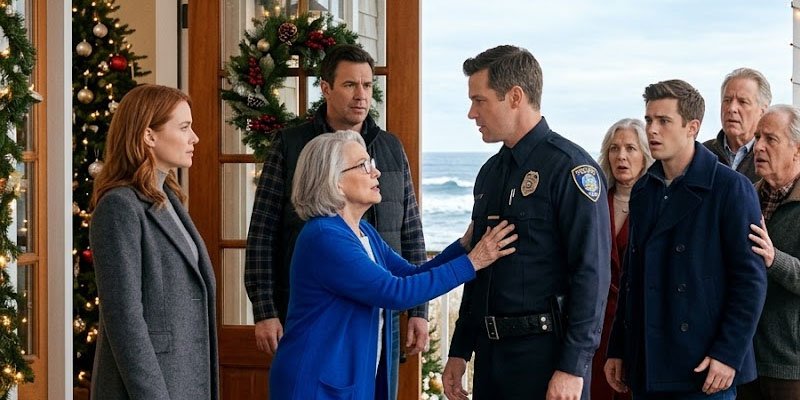
I stood on the porch beside Sheriff Callahan, an envelope in my hand.
“No,” I told her. “This year, you’re not coming inside.”
My cousin Blake laughed from behind a pile of luggage.
“Seriously, Nora. Don’t be dramatic. It’s tradition.”
I glanced at the vans, the coolers, the matching red sweaters, and the children already racing toward the dunes as if the property belonged to them.
“Tradition,” I said, “is what you call taking something for so long that you start believing you own it.”
Aunt Patricia’s smile vanished.
“Your grandmother would be ashamed of you.”
Sheriff Callahan cleared his throat.
“Actually, Ruth left a written statement with her estate attorney before she died.”
Everyone went silent.
I opened the envelope and removed copies of the letter Grandma had written for me.
To my family: If you are reading this because Nora has refused you entry, understand that she is carrying out my wishes, not betraying them.
Mom stepped forward, her face suddenly pale beneath her makeup.
“Nora, we’re your parents.”
“You were still my parents during every Christmas you forgot me.”
Dad looked toward the ground.
My sister Lauren folded her arms.
“This is punishment because Grandma loved you more than us.”
“No,” I replied. “This is protection because you cared more about her house than you cared about her.”
The sheriff gave Aunt Patricia a formal notice.
The beach house had been placed into a private trust.
No family member had the right to stay there without a written invitation.
Trying to enter would constitute trespassing.
Blake gave a dismissive laugh.
“You seriously called the sheriff on your own family?”
“No,” Sheriff Callahan replied. “Ruth did.”
He looked at me kindly.
“Show them the second page.”
My fingers tightened around the papers.
The second page had nothing to do with the house.
It was a ledger.
It documented repairs Grandma had paid for following family visits.
Medical appointments she had canceled because relatives insisted she host them.
Withdrawals from her account made after Aunt Patricia had “helped” with groceries.
Beside each person’s name were notes written in Grandma’s handwriting.
Mom whispered, “Where did you find that?”
I looked directly at her.
“From the woman you remembered every summer and forgot every Christmas.”
Aunt Patricia reached toward the ledger.
Sheriff Callahan moved between us.
“That document is part of an estate review,” he said. “Do not touch it.”
For the first time, my family fell silent without pretending their silence was courtesy.
Grandma had not simply given me the beach house.
She had also left evidence: bank statements, repair invoices, emails, and handwritten notes documenting who had taken advantage of her, pressured her, and treated her home like an inheritance while she was still alive.
Her attorney arrived twenty minutes later with copies for every adult standing in the driveway.
“The trust will seek repayment for documented misuse of Ruth’s accounts,” he explained. “Family access at the trust’s discretion is permanently revoked.”
Blake cursed.
Aunt Patricia began crying.
Mom kept saying, “This is not what Christmas is about.”
I looked at the vans filled with people who had come expecting to spend the holiday inside a home they had never bothered to ask permission to enter.
“You’re right,” I said. “Christmas was never meant to be about taking.”
Dad finally raised his eyes to me.
“Nora, please. We have nowhere to go.”
For a moment, that nearly broke me.
Then I remembered fifteen Christmases filled with empty chairs where I had never been invited to sit.
“There are hotels in town,” I said.
They drove away before sunset.
There was no dramatic screaming.
No spectacular breakdown.
Only twenty-three people carrying their luggage back into the vans while the cold ocean wind accomplished what shame never had.
That evening, I started Grandma’s fireplace and set one piece of pie on her blue plate.
I cried, but it wasn’t because I was alone.
It was because the house was finally quiet.
During the months that followed, the estate recovered enough money to support Grandma’s favorite coastal library program.
I kept the beach house available to the people who had loved her without making a spectacle of it: her nurse, her neighbor, her book club, and the young cashier she used to tip every Friday.
The following Christmas, my family sent cards.
I left most of them unopened.
For fifteen years, they had forgotten to invite me and insisted it was an accident.
Grandma had remembered every detail.
And when they finally appeared at my door, I gave them the only present they had truly earned.
The truth, wrapped in legal paper.