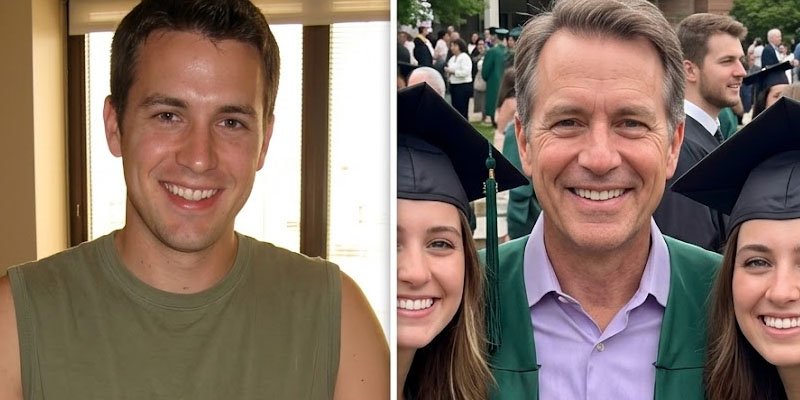
The day of graduation was bright, sunny, and warm. The auditorium was filled to capacity with families, balloons, and the cheerful buzz of excited conversations.
I sat in the front row with two bouquets of flowers in my hands, my heart overflowing with pride.
The girls crossed the stage one after another—Maya first, followed by Lila. They looked beautiful in their caps and gowns, their faces shining with a mixture of happiness and relief.
When the ceremony ended, they came through the crowd to find me. We hugged. We cried. They introduced me to their friends, and I did my best not to embarrass them.
That was when I noticed her.
Karen stood near the exit in a simple gray dress, holding a small white box wrapped with a silver ribbon. She looked older now. Thinner. Gray strands ran through her hair.
She slowly walked toward us, her steps hesitant, her eyes locked on the girls.
“Girls,” Karen said quietly. “I know I have no right to be here. But I wanted to give you something. Something I’ve kept for this day.”
She extended the box toward them.
Maya and Lila looked at it as though it were something dangerous.
“It’s a journal,” Karen explained. “I wrote one for each of you. I’ve written in them every year since you were born. I wanted you to know that I never stopped thinking about you. I never stopped loving you.”
For several long seconds, no one moved.
Then Lila stepped forward.
“You think a journal makes up for eighteen years?” she asked. Her voice remained steady, though a slight tremble could be heard underneath it. “You think you can just appear here, give us a present, and suddenly everything is fine?”
Karen started to respond, but Lila continued.
“You weren’t there for our first steps,” Lila said. “You weren’t there when we scraped our knees. You weren’t there for our school plays, parent-teacher meetings, or the nights we cried ourselves to sleep because we wondered what was wrong with us.”
Maya moved forward and stood beside her sister.
“You gave us life,” she said. “Then you gave us away. You don’t get to come back now and act like you’ve always been part of this.”
The entire room had fallen silent. Everyone was watching.
Karen’s expression collapsed. “I know I failed you,” she said. “I know I can’t change what happened. But I want to be part of your future. I want to try.”
I watched the girls look at each other. I knew that look. I had seen it countless times before—the expression they shared when they had already reached a decision.
“You can’t,” Maya said.
“What?” Karen asked.
“You can’t be part of our future,” Lila said. “Because you were never part of our past.”
Maya reached out and took the box from Karen’s shaking hands.
She opened it.
Inside were two small leather-bound journals, each bearing one of the girls’ names embossed on the cover. I could see they were packed with handwritten pages.
Maya looked at Lila.
“What do you think?” she asked.
Lila studied the journals. Then she looked back at Karen.
“Read them,” Lila said. “We’ll keep them, and we’ll read them.”
The following morning, they read the journals.
They stayed in their room for hours, going through page after page of letters their mother had written. Some were simple: “I thought about you today. I wondered what you were doing.” Others were painful: “I dreamed about you last night. I woke up crying.” Some were full of regret: “I should have stayed. I should have fought harder.”
They discovered photographs she had placed inside—pictures of herself, pictures of them from a distance, and pictures relatives had sent her. There were also drawings and poems she had created for them.
They remained silent for a long time afterward.
When they finally came downstairs, Maya’s eyes were red.
“I don’t forgive her,” she said. “Not yet. Maybe I never will.”
Lila nodded. “But I think… I think we understand a little more now.”
They didn’t call her. They didn’t contact her. But neither of them threw the journals away.
Several days later, Maya gave me a letter.
“Dad,” she said. “I need you to read this.”
It was from Karen.
Dear John,
I know I don’t deserve your forgiveness. I know I don’t deserve theirs either. But I need you to understand that leaving was the hardest thing I’ve ever done—and staying away was even harder.
I was broken, John. I was broken before I ever met you, and I was still broken when I left. I had no idea how to be a mother, and I was terrified I would hurt them the same way my mother had hurt me.
I believed I was protecting them. I believed I was protecting you.
I was wrong. I understand that now.
I don’t expect anything from you or from them. I only want you to know that I’m different now. I’ve been in therapy for years. I’ve worked on myself. I’ve learned how to forgive the person I used to be.
And I need you to know how grateful I am to you. You gave them the life I couldn’t give them. You were the parent they deserved.
Thank you.
Karen
I read the letter three times. Then I folded it and placed it in my pocket.
I didn’t call her either.
That happened three years ago.
My daughters are finishing college now. They are strong, independent, and successful. They still don’t call Karen “Mom.” They continue to keep her at a distance.
But they have begun speaking with her occasionally. Sometimes they talk on the phone. Sometimes they exchange letters. It’s slow. It’s careful. But it is happening.
I don’t know whether they will ever completely reconcile. I don’t know whether Karen will ever become a true part of their lives. But they have found something that works for them.
And I’ve discovered something too.
I’ve learned that being a parent isn’t about being flawless. It’s about showing up. Even when things are difficult. Even when you have no idea what you’re doing. Even when the person you’re trying to protect is yourself.
I showed up. Every single day.
And that was what mattered.
Karen left because she was broken. She remained away because she was ashamed. She returned because she was courageous enough to try—even knowing she might fail again.
My daughters were right to be angry. They were right to protect themselves. And they were right to eventually, when they were ready, allow her into their lives just a little.
Forgiveness doesn’t mean forgetting. It means finding a way to keep moving forward—even when the person who hurt you isn’t part of the journey.
I’m proud of them. I’m proud of all of us.