
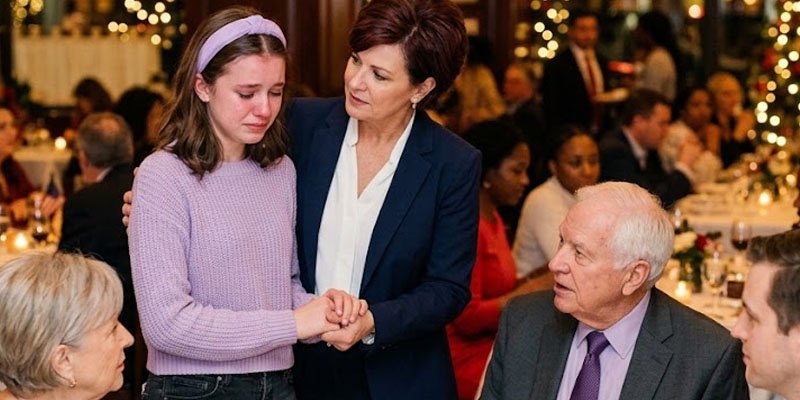
My mother looked at my 13-year-old daughter and whispered, “we don’t sit with mistakes,” I walked her out without saying a word, that night, my father asked if I was still making the car payment, by sunrise, every dollar was gone, but later, I found something on my daughter’s phone that…
My name is Marlo, and this is the story of the night my family finally revealed exactly who they were, and the morning I decided to believe what they had shown me.
I want to begin with something people rarely talk about when it comes to family. Most hurt doesn’t happen in one huge, dramatic moment. It happens through the little things—the birthdays forgotten, presents with no names, and quietly worded questions that are actually judgments disguised as concern.
By the time someone finally says the thing out loud, the thing that tears everything apart, it usually isn’t truly unexpected.
You already knew.
You simply kept hoping you were mistaken.
I had been hoping that for years.
I adopted my daughter, Sole, when she was seven. Before that, she had lived with me as a foster child for almost a year—exactly eleven months.
Eleven months of learning which cereal she loved, how thunderstorms frightened her, and the way her entire face lit up whenever something truly made her laugh.
By the time the county paperwork had been stamped and her last name had been changed on her school records, she already recognized the sound of my car pulling into the driveway, knew how I drank my coffee, and knew which drawer contained the Band-Aids.
She was mine.
Not basically.
Not nearly.
Not “in every way that matters,” as though biology still had the final say.
Mine completely, legally, and in every quiet way that paperwork could never describe.
She was the best decision I had ever made.
My parents never forgave me for it.
Not because they ever seemed openly cruel.
My mother made casseroles for church fundraisers.
My father coached Little League for fifteen years.
From the outside, they looked like the kind of family that belonged in perfect Christmas photographs.
But underneath was another kind of arithmetic, one that measured people according to worth, blood, and usefulness.
From the moment I brought Sole home, she didn’t fit their equation.
It didn’t start loudly.
It never does.
My mother forgot Sole’s birthday that first year.
I told myself she was still getting used to things.
The following year, she mailed checks to my nephews and completely left Sole out.
When I brought it up, Mom sighed and said she hadn’t known what Sole liked yet.
Sole was eight.
She loved art supplies, mystery novels, and any movie that had animals in it.
I had told Mom those things three times.
My father called her “that girl” whenever he was irritated.
Never around me if he could help it, but Sole heard him once.
She was nine.
Later that evening, she came to me quietly and asked, “Does Grandpa know my name?”
I told her, “Of course he does.”
I shouldn’t have said that.
Christmas presents came in two categories.
For my nephews—my brother Chris’s boys—there were embroidered names, thoughtful selections, presents that communicated, I see you.
For Sole, there were clearance items that were still wrapped in plastic.
One year, it was a soap set.
Another year, a candle.
Sole never complained.
Every time, she thanked them with handwritten notes because that is simply the kind of child she is.
They never replied.
Then came the questions, usually asked over coffee while Sole was somewhere else, spoken in soft voices filled with supposed concern.
“Does trauma stay with kids like her?”
“Do children from those situations really bond the way regular children do?”
“Have you ever thought about what you’ve given up, Marlo? A real family? A real life?”
Whenever I pushed back, I was told I was too sensitive.
Whenever I created distance, they accused me of keeping them away from their granddaughter.
And because I loved the idea of family, because I had spent my whole life believing people could grow beyond their worst moments, I kept going back.
About a month before the dinner, I finally gave them a clear warning.
I sat across from Mom in her kitchen and said, “One more cruel thing toward Sole. One more. And we are done. Not a break. Not a cooling-off period. Done.”
She stirred her coffee and nodded as though I had said something perfectly reasonable but not especially serious.
I don’t think either of them believed me.
People rarely believe the person who has spent years paying bills, smoothing over conflicts, and showing up.
That person has always shown up before.
The dinner took place at a restaurant in town, one of those places with warm string lights, old music, and an atmosphere that makes everything feel normal even when it isn’t.
The hostess seated us beside the front window.
Dad had already returned his drink before we had even opened the menus.
Mom kept rearranging her silverware.
Chris sat across from me, checking his phone beneath the table and smiling at things he never told us about.
Sole sat beside me in her cream blouse, her back straight and her napkin neatly folded in her lap.
She was trying so hard to be perfect that my chest ached.
She always did that around them.
That invisible preparation.
That careful stillness.
At home, she left her shoes in the middle of the floor.
She sang off-key to whatever happened to be playing.
She fell asleep on the couch with her book spread across her face.
At home, she was alive.
Around my family, she made herself smaller.
I had noticed it for years and convinced myself it was shyness.
Sole kept her eyes lowered toward her plate.
Then the waiter brought the dessert menus.
Mom leaned toward Sole the same way she always did when she wanted something cruel to sound compassionate.
Her voice became soft and almost gentle, but everyone at the table could hear her.
“We don’t sit with mistakes.”
The entire table fell silent.
Sole’s fingers tightened around her spoon until it clicked against the bowl.
Her shoulders curled inward.
Her eyes dropped so quickly that it looked as though a light had gone out.
My hand tightened around my water glass.
For one long, freezing second, I wanted Mom to repeat herself.
Loudly.
At full volume.
In front of everyone.
I wanted those words hanging in the air long enough for the entire restaurant to understand exactly what kind of woman she was.
I didn’t.
I put the glass down.
I stood, slipped my hand into Sole’s trembling one, and said quietly and completely, “We’re leaving.”
Chairs scraped against the floor.
Dad looked offended before he looked surprised.
Chris finally put his phone away.
Mom stared up at me as if I had humiliated her simply by refusing to let her continue.
“Don’t be dramatic,” she said.
I looked directly at her.
“You just called my daughter a mistake.”
“She knows what I meant.”
“No,” I said. “You know what you meant.”
Then I walked Sole through the restaurant, past the hostess stand, the other tables, and the little flag in the holiday centerpiece beside the door, while half the room pretended they weren’t watching.
The cold outside was biting.
Sole carefully climbed into my car, almost as though she were afraid she was taking up too much room.
She fastened her seatbelt and stared straight ahead with that awful stillness children use when they are trying not to break down.
I got behind the wheel.
For a while, neither of us said anything.
Then she whispered, “Am I?”
“Are you what?”
“A mistake?”
I turned toward her.
“No,” I said. “Never. Not for one second. You are the best decision I have ever made.”
Her mouth trembled.
I reached across the console and held her hand until her fingers gradually relaxed.
“They are wrong,” I told her. “And they do not get to decide who you are.”
That was when she finally cried.
At home, I made hot chocolate that she barely drank.
I settled her on the couch under two blankets with a movie she had already watched a hundred times.
I stayed beside her quietly because I didn’t trust myself to control the temperature of my own words yet.
The kind of anger that changes your life isn’t loud.
It doesn’t arrive shaking.
It comes quietly, cleanly, and with certainty, like winter air slipping underneath a door.
That night, I felt it settle inside me as though it had always been waiting there.
At 10:14 p.m., Dad texted.
“You’re still making the car payment tomorrow, right?”
Not, Is Sole okay?
Not, Your mother went too far.
Not, I’m sorry.
Just the bill.
For three years, I had paid their car note, part of their utilities, Chris’s phone bill, and the pharmacy gap Mom called temporary every single month even though it had never actually been temporary.
I did it because after my divorce, I was more financially stable than they were.
I did it because I had been raised to believe that taking care of family was a virtue, not a transaction.
I had been wrong about which one it was for them.
I opened my banking app.
Car payment canceled.
Utility transfer removed.
Chris’s phone autopay deleted.
Pharmacy account closed.
Then I went through every connected account, saved card, and automatic transfer.
I changed passwords.
Revoked access.
I updated security questions with answers none of them could guess because they had never paid enough attention to know the little details of my life.
Not Sole’s favorite cereal.
Not the name of my first pet.
Not the street where I lived before we moved.
They knew the bill schedule.
They did not know me.
By midnight, I had blocked Mom.
At 12:07, Dad.
At 12:11, Chris.
Then I sat at the kitchen table and picked up Sole’s phone.
She had casually mentioned once that Grandma had sent her a few messages.
She hadn’t seemed concerned.
I let it go.
I shouldn’t have.
There were three messages from Mom, all sent during the previous month, each disguised as gentle concern.
“Do kids at school ever make you feel different?”
“Do you ever worry your mom regrets taking on so much?”
“Do you ever wonder where you really belong?”
I sat at the kitchen table in the blue glow of that phone and finally understood something I had refused to acknowledge for years.
My parents hadn’t simply been cruel at dinner.
They had been quietly working on my child from the side, the way people do when they want to hurt someone without getting caught.
They had planted doubts in a thirteen-year-old girl’s mind.
Questions meant to weaken her sense of herself, create distance between us, and make her question the one person and place where she had always felt safe.
I pictured Sole at seven, arriving at my door with one bag and a stuffed rabbit missing an eye.
At nine, quietly asking whether Grandpa knew her name.
At dinner, folding herself smaller and smaller, trying to occupy so little space that nobody would find a reason to judge her.
She had spent six years trying to earn something that should have belonged to her from the very beginning.
And while she was doing that, Mom had been messaging her, asking whether she believed I regretted her.
By morning, I had twenty-nine missed calls.
Dad left voicemails demanding explanations.
Mom cried about betrayal, ingratitude, and everything she supposedly had done for me.
Chris called me selfish for destroying the family over one comment.
One comment.
I stood at my kitchen counter and listened to every voicemail.
Not because any of them changed my decision.
Because I needed to hear, clearly and one final time, what each person thought the actual problem was.
None of them mentioned Sole.
Not one voicemail among twenty-nine calls included the words, “Is she okay?” or “I went too far,” or even her name.
I deleted them all.
Then Sole’s phone lit up beside me.
Mom again.
I read the first line.
And unlike the dinner, the forgotten birthdays, or six years of quiet erosion, this time there was nothing inside me that wanted to explain.
Nothing wanted to give another warning.
Nothing wanted to hope they could become better than what they had already shown me.
I took screenshots of every message Mom had sent Sole during the previous month.
I forwarded them to my email.
I saved everything.
Then I did something I should have done years before.
I called a family attorney.
Not because I wanted anything dramatic.
Not because I intended to seek a restraining order or take court action.
Sole was safe, and I wasn’t afraid of my parents in that particular way.
I called because I had spent three years financially supporting people who now had every reason to become vindictive, and I needed to know exactly where I stood.
The attorney explained everything to me.
She confirmed that what I had done was legally clean.
No contracts.
No legal obligations.
No recourse.
The car.
Utilities.
Phone bill.
All voluntary.
My money.
My choice.
Gone.
“You’re free,” she said.
I hadn’t expected that word to feel so enormous.
Two weeks passed.
Dad tried contacting me through a cousin, asking me to be reasonable and think about what I was doing to the family.
I sent one message back through that cousin.
“I am not available for this conversation.”
Mom tried another approach.
She contacted a woman from my church who knew both of us and hoped she could intervene.
The woman called me kindly.
She asked whether I was okay, and when I explained what happened at dinner and what I found on Sole’s phone, she didn’t pressure me toward reconciliation.
She simply said, “I had no idea. I’m sorry, Marlo.”
That meant more to me than she realized.
Chris sent one final text from an unfamiliar number.
“You think you’re better than us. You always have. Enjoy your perfect little life.”
I read it once.
I didn’t respond.
Some messages aren’t invitations to have a conversation.
They are demands for a reaction.
And there is a certain strength in giving people absolutely nothing when that is what they deserve.
The harder part wasn’t cutting them off.
The harder part was Sole.
Not because she was angry at me.
She wasn’t.
In many ways, she seemed relieved, in that heartbreaking way children can feel relief when something they have always sensed but couldn’t put into words finally becomes visible.
The harder part came later, when she would suddenly grow quiet during dinner or stop halfway through her homework and look at me with something cautious in her eyes.
One evening, she asked, “Are you sad about it?”
I thought for a moment.
“I’m sad about what I thought they could be,” I told her. “I’m not sad about what I did.”
She nodded slowly.
“Me neither,” she said.
That was when I realized Sole had known for a long time.
She had simply been waiting to see what I would do.
I think about that often.
I think about all the years she sat across from people who made her feel like a question mark and still arrived with a straight back and neatly folded napkin, trying to give them some reason to love her.
She deserved better.
She deserved someone who wouldn’t wait for a ninth incident, or a tenth, or a twenty-ninth voicemail.
She deserved someone who left the first time.
I was late.
But I left.
A few months after the dinner, I started making changes I had put off for years.
I redid Sole’s room with a fresh paint color, shelves for her books, and a light she chose herself that filled everything with a soft golden glow at night.
We visited the museum she had been asking about for two years.
We drove three hours to see a band she loved and sang with the windows down all the way home.
I enrolled her in an art class.
Within six weeks, her teacher pulled me aside and said, “She has something real. I want you to know that.”
I already knew.
But I was happy that someone else finally recognized it.
I didn’t miss my family.
I want to be honest about that because people often expect a different ending.
They expect grief.
Eventually forgiveness.
At least some uncertainty.
I felt none of it.
For the first time in a very long while, my house felt like it was at the right temperature.
Like I could finally stop preparing myself for whatever came next.
Like the air around us no longer came with a cost.
Sole laughed more.
Not louder.
Just more freely.
More often.
From somewhere deeper.
She stopped making herself small.
She left her shoes in the middle of the floor.
Sang off-key.
Fell asleep on the couch with a book covering her face.
And I let her.
It was the most ordinary and beautiful thing I had ever seen.
During those months, we created something I don’t have an exact word for.
Not because it was complicated.
Because it was simpler than people expect.
Safety.
Warmth.
A home where nobody had to earn their place at the table.
I heard from Dad one more time.
About four months after dinner.
Not a call.
Not a voicemail.
A handwritten letter sent to my house.
He said he was sorry about the car payment situation.
He said Mom had been under stress.
He said family was family and surely I understood that nobody was perfect.
He never mentioned what Mom had said to Sole.
Never mentioned the messages.
Never mentioned Sole’s name.
I read the letter once, folded it, and placed it in a folder in my desk.
Not because it mattered to me.
Because documentation matters, and I had learned that lesson the hard way.
I never wrote back.
Here is what I know now that I didn’t completely understand before that dinner.
Protecting your child isn’t always dramatic.
It isn’t necessarily a speech, a scene, or some grand departure.
Sometimes it simply means standing up, taking a hand, and walking toward the door.
The money was not the point.
It never had been.
The money was simply the final thing I had continued giving to people who had spent years hurting my daughter.
And the most important thing—the thing I want anyone hearing this story to understand—is that waiting for people to become willing to treat your child properly is not patience.
It is sacrifice.
And the person being sacrificed is not you.
Sole is fourteen now.
She still makes hot chocolate she doesn’t always finish.
Still reads after bedtime with a flashlight she thinks I don’t know about.
Still laughs with her whole face when something is genuinely funny.
She is not a mistake.
She is the reason I finally stopped mistaking tolerance for love.
I used to believe that keeping a family together was always worth the cost.
I don’t anymore.
Some tables simply aren’t worth going back to.
Some seats were only ever offered with conditions.
And when someone shows you they are willing to spend your child’s sense of worth, that isn’t a family disagreement.
That is a boundary.
I crossed it by leaving.
I have never regretted the direction I walked.
If you have ever had to choose between keeping the peace and protecting someone you love, I want to ask you something.
Looking back, do you think you made that choice too late, too early, or exactly when you needed to?
Tell me in the comments.
I read every single one.




