
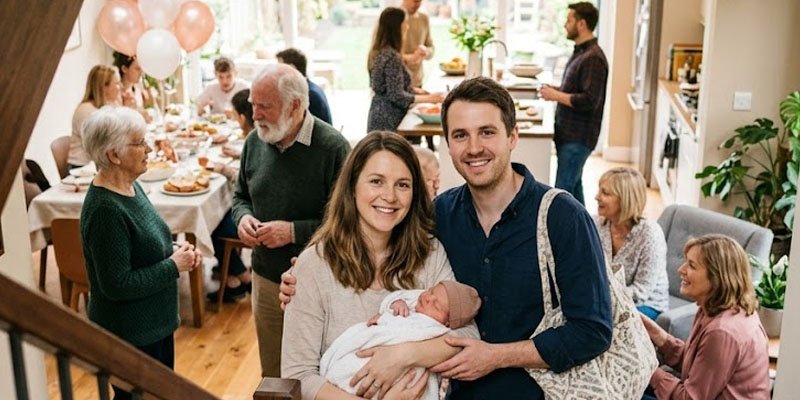
For five seconds, Caleb said nothing.
Five seconds may not sound like much.
But when you have just asked your husband if he intends to leave your home with his father only three days after you gave birth, those seconds feel endless.
Ron was the first to speak.
“Come on, Caleb.”
He let out a dismissive chuckle.
“Don’t let postpartum emotions make this into something it’s not.”
Caleb looked at him. Then he looked at Grace.
Our daughter had fallen asleep again against his chest, even with a room full of quiet adults surrounding her.
He said:
“Dad, leave.”
Ron’s expression changed.
“What?”
“Everyone leaves.”
For the first time that day, I saw genuine surprise on his face.
“You’re serious.”
“Yes.”
“You invited us.”
Caleb swallowed.
“I let you come.”
He glanced in my direction.
“I shouldn’t have.”
Ron’s face reddened.
“So your wife gets upset and now twenty people are being kicked out?”
Caleb answered:
“She had surgery three days ago.”
“She had a baby.”
“She had both.”
Ron dismissed it with a wave of his hand.
“Women have been doing this forever.”
Aunt Melissa walked by him carrying her suitcase.
“And men have been saying that forever too.”
I almost smiled.
Ron turned toward her.
“You’re staying in a hotel because of this ridiculousness?”
“I’m staying in a hotel because it was obvious this room wasn’t ours.”
She looked at me.
“Erin, I’m sorry. I honestly believed you had agreed to the weekend.”
That sentence mattered.
I looked toward Caleb.
He closed his eyes.
Ron said:
“She did agree to it.”
“No,” Caleb said.
Everyone looked at him.
He went on:
“I told Dad I thought she would be okay once we got home.”
My stomach tightened.
Melissa said:
“That’s not what Ron told us.”
Ron snapped:
“Don’t start.”
“What did he tell you?” I asked.
Melissa hesitated.
Then:
“That you knew the family was coming and that you were nervous, but excited about it.”
There was the other version.
I looked around the living room.
At cousins.
Aunts.
Children.
People who had driven for hours.
Several of them now looked embarrassed rather than entitled.
One cousin whispered:
“We thought this was a welcome-home party.”
I believed her.
That realization did not make me any less angry.
It changed the direction of my anger.
Ron had not merely ignored my no.
He had removed it from everyone else’s understanding of what had happened.
Caleb had made that possible by refusing to correct him.
I looked at my husband.
“Did you know he was telling people I agreed?”
“No.”
Ron scoffed.
“Oh, please.”
Caleb turned toward him.
“You told me everyone understood it was a surprise.”
“It was.”
“You told them Erin knew?”
“I told them she’d be fine.”
“That’s not the same thing.”
Ron gave a bitter laugh.
“Now words matter?”
Caleb’s expression changed.
“Yes.”
That was probably the first genuinely helpful thing he had said all afternoon.
The party ended awkwardly.
There was no dignified way to take apart a family celebration after the newborn’s mother unplugged the karaoke.
People packed food into foil trays.
Children were collected.
Someone gathered the coats.
Caleb reserved three hotel rooms near Richmond for the relatives who had been drinking.
Two families headed home.
Melissa and Joe took their luggage out of the guest room themselves.
She found my postpartum basket inside the hall linen closet.
She brought it back to me without saying a word.
That small act nearly brought me to tears.
Forty-five minutes after I unplugged the speaker, the house was empty except for Caleb, Grace, and me.
The silence felt incredible.
I could hear the refrigerator humming. I could hear Grace breathing. I could hear my own body finally admitting how completely exhausted I was.
Then I noticed the mess.
Plates.
Cups.
A sticky kitchen floor.
Half of a sheet cake.
Empty cans.
Furniture moved around.
I looked at Caleb.
He immediately said:
“I’ll take care of it.”
“Not tonight.”
“What?”
“You’re not cleaning up after a party until two in the morning and then being exhausted when Grace wakes up.”
He nodded.
“Okay.”
“Throw out anything that smells. Put everything else in the garage.”
“Okay.”
“I need my recovery room back.”
“Okay.”
“And I need you to stop saying okay as if that ends the conversation.”
He stopped.
That was the first moment we were truly alone with the consequences of what he had done.
Caleb put Grace in her bassinet after moving it downstairs.
Then he helped me get comfortable in the recliner.
He brought me water.
My medication.
A blanket.
Everything he should have been doing from the moment we first walked through the door.
Then he sat on the floor.
“I messed up.”
“Yes.”
“I thought Dad would have lunch.”
I stared at him.
“You moved my bassinet upstairs.”
He closed his eyes.
“I knew people were staying.”
“How many?”
“Six originally.”
“And you still didn’t tell me.”
“No.”
“Why?”
His answer took a long time.
“Because I knew you’d say no.”
At least he was telling the truth.
“Then why did you say yes?”
He rubbed both hands over his face.
“Dad had already told people. Melissa had taken Friday off. The Tennessee family had a hotel cancellation deadline. Everyone was excited.”
I almost laughed.
“So all those decisions were made before mine.”
“Yes.”
“And somehow my decision became the inconvenient one.”
Caleb stared down at the floor.
“Yes.”
There it was.
Not malicious. Not complicated.
Avoidance.
His father had created momentum.
Caleb decided it was easier to let that momentum roll over me than to stand in front of it.
“I thought once you saw everyone,” he said, “you might be happy.”
“I told you what would make me happy.”
“I know.”
“Quiet.”
“I know.”
“Rest.”
“Yes.”
“One week before people came through the house.”
“Yes.”
I looked at him.
“You didn’t misunderstand me.”
“No.”
That difference mattered more to me than his apology.
He had understood me.
He simply believed disappointing his father would have worse consequences than disappointing me.
“I need you to correct the family story,” I said.
“What do you mean?”
“Tonight.”
I handed him his phone.
“You tell them I did not approve that party.”
He looked uncomfortable.
Good.
“You tell them I didn’t change my mind after everyone arrived.”
He nodded.
“You tell them you knew I wanted no overnight guests and agreed anyway.”
His expression tightened.
“That’s going to make Dad angry.”
I stared at him.
He gave a quiet, embarrassed laugh.
“Right.”
Then he began typing.
He showed me the message before sending it.
I made him change one sentence.
His first draft said:
Things got out of control.
I deleted it.
“No.”
“What?”
“They didn’t get out of control.”
I handed the phone back.
“You made a choice.”
Caleb rewrote it.
Family — today was my mistake. Erin had clearly asked for a peaceful first week and no overnight guests. I agreed to people coming anyway because I didn’t want to disappoint Dad and believed we could make it work once she was home. Erin did not approve of the party and did not suddenly change her mind today. I placed her in an unfair situation when she had just returned home from surgery with our three-day-old daughter. Please give us space until we invite visitors.
He sent it.
Ron replied within thirty seconds.
Unbelievable.
Then:
Hope you remember who was there for you when you need family.
Caleb stared at the message.
I remained silent.
He put his phone face down.
For the next week, no one from his family came to visit.
It was the quietest seven days our house had experienced since we bought it.
And I needed every one of them.
Recovery was not glamorous.
I moved slowly.
Getting out of bed hurt.
Feeding Grace seemed to take forever.
Some nights she slept in stretches long enough to make us hopeful, then apparently remembered she was a newborn and abandoned the idea completely.
Caleb took care of almost everything else.
Diapers. Laundry. Meals. Washing bottles. Bringing me water. Keeping track of medication.
Taking Grace after feedings so I could rest.
Not because he deserved praise for being a parent.
Because there was finally no audience around to make caregiving look like a celebration.
At three in the morning, family support looked different.
No balloons. No karaoke. No crowd competing to hold a quiet, sleeping baby.
It looked like Caleb changing a diaper beneath a dim light while Grace cried and I fought against breaking down from exhaustion.
One night he whispered:
“I think I finally understand why that party was ridiculous.”
I looked at him.
“You understand now?”
He winced.
“Bad choice of words.”
“Yes.”
He corrected himself.
“I understand it better.”
That I believed.
Ron did not apologize.
Not that week.
Not the week after either.
He told Caleb that I had “turned the birth into a control issue.” He told Sherry that he felt like he needed an appointment just to meet his own granddaughter. He told at least one cousin that young parents had become “nervous around family.”
I stopped listening to the updates.
If Ron needed me to appear unreasonable so he could remain reasonable in his own version of events, that was something he would have to deal with.
At two weeks postpartum, Sherry texted me directly.
Not through Caleb.
Would Thursday at 2 be okay if I visited for about an hour? Just me.
I said yes.
She arrived at 1:58.
She rang the doorbell.
That sounds almost absurdly insignificant.
But before Grace was born, Ron and Sherry had always used the keypad code whenever they came over.
I noticed the bell.
Sherry washed her hands.
Asked whether she could hold Grace.
Stayed for fifty minutes.
Then said:
“I’m going to leave before you have to ask.”
I almost cried again.
Not because she was perfect.
Because she had noticed.
Ron refused to visit under “conditions.”
His decision.
Five weeks passed.
Then six.
He saw pictures in the family group chat.
Nothing more.
Caleb struggled with it.
I could tell.
His father had always been the center of his family.
The person who set Thanksgiving schedules, vacation houses, tailgate plans, and decided which cousin needed help moving.
Caleb was learning that boundaries sometimes meant losing someone’s approval.
That consequence belonged to him.
Not me.
At seven weeks, Ron texted me.
Not Caleb.
Me.
Can I come see Grace Saturday?
No greeting. No apology.
Still, he had asked.
I replied:
2:00 works. Please text before you leave.
His response:
Fine.
Saturday at 1:42:
Leaving now.
At 2:03, the doorbell rang.
Ron stood outside holding a stuffed rabbit.
He looked uncomfortable.
So did I.
For a moment, neither of us moved.
Then he said:
“I still believe the party had good intentions.”
I almost closed the door.
Instead, I replied:
“Intent wasn’t the part I needed you to change.”
His jaw tightened.
“I’m not apologizing for loving my granddaughter.”
“I never asked you to.”
He looked confused.
That was the entire issue.
In Ron’s mind, love and access were still tied together.
If I restricted one, he assumed I was rejecting the other.
I stepped aside.
“You can come in.”
He entered.
He no longer had the keypad code.
Caleb had changed it the morning after the party.
Ron noticed.
Of course he did.
He said nothing about it.
Grace was awake in her bassinet.
Ron slowly walked toward her.
He looked at me.
“Can I pick her up?”
There it was.
Three simple words.
Can I?
Not complete understanding.
Not a completely transformed man.
Action.
I nodded.
“Yes.”
He held his granddaughter for nearly forty minutes.
She slept through most of it.
Nobody sang.
Nobody passed her around. Nobody made a schedule.
When she began fussing, Ron instinctively rocked her.
Then he looked at me.
“She hungry?”
“Probably.”
He handed her back.
No argument.
That was enough for one afternoon.
Caleb and I began counseling after my six-week postpartum checkup.
Not because our marriage was falling apart.
Because I refused to let what happened become one of those family stories people eventually retell as:
Remember when Grandpa planned that huge welcome-home party and Erin got upset?
No.
The story was never really about a party.
It was about Caleb believing my clearly stated boundary could be pushed aside because enough people had already made plans.
That needed to be repaired.
Eventually, he understood that.
Not because of one conversation. Because of repeated choices.
The following Thanksgiving, Ron asked Caleb whether we were staying for four days.
Caleb said:
“We can do Thursday afternoon.”
Ron pushed back.
Caleb did not look toward me and ask whether I could compromise.
He simply repeated:
“Thursday afternoon.”
I heard the conversation from the kitchen.
I smiled.
Months earlier, my husband would have waited for me to become the difficult one.
This time, he took responsibility for the answer.
Grace was eight months old by then.
Healthy.
Loud.
Completely uninterested in the family mythology surrounding her arrival.
One rainy afternoon, I opened the hallway closet looking for winter blankets.
Behind them was the old sheet of paper Ron had taped to the refrigerator.
BABY RELIEF CREW.
Caleb must have put it there while cleaning up after the party.
Names. Times. Midnight.
People assigning themselves time with my three-day-old daughter as though motherhood were a shift someone needed to take away from me.
I held the page for a moment.
Then Grace began calling loudly from the living room because a stacking cup had rolled underneath the sofa.
I walked over.
Picked it up.
Handed it back.
She smiled as though I had just performed a miracle.
I went back to the closet and put the old schedule into the recycling.
Not because I wanted to erase what happened.
Because I no longer needed that piece of paper as proof that it had happened.
The evidence existed everywhere else.
In a keypad code controlled only by Caleb and me. In relatives texting before visiting. In a father-in-law who still disagreed with me but now rang the doorbell.
And in a husband who had finally learned that supporting his wife did not mean managing her reaction after someone ignored a boundary.
Sometimes it meant standing beside that boundary before anyone crossed it.
Three days after giving birth, I came home believing I was too exhausted to push back.
Ron had expected that.
So had Caleb.
They were right about one thing.
I was exhausted.
I simply discovered that exhaustion had not taken away my voice.