
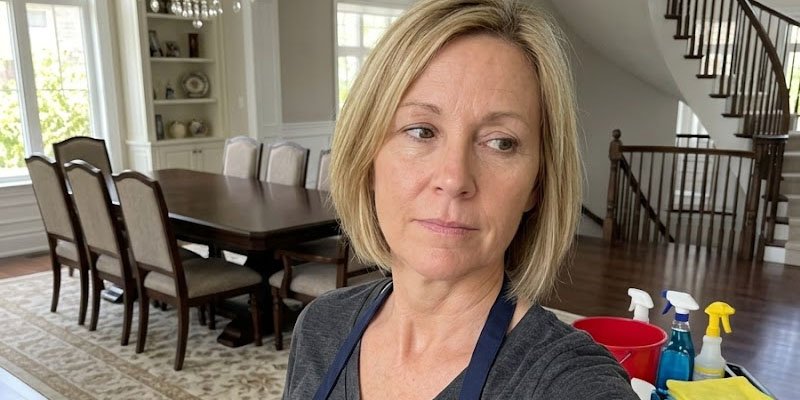
I cleaned the same woman’s house every Thursday for eight years. Then, shortly before she moved away, she asked me to return one last time. But she made one unusual request.
“Don’t bring your cleaning supplies.”
I assumed she wanted to give me some old dishes or furniture before the movers arrived. Instead, she showed me something she had been secretly keeping for eight years. And it would change my daughter’s future.
The first time Margaret Whitaker called me, I was standing in a grocery-store parking lot in the rain, crying while clutching a bag of frozen peas. The peas weren’t the issue. The real problem was that I had forty-one dollars in my checking account, a nine-year-old daughter waiting in the car, and a husband who had left three weeks earlier. He had even taken our best vacuum cleaner. Of all things. I was trying to build a cleaning business, and he knew it.
That afternoon, I had driven all over town, taping handwritten cards onto bulletin boards at the library, laundromat, coffee shop, and grocery store. Every card read:
HOUSE CLEANING. Honest. Reliable. Thorough. References available. Call Carly.
My references were two neighbors and my former boss from the dental office where I had worked before my daughter Willa was born. It wasn’t much, but it was truthful.
My phone rang while I was putting groceries into the trunk. I nearly let it go, but then I answered.
“Hello?”
“Is this Carly? The house cleaner?”
The voice belonged to an older woman. Precise, composed, self-assured.
“Yes.”
“My name is Margaret Whitaker. I saw your card at the library. I have a four-bedroom house on Linden Street. I need someone once a week. Are Thursdays available?”
At that moment, every day was available. I would have cleaned her house at three in the morning if she had asked, but I tried to sound professional.
“Let me check.”
I stood there in the rain, pretending to look over an imaginary calendar.
“Yes. Thursdays are open.”
“Good. Come tomorrow at ten.”
Then she stopped.
“You’re crying.”
I went still.
“I’m sorry?”
“It’s raining too. I can hear it.”
Another silence.
“Ten tomorrow. 418 Linden Street. Blue door.”
Then she ended the call.
When I got back into the car, Willa looked up from her library book.
“Who was that?”
“A woman who might give us our first real cleaning job.”
“Is she nice?”
I thought about her voice and the way she had realized I was crying without making me explain myself.
“I don’t know yet. Maybe.”
The house on Linden Street was enormous compared with anything I had ever cleaned. Built in the 1920s, it had white columns, a broad porch, a blue front door with a brass pineapple knocker, and a massive oak tree in the yard. Margaret opened the door before I even had a chance to knock. She was around seventy, petite and straight-backed, with short white hair, reading glasses dangling from a silver chain, gray trousers, a navy cardigan, and pearl buttons. She looked like someone who had spent her entire life expecting people to be punctual.
“Come in, Carly.”
She showed me around the house: the long wooden hallway, the living room with an old piano, the formal dining room, the enormous black-and-white tiled kitchen, four bedrooms, three bathrooms, and a claw-foot bathtub.
“My husband and I bought this house in 1971. We raised our daughter Susan here. She lives in Oregon now.”
She stopped.
“My husband died two years ago.”
Then she continued walking.
“The house is too big for one person.”
“Are you planning to move?”
“No.”
She looked at me.
“I’m too stubborn.”
We eventually reached the small round table beside the kitchen window. Margaret sat down. I remained standing.
“I’ll pay you one hundred dollars every Thursday. Nine until two. I’ll leave a check on the counter.”
One hundred dollars each week. Four hundred a month. It wouldn’t fix everything, but it meant groceries, electricity, maybe part of the rent. It was a start.
“That would be wonderful.”
She opened a drawer and pulled out a brass key.
“You’ll need this. I’m usually out on Thursdays. Bridge. Volunteer work. Errands.”
She extended it toward me.
“Don’t lose it.”
I looked at the key.
“You don’t know me.”
“I called your references.”
She peered at me over her glasses.
“Your old boss said you once drove forty minutes to return a wallet a patient had left in the waiting room. Your neighbor said you watched her dog for two weeks and refused payment.”
Then she added:
“And people intending to steal from you usually don’t apologize for crying.”
I didn’t know how to respond.
“Thank you, Mrs. Whitaker.”
“Thursday. Nine o’clock.”
That first Thursday, I arrived at 8:40 and sat in my car for twenty minutes because I didn’t want to appear too eager. When I went inside, there was a note on the kitchen counter, written in flawless cursive on cream-colored paper.
Carly — Supplies are under the sink. Do not use bleach on the kitchen floor. It’s original. Guest towels are white with blue stitching. Mine are plain gray. Please don’t move the photographs on the piano. — M.W.
I followed that note as if it were law. I scrubbed grout, baseboards, doorframes, bathrooms, even the inside of the oven. When I dusted the piano, I carefully lifted every photograph and put each one back exactly where the dust marks showed it had been.
At noon, I sat in my old Honda and ate a peanut-butter sandwich. I could have eaten inside the kitchen, but it didn’t feel appropriate. It was her kitchen. I was the cleaner. So every Thursday, for eight years, I ate lunch in my car.
Margaret returned shortly after one that first day. She walked through the house, ran one finger across the piano, inspected the bathroom, and opened the oven. She stared inside for several seconds before closing it.
“Thank you, Carly.”
That was all. But I drove home sitting a little taller.
For nearly a year, we hardly spoke. Every Thursday brought another note.
The back window sticks. Don’t force it.
Susan is visiting. Please prepare the blue bedroom.
There’s soup in the refrigerator if you want some.
I never ate the soup. I assumed she was simply being polite. Eventually, I began leaving notes too.
Mrs. W — Out of dish soap. Bought more. Receipt under the salt shaker. — C.
Mrs. W — Kitchen faucet is dripping. Probably needs a washer. — C.
Mrs. W — Found a pearl earring under the sofa. It’s in the dish by the door. — C.
Sometimes she was home. On those days, she would quietly sit with a book while I worked. Once, she asked:
“How is your daughter?”
“She’s good. Fourth grade now.”
“What does she like?”
“She draws houses.”
Margaret looked interested.
“Houses?”
“Floor plans mostly. Where the rooms should go. She says she wants to design houses one day.”
“That’s a good ambition.”
Then she went back to reading.
The first winter, Willa’s school closed because of snow. I had nobody to look after her. My mother lived hours away, my friends were working, and my ex-husband was, as usual, “busy.” So I called Margaret.
“I’m sorry. Would it be all right if I brought Willa tomorrow? She’ll stay quiet. I promise.”
There was a pause.
“Bring her.”
The following morning, I seated Willa at the kitchen table with a book and sketchpad. She promised she wouldn’t move. Margaret came in and looked at her.
Willa pushed her glasses higher on her nose.
“I like your house. It has a lot of windows.”
“It does.”
“How many?”
Margaret thought for a moment.
“I honestly don’t know.”
Willa’s eyes grew wide.
“Can I count them?”
I immediately said:
“No. You promised to stay in that chair.”
But Margaret looked at Willa and then at me.
“She can count them.”
So Willa spent the day walking around the house with her sketchbook. She counted every window and drew every room: the kitchen, the piano, the claw-foot bathtub. When she finished, she placed the drawing on the table.
“Forty-two windows.”
Margaret studied the picture.
“And one attic window is broken. There’s a bird’s nest in it.”
Margaret continued staring at the drawing.
“You can keep it,” Willa said.
Margaret’s voice became softer.
“I’d like that very much.”
I assumed the drawing would eventually be tucked away in a drawer. I was wrong.
Life continued. My cleaning business expanded. I gained more clients, but Thursdays always belonged to Margaret. She wasn’t my wealthiest client or my best-paying one, but she never canceled. Not once. Even when she traveled to Oregon to visit Susan, she still left the weekly check.
Please come as usual. The plants need water and the house needs someone in it.
At the time, I assumed she meant someone needed to make the house appear occupied. Years later, I understood what she meant.
My divorce became final. My ex moved away. Willa slowly stopped asking when he would come to see her. Then, during my third year cleaning Margaret’s house, Willa had a serious asthma episode. We spent the night in the emergency room. Three weeks later, the medical bill arrived. It was more than I earned in two months.
That Thursday, Margaret found me mopping the kitchen.
“Is Willa all right?”
I stopped.
“How did you know something happened?”
“You’ve mopped that same square three times.”
I looked down. She was right. So I told her. Margaret didn’t pity me or offer me money. She simply said:
“I’m glad she’s okay.”
Then she added:
“Carly, you’ve worked here three years. You can call me Margaret.”
“I don’t think I can.”
For the first time, she almost smiled.
“All right. Mrs. Whitaker it is.”
The next Thursday, my check was no longer $100. It was $125. Her note contained only:
Cost of living.
She never mentioned the raise again.
During our fourth year together, everything changed. I arrived one F




