
The Farewell My Son-in-Law Tried to Hurry
My thirty-six-year-old daughter, Claire Whitmore, had always been the healthiest person in our family—the sort of woman who carried groceries for elderly neighbors, took a three-mile walk before breakfast, and remembered everyone else’s doctor appointments before making time for her own.
That was why, when her husband phoned shortly after two on a Friday morning and told me she had unexpectedly collapsed in their bedroom, I found it difficult to process his words.
Claire had experienced occasional heart flutters during the month before, but her cardiologist had regarded them as minor.
She had worn a small monitoring patch for ten days, and the initial readings had shown nothing particularly alarming.
Yet by sunrise, her husband, Evan Whitmore, had already begun making arrangements for her cremation.
There would be no independent examination, no second medical opinion, and barely any time for family members to say goodbye.
Whenever anyone questioned why everything was happening so quickly, Evan calmly repeated the same explanation.
“Claire told me she wanted to be cremated. I’m honoring my wife’s wishes.”
I had worked for twenty-eight years as a respiratory therapist at a major Milwaukee hospital. I knew a heart could stop for many different reasons, but saying “her heart stopped” was not an explanation. It only described the final event.
When I asked Evan to postpone the cremation, he refused.
“The physician already signed the paperwork, Margaret.”
“A physician who wasn’t treating her.”
“Dr. Nolan has known my family for years.”
“But he barely knew Claire.”
Evan’s face became tense.
“Please don’t turn this into another one of your hospital investigations. Our daughter needs peace, and so do I.”
Our daughter. He was referring to eight-year-old Lily, my granddaughter, who had said only a few words since her mother died.
On the morning of the service, Lily sat beside me on the drive to the funeral home, clutching a stuffed fox Claire had given her years earlier.
Halfway there, she placed one tiny hand against my wrist.
“Grandma, Mommy is crying.”
I looked over at her, thinking she meant she was remembering Claire.
“What makes you say that, sweetheart?”
Lily continued looking straight ahead.
“She says Daddy is going to burn the truth.”
My hands tightened slightly around the steering wheel.
“What truth?”
Lily touched the side of her neck and whispered, “She says you need to look.”
Children experiencing grief can express memories in unusual ways, so I chose not to question her any further. I simply assured her that she was safe with me and kept driving, even though a quiet feeling of warning had begun taking root inside me.
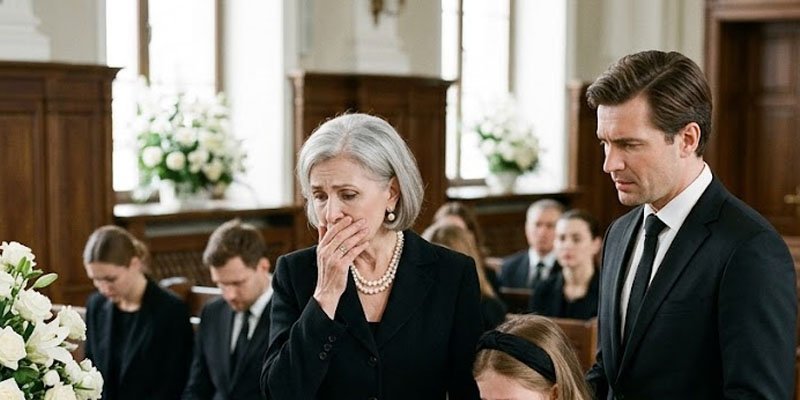
At the funeral home, Evan stood beside Claire’s open casket in an expensive charcoal suit, greeting visitors with remarkable composure. He seemed to know precisely when to lower his gaze, when to embrace someone, and when to place a hand against his heart.
To everyone else, he looked like a grieving husband doing his best to remain composed.
To me, he looked as though he were watching everyone.
Claire was dressed in a cream-colored, high-necked dress Evan had chosen. She had hated high collars since she was a child, and seeing her dressed in one felt strangely unfamiliar, as though someone had created an imitation of her without remembering the person she actually was.
The cremation had been scheduled for less than two hours after the service.
While the minister was speaking, Lily began trembling beside me.
“Grandma, she says he lied.”
Evan immediately glanced across the aisle.
Lily’s breathing became uneven as she pointed toward her mother.
“She says, ‘Please don’t let him burn me.’”
Before I could rise, Evan spoke firmly.
“Margaret, sit down.”
The entire room went quiet.
I stared at him, disturbed not only by the authority in his voice but also by the timing. I had never told him what I planned to do, yet somehow he seemed to know.
Lily pulled gently at my sleeve.
“Look under Mommy’s collar.”
I moved toward the casket. Evan stepped into the aisle, but the funeral director, Mr. Caldwell, also came closer.
“You’re upsetting everyone,” Evan said.
“I need to see my daughter.”
“Don’t touch her.”
That was the moment I found the determination I had been lacking.
I carefully raised the lace around Claire’s collar. Beneath the cosmetics were several visible marks along the side of her neck, positioned unlike an ordinary medical procedure. Near her hairline was a tiny puncture, while near her collarbone was a pale, irritated square of skin where an adhesive patch seemed to have been removed recently.
A woman standing nearby covered her mouth.
Evan responded almost instantly.
“Those marks happened during the preparation.”
Mr. Caldwell inspected them and shook his head.
“No, sir. They did not.”
Lily began to cry.
“That’s not the truth. He put it lower.”
She pointed toward Claire’s waist.
Evan stepped forward, and for the first time that morning, the carefully controlled sadness vanished from his face. What appeared in its place looked unmistakably like fear.
Mr. Caldwell positioned himself between Evan and the casket while I cautiously lifted only the outer layer of Claire’s dress near her hip. A narrow strip of medical tape had been attached to her skin. Beneath it was a thin plastic module smaller than a credit card.
Evan went pale.
“That has nothing to do with what happened,” he said.
No one had even asked him what the object was.
Mr. Caldwell immediately halted the cremation arrangements and contacted county authorities.
Twenty-five minutes later, Detective Hannah Brooks arrived with two officers. She listened carefully, examined the concealed object, and ordered Evan to move away from the casket.
He asked for an attorney and argued that, as Claire’s husband, he had control over the arrangements. None of it changed what happened next. Claire was taken to the county medical examiner, and the device was placed inside an evidence bag.
Mr. Caldwell recognized it before anyone else.
“That appears to be the recorder from a cardiac monitoring patch.”
Claire’s monitoring patch.
The very same one Evan had claimed had fallen off several days earlier.
That evening, Detective Brooks confirmed the serial number. The device belonged to Claire, and technicians believed that most of its stored information could still be recovered.
Evan had apparently arranged for it to disappear with her before anyone could discover what it might contain.
And somehow, Lily had remembered precisely where he had hidden it.
The Little Girl Who Remembered
Lily came home with me that evening carrying a single backpack, two pairs of pajamas, her stuffed fox, and a silver bracelet Claire had given her for her eighth birthday.
As I put her to bed, she asked the question I had been dreading.
“Is Daddy angry because I told you?”
“You didn’t do anything wrong.”
“He looked angry.”
“Whatever your father feels is his responsibility. It isn’t your fault.”
She pulled the blanket up beneath her chin.
“Mommy wanted me to tell.”
I stayed beside her.
“When you say Mommy talks to you, do you actually hear her voice with your ears?”
Lily considered the question carefully before placing her palm over her chest.
“No. I hear her here, when I remember her face.”
I didn’t challenge what she said. Children often turn fear and memories into words they can understand.
Whatever was happening inside Lily, I would not let anyone take advantage of it or turn her into some kind of public curiosity.
The next afternoon, Detective Brooks arrived with a child interviewer named Rebecca Sloan. I was not allowed inside the room, which I understood, although waiting in the kitchen for nearly an hour felt unbearable.
When they finished, Rebecca told me Lily was frightened but had expressed herself clearly. Detective Brooks then asked whether Claire had ever told me she was afraid of Evan.
My immediate answer was no.
Then I remembered Thanksgiving.
Claire and I had been washing dishes while Evan watched football in the den.
Without turning toward me, she had asked, “Mom, if your husband lied about money, how much would it take before you stopped trusting him?”
“What kind of money?”
“Enough to change the way you see him.”
When I asked if she meant Evan, she smiled too quickly.
“No. It’s about someone I know.”
At the time, I had believed her explanation. Now I told Detective Brooks everything.
Three days later, preliminary medical findings established that the marks around Claire’s neck had been present before she became unresponsive. The small puncture had also occurred earlier, and testing showed that medication had been introduced through it.
None of the medications appeared in Claire’s medical records.
The monitoring device revealed even more.
Evan had claimed Claire suddenly collapsed around 1:10 a.m. and that he immediately called emergency services. The recovered information showed that her heart rhythm had remained generally normal through most of the evening.
At 12:07 a.m., the device recorded unusually intense physical movement.
After that, her heart rate changed gradually instead of stopping without warning.
The emergency call was made at 1:28.
That was eighteen minutes later than Evan had claimed.
Investigators also obtained footage from the funeral home.
On the afternoon before the service, Evan had requested six private minutes with Claire, saying he wanted to leave a letter beside her. A camera captured him entering the preparation corridor carrying a small white object.
He had brought Lily with him, although he later told me she had refused to come.
That was another lie.
Lily told Rebecca that her father had instructed her to wait outside the preparation room. Curious, she eventually went toward the doorway and saw him lifting part of Claire’s dress and attaching something near her hip.
When she asked what he was doing, he crouched in front of her.
“You’re confused because you’re sad.”
“I saw you put something there.”
“No, you didn’t. Mommy had a weak heart, and we are not going to make everything worse by telling stories.”
Only then did investigators understand what Lily had been referring to during our drive. Claire had once explained the monitor to her daughter after Lily decorated a spare adhesive cover with a purple star.
“This is my little truth sticker,” Claire had joked. “If I ever faint, it tells the doctor what my heart was doing.”
To Lily, the meaning was simple.
The patch told the truth.
Her father removed it. Her father hid it.
Then he intended for it to disappear.
Claire had not literally spoken to Lily during our drive to the funeral home, but the lesson she had once taught her daughter remained clear in her memory.
Using the only language an eight-year-old could find, Lily had delivered her mother’s warning.
The Navy Folder
Two days after the medical meeting, I received a message from an unknown number.
Check the navy folder in Claire’s sewing room before Evan reaches the house.
Detective Brooks told me not to enter the property. Investigators secured the home instead, and by that evening, they had found the folder behind several boxes of fabric.
Inside were loan statements, property records, printed emails, and copies of documents bearing Claire’s signature.
Across one bank statement, she had written in small capital letters:
I NEVER APPROVED THIS.
The transaction involved $312,000 transferred through an account linked to a cottage Claire had inherited from my mother near Door County. The property belonged solely to Claire and was worth more than a million dollars. She called it Lily’s future.
Evan owned a boutique hotel development company called Whitmore Hospitality.
From the outside, the business looked successful, with polished offices, glossy brochures, and ambitious plans for a waterfront hotel complex.
Behind that image, however, the company was nearly $1.9 million short. Construction costs had risen, investors were withdrawing, and the primary lender was threatening to shut down its credit line.
Evan had identified Claire’s cottage as possible collateral. Her signature appeared on two authorization pages, despite the fact that she had never approved them.
Among the papers was an email Claire had sent to a family attorney, Melissa Grant.
I believe my husband used my name on financing documents. I need to stop further transactions without warning him until I understand everything he has done.
The message was dated six days before Claire’s passing.
A handwritten note from her consultation stated:
Do not confront him again until Lily is with Mom.
Claire had intended to bring Lily to my house on Friday.
She never made it to Friday morning.
There was another reason Evan was frightened of that folder. His company had transferred nearly $100,000 to a consulting business run by a woman named Audrey Hayes. Investigators soon learned that Audrey and Evan had secretly been involved for eight months.
Audrey cooperated after learning what had happened. She handed over their messages, including one Evan had sent two nights before Claire’s final night.
Thursday changes everything.
After that, I can breathe again.
Audrey had responded:
Are you finally filing for divorce?
His answer was:
Something like that.
At 12:32 on Thursday night, he wrote:
She’s asleep. This is almost finished.
Audrey asked what he meant. Evan did not respond for more than three hours.
There was also a $2.8 million life-insurance policy. Evan contacted the insurer less than eighteen hours after Claire’s passing and asked how quickly the money could be processed, whether an independent examination was necessary, and whether cremation would affect the claim.
Any one of those details could have had an innocent explanation.
Taken together, however, they began creating a disturbing pattern.
Then investigators traced the medication found during Claire’s medical examination.
A telehealth account had been created in her name three weeks earlier using her birth date, insurance information, and home address. But at the time the account was opened, Claire was speaking at Lily’s school for Career Day. Photographs and a school recording confirmed she had been there.
The account had been created through the internet connection at Evan’s office.
The package was delivered to a private mailbox he maintained and then redirected to his company. His receptionist remembered signing for it and leaving it on his desk.
Later that afternoon, she saw him take the package toward his car.
The password used for the account was LilyBug2018—the same password Evan used for several family subscriptions.
Claire had neither ordered nor collected the medication.
Someone had apparently used her identity to obtain it.
What Happened After Midnight
During Lily’s second interview, Rebecca asked how she knew her father had hidden the monitor.
Lily stared toward the floor for almost a minute.
Then she quietly said, “Because I saw him do things before the funeral, and I saw him with Mommy that night.”
Shortly after midnight, Lily woke after hearing a drinking glass fall in the kitchen. From the stairs, she heard her parents arguing.
“You used my name,” Claire said.
“I was going to replace the money.”
“I already sent everything to Melissa.”
“You’re going to ruin years of work over paperwork?”
“It isn’t paperwork, Evan. You used something that belonged to me and Lily.”
Then Claire said that she and Lily would leave in the morning.
Evan answered, “You’re not taking my daughter away.”
Lily saw him hold Claire’s arm as Claire tried to move around the kitchen island. Frightened by the argument, she hurried upstairs, but several minutes later, after everything became quiet, she returned.
Her mother was lying on the bed with her eyes open. Evan stood nearby, one hand close to her neck and a small reflective object in the other.
Claire looked toward the doorway and noticed Lily.
“Lily… Grandma,” she managed to say.
Evan turned toward the doorway, and Lily ran back to her bedroom, crawled beneath the bed, and eventually fell asleep.
Later, Evan carried her downstairs. He was crying and told her that Claire’s heart had stopped. When Lily asked why her mother had been struggling with him earlier, Evan insisted that she must have had a frightening dream.
The next day, he continued repeating that explanation.
Lily was confused.
Lily was imagining things.
Lily had dreamed it.
But Claire had left evidence of her own.
On the morning before her final night, she had met with Melissa Grant. Melissa recorded consultations with clients’ permission, and Claire’s voice was clearly captured on the file.
“I believe Evan copied my signature.”
“Does he know you discovered it?”
“Yes. I confronted him on Sunday.”
“How did he respond?”
“He said married people sign things for each other all the time.”
“Not without permission.”
“That’s what I told him. Then he said if I brought down his company, he would make sure I regretted it.”
Melissa asked whether Claire felt comfortable returning home.
After a long pause, Claire answered, “Safe enough to get Lily out tomorrow.”
She declined police assistance because she did not believe Evan would go beyond intimidation and financial deception. She wanted a divorce, an investigation into the documents, and some distance between Lily and the turmoil surrounding the company.
Near the end of the meeting, Claire said something that later left everyone who heard the recording silent.
“If Evan ever tells people something happened because of my heart, please ask them to check the monitor.”
She had noticed his unusual interest in the device. He had asked how long it stored information and whether older recordings could still be recovered.
A review of Evan’s laptop showed searches conducted over three weeks:
How long does a wearable monitor store data?
Can cremation destroy electronics?
Can a spouse refuse an independent examination?
How soon can cremation occur after an unexpected passing?
At 11:19 on Thursday night, while Claire was still alive, he searched:
Can deleted heart-monitor data be recovered from internal memory?
Those searches alone did not prove what had happened. But alongside the hidden device, the medication account created without Claire’s knowledge, the disputed financial documents, and Lily’s recollections, they indicated possible preparation in advance.
Even so, Evan’s attorneys argued that Claire might have taken the medication herself, that the marks around her neck could have resulted from an attempt to help her, and that my medical experience might have unintentionally influenced Lily’s memories.
Then investigators found a recording on Claire’s laptop that challenged that explanation.
After noticing Evan entering her sewing room, Claire had installed a security program that automatically saved short webcam recordings whenever the laptop was opened late at night.
At 12:18 a.m., Claire appeared at her desk, visibly distressed but alert. She attached copies of the disputed loan documents to an email addressed to Melissa.
“I’m sending this now,” she whispered.
Evan’s voice came from the doorway.
“What are you doing?”
“Making sure you can’t erase it.”
“What did you send?”
“Everything.”
He stepped into view.
“You have no idea what you’re doing.”
“I know exactly what I’m doing.”
“You’re destroying my company.”
“You did that yourself.”
Claire stood.
“Lily and I are leaving in the morning.”
The desk shifted as Evan moved closer.
“Don’t touch me.”
The clip ended. A second recording started twelve minutes later. The chair was empty, but the microphone captured voices coming from the hallway.
Claire’s voice sounded weak.
“Evan, please stop.”
A child could be heard crying upstairs.
Then Evan said, “You should have let me fix this.”
The Physician Who Trusted the Wrong Man
The physician who signed the preliminary paperwork was Dr. Peter Nolan, a longtime friend of Evan’s family. He was not Claire’s regular doctor and had never reviewed her monitoring data, spoken with her cardiologist, or examined her complete medical history.
He had depended almost entirely on Evan’s account of what happened.
A forgotten camera inside Evan’s vehicle showed how that occurred.
Evan had installed an interior dash camera after a break-in the previous year. It activated whenever the doors opened and automatically uploaded clips following sudden movement. At 1:19 a.m., Evan was sitting in the driver’s seat, breathing heavily while speaking with Dr. Nolan through the vehicle’s audio system.
“Don’t ask questions. I need the cremation paperwork ready in the morning.”
Dr. Nolan replied, “Evan, what happened?”
“It’s done.”
The conversation ended moments later.
Phone records showed that Evan contacted Dr. Nolan at 1:22, six minutes before calling emergency services. Nolan said Evan had told him Claire was unconscious and that he immediately advised Evan to contact emergency responders.
Investigators found no evidence that Nolan had supplied the medication or known in advance what Evan was planning. They did discover, however, that Evan had invested $135,000 in Nolan’s struggling private medical practice. Nolan had failed to disclose that financial connection when he agreed to certify Claire’s passing as a natural cardiac event.
His decision to trust a longtime friend nearly stopped important questions from being raised.
He was not charged in connection with Claire’s passing, but the medical board opened proceedings against him. He eventually admitted that his personal and financial relationship with Evan had compromised his professional judgment, and he lost the practice he had been trying to save.
By then, the county medical examiner had completed her report. Claire’s system contained powerful medication that had not been prescribed to her, and the examination identified evidence of substantial pressure around her neck.
The official conclusion determined that her passing resulted from the intentional actions of another person.
Evan surrendered through his attorney.
The charges included responsibility for Claire’s passing, tampering with evidence, forgery, identity-related financial offenses, and misuse of marital assets.
The court granted me temporary guardianship of Lily.
She continued asking about her father, something some relatives found difficult to understand. But Lily was only eight. Children do not simply stop loving a parent because adults uncover deeply disturbing things about that person.
“Is Daddy being held because I told?” she asked one evening.
“No, sweetheart.”
“Is it because I saw him?”
“No. Your father is facing consequences because of the choices he made.”
“You promise it isn’t my fault?”
“I promise.”
That became the promise I repeated whenever guilt appeared across her face.
The Truth Tested in Court
Six months after his arrest, Evan offered to admit that he had given Claire medication “to calm her,” hidden the monitor, and delayed contacting emergency services. He maintained that he had never intended for Claire to lose her life.
The prosecutor asked whether I would support a reduced charge in return for that admission.
I surprised myself when I answered, “No. I want every piece of evidence heard in court. I want Claire’s truth tested somewhere he cannot hide it under her dress or dismiss it as grief.”
The trial began the following spring.
Lily did not testify in the main courtroom. Her recorded interviews were presented under carefully controlled conditions, while specialists explained why her earliest statements—made before she understood the investigation’s scope—were particularly important.
The defense tried to portray me as an angry mother who had unintentionally led a vulnerable child toward an inaccurate memory.
But the timeline weakened that argument. Lily had identified the location of the hidden monitor before I even knew it was missing. She had described the reflective object before medical testing confirmed the small puncture. She had repeated Claire’s words about going to Grandma’s before investigators found the calendar entry.
The monitoring data matched the broken glass and confrontation Lily remembered. The laptop recorded Claire’s dispute with Evan.
The telehealth records linked him to the medication. His internet searches indicated preparation, while the funeral-home footage documented his attempt to conceal the monitoring device.
His own messages established a possible motive.
His own voice in the car revealed urgency rather than confusion.
After three weeks of testimony, the jury deliberated for eleven hours. When they returned, Lily was at school, and I was grateful for that. I sat beside my son, Daniel, holding the silver bracelet Claire had once given her daughter.
The jury found Evan responsible on every major count.
He showed almost no reaction until the judge mentioned Lily. Then he lowered his head.
At sentencing, I was permitted to speak.
I did not insult him. I did not call him a monster, because monsters belong in fairy tales, while Evan was a human being who had made a series of deliberate choices. Calling him something inhuman would have made it easier to separate those choices from reality.
Instead, I said, “Claire trusted you with her home, her future, and her child. When she discovered what you had done, she tried to leave with dignity. You answered her courage by trying to erase her voice. But you overlooked the one person who understood her better than anyone else inside that house. You overlooked her daughter.”
I looked directly at him.
“Lily remembered.”
What Claire Left Behind
Four years have passed since that morning at the funeral home.
Lily is twelve now. She still keeps the stuffed fox on a shelf, although she pretends it stays there only because I refuse to throw anything away. She attends counseling, plays the cello, and laughs far more easily than she once did.
She understands the broad truth about her father, but we share additional details only when she feels ready. Healing rarely moves in a straight line, especially for a child who loved both parents and lost them in two completely different ways.
Claire’s cottage was preserved. The disputed financing never became a permanent claim against the property, and the remaining money connected to Evan’s company was recovered through civil proceedings. We visit the cottage every summer.
One afternoon on the porch overlooking the water, Lily asked whether I truly believed Claire had spoken to her during our drive to the funeral home.
I considered giving her a practical explanation about memory, fear, and the ways a child’s mind can process overwhelming experiences.
All of that would have been reasonable.
Instead, I asked, “What do you believe?”
Lily watched the sunlight moving across the lake.
“I think Mommy taught me what the monitor meant before she left. Then, when I got scared, I finally understood why she taught me.”
I nodded.
“That sounds right to me.”
She leaned against my shoulder.
“So she didn’t really come back?”
I wrapped my arm around her.
“Love doesn’t always have to come back, sweetheart. Sometimes it leaves something behind that knows exactly where to find us.”
Claire left behind a folder, an email, a recording, a small medical device, and a child brave enough to speak when an adult repeatedly told her she was confused.
But what she truly left behind was much harder to erase.
She left the truth inside Lily’s memory.
And because one little girl refused to forget what she had witnessed, the farewell Evan tried to rush was delayed long enough for Claire’s voice to finally be heard.