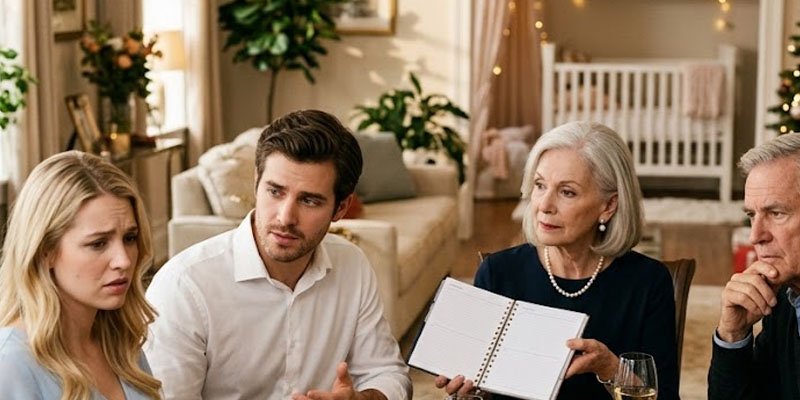
I was eight months pregnant when, over Sunday roast, my husband told me that our daughter already had a name chosen for her.
It wasn’t a possibility. It wasn’t a preference. And it wasn’t something we were apparently supposed to discuss.
A name.
His parents had selected it, printed it on invitations, and embroidered it onto blankets.
It was tied to a reception they had already booked.
And somehow, I was the last person sitting at that table to find out.
The roast beef was still steaming when Garrett placed his fork beside his plate and glanced at me with the careful expression he always wore when he wanted something unreasonable to sound perfectly normal.
“My parents have decided on the name,” he said.
I stared at him for a moment.
“Decided on what?”
Across the table, Evelyn—my mother-in-law—reached beside her plate and slid a cream-colored notepad in my direction.
Her handwriting was neat, elegant, and unmistakably intentional.
At the top, underlined twice with blue ink, were two words.
Gertrude Agnes.
Underneath them was a list.
Announcement cards. Embroidered blankets. Flowers.
A family reception. A photographer. A church gathering.
Even a cake order.
I silently examined the page in front of me.
“You already ordered all of this?”
Evelyn gave me a gentle smile.
It was the kind of smile people use when they believe they are patiently dealing with someone difficult.
“We wanted everything ready before she gets here.”
I turned to Garrett.
For seven months, Garrett and I had been talking about our daughter’s name.
We had a shared list saved on my phone.
Charlotte. Lila. Claire. Eleanor. Rose.
Sometimes, late at night, Garrett would place his hand on my stomach and throw out ridiculous names just to make me laugh.
“Princess Lasagna.”
“No.”
“Garretta?”
“Absolutely not.”
“Thor?”
“She’s a girl.”
“Girls can be Thor.”
Those moments had felt like they belonged to us.
Private. Tender.
They had felt like proof that we were becoming parents together.
Now my husband could hardly look me in the eye.
“It matters a lot to them,” he said.
“That still doesn’t answer my question.”
He let out a quiet sigh.
“Stella, there’s no reason to turn this into a major issue.”
I placed my hand over my stomach.
Our baby shifted beneath my palm.
“So everybody discussed my daughter’s name except me?”
No one answered.
Garrett’s father, Martin, all at once became fascinated by his mashed potatoes.
Evelyn straightened her napkin.
Garrett leaned back.
“It’s a family name.
They’ve already told people.”
Something inside me all at once went entirely still.
“They’ve already told people?”
“Yes.”
“So that means it’s decided?”
“That isn’t what I said.”
“It’s precisely what you said.”
Evelyn breathed in.
“Stella, nobody is trying to upset you.”
I faced her.
“Then why am I learning this after invitations were ordered?”
Her expression tightened for less than half a second.
“You’ve been tired recently.
We didn’t want to overwhelm you.”
There it was—the excuse.
Pregnancy.
The convenient excuse to leave me out of decisions concerning my own child.
I could feel all three of them watching me.
Waiting for my reaction.
They expected me to be angry.
Maybe tears.
Maybe even a scene.
Afterward, Garrett could say I was only reacting because I was hormonal.
Evelyn could tell everyone she had simply been excited about her first granddaughter.
Martin could shake his head and say I was being too sensitive.
Then I realized something.
If I argued, they would make my reaction the issue instead of confronting what they had done.
So I smiled.
I neatly folded my napkin.
Placed it beside my plate.
And spoke a single word.
“Okay.”
Evelyn relaxed at once.
Garrett silently picked up his fork again.
Martin cleared his throat and reached for the gravy.
They believed I had given in.
That was their first mistake.
Because this story had began long before that Sunday dinner.
For months, decisions about my pregnancy had been made around me instead of with me.
At first, the decisions seemed minor.
Evelyn brought curtains for the nursery although I had already selected some.
“These are more traditional,” she said.
She replaced the lamp.
Then the rug.
One afternoon, I returned from work and discovered three pieces of wall art gone.
A wooden moon.
Two watercolor prints.
And a mobile I had spent half of Saturday choosing.
Garrett stood at the kitchen island checking his phone.
“Where are the nursery decorations?”
He glanced up.
“Mom thought the room seemed too modern.”
I glanced at him steadily.
“She took them?”
“She put them in the garage.”
“And you allowed her?”
He exhaled.
“She’s excited, Stella.”
That became his answer to everything.
She’s excited.
When Evelyn began a private family chat about my baby shower without adding me.
She’s excited.
When she told relatives they could visit during my first week home without asking me.
She’s excited.
When she ordered a christening gown although Garrett and I had never discussed baptism.
She’s excited.
When she began calling the nursery “Gertrude’s room” before anyone had ever explained that name to me.
I noticed that one.
But when I questioned Garrett what she meant, he shrugged.
“Probably one of her family traditions.”
I should have pushed the issue further.
Instead, I trusted what he told me.
That became a mistake I would remember for a long time.
in time, I stopped arguing about each separate incident.
I began keeping records of them.
Not because I was preparing for some dramatic confrontation.
At least, not yet.
I simply needed to reassure myself that I wasn’t imagining what was happening.
I kept nursery receipts.
Saved household statements.
Screenshotted family messages about plans I had never approved.
I recorded dates.
Then, one Friday afternoon, something appeared on the tablet we shared.
Garrett was outdoors washing his car.
I was replying to emails at the kitchen table when a notification appeared across the screen.
DEPOSIT CONFIRMATION
Normally, I would have ignored the notification.
But the amount caught my eye.
$4,850.
I opened the email.
A private event venue had received a deposit for a celebration planned six weeks after my due date.
I opened the attached invoice.
At the top, in elegant script, appeared the words:
WELCOME, GERTRUDE AGNES WHITMORE
My stomach sank.
The venue. The flowers. The catering. The guest count.
Seventy-two people.
I continued scrolling.
Personalized place cards.
Custom napkins.
A photo backdrop.
Cake.
Everything revolved around a baby whose mother had never accepted the name written on the invoice.
For several moments, I stood motionless in the kitchen.
Then I heard Garrett laughing outside.
I printed out the invoice.
Folded it up.
Slipped it into a plain folder inside my desk.
And I made a decision.
The next morning, I called the hospital where I planned to give birth.
I questioned about newborn paperwork.
Who completed it.
When it was filed.
Whether visitors or grandparents had any role. Whether anyone besides the parents could give staff instructions about the child’s legal name.
The woman answered calmly.
Then she told me something important.
“The birth registration worksheet is normally completed by the parents after delivery, but the person who gave birth can request privacy and indicate that registration decisions are not to be discussed with visitors.”
“Even family?”
“Visitors have no authority over your medical records or the newborn registration.”
I wrote that information down.
Then I questioned again.
Just to make absolutely certain.
Her answer remained the same.
Before we ended the call, she transferred me to patient services.
By that afternoon, I had obtained a preliminary newborn information packet and a hospital privacy request.
One page was especially important.
I filled it out.
Folded it up.
Put it inside my purse.
And told no one.
When I got home, Garrett was standing in the nursery with a white blanket in his hands.
The name
Gertrude
had been stitched across one corner with gold thread.
“Mom says the rest will be finished by Tuesday.”
I glanced closely at the blanket.
Then at him.
“They’re certainly making a lot of plans.”
He smiled.
“It’ll all work out.”
I nodded.
“Yes.”
Then softly, I added:
“I think it will.”
Over the next several weeks, the packages kept arriving.
Custom bibs.
Monogrammed towels.
Silver infant spoons.
A wooden memory box.
Every item carried the initials
G.A.W.
No one questioned what I believed.
And by Sunday dinner, Evelyn spoke about Gertrude Agnes as if the child had already arrived and been baptized.
That was why I answered “Okay.”
Because sometimes people reveal far more when they think you have stopped resisting.
After dinner, Garrett and I drove home in almost complete silence.
He glanced relieved.
“You handled tonight really well,” he eventually said.
I turned toward the window.
“What is that supposed to mean?”
“You didn’t make things uncomfortable.”
I almost laughed.
“Good to know.”
He entirely failed to catch the sarcasm.
When we arrived home, I went upstairs.
Twenty minutes later, I heard him on the phone with Evelyn.
“They’re finally getting everything exactly the way they want,” he told her.
I stood inside my office holding the envelope in my hand.
For the first time in months, I felt entirely calm.
Three weeks later, at 12:47 in the morning, I woke with sudden pain tightening across my lower back.
I at once sat up.
Garrett stirred.
“You okay?”
“I think so.”
Then another contraction arrived.
Fourteen minutes later, another.
By 3:00 a.m., the contractions were eight minutes apart.
Garrett instantly went from sleepy husband to anxious first-time father.
“Should we leave now?”
“No.”
“Are you sure?”
“Yes.”
“Should I call Mom?”
“Absolutely not.”
He called her anyway.
By the time we reached the hospital, Evelyn already knew.
Martin knew.
Apparently half of their family knew.
I was in labor for sixteen hours.
Sixteen exhausting hours of pain.
Exhaustion. Fear.
Ice chips. Monitors. Nurses.
Garrett tried being supportive, but every twenty minutes his phone buzzed.
Evelyn.
at last, during a contraction so intense it made the room spin, I grabbed his wrist.
“Turn it off.”
“What?”
“The phone.”
“But Mom—”
“Garrett.”
Something in my expression stopped him.
He switched it off.
At 7:18 that evening, our daughter came into the world screaming.
For a while, everything else disappeared.
All the frustration.
All the arguments.
All those ridiculous blankets and invitations.
The nurse gently placed her against my chest.
She had dark hair pressed against her tiny head.
A wrinkled forehead. A perfect nose.
And the tiniest hand I had ever seen.
When her tiny fingers curled around mine, I cried.
Not silently. Not gracefully.
I sobbed.
Garrett cried too.
For several minutes, we were simply two stunned, grateful people staring at the tiny human we had created.
“I love her,” he whispered.
“So do I.”
For one fragile moment, I thought perhaps everything could still be okay.
Then Evelyn went in.
She went in carrying flowers in one hand and the embroidered blanket in the other.
“Oh, there’s my Gertrude.”
My whole body went rigid.
The nurse glanced toward me.
Garrett noticed at once.
“Mom, maybe not right now.”
Evelyn barely listened to him.
She moved closer.
“Look at her!
She looks exactly like Garrett did.”
Then she opened the blanket.
Gold thread shimmered beneath the hospital light.
GERTRUDE AGNES
I glanced down at my newborn daughter sleeping against my chest.
And whatever uncertainty I had left disappeared.
Later that evening, a hospital employee entered carrying the newborn registration paperwork.
She spoke softly.
“I understand you had some instructions on file.”
“Yes.”
Garrett was across the room speaking with his parents.
The woman passed me the form.
I glanced at the section labeled:
CHILD’S NAME
My hand trembled.
Not because I had doubts.
Because I at last realized how much this moment mattered.
I picked up the pen.
And wrote:
LILA ROSE WHITMORE.
Lila had been the first name Garrett and I had both loved months before.
Rose was my grandmother’s name.
The woman checked the form.
Then she glanced at me.
“Lila Rose?”
I smiled.
“Yes.”
After she left, Evelyn went over.
“Did you finish the papers?”
“Yes.”
“Good.
I hope you remembered Agnes has one ‘g.’
People always make mistakes.”
I glanced straight at her.
“There won’t be a problem.”
The next morning, a nurse came in to verify the information.
Garrett was beside my bed.
Evelyn and Martin were standing near the window.
The nurse smiled.
“Good morning.
I just need to confirm the newborn registration for
Lila Rose Whitmore
.”
No one answered.
Garrett went entirely still.
Evelyn’s face went blank.
Martin glanced down at the floor.
Garrett slowly turned.
“What did she say?”
The nurse at once noticed the tension.
“I can come back.”
“No,” Evelyn said sharply.
I glanced directly at her.
The nurse did the same.
Evelyn corrected herself.
“I mean… there must be a mistake.”
“There isn’t,” I said.
Garrett stared at me.
“Stella.”
“Our daughter’s name is Lila Rose.”
His face reddened.
“You agreed.”
“No.
I said ‘okay.’”
“That means you agreed.”
“It meant I understood what you were doing.”
Evelyn moved forward.
“You cannot possibly be serious.”
“I’m completely serious.”
“You let us order everything.”
“I never asked you to order anything.”
“We spent thousands of dollars!”
I laughed once.
I couldn’t help myself.
“You spent thousands of dollars naming somebody else’s child.”
The nurse silently left the room.
Garrett waited until the door closed.
Then he lowered his voice.
“You embarrassed my parents.”
I glanced at him steadily.
“Garrett, your parents reserved a reception for my baby using a name I never approved.”
“You could have told us.”
“I did.”
“When?”
“For months.
Every time I questioned to be included.
Every time I questioned why your mother kept making decisions. Every time I told you something was bothering me.”
He opened his mouth.
I continued.
“You simply didn’t think it mattered until there was a consequence.”
Evelyn’s expression hardened.
“This is childish.”
“No.
Childish is thinking that ordering monogrammed towels somehow gives you naming rights.”
Martin at last spoke.
“Everybody needs to calm down.”
I glanced toward him.
“I am calm.”
And I was.
That appeared to disturb them more than yelling ever could have.
Evelyn grabbed the Gertrude blanket.
“You have no idea what you’ve done.”
The words sounded strange.
Not furious.
Not disappointed.
Afraid.
I noticed.
Garrett noticed too.
“What does that mean?”
I questioned.
Evelyn turned away.
“Nothing happened.”
But for the first time, I knew with complete certainty that
this had never been just about tradition.
Two days later, we went home.
The first week with Lila passed in a blur.
Feeding.
Diapers.
Sleepless nights.
Tiny sounds that made me check whether she was breathing.
I would sit at 3:00 a.m. inside the nursery with her curled against me and wonder how something so tiny could rearrange an entire universe.
Garrett remained distant.
Not cruel.
Not openly angry.
Just withdrawn.
He slept in the guest room twice, saying he didn’t want to disturb us.
Evelyn didn’t visit for four days.
That alone told me that something was wrong.
On the fifth day, she showed up without calling.
I was nursing Lila.
Garrett allowed her inside.
Evelyn went straight into the nursery.
“We need to talk.”
“Not now.”
“It cannot wait.”
I glanced toward Garrett.
He closed the door.
My heartbeat at once quickened.
Evelyn was carrying a folder.
“We need to change the paperwork.”
I almost smiled.
“No.”
“You don’t understand.”
“Then explain it.”
Garrett rubbed his forehead.
“Stella, just listen.”
That sentence frightened me more than Evelyn’s anger did.
He knew something I didn’t.
I shifted Lila higher against my shoulder.
“What is happening?”
Evelyn set the folder on the dresser.
“There is a family trust.”
I remained silent.
She continued.
“My grandmother created it before she died.”
Garrett glanced toward the floor.
“The trust contains a provision for the first great-granddaughter in our side of the family.”
I glanced between them.
“What does that have to do with Lila’s name?”
Evelyn’s jaw tightened.
“The beneficiary must carry my grandmother’s full name.”
“Gertrude Agnes.”
“Yes.”
I stared at her.
all at once, everything glanced different.
The urgency.
The invitations.
The secrecy.
The money.
“How much?”
No one answered.
“How much money is in the trust?”
Garrett answered.
“About two million dollars.”
I nearly stopped breathing.
“You knew?”
He at last met my eyes.
“I found out several months ago.”
“Several months?”
“Mom explained everything.”
“And neither of you told me?”
Evelyn interrupted.
“We were trying to protect your daughter’s future.”
“No.
You were trying to manipulate me.”
“That’s ridiculous.”
“Then why conceal the trust?”
Nobody answered.
I glanced directly at Garrett.
“You let me believe this was about honoring your grandmother.”
“It is.”
“No.
Two million dollars isn’t a sentimental detail.”
He stepped closer.
“Think about Lila.
College.
A house.
Her future.”
I held our daughter closer.
“And all I need to do is change her identity to satisfy a dead woman’s condition?”
Evelyn narrowed her eyes.
“Don’t be disrespectful.”
I laughed with disbelief.
“You excluded me from naming my daughter because you wanted access to a trust, and I’m the disrespectful one?”
“Access?” she repeated.
That word triggered something.
Her response was too fast.
Too sharp.
I glanced at the folder.
“What exactly does the trust say?”
Evelyn rested her hand over it.
“You don’t need to read the whole thing.”
My stomach tightened.
“Yes, I do.”
“It’s legal language.”
“I can read.”
Garrett stepped in.
“Stella.”
I glanced at him.
“Give me the folder.”
He didn’t move.
That was enough of an answer.
I cautiously stood, Lila resting against my chest.
“Get out.”
“Stella—”
“Both of you.”
Evelyn’s expression hardened.
“You’re making a financial choice for your daughter out of spite.”
“No.”
I went toward the nursery door.
“I’m refusing to make any decision while people are keeping information from me.”
Garrett followed me into the hallway.
“This affects me too.”
“Yes.”
I turned around.
“And you knew about it while I didn’t.”
He stopped.
“You made certain your mother had a vote before your wife even had the truth.”
That night, after Garrett fell asleep, I opened my laptop.
And began searching.
The next morning, I called a lawyer.
Not a divorce attorney.
Not yet.
An estate attorney.
Her name was
Rachel Moreno
.
I explained everything I knew to her.
She listened without interrupting.
When I finished, she questioned one question.
“Have you seen the trust?”
“No.”
“Get a copy.”
“How?”
“If your daughter could be a potential beneficiary, request the trustee’s contact information.”
“Evelyn says she handles it.”
Rachel paused.
“Handles it how?”
“I assumed she was trustee.”
“Never assume anything involving that much money.”
Those words stayed with me.
That afternoon, I questioned Garrett.
“Who is the trustee?”
He hesitated.
“My mother.”
“Are you certain?”
“Yes.”
“Then give me a copy of the trust.”
“Why are you getting lawyers involved?”
“Because nobody involved me when you planned all of this.”
His jaw tightened.
“You’re making this bigger.”
“No, Garrett.
I’m at last examining it.”
He went out of the room.
An hour later, he texted Evelyn.
I knew because her name appeared across his phone.
That evening, Evelyn called me.
“I understand you’re asking for documents.”
“I am.”
“Those are private family records.”
I almost laughed.
“You told me my daughter must change her legal name to receive money from them.
They aren’t private anymore.”
Two days went by.
Nothing happened.
Then something unexpected happened.
A letter arrived.
Not from Evelyn.
From
Harrington & Cole Fiduciary Services.
I almost threw it into the junk-mail pile.
Then I noticed the words:
Regarding the Estate of Gertrude Agnes Whitmore
I opened it while standing at the kitchen counter.
Dear Mrs.
Whitmore,
We are contacting you following an inquiry regarding the potential birth of an eligible descendant under the Whitmore Family Trust…
I read that line twice.
Then kept reading.
Harrington & Cole was the trustee.
Not Evelyn.
I called right away.
A man named Daniel Price answered.
I identified myself.
There was a pause.
Then he said:
“We’ve actually been hoping to speak with you.”
The hairs on my skin seemed to rise.
“Why?”
“Because Mrs.
Evelyn Whitmore contacted our office during your pregnancy.”
“What did she tell you?”
Another pause.
“That a qualifying child would arrive shortly.”
“What does qualifying mean?”
He questioned me to verify my identity.
Then he explained.
Yes, there was a trust.
Yes, it was valued at slightly over two million dollars.
Yes, Gertrude Agnes Whitmore had established it.
But then Daniel said something that made my knees feel weak.
“The trust does not require the child to carry Mrs.
Whitmore’s name.”
I gripped the edge of the counter.
“What?”
“There is no naming requirement.”
For a moment, I forgot to breathe.
“Are you certain?”
“I’m looking at the trust right now.”
“But Evelyn told us—”
“Mrs.
Whitmore’s name appears throughout the document because she is the settlor.”
“So my daughter could have any name?”
“Yes.”
My heart began pounding.
“Then why would Evelyn tell us otherwise?”
“I can’t answer that.”
A cold feeling moved through me.
“Is my daughter eligible?”
Daniel hesitated.
“There is another issue.”
Of course there was.
“What?”
“The trust does provide funds for the first great-granddaughter descended from Mrs.
Whitmore’s son, Martin.”
“That sounds like Lila.”
“It may.”
“May?”
“Eligibility depends on documentation of parentage.”
I nearly laughed from the sheer absurdity of it.
“She’s Garrett’s daughter.”
No one answered.
A long silence.
Then Daniel silently said:
“Mrs.
Whitmore, I think you need to speak with your husband.”
Garrett came home at 6:15.
I was already waiting for him.
Lila was sleeping upstairs.
The trust letter rested on the table.
When Garrett saw the logo, his expression changed.
Not dramatically.
Just enough to tell me.
“You knew they didn’t require the name,” I said.
He said nothing.
“Garrett.”
“I can explain.”
My stomach sank.
Those were the four words guilty people always seemed to say.
“You knew?”
He lowered himself into a chair.
“Not at first.”
“How long?”
He rubbed both hands over his face.
“Since February.”
February.
I had been five months pregnant.
“So before the invitations.”
“Yes.”
“Before the blanket.”
“Yes.”
“Before Sunday dinner.”
“Yes.”
I glanced at him steadily.
“Why?”
He glanced toward the stairs.
“Because Mom said it would be easier.”
“Easier for what?”
He shut his eyes.
And all at once I knew I wouldn’t like the answer.
“My grandmother hated my mother.”
“That doesn’t explain anything.”
“She didn’t trust her.”
I waited.
“The trust completely skips Mom.”
“Okay.”
“It goes to the first eligible great-granddaughter.”
“Yes.”
“Mom has spent her entire life believing Grandma did that to punish her.”
I shook my head.
“What does that have to do with the name?”
Garrett lowered his voice.
“She wanted the baby named Gertrude Agnes because she believed it would prove something.”
“What?”
“That Grandma had been wrong about her.”
I laughed.
A sharp, stunned sound.
“So this was about your mother’s pride?”
“Not entirely.”
“Then what?”
Garrett glanced sick.
I had never seen him look that way.
“Mom has financial problems.”
Everything around me seemed to go still.
“What kind?”
“Serious ones.”
“How serious?”
“She owes people.”
“Who?”
“Banks.
Credit cards.
Martin doesn’t know everything.”
My chest felt tight.
“And the trust?”
“She thought if our daughter became the beneficiary…”
“What?”
“She could request family-directed distributions.”
I glanced at him steadily.
“You mean she planned to use our daughter’s money.”
“She said it would only be temporary.”
I stood so fast that the chair scraped loudly across the floor.
“You agreed to this?”
“No!”
“You helped her!”
“I thought things would be different.”
“You let her pressure me into naming my daughter after a woman because she intended to use my baby as a financial solution!”
“Stella—”
“Don’t.”
My voice broke.
That hurt more than I expected.
Because the lies were no longer coming only from an overbearing mother-in-law.
They were coming from my husband.
The man who had held my hand through every ultrasound.
The man who kissed my stomach every night.
The man who had watched me carry his child for nine months while silently helping his mother make plans around money connected to her birth.
Garrett stood up.
“I never wanted Mom taking anything from Lila.”
“But you knew.”
“I was trying to keep everyone happy.”
I glanced at him steadily.
“That has been your excuse throughout our entire marriage.”
He flinched.
“Stella.”
“No.
You weren’t trying to keep everybody happy.
You kept sacrificing me because I was the person least likely to walk away.”
He stared at the floor.
And somehow that hurt more than anything.
I slept in the nursery that night.
The following morning, Rachel called.
“I obtained the public probate records you asked about.”
“And?”
“There’s something more.”
I sat straighter.
“What?”
“Gertrude Agnes amended the trust three months before her death.”
A strange sensation moved through me.
“What did she change?”
“The eligibility section.”
I expected another financial requirement.
Instead, Rachel said:
“She added language regarding coercion.”
I frowned.
“Coercion?”
“Specifically, interference by any relative attempting to control the child’s identity or beneficiary status.”
My heart began pounding.
“What does that mean?”
“It means Gertrude anticipated pressure from the family.”
Rachel continued.
“If the trustee determines someone tried to manipulate the child’s parent into taking actions intended to influence distributions, that person can be excluded from any involvement in trust decisions.”
I stared blankly at the wall.
“Evelyn.”
“Potentially.”
“Why would Gertrude include that?”
Rachel paused.
“I found something that might explain it.”
“What?”
“A letter filed alongside the amendment.”
I barely breathed.
“What does it say?”
Rachel read only part.
Not enough to breach confidentiality.
But enough.
Gertrude had written that
money had damaged her family before.
She feared it might happen again.
She described a relative consumed by appearances, inheritance, and control.
She never named Evelyn directly.
She didn’t need to.
Then Rachel said:
“There’s one final paragraph.”
I closed my eyes.
“Tell me.”
Gertrude’s letter ended with a message intended for the future mother of the child.
If they make you believe belonging to this family means surrendering your voice, protect the child before you protect the family.
I began to cry.
silently.
Not because I had ever known Gertrude.
I hadn’t.
Not because I cared about her money.
At that moment, I didn’t care about it.
I cried because a woman who had died years before my pregnancy had somehow understood exactly what had happened inside my dining room.
They had turned her name into a tool of control.
And she had left behind words warning someone like me not to give in.
Three weeks later, Evelyn went ahead with the reception anyway.
I found out through Facebook.
She had changed the banner.
No longer:
WELCOME, GERTRUDE AGNES.
Now it read:
WELCOME, BABY WHITMORE.
She invited everybody.
Including me.
I declined the invitation.
Then Martin called.
For the first time, Martin sounded exhausted.
“Stella, I didn’t know.”
“Know what?”
“The trust.
Evelyn’s debt.
Any of it.”
I believed him.
“I thought she cared about the name because of her grandmother.”
“So did I.”
He was silent.
Then:
“I’m sorry.”
It was the first apology anyone in Garrett’s family had given me without adding an excuse.
“Thank you.”
Martin cleared his throat.
“She told people you changed the name because you hated our family.”
I smiled sadly.
“I figured.”
“I corrected her.”
That caught me off guard.
“She’s angry.”
“I’m sure.”
Then he said something I never expected.
“I’m leaving.”
“What?”
“I’ve spent thirty-eight years pretending that keeping the peace was the same thing as having a good marriage.”
The sentence sounded painfully familiar.
“I think Garrett learned that from me.”
I closed my eyes.
Maybe he had.
Martin continued.
“That doesn’t excuse him.”
“No.”
“No, it doesn’t.”
Garrett and I went to counseling.
For three months.
He apologized.
He cried.
He admitted that he had spent most of his life managing Evelyn’s emotions.
Whenever she was upset, everyone adjusted themselves until she wasn’t anymore.
Martin did it.
Garrett did it.
in time, I had too.
During our fourth session, the therapist questioned him a question.
“If protecting your mother’s feelings hurts your wife, whom do you choose?”
Garrett couldn’t answer.
Not right away.
That hesitation was what ended our marriage.
Not because I wanted him to hate his mother.
Not because I was seeking revenge.
But because I at last understood that love without boundaries could become another form of abandonment.
We separated when Lila was five months old.
The divorce was quiet.
Sad.
Painful.
Garrett became a better father after moving out than he had been a husband while living with us.
Maybe losing the marriage forced him to at last take responsibility for his own decisions.
Maybe people only change once excuses become more costly than honesty.
Evelyn blamed me for everything.
Of course she did.
She told relatives I had taken away her son.
Destroyed tradition.
Broken the family.
Then Harrington & Cole finished its trust review.
That changed everything.
Daniel Price called me on a rainy Tuesday morning.
“Mrs.
Whitmore—”
“Stella is fine.”
“All right.
Stella.
The review is complete.”
I watched Lila play on the rug.
She was nearly seven months old.
“What did they decide?”
“The trust recognizes Lila Rose as the eligible beneficiary.”
My mouth dropped open.
“But she isn’t named Gertrude.”
“As I explained, that was never a requirement.”
I laughed softly.
Of course.
Daniel continued.
“Because of documented attempts to influence naming and access to distributions, Evelyn Whitmore is formally barred from serving in any advisory, custodial, or representative role regarding the trust.”
I closed my eyes.
“And Garrett?”
“He has no authority over principal distributions.
They will be independently managed for Lila’s benefit.”
A wave of relief passed through me.
Then Daniel said:
“There is something else.”
By then, I almost laughed whenever anyone said those words.
“What now?”
“When Gertrude established the trust, she included a sealed personal letter.”
“For Lila?”
“No.”
I frowned.
“For whom?”
“For the mother of the qualifying child.”
The hairs on my skin seemed to rise.
“Me?”
“Yes.”
Two days later, the envelope arrived.
Heavy cream paper.
My name written by someone who had died before I ever entered the family.
Not Stella.
Simply:
To Her Mother.
I opened it while Lila slept against my chest.
The letter was surprisingly brief.
Gertrude wrote about motherhood.
About power.
About families that confused tradition with entitlement.
Then the final paragraph took my breath away.
A child does not belong to the loudest person in the room.
She belongs first to herself.
If you are reading this, then you are standing between her and people who may believe blood gives them ownership.
It does not.
Teach her that love never requires surrendering her name, her voice, or her choices.
Tears made the page blurry.
But beneath the signature was one final handwritten line.
One sentence.
And if they tried to name her after me, please know I always hated the name Gertrude.
I laughed so loudly that Lila woke.
For several moments, she glanced at me with her enormous brown eyes.
Then she smiled.
That only made me laugh harder.
After months of arguing over tradition…
After thousands of dollars spent on monogrammed blankets…
After invitations, arguments, lies, a nearly destroyed marriage, and Evelyn insisting that honoring Gertrude was sacred…
Gertrude herself had hated the name.
But the story still had one last turn.
One I wouldn’t discover until Lila’s first birthday.
Martin arrived at the party by himself.
Garrett arrived separately.
They were polite.
Careful.
Evelyn wasn’t invited.
We held the celebration in my backyard.
Nothing elaborate.
Cupcakes.
Balloons.
A little yellow dress for Lila.
She destroyed her cake with both hands and smeared frosting all over Garrett’s shirt.
We all laughed.
For the first time in a year, everything felt almost normal.
As the afternoon came to an end, Martin approached me carrying a small wooden box.
“I found this while moving out.”
I recognized it at once.
One of the keepsake boxes Evelyn had ordered before Lila was born.
The initials
G.A.W.
were carved into the lid.
“I don’t want that.”
“Open it.”
Something in his expression made me pay attention.
Inside was an old photograph.
A young woman stood beside a lake.
Dark hair.
Sharp eyes.
A beautiful smile.
Gertrude.
Behind the photograph was another document.
A birth certificate.
I glanced down at it.
Then I froze.
Gertrude Agnes Whitmore.
Except beside the name appeared another line.
Name amended at age nineteen.
I glanced at Martin.
“What is this?”
“My grandmother’s original birth certificate.”
I read the amended name.
And all at once I was unable to speak.
Gertrude Agnes had legally changed her name after becoming an adult.
To:
Lila Rose.
I stared at the document.
Then at my daughter toddling barefoot through the grass.
“No.”
Martin nodded.
“I found it with Grandma’s letters.”
My heart was pounding.
“I never knew.”
“Neither did Evelyn.”
“How is that possible?”
“She changed it back when she got married.
Her husband’s family hated Lila.
They pressured her into using Gertrude again.”
It felt as though the world tilted beneath me.
I glanced across the yard.
At my daughter.
At the little girl whose name I had chosen because Lila was the name Garrett and I had once loved…
And Rose had belonged to my grandmother.
Except somehow, impossibly, it had also been the name Gertrude had chosen for herself.
The name she had been pressured to surrender.
Martin swallowed.
“There’s a letter with it.”
I unfolded the page.
Gertrude had written it when she was twenty-one.
Decades before any of us existed.
One sentence was underlined.
If I ever have daughters in my family, I hope they grow up knowing they are allowed to choose who they become.
I could hardly breathe.
For months, Evelyn had insisted that naming my daughter Gertrude Agnes would honor the woman who created the trust.
But by refusing…
By writing
Lila Rose
on that hospital form…
By choosing a name without knowing any of this…
I had accidentally given my daughter
the exact name Gertrude had once chosen for herself.
I glanced toward Garrett.
He had noticed my expression.
“What is it?”
I handed him the document.
He read it.
His face turned pale.
Then he slowly sat down.
For several moments, neither of us spoke.
at last, he whispered:
“Oh my God.”
Across the yard, Lila squealed while chasing a yellow balloon.
Sunlight caught her dark hair.
She stumbled.
Got back up.
Kept going.
I watched her and believed about everyone who had believed they could make decisions for her before she had even opened her eyes.
Her name.
Her future.
Her money.
Her place within a family she had never questioned to inherit.
And then I believed about Gertrude.
Or rather…
Lila Rose.
A young woman who had once tried to choose herself and was pushed back into the name other people preferred.
A woman who spent the rest of her life creating protections for a girl she would never meet.
I cautiously folded the old birth certificate.
For the first time, I understood what inheritance really meant.
It wasn’t the two million dollars.
It wasn’t the trust itself.
It wasn’t property.
It wasn’t tradition.
It was the right to stop something that never should have been passed from one generation to another.
Garrett went over and stood beside me.
“I’m sorry,” he said.
I glanced at him.
He had spoken those words many times.
But now I believed he understood them differently.
“I know.”
“I wish I had protected you.”
“So do I.”
His eyes filled with tears.
“Can you ever forgive me?”
I glanced toward our daughter.
“Maybe.”
It was honest.
Forgiveness did not mean returning to the past.
It did not mean pretending nothing happened.
It did not mean rebuilding the exact same life.
Sometimes forgiveness meant releasing the anger while holding onto the lesson.
Garrett nodded.
“I understand.”
Lila all at once ran toward us with her arms raised.
“Mama!”
I bent down and lifted her into my arms.
She smelled like frosting and grass.
Garrett touched her little foot.
Martin smiled from across the yard.
And somewhere deep inside me, a year of tension at last began to ease.
I kissed my daughter’s cheek.
“You know what your name means?”
I whispered.
Obviously, she didn’t.
She was one.
She grabbed at my necklace.
I laughed.
“It means you belong to yourself.”
She squealed.
I pulled her closer.
One day, I would tell her the whole story.
I would tell her how seventy-two people received invitations announcing a name that had never been hers.
How blankets arrived embroidered with somebody else’s decision.
How grown adults argued about money before she could even support her own head.
How her father made mistakes.
How her grandmother confused control with love.
How another woman, long gone, left behind warnings nobody understood until years afterward.
And I would tell her about that hospital room.
About the pen.
About the form.
About the moment I wrote
Lila Rose
without realizing how deeply those two words already belonged to the history of the family trying to silence my voice.
Most of all, I would tell her this:
Nobody earns ownership of you simply by loving you.
Not a husband.
Not a parent.
Not a grandparent.
Not tradition.
Not money.
Not even family.
Love should leave space for your voice.
Real love should want you to use it.
Years later, whenever someone questioned why I had chosen the name Lila Rose for my daughter, I usually smiled.
Sometimes I gave them the simple answer.
“I liked the name.”
Other times, when someone mattered enough to deserve the truth, I told them everything.
The dinner.
The notepad.
The embroidered blanket.
The hidden trust.
The lies.
The letter.
The birth certificate.
And inevitably, they always questioned the same question.
“What happened to Evelyn?”
The answer was much less dramatic than people expected.
She lost control.
Nothing more.
Nothing less.
She remained Lila’s grandmother, but only within clear boundaries.
Supervised visits at first.
No financial authority.
No surprise decisions.
No speaking on my behalf.
No rewriting history.
When Lila was three, Evelyn at last apologized.
A sincere apology.
No “but.”
No “I was excited.”
No “you misunderstood.”
She sat across from me in a coffee shop and said:
“I made your pregnancy about myself.”
I remained silent.
She continued.
“I made Garrett responsible for my emotions his entire life.
Then I expected you to do the same.”
That caught me off guard.
She glanced older.
Somehow smaller.
“I thought if I could make everything perfect, I could prove my grandmother had been wrong about me.”
“She wasn’t trying to punish you.”
“I know that now.”
Evelyn lowered her eyes.
“She was trying to prevent me from becoming exactly what I became.”
There was no triumphant soundtrack.
No dramatic revenge.
No satisfaction in watching another person at last understand the harm she had caused.
There was only sadness.
And maybe the beginning of something changing.
“I can’t give you those months back,” she said.
“No.”
“I can’t repair your marriage.”
“No.”
“But if you allow me, I’d like to become someone Lila can safely know.”
I believed about it for a long moment.
Then I said:
“That will depend on what you do, not what you promise.”
She nodded.
For once, she didn’t argue.
And gradually, she improved.
Not perfectly.
But sincerely.
Garrett did too.
We never married again.
We never reunited as a couple.
But we learned how to raise Lila together without turning every disagreement into a fight.
He learned that peace created by sacrificing somebody else’s boundaries wasn’t really peace.
I learned that silence could sometimes be strategic—but remaining silent forever could become another kind of cage.
And Lila?
She grew up.
Loudly.
Curiously.
Stubbornly.
At six, she decided she hated dresses.
At eight, she announced she wanted everyone to call her “Lee” for three weeks because she believed it sounded like a detective.
At nine, she changed her mind.
Nobody panicked.
Nobody ordered monogrammed blankets.
At twelve, she read Gertrude’s letter for the first time.
She sat silently afterward.
Then she questioned:
“So Great-Great-Grandma chose my name too?”
I smiled.
“Not exactly.”
“But she chose it for herself.”
“Yes.”
“And you chose it for me without knowing.”
“Yes.”
She believed about it.
Then she grinned.
“That’s kind of creepy.”
I burst out laughing.
“Fair.”
She read the letter again.
Then her expression softened.
“I like it.”
“Your name?”
She nodded.
“But what if you didn’t?”
She glanced at me suspiciously.
“What?”
“If someday you wanted another one?”
I waited.
She understood.
“You’d let me?”
“It would be your choice.”
Lila smiled.
Then she cautiously folded the letter and handed it back.
“Nah.
I think I’ll keep it.”
And that was enough.
Because all those years before, at a dining table surrounded by people who believed a decision became theirs simply because they made it first, I had learned something I would never forget.
Families can pass down names.
They can pass down money.
They can pass down habits, expectations, fears, and wounds.
But every generation receives one extraordinary opportunity.
We get to decide what ends with us.
The night Lila was born, everyone believed the dramatic moment came when the nurse read her name aloud.
They believed my rebellion was writing two different words on a hospital form.
But that wasn’t the true moment everything changed.
It had happened weeks before.
At that Sunday dinner.
When Evelyn slid the notepad toward me.
When Garrett told me everyone had already been informed.
When three people watched me, certain that the weight of family expectations would in time bend me into agreement.
I smiled.
Folded my napkin.
And said:
“Okay.”
They heard surrender in that word.
What I actually meant was:
I see you clearly now.
And once I understood what was happening, I could at last stop taking part in it.
Years later, the Gertrude blanket still exists.
I kept just one.
Not because I miss that name.
Not because I regret my decision.
I keep it folded in a cedar chest beside Gertrude’s letter, the old birth certificate, and the hospital bracelet Lila wore during her first two days.
Someday, those things will be hers.
Not as instructions.
Not as obligations.
As evidence.
Evidence that people can love you and still make mistakes.
That something can be traditional without being sacred.
That money can be valuable without being worth surrendering your choices.
That a family can survive healthy boundaries.
And that sometimes the smallest act of resistance—a signature, a word, a name silently written on paper—can change the direction of generations.
The last time I opened that cedar chest, Lila was fourteen years old.
She stood beside me while I unfolded the white blanket.
The gold thread still shimmered along the corner.
Gertrude Agnes.
She glanced at it.
Then she glanced at me.
“You really let Grandma order all this?”
“I didn’t let her.”
“You didn’t stop her.”
“Sometimes people need to finish showing you exactly who they are.”
She believed about it.
Then nodded as if she were filing the believed away for later.
I handed her Gertrude’s letter.
She read the final lines once more.
Then she smiled.
“You know what’s funny?”
“What?”
“If Grandma had just asked you nicely whether you liked the name, none of this would’ve happened.”
I laughed.
“You’re probably right.”
She touched the old embroidery.
“Do you think Great-Great-Grandma would’ve liked me?”
I glanced at my daughter.
Fourteen years old.
Confident.
Funny.
Impossible to intimidate.
A girl who questioned questions adults sometimes wished she wouldn’t.
A girl who understood that “because I said so” wasn’t an argument.
A girl who knew her voice belonged in every decision concerning her own life.
“Yes,” I said.
“I think she would have loved you.”
Lila smiled.
Then shut the cedar chest.
And as the lid closed over the blanket bearing the name everyone had once insisted she must carry, I realized something that made me smile too.
Evelyn had wanted to preserve a family tradition.
In the end, she did.
Just not the one she had intended.
Because the most important thing Gertrude Agnes Whitmore ever passed down wasn’t her name.
It wasn’t her money.
It wasn’t even the trust.
It was the courage, buried beneath decades of family pressure, to say:
My life belongs to me.
And without realizing it, on the night I named my daughter Lila Rose, I had given that courage another chance to live.
# I Was Eight Months Pregnant When My Husband Said, “My Parents Already Picked Our Daughter’s Name.” They’d Ordered Blankets, Printed Invitations, and Planned a Celebration Without Me. I Just Smiled and Said, “Okay.” What They Didn’t Know Was That I’d Already Made One Quiet Decision of My Own.
1,205 views