
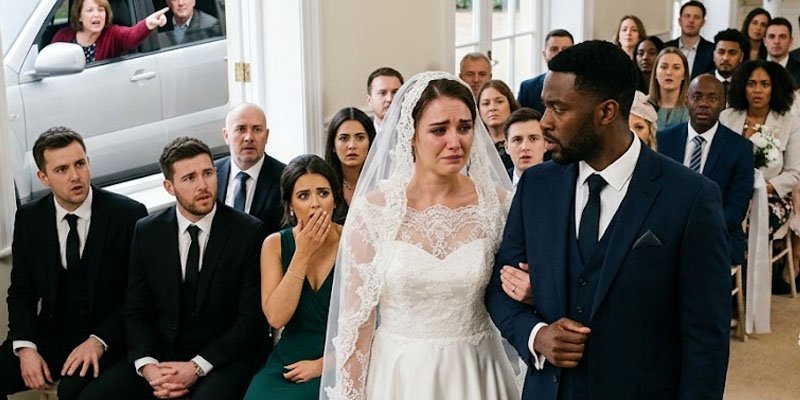
My mother persuaded all eighty-eight relatives to stay away from my wedding, telling them, “Don’t be the only idiot who shows up.” So when I walked into the chapel, my entire side was completely empty.
Then the side doors swung open.
A procession of people dressed in dark suits quietly took their seats—and outside, my mother stopped cold when she realized who they were.
By 2:17 p.m., I knew my mother had gotten what she wanted.
The left side of St. Augustine Hall in Richmond, Virginia, contained eighty-eight white chairs, each one identified by a small ivory card displaying the name of one of my relatives.
Aunts.
Uncles.
Cousins.
Family friends who had described themselves as “practically blood” for as long as I could remember.
Every single chair was vacant.
Three days earlier, my fiancé, Daniel Mercer, had shown me the message my mother posted in our family group chat after I refused to delay the wedding.
“Don’t be the only fool who shows up. She chose strangers over family. Let her marry in front of strangers.”
She then RSVP’d “no” on behalf of every relative whose invitation she had helped gather.
I convinced myself that somebody would show up anyway.
No one did.
When the music began, the coordinator leaned over and whispered, “We can wait a few minutes.”
I shook my head.
My father was meant to escort me down the aisle, but he hadn’t returned any of my calls since breakfast.
So I walked through the chapel doors by myself, holding my bouquet tightly in both hands because I was scared one hand would tremble if I loosened my grip.
Daniel’s family stood as I entered.
His mother was crying.
His brother gave me a quiet nod.
My side resembled a picture of abandonment.
I had only taken six steps when the side doors opened.
A man wearing a charcoal suit walked in first.
Then another man followed.
Then five more.
Within moments, men and women dressed in dark suits quietly began entering the empty rows. They moved with the practiced precision of people familiar with formal settings and serious events.
Some were carrying folded programs.
One woman took off her sunglasses and smiled at me as if we had known one another for years.
The vacant chairs started filling up.
I stopped in place.
Daniel looked just as bewildered.
Then I recognized the first man.
Marcus Hale.
Eleven years earlier, when I was twenty-two, I had worked overnight shifts as a receptionist at a legal aid office while completing college.
Marcus had been a junior public defender at the time.
Later, he became a federal prosecutor.
The year before, after I helped uncover falsified safety reports at the construction company where I worked, Marcus was one of the people who stood by me when the company attempted to ruin my career.
He stepped into the aisle.
“You shouldn’t have to walk alone,” he said.
Through the tall windows, I spotted my parents’ sedan stopped at the curb.
My mother leaned forward from the passenger seat, seized my father’s arm, and pointed toward the hall.
Her lips formed the words unmistakably.
“That’s—that’s not family.”
Marcus held out his arm.
“No,” I said, looking at the people who now filled all eighty-eight chairs. “But they showed up.”
Marcus escorted me down the aisle.
Yet it felt less like someone coming to my rescue and more like an answer to a question I had spent years avoiding:
Who is family when loyalty turns into a weapon?
My mother, Elaine Parker, had always believed family was defined by blood, and loyalty meant never publicly humiliating that blood.
That definition became dangerous eighteen months before my wedding.
I worked as a compliance manager for Whitmore & Cole Construction, a regional contractor responsible for municipal projects across Virginia and North Carolina.
My mother’s younger brother, Uncle Raymond, had worked there for twenty-six years and had helped me land my first interview after college.
For years, I believed I owed him everything.
Then I discovered that inspection reports concerning a parking structure in Norfolk had been altered after engineers identified defective concrete supports.
The original reports contained red warnings.
The copies submitted to the city did not.
At first, I thought it was simply an administrative mistake.
It wasn’t.
Emails revealed that senior executives had pressured inspectors to alter their findings so the company could avoid delays and penalties.
Raymond had been copied on several of those messages.
In one of them, he wrote, “We cannot let this become another public mess. Fix the language and move it forward.”
I reported the discrepancy internally.
Two days later, my access to project files was limited.
A week later, Human Resources informed me that anonymous complaints had been filed accusing me of having a “hostile management style.”
That was when I contacted an attorney.
Marcus wasn’t representing me, but he became involved in the federal investigation after the city forwarded evidence to prosecutors.
Eventually, I testified before a grand jury.
Whitmore & Cole paid a substantial settlement.
Two executives pleaded guilty to charges connected to fraud.
Raymond was never charged, although he lost his job.
My family didn’t care about that distinction.
To them, I had ruined Raymond.
My mother described the investigation as “a public execution.”
She told relatives that I had secretly recorded family members, lied for money, and that Daniel was encouraging me because he wanted to isolate me from them.
None of that was true.
But truth moves slowly when gossip has gasoline behind it.
By the time Daniel and I mailed our wedding invitations, half of my relatives had stopped talking to me.
The rest still called privately, but they pleaded with me to “make peace” by apologizing to Raymond.
I refused to apologize for reporting falsified safety documents.
Six weeks before the wedding, my mother issued her final demand.
She wanted me to postpone the ceremony, invite Raymond, and publicly say that I regretted “how the situation was handled.”
When I refused, she became disturbingly calm.
“You’ll learn what it costs to choose outsiders,” she said.
I assumed she meant that she would not attend.
I didn’t understand that she planned to turn my empty side of the chapel into a public spectacle.
What she also didn’t know was that Daniel had seen the family group message.
He never told me what he intended to do.
After my mother arranged the boycott, Daniel called Marcus.
Marcus reached out to former colleagues, investigators, city engineers, legal aid attorneys, two former coworkers who had cooperated with the case, and several people I had helped during years of volunteering at a tenants’ rights clinic.
They weren’t there as federal agents or government officials.
They came as private citizens.
The dark suits were simply because Daniel had told them the wedding was formal.
At the reception, I discovered that some of them had driven three hours.
One woman, Denise Alvarez, had flown in early from Atlanta.
Nine years earlier, while volunteering on weekends, I had helped her family fight an illegal eviction.
“You probably don’t remember me,” she said.
I did.
Her daughter had been six years old then.
Now she was fifteen, sitting beside Denise in a blue dress and eating wedding cake.
Across the ballroom, Marcus looked toward the entrance.
My parents had finally come inside.
My mother stood there wearing a cream-colored suit, staring at tables packed with the people she had dismissed as strangers.
Then she noticed Raymond.
He was standing behind her.
And unlike the rest of my relatives, he appeared ashamed.
For several seconds, nobody moved.
My mother looked at him as if his presence were the deeper betrayal.
“You came?” she asked.
Raymond kept his gaze on me.
“Yes.”
“You told me you weren’t going.”
“I changed my mind.”
She let out a brief, incredulous laugh. “After everything she did to you?”
The ballroom wasn’t entirely silent.
Glasses touched tabletops.
A server rolled a cart near the kitchen.
The band had paused between songs, and the conversations around us had dwindled into cautious murmurs.
Raymond stepped forward.
“She didn’t do this to me, Elaine.”
My mother’s expression became rigid.
I had imagined confronting her countless times.
In those imagined conversations, I always delivered the perfect speech.
Calm.
Devastating.
Perfectly articulate.
In reality, I was exhausted.
I had spent the morning wondering whether my father loved me enough to disappoint his wife.
I had walked past eighty-eight empty chairs.
I had cried in a restroom ten minutes after my vows because people who had no obligation toward me had shown more kindness than relatives whose Christmas photographs covered the walls of my childhood home.
So I asked the one question I genuinely needed answered.
“Dad, why didn’t you come?”
My father, Thomas, looked older than he had the week before.
He stared down at the floor.
“Your mother said we should arrive after the ceremony,” he said.
“That isn’t what I asked.”
He swallowed.
“I should have come.”
My mother turned sharply toward him.
“Thomas.”
“No.” His voice was quiet, but I had never heard him interrupt her that way. “She asked me.”
Then he looked at me.
“I was a coward.”
Those words hurt more than an excuse ever could have.
My father had always dealt with conflict by making himself smaller beneath it.
When my mother was angry, he washed dishes.
When she insulted someone, he changed the subject.
When she and I fought, he called later and said, “You know how she is.”
For years, that sentence had functioned as a family pardon.
You know how she is.
As if knowing somehow made everything unavoidable.
My mother crossed her arms.
“This is absurd. We came, didn’t we?”
“After the ceremony,” Daniel said.
She looked at him with unmistakable dislike.
Daniel stayed composed.
“You came to check whether the seats were empty.”
Her jaw tightened.
I immediately knew he was right.
Their sedan hadn’t been parked there by accident.
They had arrived early enough to watch.
My father closed his eyes.
Raymond exhaled.
“Elaine, tell her.”
My mother stared at him.
“Tell me what?”
Raymond reached into his jacket and pulled out his phone.
“I called your mother last night,” he said. “I told her I was coming today. I told her I wanted this nonsense to end.”
“That is not what you said,” my mother snapped.
“It is exactly what I said.”
He looked toward me.
“I should have called you myself. I didn’t because I was embarrassed.”
The word appeared difficult for him to say.
Raymond had always been the loudest person at family gatherings.
He carved the turkey.
He organized summer cookouts.
He paid restaurant bills before anyone else could reach for theirs.
When I was sixteen and my first car broke down, he spent an entire Saturday replacing the alternator in my parents’ driveway.
For a long time, loving him had made the investigation more difficult.
That was something my mother had never understood.
She treated the truth as evidence that I had stopped loving him.
Raymond rubbed his face.
“When the company first began changing those reports, I told myself it was paperwork. Then I convinced myself the engineers were being too cautious. Then I knew better and still stayed quiet.”
My mother shook her head.
“You were following instructions.”
“Yes.”
“You had a mortgage. You had employees relying on you.”
“Yes.”
“You weren’t the person who changed the reports.”
“No. But I knew.”
“I felt his voice crack slightly.
“I knew enough.”
I felt Daniel’s hand touch mine.
Raymond continued.
“When the investigation began, I was furious with you. I blamed you because blaming you was easier than admitting I had spent years becoming the sort of man who could see a warning and wonder how much it would cost to ignore it.”
My mother stepped closer to him.
“You do not need to humiliate yourself for her.”
“I’m not doing it for her.”
That stopped her.
“I’m doing it because I’m sixty-one years old and tired of hearing you rewrite what happened.”
He unlocked his phone and held it out, although no one reached for it.
“You told everyone Claire had accused me of taking bribes. She didn’t. You told them she had given prosecutors private family conversations. She didn’t. You told them Daniel threatened you. He didn’t.”
My mother’s face turned pale.
I looked toward my father.
He didn’t look surprised.
That hurt in a different way.
“You knew?” I asked.
He hesitated.
“I knew some of it wasn’t true.”
“And you let her tell people?”
His silence gave me the answer.
Behind me, a chair moved.
I suddenly remembered that dozens of people were watching us.
I turned toward Marcus.
“Can you ask everyone to give us a few minutes?”
He nodded.
Within moments, the closest guests began heading toward the terrace and bar.
Daniel’s parents quietly led others away.
Nobody objected.
Nobody acted as though they hadn’t heard.
Soon, only Daniel, my parents, Raymond, and I remained near the entrance.
My mother watched as the room emptied.
“This is exactly what you wanted,” she said to me. “An audience.”
“No. You wanted the audience. That’s why you arranged eighty-eight empty chairs.”
Her eyes flashed.
“I was trying to teach you about consequences.”
“I understand them now.”
“You chose a criminal investigation over your own uncle.”
Raymond flinched.
I looked at her.
“No. I chose not to conceal a safety problem. You turned that into a test of loyalty.”
“You always think you’re right.”
“This isn’t about whether I’m always right.”
“You embarrassed this family.”
“I did not send those messages.”
She opened her mouth, but I kept going.
“I did not tell eighty-eight people they would be fools for attending my wedding. I did not lie about what I told investigators. I did not bring Dad here to sit in a car and watch so you could find out whether I had been successfully humiliated.”
My father looked at her.
“You told me we were waiting because Claire might cause a scene if we walked in.”
My mother’s composure broke.
For the first time that day, uncertainty appeared on her face.
Then that uncertainty turned into anger.
“You’re all standing here acting like I’m some monster because I cared about keeping this family together.”
Raymond shook his head.
“No, Elaine. You cared about being obeyed.”
She stared at him.
The sentence landed without theatrics.
That was precisely why it worked.
My mother snatched her handbag from a chair.
“I’m leaving.”
My father didn’t move.
She turned toward him.
“Thomas.”
He looked at me.
Then he looked at her.
“I’m staying for my daughter’s reception.”
My mother’s expression changed.
She didn’t cry.
She didn’t yell.
She simply realized that the method she had depended on for years no longer worked.
She looked at me one final time.
“You’ll regret making this public.”
“I didn’t make it public.”
I nodded toward the door.
“You did.”
She walked away alone.
Through the glass, I watched her cross the parking lot, climb into the passenger side of the sedan, and then realize that my father still had the keys.
For one ridiculous second, nobody said anything.
Then Raymond laughed.
Not with happiness.
It was the exhausted laugh of a man who had finally reached the end of something.
My father covered his mouth, trying not to smile.
Even I laughed.
Daniel went outside and gave my mother the spare key from my father’s coat so she could leave.
Later, that became my favorite part of the entire story.
Not because it was funny, although it was.
Because Daniel didn’t use the moment to punish her.
He simply handled the immediate problem and returned inside.
The reception continued twenty minutes later.
My father didn’t make a speech.
He asked whether he could, but I told him I wasn’t ready.
He accepted that without arguing.
Raymond stayed.
Some guests became uneasy once they realized who he was, particularly two engineers connected to the Norfolk project.
He didn’t ask anyone to forgive him.
He didn’t approach Marcus.
He sat in the back, ate dinner, and left a handwritten note beside our gift table.
I read it the following morning.
It said:
Claire,
I spent a long time believing loyalty meant shielding people from consequences. You understood before I did that sometimes consequences are the only thing that makes honesty possible.
I’m sorry I allowed you to carry the blame for decisions I made.
You don’t owe me forgiveness.
I hope someday I can earn a place in your life again.
Uncle Ray
I kept the note.
Not because everything had been fixed.
It hadn’t.
Real families don’t change overnight because of one conversation.
People who have spent decades avoiding responsibility don’t suddenly become different because someone delivers the perfect speech at a wedding.
The months that followed were complicated.
My mother called relatives and claimed Daniel had arranged a “public ambush.”
Some believed her.
Others began comparing the stories she had told them and realized they didn’t line up.
Three cousins reached out to me within a week.
Aunt Melissa called while crying and admitted she had wanted to attend but was afraid my mother would turn everyone against her.
I told her I understood why she had been afraid.
I also told her I wouldn’t pretend her choice hadn’t hurt me.
That became the boundary I set with everyone.
No public revenge.
No group announcement.
No social-media post packed with screenshots.
If someone wanted a relationship with me, they had to talk to me directly and acknowledge what they had done.
Some did.
Some never called.
My father started seeing a therapist after moving into an apartment six months later.
He and my mother separated, although I never asked him to leave her and never made rebuilding our relationship dependent on it.
We slowly repaired our relationship.
He stopped saying, “You know how she is.”
Instead, he began saying things like, “I should have spoken up.”
That difference mattered.
Raymond found work with a small building supplier.
It paid less.
He sold his boat and eventually his large home outside Fredericksburg.
About a year after the wedding, he asked Daniel and me to have lunch with him.
He apologized again.
This time, Daniel asked him something I had never thought to ask.
“If Claire hadn’t reported it, what do you think would have happened?”
Raymond stared down into his coffee.
“Probably nothing,” he said at first.
Then he corrected himself.
“That’s what I used to tell myself. The truth is, I don’t know. And that was the problem.”
We didn’t instantly become close again.
But we began rebuilding.
My mother and I remained mostly estranged.
She sent birthday cards.
I answered with brief thank-you messages.
Almost two years after the wedding, she wrote that she was “sorry things got so out of hand.”
I told her I would be willing to talk when she was ready to apologize for specific decisions rather than simply apologize because those decisions had consequences.
She never replied.
Maybe someday she will.
Maybe she won’t.
What changed most after the wedding wasn’t my family tree.
It was my understanding of what those eighty-eight empty chairs represented.
When I first entered the chapel, I saw them as evidence that I had lost.
Every empty seat seemed to represent another person choosing my mother instead of me.
Then the side doors opened.
The people who occupied those chairs weren’t substitutes for my relatives.
They weren’t performers Daniel had gathered to make the photographs look better.
They were people whose lives had intersected with mine through work, service, difficult decisions, small acts of kindness, and moments I hadn’t realized were important.
Denise later sent me a photograph from the reception.
Her daughter was laughing with Daniel’s niece beside the dessert table.
Marcus sent a short message:
“For the record, I have never attended a more complicated wedding.”
The engineers mailed us a toaster.
Someone from the legal aid office sent a framed copy of the clinic’s old volunteer schedule from the year I worked there.
My name was highlighted on Thursday nights.
And in our wedding album, one photograph means more to me than all the rest.
I’m halfway down the aisle.
Marcus is beside me.
Daniel is waiting at the front.
Behind us, every row is filled.
If you look closely through the window, you can see my parents’ car beside the curb.
For years, my mother taught me that being abandoned by family was the worst thing that could happen.
She was wrong.
The worst thing would have been spending the rest of my life so terrified of an empty chair that I became willing to sit beside anyone, tolerate anything, and call it love.
On my wedding day, eighty-eight people stayed away because one person told them loyalty demanded it.
Eighty-eight others came because nobody demanded anything from them.
That was the difference I remembered.