
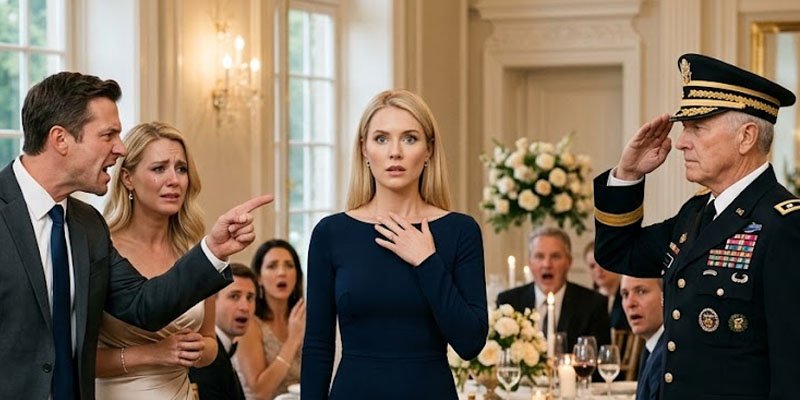
The dinner was supposed to be simple: sixty guests, a private dining room in a historic hotel in Alexandria, Virginia, and one carefully arranged evening during which my younger sister, Emily, would officially become part of the Whitmore family.
For three weeks, my mother, Diane Carter, had reminded everyone that Emily was marrying “into a distinguished family.”
She had repeated the phrase so often that eventually, nobody seemed to notice it anymore.
I arrived ten minutes late in a plain navy dress, my hair neatly pinned back, wearing nothing but a small silver watch.
I had come straight from work and changed in the employee restroom at the gas station where, according to my mother, I had “wasted my life.”
At least, that was the version she told other people.
When Emily’s fiancé, Daniel Whitmore, introduced me to his parents, my mother spoke before I could say a word.
“Oh, this is Claire,” she said with a quiet laugh. “Don’t mind her. She works at a gas station.”
A few guests offered polite chuckles.
Daniel looked uncomfortable. Emily kept staring down at her plate.
Across the table, Daniel’s father suddenly went completely still.
General Richard Whitmore, a four-star United States Army general, slowly set his fork down.
His eyes stayed on me as he rose from his chair.
Every officer sitting nearby noticed what was happening before anyone else did.
Chairs moved. Conversations died away. Even the waiters stopped beside the wall.
General Whitmore straightened his posture, raised his right hand, and saluted me.
“Colonel Carter,” he said clearly. “It’s an honor.”
My mother almost lost her balance against her chair.
Emily’s face turned pale.
I stood and returned the salute.
“At ease, General,” I said.
No one was laughing now.
My mother looked between the two of us. “Colonel?”
General Whitmore appeared honestly surprised. “You didn’t know?”
I pulled my chair back and sat down.
My official civilian position was assistant manager at a twenty-four-hour gas station outside Arlington.
That part was entirely true.
What my family didn’t know was that the station was owned by a federal nonprofit supporting veterans in transition, quietly employing soldiers, reservists, and intelligence personnel between assignments. I had chosen to work there three nights a week.
My actual full-time job was at the Pentagon.
I was Colonel Claire Carter, U.S. Army, specializing in logistics and strategic mobility, and I had recently transferred from U.S. Transportation Command after eighteen years of service.
General Whitmore had chaired the board that approved one of my operational commendations following a difficult overseas evacuation mission.
My mother tightened her fingers around the tablecloth.
Emily whispered, “You told me you handled inventory.”
“I do,” I replied. “Just not the kind you imagined.”
Daniel looked at me and then back at Emily.
That was when I realized my sister had told his family far more about me than I had ever told my own.
The silence around us was no longer ordinary em.bar.rass.ment. It had turned into a calculation.
Someone at that table already knew exactly why Emily had wanted me diminished before I arrived.
General Whitmore remained standing until I had settled back into my chair. His wife, Margaret, looked at Emily as though she were mentally replaying an entire conversation.
Daniel spoke first.
“Emily told us you left the Army.”
My sister’s fork made a faint metallic sound against her plate.
“I never said she left,” Emily replied too quickly.
“Yes, you did,” Daniel said. “At my parents’ house in May. You said Claire had been forced out because of some disciplinary problem, and that she was embarrassed about it, so the family avoided talking about it.”
My mother turned toward Emily.
“You said that?”
The question nearly made me laugh. Not because anything was funny, but because Diane sounded shocked by a story only a little worse than the one she had been repeating herself for years.
I placed my napkin carefully beside my plate.
“For clarity,” I said, “I have never been discharged, disciplined, demoted, or asked to resign.”
General Whitmore gave a short nod.
“That is correct.”
Emily’s eyes immediately shifted toward him.
“I was only trying to avoid uncomfortable questions.”
“By implying a court-martial?” Daniel asked.
“I never said court-martial.”
“You said ‘serious disciplinary action.’”
Around us, sixty guests suddenly became very interested in acting as though they could hear nothing.
My mother leaned toward me.
“Why didn’t you tell us you were a colonel?”
That was the question she decided to ask.
Not why Emily had created the story. Not why she had embarrassed me in front of strangers.
Why had I allowed her misunderstanding to continue?
“You knew I joined the Army,” I said. “You came to my commissioning.”
“That was years ago.”
“You knew I deployed.”
“You stopped telling us about it.”
“After every conversation became a joke about me playing soldier.”
Her expression grew tense.
The truth was much less dramatic than everyone at that table probably imagined.
There had been no secret identity.
No classified order stopping me from contacting home.
My mother had simply stopped asking meaningful questions about my career, and eventually I stopped volunteering information.
She knew I had remained connected to the military for years. She just assumed that eventually I had left.
When I began helping at a gas station owned by my former platoon sergeant, Marcus Reed, she saw me wearing the polo shirt during one video call and filled in the rest of the story herself.
I never took the time to correct her.
Working there three evenings a week had originally started as a favor after Marcus established a paid transition program for veterans struggling to find dependable civilian employment. I handled schedules, inventory, payroll problems, and sometimes worked the register. My command knew about the job and had approved it.
I liked it because nobody cared about my rank.
At the Pentagon, my rank often entered a room before I did.
At Marcus’s station, a teenager named Luis complained whenever I stocked the energy drinks incorrectly.
Both sides of my life were genuine.
Neither one erased the other.
Margaret Whitmore turned toward Emily.
“Why did you want us to think your sister had failed?”
Emily swallowed.
Daniel’s expression changed before she responded.
I knew that look immediately.
He already understood.
“My parents compare people,” Emily said quietly. “Constantly. Claire was always the one who left, the difficult one, the person who never quite belonged. Then I met Daniel, and his father was a general, and suddenly Mom became interested in military careers. I knew exactly what would happen if she found out Claire outranked the version of Claire she had created.”
“I don’t compare you,” my mother said sharply.
Emily finally looked directly at her.
“You introduced your own daughter by telling sixty people to ignore her.”
Diane fell silent.
Emily’s voice shook, but she continued.
“I wanted something that was mine. One family where I wasn’t just Claire’s younger sister. So when Daniel asked about her, I made her seem smaller.”
There it was.
It wasn’t merely jealousy.
It was fear that had been repeated so often it had slowly become cruel.
Daniel pushed his chair back several inches.
“And you let me repeat that story to my parents.”
Emily reached toward him.
“Daniel—”
He gently moved his hand away.
General Whitmore never raised his voice.
There was no need.
“Colonel Carter,” he said, “I owe you an apology. My family was given false information about you inside our own home.”
“You don’t owe me one, sir.”
“No,” he said. “But someone does.”
My mother lowered her eyes to her plate.
Emily watched Daniel.
And for the first time that night, neither of them could expect me to carry their discomfort for them.
Dinner never really recovered.
Technically, it went on. Plates were served. Wine was poured. A waiter announced dessert with the determination of someone entering an extraordinarily tense room.
But the evening everyone had carefully arranged was already over.
Daniel asked Emily to speak with him privately outside.
She followed him without looking at me.
My mother remained seated for almost a minute, staring at the candles between us. Then she leaned close enough that no one else could hear.
“You embarrassed me.”
I looked straight at her.
She seemed to realize almost immediately how unreasonable that sounded, because her expression changed.
“I mean,” she continued softly, “you could have warned me.”
“About what?”
“Your rank. The Pentagon. Knowing General Whitmore.”
“I didn’t know he would be here.”
“He’s the groom’s father.”
“I knew his name. I didn’t realize he was Daniel’s father until Emily sent the formal invitation. And knowing someone professionally isn’t the same as knowing them socially.”
She pressed her lips together.
“You let me say that in front of everybody.”
“No, Mom. You chose to say it.”
That sentence struck harder than anything I could have said by raising my voice.
For most of my life, Diane had possessed an unusual talent for reversing cause and consequence.
If she insulted someone and they reacted, their reaction became the problem.
If she forgot someone’s birthday, the person who was hurt became “too sensitive.”
If Emily received an award, Mom praised her until someone mentioned one of mine, and suddenly the evening turned into an argument about whether I was trying to attract attention to myself.
I learned early that defending myself usually only made the conversation last longer.
So eventually, I stopped.
At nineteen, I stopped explaining why ROTC weekends mattered more to me than sorority events.
At twenty-four, I stopped talking about deployments after she described my logistics work as “moving boxes for men who actually fight.”
At thirty-two, I stopped correcting her when she introduced me as someone who “used to be in the Army.”
At thirty-eight, when she saw me wearing Marcus Reed’s gas-station polo during a video call and remarked, “Well, I suppose honest work is honest work,” I simply agreed.
Silence had protected me.
But silence had also created an empty space, and my mother and sister filled it with whatever version of me suited them best.
General Whitmore interrupted my thoughts.
“Colonel, may I sit with you?”
He pointed toward Daniel’s empty chair.
“Of course.”
He sat down, no longer acting like a general, but like a father trying to navigate an uncomfortable family situation.
“I want to clarify something,” he said. “My salute was instinctive respect. But I may have made tonight harder for you.”
“You didn’t.”
“I turned private family ignorance into a public revelation.”
“My mother made things public before you ever stood.”
His expression tightened with something close to sympathy.
“I’ve chaired enough command reviews to recognize that distinction without needing an explanation.”
I appreciated that.
He also didn’t ask which mission had earned my commendation.
He knew better than to ask.
The evacuation had been difficult, rushed, and politically sensitive. My team had coordinated aircraft, ground convoys, medical transportation, and civilian manifests under circumstances in which every plan could become obsolete within hours.
There had been no single dramatic moment that defined the mission.
The work involved hundreds of decisions, most of them unseen and some almost impossible.
The citation made everything sound organized.
Reality had been different.
“Daniel respects you,” General Whitmore said.
“He barely knows me.”
“He respects what he knows about your record.”
“That’s different from knowing me.”
“Fair.”
He looked toward the doors where Daniel and Emily had disappeared.
“My son’s concern tonight isn’t that Emily lied about a colonel.”
“I understand.”
“It’s that she lied because the truth would have been inconvenient.”
I nodded.
That was exactly the issue.
Even if I had merely been a gas-station cashier and nothing more, Emily’s dishonesty would still have mattered.
The uniform made the revelation more surprising, but it did not alter the underlying principle.
Twenty minutes later, Daniel returned alone.
His expression was controlled, though his eyes appeared red.
“Claire,” he said, “could we talk?”
We walked outside into the hotel courtyard.
The September evening was cool, and traffic along King Street created a low hum beyond the brick wall.
Daniel put his hands into his pockets.
“I owe you an apology.”
“You trusted someone you loved.”
“I repeated what she told me.”
“You had no reason to think she had invented it.”
“I could have asked you myself.”
“You had only met me twice.”
He gave a quiet, humorless laugh.
“You’re making this easier than I deserve.”
“I have no desire to make it harder.”
He studied me for a moment.
“I postponed the wedding.”
“When?” I asked.
“Just now.”
“And Emily?”
“She thinks I’m punishing her.”
“Are you?”
“No. I’m trying not to marry someone while wondering which parts of our life together have been deliberately edited.”
That was a more thoughtful answer than I expected.
He explained that the story about my discharge wasn’t the only example.
Emily had exaggerated her professional position when they first met, claimed she had personally paid off student loans that our mother had actually covered, and once told Daniel that our father had abandoned the family when the reality was much more complicated.
Our father, Thomas Carter, had separated from my mother when I was twenty-one.
He had not a.ban.don.ed us.
He called regularly. He sent money.
He attended Emily’s high school graduation and my commissioning ceremony.
Diane made staying in contact so emotionally exhausting that eventually both daughters learned to keep those relationships separate.
Apparently, Emily had rewritten that part of our history too.
“Do you think she’s a bad person?” Daniel asked.
I paused before answering.
“She’s my sister,” I said. “In some ways, I know her better than you do, and in others, you know her better than I do. She learned early that whichever version of events Mom preferred usually became the official version. Sometimes Emily resisted that. Sometimes she benefited from it. Somewhere along the way, I think she learned to reshape reality before reality had a chance to em.bar.rass her.”
“That doesn’t really answer my question.”
“It isn’t a question I should answer for you.”
He nodded slowly.
Then he as




