
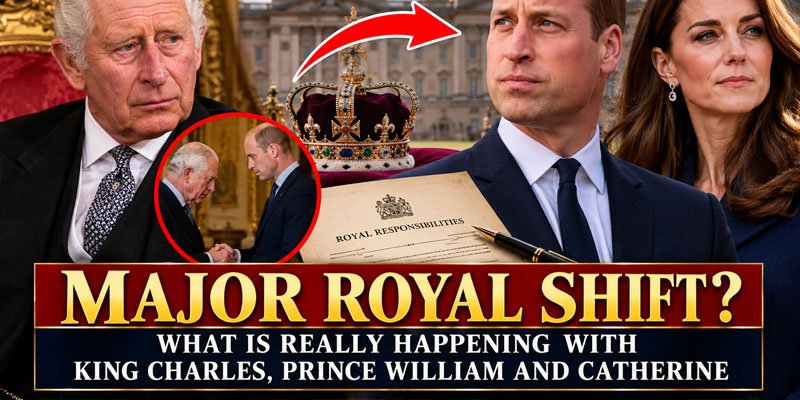
King Charles and Prince William: What Is Really Happening Behind the Claims of a Royal Power Transfer?
Dramatic claims online suggest King Charles is preparing to hand greater royal responsibility to Prince William. But what do the official records actually show?
London — A dramatic wave of online royal coverage has raised fresh questions about the future of the British monarchy, with one widely circulated YouTube video claiming that Buckingham Palace has confirmed a major development involving King Charles III and his eldest son, Prince William.
The video, presented in highly sensational terms, suggests that concerns surrounding the King’s health have triggered an important transition inside the Royal Family and that William is increasingly being positioned to take on responsibilities traditionally associated with the monarch.
Catherine, Princess of Wales, is also portrayed as playing an important part in the alleged transition.
However, a review of the available official royal records presents a considerably more measured picture.
There is currently no verified Buckingham Palace announcement stating that King Charles has transferred the powers of the Crown to Prince William, suspended his constitutional responsibilities or begun an emergency succession process.
What the official record does show is that Charles continues to undertake public and official engagements, while William already has a substantial programme of work as heir to the throne.
That distinction is important.
King Charles Remains Active in September 2026
King Charles’s health has understandably attracted considerable public attention since Buckingham Palace announced in 2024 that doctors had identified a form of cancer following a hospital procedure.
At the time, the Palace said the King would postpone public-facing duties temporarily while receiving treatment, but would continue state business and official paperwork.
Since then, the King’s public programme has continued.
The official Royal Family website records a series of engagements undertaken by Charles during September 2026. These include activities in Scotland, meetings, speeches and events connected with areas including environmental issues, renewable energy and artificial intelligence.
On September 17, for example, the Court Circular recorded Charles visiting the Royal Conservatoire of Scotland at New Cumnock Town Hall before convening a forum on artificial intelligence and its role in serving the public good at Dumfries House. He later attended a reception and hosted a dinner.
The official record also shows that Charles continued carrying out engagements later in September. On September 21, he received Ecumenical Patriarch Bartholomew I at Balmoral.
The Royal Family’s official news archive also lists a September 22 engagement involving the King and renewable energy in Scotland.
These records do not establish what the King’s private medical situation is, nor do they provide a medical assessment. They do, however, demonstrate that he has continued to appear in the official programme and undertake public duties.
Why Prince William’s Growing Role Can Be Misinterpreted
Prince William’s increased visibility is real, but it does not automatically mean that the Crown is being transferred to him.
William is the Prince of Wales and heir to the throne. His position naturally involves carrying out a substantial number of official engagements on behalf of the Royal Family.
The constitutional structure of the monarchy allows working members of the Royal Family to undertake official duties while the reigning monarch remains on the throne.
This means that seeing William attend meetings, visit communities, represent the Royal Family or participate in major national and international activities is not, by itself, evidence that Charles has relinquished his responsibilities.
In fact, the official Court Circular illustrates how Charles and William can undertake substantial programmes of work at the same time.
On September 17, while Charles was carrying out engagements at Dumfries House, William and Catherine were undertaking their own official engagements on the Isle of Bute.
That is consistent with the normal division of duties within the modern Royal Family.
William Is Preparing for a Future Role — But That Is Not the Same as Becoming King
There is an important distinction between supporting the reigning monarch and succeeding the reigning monarch.
William’s status as heir means that his public responsibilities are significant and are expected to grow over time.
His official work also gives him experience in areas that are likely to become increasingly important to him if and when he eventually becomes King.
But succession is not triggered simply because an heir takes on more engagements.
The existence of a larger workload for William therefore should not automatically be interpreted as evidence that Charles has stepped aside.
A formal change in sovereign would be a fundamentally different constitutional event.
Catherine Continues to Work Alongside William
Catherine, Princess of Wales, is also continuing her official programme.
The Court Circular records that on September 16 she held a meeting at Windsor Castle with representatives from the Duchy of Cornwall and the Royal Foundation of the Prince and Princess of Wales.
Her involvement is significant because the Prince and Princess of Wales increasingly undertake work together across a range of public causes and institutions.
But Catherine’s continuing activity does not establish that she has acquired a new constitutional position because of a health emergency involving the King.
Instead, the available records show her working within the established role of the Princess of Wales alongside William.
The Health Story Is Genuine — But Some Online Claims Go Further Than the Evidence
The King’s cancer diagnosis is not an invented story.
Buckingham Palace publicly announced in 2024 that diagnostic tests had identified a form of cancer. The Palace did not publicly disclose the specific type of cancer. At the time, doctors advised Charles to postpone public-facing duties while he underwent treatment.
The Palace statement also made clear that Charles would continue with state business and official paperwork during that period.
Since then, the King’s public schedule has resumed.
In May 2026, for example, Charles visited the Cancer Centre at Guy’s Hospital, where he met patients, doctors and researchers and was briefed on cancer research and treatment.
In June 2026, Charles and Queen Camilla also hosted a reception marking the 125th anniversary of Cancer Research UK. The Royal Family’s official account described Charles as a patron of the organisation.
These activities do not reveal the full details of his medical condition. They do show, however, that the King has continued a public programme while his treatment has remained a matter of public interest.
What About an Emergency Transfer of Power?
This is where the online claims require the most caution.
A headline suggesting that the “Palace confirms” a major transfer of royal responsibility may give viewers the impression that Buckingham Palace has issued a formal constitutional announcement.
The official material currently available does not support that interpretation.
There is no verified Palace announcement identified in the current official press-release record stating that Charles has handed the powers of the Crown to William. The Royal Family’s current press-release archive continues to publish announcements concerning the King’s programme and other official royal matters.
Likewise, the official royal news archive continues to record Charles’s activities in September 2026.
That does not mean that Charles’s responsibilities can never change.
It simply means that a major constitutional development should not be presented as confirmed unless there is an authoritative announcement supporting it.
The Difference Between Royal Duties and the Crown
One of the easiest ways for online royal stories to become misleading is through the use of the word “power.”
Members of the Royal Family can carry out official engagements, represent the Crown at events and support the monarch without becoming the sovereign.
The King remains the constitutional head of state.
An heir can therefore become increasingly prominent without becoming King.
This distinction is especially important when discussing William because his position naturally places him at the centre of the monarchy’s long-term future.
His current responsibilities can be substantial while Charles remains the reigning monarch.
The Court Circular Provides an Important Record
For anyone attempting to verify claims about royal activity, the Court Circular is particularly useful.
The Royal Family describes it as the official record of past royal engagements, with records going back decades.
Recent entries provide a detailed picture of the different roles being carried out by Charles, William, Catherine and other members of the Royal Family.
For example, September records show Charles undertaking engagements at Balmoral and in Scotland, while William and Catherine were separately carrying out their own official programme.
That evidence provides a much more nuanced picture than the idea of a sudden overnight transfer of responsibility.
Could Charles’s Schedule Change in the Future?
Of course, it could.
The King’s schedule can change because of health, age, travel requirements, constitutional commitments or other circumstances.
The same is true of other senior members of the Royal Family.
But a possible future adjustment should not be confused with a confirmed event.
If Buckingham Palace were to announce a significant constitutional change, such an announcement would be expected to appear through authoritative Royal Communications and other official channels.
Until such evidence appears, claims of an emergency transfer should be treated as unverified.
Why Sensational Royal Headlines Spread So Quickly
Royal health and succession stories attract enormous attention because they combine two subjects that naturally generate public interest: the personal wellbeing of a monarch and the future of the institution he represents.
The situation is particularly sensitive because Charles has publicly disclosed his cancer diagnosis.
That genuine health story can make dramatic claims about his future responsibilities appear more believable.
A headline such as “Palace Confirms Major Change for King Charles and Prince William” can therefore create an impression of an official announcement even when the underlying evidence is simply that William has been undertaking more public duties.
The difference between those two claims is substantial.
What the Official Record Shows
At present, the available official evidence establishes several points.
King Charles remains the reigning monarch.
Charles continues to undertake official engagements. The Royal Family’s September 2026 records include multiple activities involving the King.
Charles has a publicly announced cancer diagnosis. Buckingham Palace disclosed the diagnosis in 2024 but did not identify the specific type of cancer publicly.
Prince William continues to undertake a significant programme of official work. His role as heir to the throne naturally involves substantial public responsibilities.
Catherine continues to undertake official engagements alongside William and independently.
What the current official material does not establish is an emergency transfer of the Crown from Charles to William.
It also does not establish that Charles has suddenly suspended his constitutional responsibilities.
What Would a Genuine Major Transition Look Like?
A genuine constitutional change would be fundamentally different from an increase in William’s workload.
It would require clear and authoritative evidence rather than inference from photographs, social-media posts, YouTube videos or changes in the royal diary.
The distinction matters because the monarchy is not transferred simply because the heir undertakes more engagements.
The current evidence instead shows a reigning King continuing his official work while his heir carries out his own substantial programme.
The Future of the Monarchy
The long-term future of the monarchy will inevitably involve Prince William.
As heir to the throne, his public role is expected to remain important.
Charles’s health has also ensured that questions about the future leadership of the institution remain part of public discussion.
But there is a difference between discussing the monarchy’s future and announcing that the future has already arrived.
The official record currently supports the first.
It does not establish the second.
The Bottom Line
The online video may use dramatic language about a major royal transition, but the available official evidence tells a more measured story.
King Charles continues to carry out official engagements while receiving treatment following his publicly announced cancer diagnosis. Prince William continues to perform a substantial programme of duties as Prince of Wales and heir to the throne, while Catherine also remains active in her official role.
Those facts are significant, but they should not be presented as proof that Buckingham Palace has transferred the Crown or formally handed Charles’s constitutional responsibilities to William.
There is currently no verified Palace announcement confirming an emergency transfer of royal authority from King Charles to Prince William.
For now, the evidence points to an active reigning monarch working alongside an increasingly prominent heir — not a formally announced change of sovereign.
As royal health and succession stories continue to attract attention online, the most important question remains simple:
What has actually been confirmed by the Palace, and what is merely being inferred from the Royal Family’s changing public schedule?
At present, that distinction is especially important.




