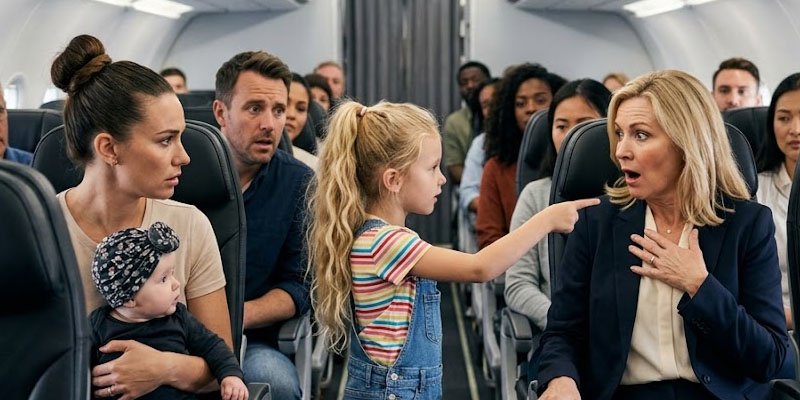
“Ma’am, stop behaving as though you’re the victim. You’re the one who decided to board a plane with a newborn and a little girl.”
The woman said it loudly enough that several passengers in Row 11 immediately turned their attention toward me.
My son, Leo, was just six weeks old.
He was sleeping against my chest inside the soft blue carrier my mother had given me shortly before she passed away. His tiny cheek rested against my shirt, and with every sleepy breath, his warm exhale slightly dampened the fabric.
Standing beside me was my ten-year-old daughter, Maya, clutching the straps of her purple backpack decorated with tiny embroidered stars.
This was the first time I had ever traveled alone with both of my children.
We were traveling from Chicago to Orlando, where my sister had offered to have us stay for several weeks.
My husband, David, was working long hours on a construction project, and since Leo had been born, I had not slept for more than three hours at a stretch.
Because of that, I had planned every part of the trip obsessively.
I paid extra for two adjoining seats that came with additional legroom.
One seat was for Maya.
The other was for me, with Leo traveling on my lap.
I had personally chosen Row 11.
I checked our boarding passes over and over.
I arrived at O’Hare much earlier than necessary because the last thing I wanted was additional stress.
But when we finally arrived at Row 11, another person was already occupying my seat.
The woman appeared to be in her early fifties.
A pair of designer sunglasses sat on top of her head.
Her beige trench coat was spread across part of the seat.
A large leather tote was taking up some of the aisle.
She had even taken off her shoes and placed one bare foot against the wall of the aircraft, as if the entire row belonged to her.
I tried to stay composed.
“Excuse me. I believe these are our seats.”
She gradually looked up.
First, she looked at me.
Then she looked at Leo sleeping against my chest.
Then her eyes moved to Maya.
Without saying another word, she pulled her noise-canceling headphones back over her ears.
“I’m already comfortable,” she said.
I looked at her in disbelief.
Then I took out our boarding passes.
“We’re assigned 11A and 11B.”
She pulled one side of her headphones away from her ear and released an exaggerated sigh.
“It’s always the same with mothers,” she muttered. “You have children, and suddenly you expect everyone around you to inconvenience themselves for you.”
Maya immediately looked down.
Leo moved slightly against my chest.
I rested my hand on his back, hoping to keep him asleep.
By that point, several people were beginning to gather behind us in the aisle.
A flight attendant quickly came over and examined both sets of boarding passes.
Her expression became tense.
“There seems to have been a duplicate seat assignment,” she said carefully.
“I specifically paid extra for these seats,” I answered.
“I understand, ma’am.”
She lowered her voice.
“There’s another available seat about three rows behind you. If you could take that one, we could finish boarding.”
For a second, I wondered if I had heard her correctly.
“You want me to sit three rows away from my ten-year-old daughter?”
The attendant looked uneasy.
“We’ll keep an eye on her. The flight is already delayed, and this passenger is refusing to move.”
The woman sitting in my seat let out a dry laugh.
“Of course I’m refusing. I got here first.”
Then she looked toward Maya.
“She’s old enough to sit without her mother for a few hours. It’s not going to hurt her.”
Someone behind us let out an impatient sigh.
Another passenger muttered something about missing our departure window.
My face grew hot.
It wasn’t embarrassment.
It was anger.
The deep, restrained kind of anger mothers learn to swallow when they are carrying a sleeping baby while an older child watches carefully to see how adults respond when something is unfair.
Maya touched my arm.
“It’s okay, Mom. I can stay here.”
I looked down at her.
“No, sweetheart.”
“Really. I can.”
The flight attendant promised that she would check on Maya regularly.
The woman in my seat adjusted her coat with the satisfied look of someone convinced she had won.
I hated every moment of it.
But with the aisle blocked, Leo starting to stir, and Maya repeatedly insisting she would be fine, I reluctantly agreed.
I helped Maya get settled into the window seat.
She tucked her purple backpack underneath the seat in front of her.
But as she leaned down, I noticed something change in her expression.
Her eyebrows drew together.
She had noticed something.
“Excuse me, ma’am,” Maya said politely. “I think you have—”
“Listen, kid,” the woman interrupted. “Don’t start.”
Maya fell silent.
I kissed her forehead.
Then I returned to Row 14, keeping Leo close against my chest.
From my new middle seat, I could barely see Maya over the tops of the seats in front of me.
She turned around once.
She gave me a little smile.
I smiled back.
But something in her expression told me she was uncomfortable.
As the aircraft moved along the runway and rose into the sky, I had no idea that my daughter had already noticed something that would soon bring nearly half the cabin to a complete standstill.
PART 2
For the first ten minutes of the flight, I focused on nothing more than breathing.
Leo remained asleep, his mouth slightly open and his tiny fists curled against my chest.
The older man sitting to my left was already softly snoring.
The young man on my right, wearing headphones, quietly helped me push the diaper bag beneath the seat without making a fuss.
It was such a simple gesture.
But on a difficult day, even small acts of kindness can feel enormous.
Even so, I couldn’t stop glancing toward Row 11.
Maya was sitting unusually straight.
I recognized that posture.
She used it whenever she wanted to show that she was mature enough to deal with something, even when she was deeply uncomfortable.
The woman beside her had stretched her legs out once again.
One bare foot reached into the extra space I had paid for Maya to have.
Her headphones were on again.
She stared through the window as if my daughter wasn’t even there.
Then I saw Maya lean forward.
She looked toward the floor.
Then she looked at the woman.
She spoke quietly.
The woman pulled one headphone away, snapped something at her, and immediately put it back on.
Maya straightened herself again.
My chest tightened.
A few minutes later, the seatbelt sign turned off.
Passengers started opening the overhead bins.
A flight attendant pushed the beverage cart along the aisle.
Then Maya’s voice carried above the steady hum of the plane.
“Ma’am, my mom taught me not to embarrass people in front of strangers.”
Several passengers turned to look.
The woman slowly removed one headphone.
Maya continued.
“That’s why I tried to tell you quietly before we took off.”
The woman yanked off her headphones.
“Then keep your mouth shut now.”
Her voice was so harsh that a woman sitting in the row behind them lowered her tablet.
I immediately began unbuckling my seatbelt.
At that same moment, Leo woke up and started fussing.
The flight attendant noticed the commotion and moved toward Row 11.
But Maya was already standing.
She carefully unbuckled herself, using the seat in front of her for balance.
Then she opened her purple backpack.
She reached inside and pulled out a clear plastic pencil pouch.
But there were no pencils inside.
A thick brown leather wallet was sitting inside it.
Maya lifted it with both hands.
The nearby rows became completely silent.
Even the beverage cart stopped.
The woman stared at the wallet.
Then she looked at Maya.
Then her eyes returned to the wallet.
“Is this yours?” Maya asked.
The color immediately drained from the woman’s face.
Maya calmly continued.
“It was stuck underneath your leg near the seat frame when we boarded. I noticed it when I sat down. I tried to tell you earlier, but you told me not to bother you.”
Nobody said anything.
The man across the aisle lowered his phone.
The woman holding the tablet covered her mouth.
Even the flight attendant stood frozen.
The passenger suddenly snatched the wallet from Maya’s hands.
She opened it in a panic.
First, there was her driver’s license.
Then several credit cards.
Then a thick stack of cash.
Then her fingers found something else.
A folded white envelope.
The instant she touched it, her hands began to shake.
“Thank you,” she whispered.
Her voice was nearly drowned out by the engines.
Maya didn’t smile.
She didn’t appear triumphant.
She simply returned to her seat.
“There was also a piece of paper sticking out,” she said softly. “I didn’t touch it.”
The woman immediately shut the wallet.
And from the way she reacted, I understood something.
This wasn’t simply about losing money or credit cards.
Whatever was inside that envelope meant something extremely important to her.
PART 3
For several minutes afterward, an unusual silence spread throughout the cabin.
I remained in Row 14 with Leo now awake in my arms.
Maya had already taken out her book.
She sat there reading as though nothing remarkable had happened.
And perhaps, from her perspective, nothing had.
She hadn’t raised the wallet to embarrass anyone.
She hadn’t done it to get revenge.
She had only tried to return something valuable.
She had tried to tell the woman privately.
And the woman had treated her as though her voice meant nothing.
The flight attendant crouched beside Row 11 and spoke quietly with the passenger.
I couldn’t hear everything, but I could see the woman clutching her wallet tightly against her chest.
She looked completely different now.
The smug expression was gone.
The arrogance had vanished.
She looked like someone who had been forced to see herself honestly for the first time.
A few minutes later, the flight attendant came back to me.
“Ma’am,” she said gently, “the passenger in Row 11 would like to switch seats with you. She’ll take your current seat in Row 14, and you can return to your original seat beside your daughter.”
I raised my eyebrows.
“Now she wants to move?”
The flight attendant looked down.
“Yes. She also wants to apologize.”
I looked at Leo.
His dark eyes were wide open now, taking in everything around him.
Then I thought about Maya.
Her straight posture.
Her quiet patience.
The fact that she had stayed polite even after an adult had treated her badly.
“My daughter needs to be sitting beside me,” I said. “That’s all I care about.”
The attendant nodded.
“Of course.”
Maya gathered her backpack and came toward me first.
“Are you okay?” I asked.
“Yeah, Mom.”
“Were you scared?”
She paused to think.
“I was angry. But I wasn’t scared.”
Something about her answer hurt me.
A ten-year-old girl shouldn’t have to learn the difference between anger and fear because of an adult stranger on an airplane.
I put one arm around her.
For a moment, she rested her head against my shoulder.
Only long enough to remind me that although she had handled everything with remarkable maturity, she was still my little girl.
Then we returned to our original seats.
The woman collected her trench coat, tote bag, and shoes.
As she walked past Maya, she stopped.
“I’m sorry,” she said.
Maya looked up from her book.
“I shouldn’t have spoken to you like that,” the woman continued. “Or to your mother. And thank you for giving me my wallet back.”
Maya watched her for a moment.
Then she said,
“My mom says you should return something that isn’t yours even when the person who owns it is mean to you.”
A soft murmur moved through the nearby rows.
The woman briefly closed her eyes.
“Your mother is right.”
Then she walked toward Row 14.
For several minutes, nothing else happened.
Leo fell asleep again.
Outside the window was nothing but an endless blue sky.
Then the woman leaned slightly toward me from three rows behind.
“My name is Patricia,” she said quietly.
I hesitated.
“Mariana.”
She nodded.
“I was in Chicago signing documents.”
Her voice trembled slightly.
“My sister is very sick.”
I turned toward her.
Patricia swallowed.
“I had medical power-of-attorney documents in that wallet. And cashier’s checks for her treatment in Florida.”
I stared at her.
There was no arrogance left in her face.
Only exhaustion.
“If I had lost that wallet,” she whispered, “I don’t know what I would have done.”
I remained silent.
She tightened her hands around her purse.
“That doesn’t excuse the way I treated your daughter.”
“No,” I said. “It doesn’t.”
She nodded.
She didn’t argue.
She didn’t attempt to defend herself.
“My sister has a daughter,” Patricia continued. “She’s about Maya’s age.”
Her eyes moved toward my daughter.
“When Maya stood there holding that wallet, all I could think about was my niece.”
Her voice cracked.
“I imagined someone speaking to her the way I spoke to Maya.”
In front of us, Maya was quietly reading.
Her purple backpack rested against her legs.
She looked calm.
But I knew she would remember this flight.
Not because of the wallet that had been lost.
Not because half the cabin had witnessed what happened.
She would remember it because someone had tried to make her feel insignificant.
And she had refused to make herself smaller.
Patricia took an unsteady breath.
“When I saw that envelope inside the wallet, I panicked. Not because there was anything bad inside it. I panicked because I realized how close I had come to losing everything important because I was behaving selfishly and arrogantly.”
She looked straight at me.
“I behaved horribly.”
I didn’t tell her she hadn’t.
Because she had.
She had looked at a mother carrying a newborn and decided that we were an inconvenience.
She had looked at a child and decided that she could silence her.
She had taken a simple seating issue and turned it into a confrontation because she believed nobody would challenge her.
But now she was admitting it.
“My daughter didn’t return your wallet because she wanted to teach you a lesson,” I said.
Patricia lowered her gaze.
“She returned it because that’s the kind of person she is.”
“I know.”
“The problem is that people sometimes mistake patience for permission.”
Patricia looked confused.
“Permission?”
“Permission to push people around. Permission to embarrass them. Permission to take something that doesn’t belong to you simply because someone is too tired or too polite to argue.”
She swallowed.
“I should have moved when you first asked.”
“Yes.”
“And the flight attendant shouldn’t have made you move.”
At that exact moment, the attendant happened to walk by carrying a pitcher of water.
She heard Patricia.
She stopped.
Her face flushed.
“You’re right,” she admitted. “I’m sorry. I should have enforced the assigned seating.”
I looked at her.
She wasn’t cruel.
She was a tired employee trying to keep a delayed flight moving while dealing with a difficult passenger.
But Maya had still been the person who paid the price.
“My daughter was separated from me because everyone wanted to avoid an uncomfortable confrontation,” I said.
The attendant nodded.
“I understand.”
There was no shouting.
No dramatic applause.
No spectacular punishment.
Just three women sitting inside an airplane and recognizing something that should have been obvious from the start.
The rest of the flight was peaceful.
Patricia never put her headphones on again.
She sat quietly staring through the window, her wallet resting in her lap.
It was almost as though she needed to feel its weight as a reminder of how close she had come to losing it.
When we landed in Orlando, Maya immediately helped me.
She picked up the diaper bag and waited beside me while the aisle gradually cleared.
As we passed Row 14, Patricia stood.
“Maya.”
My daughter stopped.
Patricia opened her wallet.
For a moment, I worried she might offer Maya money.
Instead, she removed a small laminated prayer card.
The image of the Virgin Mary had faded somewhat, and the edges were worn from years of being handled.
“I’m not giving this to you as a reward,” Patricia said quickly.
Maya looked at the card.
“You can’t put a price on what you did.”
Patricia held it toward her.
“My sister gave this to me before she went into the hospital. She always says it protects people who choose to do the right thing even when nobody is watching.”
Maya looked toward me.
I gave her a small nod.
She accepted the card carefully.
“Thank you.”
Patricia’s eyes filled with tears.
“Don’t ever change,” she told her. “And never let anyone make you feel like your voice doesn’t matter.”
Those words remained with me.
At baggage claim, we waited for our stroller and suitcases.
Maya walked over to Leo’s carrier and gently touched his tiny hand.
“We did okay, right, Mom?”
I smiled at her.
“You did more than okay, sweetheart.”
She became quiet for a moment.
“Was it wrong that I was angry at her?”
“No.”
“Because I was really angry.”
I knelt slightly so that I could look directly at her.
“You can accept someone’s apology and still understand that what they did was wrong.”
Maya considered that.
“So forgiving someone doesn’t mean pretending it never happened?”
A lump rose in my throat.
“No, baby. It doesn’t.”
She carefully placed Patricia’s prayer card into the front pocket of her purple backpack.
When we finally walked outside, the warm Florida air surrounded us.
Palm trees swayed gently in the breeze.
Cars moved through the airport pickup lanes.
My sister was standing near the curb, waving both arms wildly.
As though we had just returned from some enormous journey.
And in a strange way, we had.
I looked at my children.
Leo was sleeping peacefully.
Maya walked beside me with her head held high.
Her purple backpack sparkled with tiny stars beneath the sunlight.
She seemed just a little older than she had that morning.
Still a ten-year-old girl.
But now carrying a lesson she would likely remember for the rest of her life.
I thought about all the times mothers are expected to step aside simply because they don’t want to inconvenience anyone.
I thought about how often young girls are encouraged to remain quiet rather than risk making someone else uncomfortable.
And I realized that justice doesn’t always come through yelling, punishment, or some dramatic victory.
Sometimes it arrives quietly.
In the hands of a ten-year-old girl holding a wallet that wasn’t hers.
A girl who chose kindness even after someone treated her badly.
And who, without ever raising her voice, showed an entire airplane exactly who should have been ashamed of their behavior.