He was sitting alone in the corner booth at Merle’s Diner just off Route 9. A glass of ice water rested in front of him, beads of condensation sliding down the sides, while his backpack sat beside him on the seat like it was the only thing keeping him company. He’d been there for around forty-five minutes. Quiet. Respectful. He never fidgeted with the napkin holder or tore open the sugar packets. He simply gazed through the window as though he was expecting someone who never showed up.
I was seated two booths away, finishing a serving of meatloaf I probably didn’t need, when I heard someone speak.
“Hey, kid.”
The manager—a stocky man named Garrett wearing a clip-on tie and carrying the permanent expression of someone who woke up angry every morning—stood over the boy with his arms folded across his chest.
“You’ve been taking up this booth for nearly an hour. Are you planning to order something, or are you just wasting my seating?”
The boy slowly lifted his head. His eyes were bloodshot. Not from crying—just exhausted. The kind of weary red eyes you notice on a kid who clearly hadn’t spent the previous night anywhere safe.
“I don’t have any money, sir. I’m only waiting for my uncle. He told me he’d meet me here at four.”
It was already 4:47.
Garrett didn’t seem to care.
“This isn’t some waiting area. Buy something or leave. I’ve got paying customers who could use this booth.”
I glanced around the diner. At least half the booths were still empty. The lunch crowd had disappeared a long time ago. There couldn’t have been more than eight people inside, and nearly all of them had stopped eating to watch what was happening.
The boy unzipped his backpack, reached inside, and took out a wrinkled one-dollar bill. “Could I have another glass of water? I’ll pay for it.”
Garrett grabbed the dollar from the table and pointed toward the entrance. “Water doesn’t cost anything, so you’re still not a customer. Get out. Go wait on the curb with the rest of them.”
My fork froze halfway to my mouth. A woman standing near the register quietly murmured something to her husband. No one stepped in. No one said a single word.
The boy climbed out of the booth. He slung his backpack over his shoulder—it looked almost empty—and quietly headed toward the door.
That was the exact moment the front door swung open.
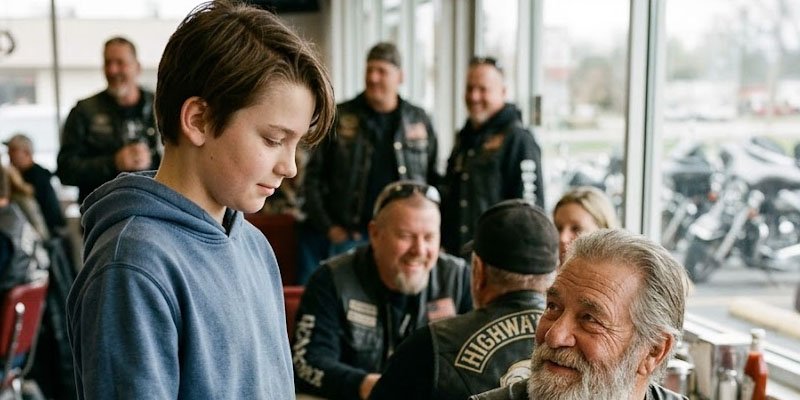
A man stepped inside. He looked somewhere in his late fifties, maybe sixty. His face was weathered, framed by a neatly trimmed silver beard. He wore a worn black leather vest over a faded flannel shirt, and his boots carried the kind of scuffs earned from walking roads most people would never travel. He wasn’t especially large, yet somehow he filled the doorway as though he belonged there.
His eyes settled on the boy. Then they shifted to Garrett. Finally, they returned to the boy again.
“Sit back down, son,” he said quietly. His voice wasn’t loud. It didn’t have to be.
The boy paused uncertainly. Garrett took a step closer. “Sir, that kid isn’t a customer. I already told him to—”
“I heard exactly what you told him.” The man walked straight past Garrett as if he were nothing more than a piece of furniture, then took the seat across from the boy. Without removing his vest, he slowly reached inside it—and every person in the diner fixed their eyes on his hand.
He pulled out a menu.
Then gently slid it across the table.
“Order whatever you’d like.”
Garrett’s expression tightened. “Now wait just a minute, you can’t just—”
Then every person inside heard it.
A deep, rolling rumble. It wasn’t thunder. It wasn’t the sound of a passing truck. It was heavier than that. The sort of vibration you could feel in your chest before your ears fully recognized it.
Motorcycles.
Looking through the front window, I watched them arrive. One bike. Then three more. Then ten. Then even more after that. They kept rolling into the parking lot, moving slowly and deliberately, engines growling while their headlights sliced through the late afternoon like wolves closing in around a campfire.
They didn’t scatter across the lot. Instead, they positioned themselves in a broad half-circle facing the diner. Forty motorcycles. Maybe even more. Every rider wore the exact same patch across the back of their vest.
Garrett’s face lost all its color almost instantly.
The man sitting in the booth never glanced toward the window. His eyes stayed locked on Garrett as he reached into his vest one more time.
If you’d like, I can also make it more suspenseful, more cinematic, or more suitable for YouTube storytelling while keeping the same plot.
This time, he removed a laminated identification card and carefully placed it on the table.
From where I was sitting, I couldn’t make out what it said. Garrett could. He bent down for a closer look, narrowed his eyes, then jerked backward as though he’d just touched a live wire.
The entrance door opened once more. A woman dressed in biker leathers stepped inside, followed by two other men. None of them took a seat. They remained by the doorway with their arms crossed, silently observing everything.
The man sitting across from the boy finally broke the silence again. He spoke five words to Garrett that made everyone in the diner stop breathing for a moment.
He said, “The boy you kicked out… is my client, and your new boss.”
Silence.
Not ordinary silence. It was the kind that weighed down the entire room, draining every bit of air from it. Somewhere a few booths away, a fork clanged against a plate, sounding as loud as a gunshot.
Garrett simply stood there, staring with his jaw hanging open. His eyes shifted from the calm confidence in the man’s face to the boy, who appeared just as bewildered as everyone else.
“My… boss?” Garrett muttered, letting out an uneasy laugh. “That’s funny. He’s just some homeless kid. Now get out of my diner before I call the police.”
The man in the leather vest remained completely composed. He merely tapped the laminated card resting on the tabletop.
“My name is Arthur Connelly,” he said. “I’m an attorney. That card is my official state bar identification.”
Then, for the third time, he reached inside his vest, moving even more deliberately than before, and removed a thick manila envelope. He laid it gently on the table.
“And this,” Arthur said in an even tone, “is the final will and testament of Merle Buchanan, the owner of this diner.”
Garrett’s forced grin disappeared in an instant. “Merle? What does Merle have to do with any of this?”
“Merle died four days ago,” Arthur replied quietly. His words settled over the room with unmistakable finality.
A shocked gasp came from the kitchen entrance. Donna, a waitress who had worked there for two decades, covered her mouth with her hand. She had known Merle ever since she was a young girl.
“He was a good man,” Arthur continued, keeping his eyes fixed on Garrett. “A private man who rarely let anyone close. So private, in fact, that I imagine you assumed he didn’t have anyone left in his life.”
Garrett remained speechless. His expression had become a mixture of disbelief and growing fear.
Arthur turned toward the boy, whose name we would soon discover was Sam. His features softened noticeably. “But he did. He had a daughter. And she had a son.”
He faced Garrett once again, and the firmness returned to his voice. “This is Samuel Buchanan, Merle’s grandson. According to this legally binding document, he inherits everything Merle owned. Including this diner.”
Sam looked at Arthur with exhausted eyes filled with countless questions. “My… my grandpa?”
“Yes, son,” Arthur answered gently. “Your grandfather.”
“But I thought…” Sam whispered so quietly it was barely audible. “My mom always told me he never wanted us around.”
A look of genuine sadness crossed Arthur’s face. “Your mother and your grandfather had a falling out many years ago, son. It’s a long story. But he never stopped caring about you. He was simply an old man who never figured out how to repair what had been broken.”
Arthur slid a plate of crackers closer to Sam. “He left all of this for you. He wanted you to finally have somewhere you could call home.”
At last Garrett found his voice, though it came out in a nervous, high-pitched squeak. “This is ridiculous! You can’t honestly expect anyone to believe this. I’ve managed this place for twelve years! Merle was planning to sell it to me!”
“Was he?” Arthur replied, lifting one silver eyebrow. “Because the records I have tell a different story. Your supply expenses are thirty percent higher than they should be, while revenue has fallen by twenty percent over the past year.”
He leaned forward slightly. “It almost appears as though someone has been manipulating the books, making the business seem far less valuable so they could purchase it at a bargain.”
Every trace of color vanished from Garrett’s face. He understood. This man already knew everything.
“I have no idea what you’re talking about,” Garrett protested, glancing around the room for support that never came. Everyone simply watched the disaster unfold.
“Merle knew,” Arthur replied. “He hired an independent auditor six months ago. He was only waiting for the right moment to fire you. Unfortunately, he passed away before he had that opportunity.”
Arthur motioned toward the entrance, where the three bikers still stood without moving. “He did, however, have loyal friends. He had family. Those men and women outside? They belong to the Sons of Redemption, a club Merle helped establish after returning from military service.”
“We’re a veterans’ organization,” Arthur explained to everyone in the diner. “We take care of our own. And Merle was one of our brothers.”
He looked back at Sam. “Your grandfather was a hero, son. In more ways than you can imagine.”
Sam could only stare at the will lying on the table, then at the bikers standing by the entrance, and finally back at Arthur. A lone tear carved a clean trail through the dirt on his cheek. He hadn’t been waiting for an uncle after all. He had been waiting for a ghost. He had come to the only place he knew, hoping to meet a grandfather he had never known, unaware that he had arrived too late.
If you’d like, I can also rewrite the next section in the exact same style and consistency.
“I… I don’t even know how to run a diner,” Sam murmured, his voice trembling.
“You won’t have to figure it out by yourself,” Arthur replied gently. “Not on your own.”
He gestured toward the bikers. “We’ll stand with you. It’s a promise we made to Merle.”
At that moment, Donna, the longtime waitress, stepped out from the kitchen. Tears glistened in her eyes, yet there was a warm smile on her face.
She looked directly at Sam. “Your grandfather was the finest boss I’ve ever worked for. He gave me a chance when nobody else would.”
Then her expression hardened as she turned toward Garrett. “And this man… he’s been poisoning this place ever since Merle got sick. He slashed our hours, barked at the staff, and treated customers with no respect.”
She raised a shaking finger toward Garrett. “He’s the reason this business has been struggling. Not the economy. Him.”
One of the cooks standing in the kitchen entrance nodded in agreement. The fear Garrett had used to control the employees had finally disappeared.
With nowhere left to hide and everyone watching, Garrett did the only thing a coward would think of. He charged forward.
Not toward Arthur. Not toward the bikers.
He lunged at the will lying on the table, reaching desperately for the envelope, hoping to rip it apart and erase the proof that would destroy him.
He never got the chance.
One of the bikers by the entrance moved far faster than someone his size should have. Within two long steps, he was beside Garrett, gripping his shoulder with a hand that felt like solid steel.
Garrett cried out in pain.
“I don’t think that’s happening,” the biker said in a deep, rumbling voice.
“That’ll do, Tiny,” Arthur said calmly.
Tiny—whose nickname couldn’t have been less accurate—let out a grunt and released Garrett, who staggered backward while clutching his aching shoulder.
“Leave my diner,” Sam said.
It was the first time he had spoken with real confidence. His voice remained soft, yet the words carried through the silent diner.
He met Garrett’s eyes. Grief and determination filled his young face, making him seem far older than his years. “This was my grandfather’s place. You don’t belong here anymore. Leave.”
Garrett stared at him, his anger slowly collapsing into helpless disbelief. A quiet old man, a lawyer in biker leathers, and the twelve-year-old boy he had tried to throw out over a free glass of water had brought him down.
Without another word, he spun around and hurried out through the back door, his clip-on tie hanging crookedly.
For a brief moment, the diner fell completely silent.
Then Arthur slid the menu back across the table toward Sam. “Now… like I told you before. Pick whatever you want. It’s all on the house.”
For the first time, a small smile, blurred by tears, appeared on Sam’s face. “Could I… could I have a cheeseburger? Maybe with some fries?”
“You can have as many cheeseburgers as you’d like,” Arthur replied with a grin.
Then he looked over at Donna. “And I have a feeling the folks outside could use a meal too. Get the grill going. The Sons of Redemption are treating everyone today.”
The entire diner seemed to exhale together. The heavy tension disappeared, replaced by quiet laughter and cheerful conversation.
During the next hour, I witnessed something remarkable.
The bikers came inside one after another, not as intimidating strangers but as respectful guests. They filled the empty booths, their leather vests creaking softly as they spoke in calm voices. They weren’t just bikers—they were plumbers, electricians, mechanics, teachers, grandfathers, brothers. They were Merle’s family.
Each of them introduced themselves to Sam, taking turns shaking his small hand with rough, hardworking hands. They shared stories about his grandfather—his quiet generosity, his stubborn determination, and his famously awful jokes.
They were giving Sam something he had never possessed before.
They were giving him his family’s story.
Donna and the kitchen crew worked nonstop, laughing as they called out orders. Burgers covered the grill while baskets of fries bubbled in the hot oil. The diner felt livelier than I had ever seen it.
Sam remained in his booth with a cheeseburger half finished in his hands, quietly listening to every story. He was no longer the lonely, exhausted boy who had walked through the door earlier that afternoon. He had become the center of a family he never knew existed. At last, he was home.
I finished my meatloaf, paid for my meal, and left Donna the largest tip I’d ever given anyone. As I made my way toward the exit, I passed the corner booth.
Arthur was sketching columns on a napkin while explaining them to Sam. “This is your inventory,” he said, pointing to one section. “And this is your payroll. The most important rule in business, Sam, is simple: always take care of the people who take care of you.”
Sam listened carefully, taking in every single word.
News about what happened at Merle’s Diner spread through our small town almost overnight. People stopped by just to meet the new owner—a quiet young boy surrounded by a family of leather-clad protectors.
They didn’t simply save the diner. They transformed it. Using their different trades, the bikers repaired the leaking roof, fixed the faulty wiring, and freshened the building with a brand-new coat of paint.
Every afternoon after school, Sam was there. He learned how to clear tables, operate the cash register, and welcome customers. He even learned the secret recipe his grandfather had always used for the diner’s famous chili.
Everyone eventually discovered that the crumpled dollar he had offered Garrett was literally the last dollar he owned. He had run away from a foster home in a neighboring town, a place where he had always felt like a case number instead of a child. He had been trying to reach the only family he believed he still had.
The diner became his safe place. The bikers became his family. Arthur became the uncle he had been hoping to find.
A person’s true worth is measured not by what they own but by what they choose to give. It’s revealed in the kindness shown when nobody is watching and in the respect offered to people who have nothing to offer in return. Merle had lived according to that belief, and in the end, that legacy proved far more valuable than any building or bank balance.
Garrett treated a child as though he mattered to no one, and because of that choice, he lost everything. Sam arrived with nothing at all, yet he gained a home, a future, and a family because one man chose to see a human being instead of seeing a burden.
That day, inside a small diner along Route 9, a lost boy finally found what had always belonged to him. It wasn’t merely a restaurant—it was a community built on the simple but powerful belief that everyone deserves a place at the table.