Part 1: The Question That Exposed Everything
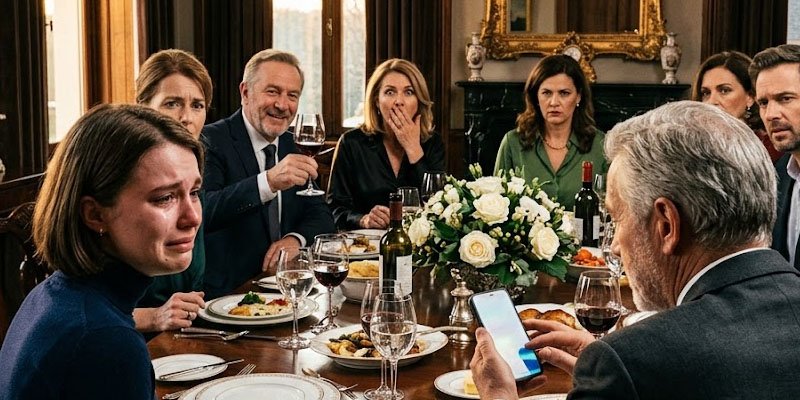
My father asked a single question, and the entire dining room instantly fell into silence.
“Why did you come here in a taxi, Jenna? Where’s the Honda Civic I gave you?”
Across the table, my husband Patrick quietly continued cutting his steak, looking completely unbothered, as if he had done absolutely nothing wrong.
For the past three years, I had been softening the truth about his behaviour in my own mind.
Whenever he insulted me, I convinced myself it was just his sense of humour. When he criticised the way I spent money, I called it financial responsibility. When he used my credit card without asking, I reminded myself that marriage was supposed to be built on trust.
Most of that money always ended up with his mother.
In the beginning, Patrick insisted she needed help paying for medication. After that came home repairs, church contributions, new tyres, presents, and unexplained medical expenses that I was never allowed to verify.
Every favour was described as temporary.
Every concern I raised was treated as proof that I was selfish.
My father recognized the changes in me long before I was willing to admit them. He noticed how I glanced at Patrick before speaking and how anxious I became whenever the subject of money came up.
My father, however, had one principle when it came to his grown children.
He offered advice only once.
After that, he simply waited.
Six months before that dinner, he surprised me with a silver Honda Civic.
It was dependable, practical, and safe—exactly the kind of gift my father believed was worthwhile.
“This car is yours,” he told me as he placed the keys in my hand. “Not the family’s. Not Patrick’s. Yours.”
Along with the keys, he handed me a folder containing the insurance papers, registration, and all the vehicle documents. Attached to the front was a yellow note that read:
Keep this in your desk, not the glove compartment.
At the time, I assumed he was simply being extra cautious.
That car slowly returned pieces of my independence.
I could drive myself to work without asking Patrick. I could stop at the grocery store or visit my parents without feeling obligated to explain every trip.
For the first time in years, I remembered what it felt like to be free.
Then Patrick began bringing up his mother.
At first, he complained that her car was old and embarrassing.
Later, he argued that I hardly ever used mine.
Eventually, he turned it into a question of morality.
“You’re letting an older woman struggle while you keep a car you barely even need.”
I refused.
He asked again.
I refused again.
By the third attempt, he acted as though my opinion no longer mattered.
One Thursday evening, I walked out of work and found that my Civic had disappeared from the parking lot.
For a brief moment, I believed someone had stolen it.
I called Patrick over and over.
Six minutes later, a text message appeared.
Don’t start. Mom needed it. We’ll talk when you get home.
While I was at work, he had taken my car and handed it over to his mother.
I had no choice but to take a taxi home.
Patrick insisted I was overreacting and said countless people managed perfectly well without owning a car.
His mother sent me a single message:
Thank you for understanding sacrifice.
But sacrifice is meaningful only when it is freely chosen.
No one had asked for my choice.
For almost two weeks, I remained silent.
Instead, I quietly gathered evidence.
I saved every text Patrick sent, every taxi receipt, every credit-card notification, and even took a photograph of the empty parking space outside my office.
I wasn’t completely sure what I was preparing for.
I only knew that Patrick had become remarkably good at making me question my own memories.
By the evening of my parents’ monthly family dinner, I felt completely drained.
My taxi arrived at 7:18.
Patrick was already sitting at the table.
He didn’t appear ashamed.
He looked perfectly at ease.
My father watched as I walked inside. His eyes moved from my handbag to my shoes before briefly looking toward the driveway.
Once I took my seat, he calmly asked where the Civic was.
I was about to lie.
I had already decided to say it was in the repair shop because protecting Patrick had become second nature.
But before I could speak, he answered first.
“I gave it to my mother,” he replied. “She needed it more.”
He went on to explain that his mother felt ashamed of driving her old car and insisted I could easily rely on taxis instead.
The entire table fell silent.
Patrick spoke as if the car had always been his and he had every right to decide who should have it.
My father never raised his voice.
He looked directly at Patrick and offered a faint, controlled smile.
“I understand,” he said.
Patrick visibly relaxed.
He was certain he had come out on top.
Then, hidden beneath the table, my father quietly picked up his phone and sent a message.
Part 2: The Car He Never Owned
Dinner went on, but the mood in the room had completely shifted.
Patrick carried on talking about business deals, investments, and influential connections, clearly believing the awkward exchange was behind him.
Then his phone started ringing.
“It’s my mother,” he said confidently.
He answered with a smile.
Within moments, that smile disappeared.
“Mom?” he asked. “Slow down. What happened?”
Everyone watched the expression on his face change.
His shoulders became tense.
Then he said, “Don’t sign anything. Tell me you haven’t signed anything.”
At that moment, my father’s phone vibrated.
He looked at the screen before quietly turning it toward me.
The picture showed my Honda Civic parked under the bright lights of a petrol station near Patrick’s mother’s church.
A tow truck was positioned in front of it. A man carrying a clipboard was speaking with Patrick’s mother while she argued and gestured angrily with her hand.
Across the top of the document displayed on my father’s phone were the words:
Hale Surgical Associates.
That was the moment everything about the folder made sense.
My father had obtained the Civic through an employee vehicle assistance programme connected to his medical practice.
Although the car had been assigned solely to me, the programme still retained legal protections over the vehicle.
Patrick had absolutely no legal authority to give it to anyone.
His mother had no legal right to keep it.
The man standing beside the tow truck was not an ordinary towing operator.
He was the fleet compliance manager for the medical group.
My father had contacted him while sitting quietly beneath the table.
Patrick slowly lowered his phone.
“Richard,” he said uneasily.
My father carefully placed his knife and fork side by side.
“You gave away a vehicle that was never yours.”
Patrick tried to laugh it off.
“This is family.”
My father gave a slight nod.
“That is precisely why I asked you in front of the family.”
Then he instructed Patrick to put his mother on speakerphone.
Her angry voice immediately echoed through the dining room.
She complained that someone was taking the car away from her and insisted Patrick had promised it belonged to her now.
My father answered in a calm, steady voice.
“Mrs. Collins, the Honda Civic was never Patrick’s to give away. Please hand the keys to Mr. Alvarez and sign the release confirming you accepted the vehicle without authorization. If you refuse, he will notify the police.”
She stopped shouting at once.
After a long pause, she spoke quietly.
“Patrick told me Jenna had agreed.”
Every person seated around the table turned to look at me.
“I did not,” I replied.
My voice remained steady.
Patrick turned to me with anger in his eyes.
“You could have helped my mother.”
There it was again.
He had taken my car, deceived his mother, and embarrassed me, yet somehow he still tried to convince everyone that the real problem was my unwillingness to be generous.
My father paid no attention to him and asked me a single question.
“Jenna, would you like the car brought back here or to your apartment?”
It was the first time in months that someone had asked what I wanted.
“Here,” I answered.
Patrick looked at me in disbelief.
“You’re really going to do this?”
“No,” I replied. “You already did this. I’m simply done paying the price for it.”
My brother was the first to stand.
Then my cousin and my uncle got up from their seats.
No one threatened Patrick.
They didn’t have to.
The room he had expected to stay quiet was no longer on his side.
My father instructed him to wait in the study until his ride arrived.
“Jenna will not be leaving with you tonight.”
Patrick let out a laugh, but the fear beneath it was impossible to miss.
“She’s my wife.”
My father’s expression never changed.
“She is my daughter. More importantly, she is her own person. You seem to have forgotten both.”
I walked upstairs to my childhood bedroom, locked the door, and sat on the bed, trembling.
At exactly 9:16, the Civic was returned.
My father set the keys on the dresser beside me.
He also handed me a folder containing the recovery report, the unauthorized-transfer release signed by Patrick’s mother, and copies of Patrick’s messages admitting exactly what he had done.
“You don’t have to make every decision tonight,” he said.
It was the kindest thing anyone had said to me in months.
Part 3: The First Step Out
I didn’t make every decision that night.
But I made enough.
I did not go home with Patrick.
The next morning, I called my bank, removed him as an authorized user, and changed every password connected to my accounts.
My brother came with me to the apartment while I packed my belongings.
Patrick shifted constantly between apologizing and becoming angry.
One moment he promised everything would change.
The next, he accused me of destroying our marriage over a car.
His mother called me selfish, overdramatic, and heartless.
Then my father’s attorney requested that every future conversation be kept in writing.
After that, her calls stopped.
People like Patrick relied on confusion.
Written records took away the uncertainty he needed to manipulate me.
Over the next several weeks, I realized how much of my life had been reorganized to make his life easier.
My credit cards had paid for far more of his mother’s expenses than I had ever understood.
Patrick had also been telling friends that I was irresponsible with money while secretly using my accounts so he could appear generous.
The Civic was never the beginning of his behavior.
It was simply the first thing he stole that he had become confident enough to admit in public.
The divorce itself was not dramatic.
It consisted of paperwork, signatures, passwords, bank records, and stacks of cardboard boxes.
Some nights, I lay awake wondering if I had been too unforgiving.
Then I would open the evidence folder beside my bed.
Patrick insisted the car had all been a misunderstanding.
The documents proved otherwise.
He claimed I had given my permission verbally.
His own messages contradicted that claim.
He accused my father of manipulating me.
My attorney answered by asking why a grown husband believed he needed approval from his father-in-law in order to avoid giving away his wife’s car.
Six months later, I still drive the Civic.
There is a small scratch on the rear bumper left by the towing equipment.
At first, I hated seeing it.
Now I refuse to have it repaired.
It reminds me that getting something back does not erase the harm caused when it was taken away.
It also reminds me of that dinner table.
The silence.
The blue glow from my father’s phone beneath the white tablecloth.
And the exact moment I stopped protecting a man who had never protected me.
For three years, Patrick convinced me that staying silent was the easiest way to survive our marriage.
That night, my father taught me a different lesson.
Silence is not always a sign of surrender.
Sometimes it is simply the final breath before the truth is finally spoken.