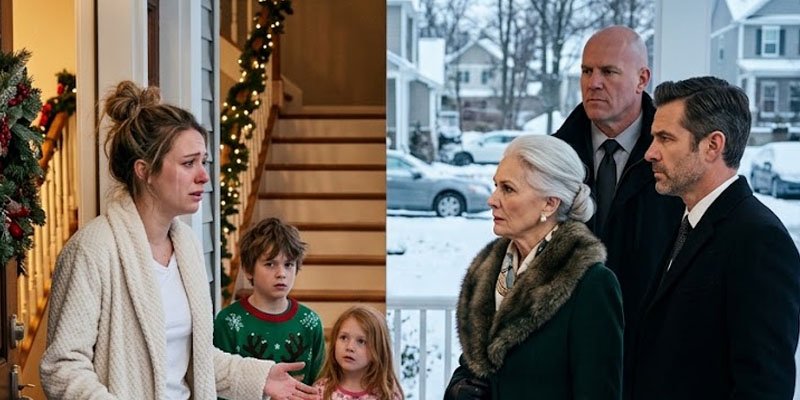
On the first occasion my mother tried to take me home, she appeared at six in the morning with two men in dark coats and a folder bearing my signature. On the second occasion, she attempted to erase my children from our family history. But the biggest surprise wasn’t what my mother did. It was what my father had arranged thirteen years earlier, knowing he might never get the chance to explain. When at last I uncovered his secret, my mother had already made a mistake that would change everything. My name is Claire Whitmore. I’m thirty-nine, divorced, and raising two children who have taught me more about love than anyone else. Until last Christmas, I believed my greatest failure was never making my mother proud. I had been mistaken. My actual mistake was believing I had to earn my place in my own family. Everything started with a casserole, two Christmas sweaters, and one unforgettable phone call. On Christmas afternoon, almost every driveway in our Marshfield, Wisconsin, neighborhood was filled with visiting family members. Except ours. I was standing in the kitchen holding a warm casserole wrapped in a towel, looking at my phone once more. My eleven-year-old son, Noah, stood waiting by the door in his green reindeer sweater. His eight-year-old sister, Sophie, wore a red Christmas sweater with a tiny silver bell near her shoulder. It jingled each time she moved. Usually, I adored that sound. That afternoon, it only increased my anxiety. “Mommy, when are we going to Grandma’s?” I took a quick look at the clock. 2:07 p.m. “Soon, sweetheart. Grandma probably has more cooking to finish.” I’d already given that explanation twice. Six days earlier, my mother, Evelyn Whitmore, had invited us to Christmas dinner at the farmhouse. She’d specifically mentioned my children. “Bring those babies,” she’d said. “And don’t forget your casserole.” She promised to text the time after confirming Aunt Carol’s arrival. I ought to have followed up sooner. But even at thirty-nine, a part of me continued to hope this Christmas might turn out differently. Noah entered carrying a pie box. “Should I put this in the van?” “Not yet, buddy. The roads are icy. Let’s wait for Grandma’s call.” He gave a nod, left the pie on the counter, and returned to the door. He made no complaint or ask why nobody had called. He just waited. Later, that quiet moment would stay with me more than almost anything else. My son wasn’t merely excited about visiting his grandmother. He seemed like a child who had already learned that family affection wasn’t always dependable. At 2:15, I called. Mom answered on the fourth ring. “Hello, Claire!” She sounded cheerful. Behind her, I heard silverware, moving chairs, conversations, and laughter. A smile came automatically. “Hey, Mom. What time should we come over?” She paused. Then came the words I’ll never forget. “Oh, honey, we already ate.” For an instant, I couldn’t make sense of them. “What?” “We had dinner at noon this year. It worked better.” I looked toward the hallway. Noah was watching. Sophie held her little Christmas purse, filled with handmade cards for her grandparents. “You already ate?” “Well, Aunt Carol arrived early, and everyone was hungry. We couldn’t let the food get cold.” Then I heard my younger sister, Jenna, laughing. It wasn’t an awkward or apologetic laugh. It sounded amused, almost as though she’d anticipated my reaction. “Claire?” Mom interrupted. “Don’t make a big thing out of it.” I had no answer. Six days earlier, she’d invited my children. They’d chosen their outfits, wrapped presents, and counted down the days. Sophie had spent two evenings making a paper angel for Grandma’s tree. Yet everyone had eaten without us. No call. No message. Not even a question about where we were. “Okay, Mom,” I murmured. “Well, Merry Christmas, sweetheart.” I ended the call. Noah studied my expression. “Is Grandma ready?” I swallowed hard. “Plans have changed.” Sophie looked confused. “What plans?” “We’re having Christmas dinner right here.” I attempted to sound excited, as though it were a marvelous surprise. Our home was half of a modest duplex, with no dining room, just a kitchen counter and three stools. Still, I took out our nicest plates. I lit a vanilla candle from a school fundraiser, served the casserole, and cut generous slices of pie. Sophie arranged paper napkins beneath every plate. Noah softly removed the shoes he’d worn since lunchtime and placed them beside the door. Then He came back. “Mom?” “Yes?” He glanced at Sophie. “Was it us?” My heart dropped. “What do you mean?” “Did Sophie and I do something wrong? Is that why Grandma didn’t want us there?” “No.” My answer came too quickly, startling him. I spoke more gently. “No, sweetheart. Absolutely not.” “Are you sure?” I hugged him. “More sure than anything.” Yet other questions weighed on me. How had my children reached an age where they felt responsible for an adult’s choices? And why had I spent years trying to please family members who couldn’t even save two places at Christmas dinner? Later that evening, we watched Christmas movies. Sophie fell asleep against my shoulder, still wearing her sweater. Noah stayed until the final credits. Before heading upstairs, he turned around. “Mom?” “Yeah?” “I’m glad we stayed home.” I smiled. “Me too.” He paused uncertainly. “It was better here anyway.” Only after he went upstairs did I At last allowed myself to cry. I washed our three plates in the quiet kitchen. Then I opened the drawer beside the stove. Inside lay a thick bank envelope. Four words were written across it in my handwriting. MOM — TAXES, JANUARY. Inside was $5,200. I’d saved it throughout the previous year. Twenty dollars some weeks. Fifty whenever possible. Occasionally a hundred, provided nobody needed shoes, school supplies, or medicine. Every Friday after payday, I added something. Not for a vacation. Not for a better vehicle. Not even for the emergency savings we badly needed. It was for my mother’s property taxes. Taxes on a farmhouse where my children hadn’t been included in Christmas dinner. Holding that envelope, I recalled all the things I’d told Noah and Sophie we couldn’t afford. A weekend at Wisconsin Dells. Sophie’s swimming lessons. New winter boots for Noah, whose classmates had begun noticing the duct tape holding his old pair together. Yet I’d saved $5,200 for family members who hadn’t thought to contact us on Christmas. I took a seat gradually. For the very first time, I confronted a question I’d avoided for decades. If I ceased supporting my mother financially, would she still want me around? The possibility frightened me. Because somewhere inside, I had a suspicion I already knew the answer. To see why I kept paying, you need to know about the farmhouse. It stood twenty-five minutes outside Marshfield, beyond a gravel driveway bordered by sugar maples. White siding. Green shutters. A wide porch with a swing Dad built when I was thirteen. The property included twelve acres of pasture, an aging machine shed, and a maple dining table that could accommodate nearly every visiting relative. My father, Paul Whitmore, repaired industrial machinery at a cheese plant. He was quiet and practical. He smelled of motor oil, coffee, and the peppermint candies he carried in his shirt pocket. When something broke, Dad repaired it. When someone needed support, he didn’t deliver speeches. He showed up. My mother, Evelyn, was different. She could command any room. She determined seating arrangements, dessert assignments, and which family issues could be discussed. I was the oldest daughter. The dependable one. Jenna, six years younger, was everyone’s baby. Beautiful, charming, and constantly “finding herself.” When Jenna missed a payment, someone covered it. When she damaged a car, Dad helped replace it. When she left beauty school, Mom praised her bravery. When I earned a scholarship and worked two college jobs, Mom simply said, “Well, of course. Claire’s always been independent.” She presented my independence as a compliment. In the end, I At last grasped what it meant. Because I could manage alone, nobody felt obligated to help me. At seventeen, I balanced my parents’ checkbook. At twenty-two, I organized Dad’s health insurance paperwork. At twenty-eight, I lent Jenna money for a salon lease. Then, at thirty, I made a financial decision that changed my future. Dad d!ed unexpectedly in the fall of 2013. One moment, he was repairing an old tractor in the machine shed. Soon afterward, an ambulance was heading down our driveway. He passed away before I reached the hospital. I can still recall standing beneath those fluorescent lights, struggling to accept that the person who’d always made me feel secure would never answer another call. Five months later, Mom asked me to visit the farmhouse. I was seven months pregnant with Noah. My husband, Eric, drove me after work. Mom sat at the maple dining table, surrounded by paperwork. She’d been crying. “Your father left me in a terrible situation,” She said softly. There was a second mortgage. Forty-six thousand dollars. Some debt came from medical expenses. The rest involved money Dad had borrowed after Jenna walked away from her beauty salon lease. The farmhouse secured the loan. The bank was requesting payment. Mom slid the notice toward me. “I have no idea what I’m going to do.” Eric and I had exactly $46,000 saved. Six years of careful budgeting. Six years of inexpensive apartments, delayed vacations, and secondhand furniture. We’d planned to buy our first home before Noah arrived. I examined the notice. Then I gazed at my mother’s trembling hands. “I can’t lose this house,” she said. “It’s all I have left of your father.” She never explicitly asked for the money. She didn’t need to. Three days afterward, Eric and I transferred our entire savings to settle the debt. Our dream of owning a home vanished. Mom cried and hugged me. “You’re my angel.” Jenna sent a heart emoji. That was all. No repayment agreement. No acknowledgment of our sacrifice. No discussion about our future. Just another family emergency Claire had solved. As the years passed, the requests continued. A broken furnace. A replacement roof. Insurance payments. Property taxes. I’d become the emergency fund my family never bothered to establish. Then Eric and I divorced. There was no dramatic confrontation or affair. Just years of quiet resentment that In the end overwhelmed us. One evening, sitting across the kitchen table, Eric said something I have never forgotten. “Claire, I love you. But I can’t spend my life being the last person on your list.” I accused him of being unfair. He shook his head in response. “No. What’s unfair is that your mother gets our savings, Jenna gets endless excuses, and our family gets whatever remains.” I hated hearing it. Mostly because he was right. After our divorce, Eric moved into an apartment across town. We shared custody, and He stayed a devoted father. But I At last had to confront the consequences of decisions I’d always called love. The house we’d planned to buy was gone. So was our marriage. Yet somehow, I was still saving money for Mom. Until that Christmas. The week after Christmas, I did something completely new. I opened the envelope. I deposited $3,500 into savings accounts for Noah and Sophie. I settled an overdue dental bill. Then I booked three nights at an indoor waterpark resort in Wisconsin Dells. Our trip wouldn’t happen until spring break. But when I showed the children our reservation, Sophie squealed so loudly that our neighbor knocked to make sure everything was okay. Noah studied the pictures of the waterslides. “Really, Mom?” “Really.” He wrapped his arms around me. A real, full-body hug from my eleven-year-old boy. The kind he’d started giving less frequently. All at once, I At last grasped how much happiness I’d postponed while waiting for my family members’ approval. Seven days after Christmas, Mom called. I responded out of habit. “Claire, the property taxes are due. We need the fifty-two hundred.” No greeting. No apology. Not even a question about the children. Only money. I took a quick look at our resort confirmation beside my coffee. “Oh, Mom,” I said calmly. “I already spent it.” Silence. “What?” “The money’s gone.” “Claire, that’s not funny.” “I’m serious.” “You know those taxes must be paid.” “Then you’ll have to arrange something else.” Her tone grew sharper. “That money was meant for the farmhouse.” I drew in a slow breath. “No, Mom. That money belonged to me.” She sounded genuinely shocked. “After everything I’ve done for you?” There it was. The recognizable sentence that once sent me reaching for my checkbook. This time, I stayed calm. “What have you actually done for me lately, Mom?” “How dare you?” “Did you even notice my children weren’t at Christmas dinner?” “Claire, we’re not discussing that again.” “We haven’t discussed it once.” “You’re being selfish.” I examined the photographs covering my refrigerator. Noah smiling with missing front teeth. Sophie wearing butterfly wings. All three of us were together at the county fair. My family. “I’m finished paying for the privilege of being treated like an inconvenience.” Then I ended the call. For the very first time, I didn’t call back to apologize. I believed the matter was settled. I was mistaken. The knocking began at exactly 6:03 The morning after. Three firm knocks. A pause. Then three more. I hurried downstairs in my bathrobe. Outside, darkness still covered the neighborhood. Snow lined the porch railing, while streetlights illuminated the icy road. When I opened the door, Mom stood there wearing her burgundy winter coat. Two unfamiliar men waited behind her. One carried a leather folder. The other held a clipboard. “Mom? What’s happening?” She moved forward. “Claire, we need to settle this nonsense.” I stayed in the doorway. “At six in the morning?” The taller stranger cleared his throat. “Mrs. Claire Whitmore?” “Yes?” “I’m Robert Hayes, an attorney. This is Henry Pike, a title examiner.” I looked between them. “Why are you here?” Robert glanced toward Mom. “We’ve been asked to clarify the legal status of the Whitmore farmhouse.” My stomach clenched. Mom crossed her arms. “Since you’re refusing to cooperate, certain matters need to be made official.” “What matters?” Robert opened his folder. “The property records include a document bearing your signature.” “What document?” “A trustee acceptance filed after your father’s passing.” I blinked. “I’m sorry. A what?” He produced an old document. The date read November 2013. At the bottom was a recognizable signature. Mine. Claire Whitmore. My pulse quickened. “I can’t make sense of.” Robert turned the page. “Your father transferred the farmhouse and surrounding acreage into a trust before his death. This document identifies you as successor trustee.” Mom’s expression shifted. “Robert, there’s no need to explain all that now.” He went on. “The issue is that your mother recently attempted to use the property as collateral for another financial arrangement. The records suggest she may lack the authority.” I faced her. “Another financial arrangement?” She avoided my eyes. “It’s a misunderstanding.” Henry stepped closer. “Mrs. Whitmore, you should understand that your mother may not personally own this property.” I tightened my grip on the doorframe. “What?” Robert showed me the paperwork. “According to the recorded documents, your father placed the farmhouse in a family trust.” I examined my signature. Behind that page was another document bearing a notary seal. Mom reached toward the folder. “That’s enough.” Robert kept it in his hands. “Mrs. Whitmore, these records must be properly addressed.” Mom faced me. “Claire, just sign what they need, and everything can return to normal.” Those recognizable words echoed in my mind. Just help. Just pay. Just one more favor. I gazed at the two men. “What exactly am I supposed to sign?” Robert paused. “A document confirming your mother’s authority to proceed with a proposed property transaction.” “What transaction?” Nobody answered. For the very first time, real fear appeared in Mom’s eyes. Then Robert spoke. “Mrs. Whitmore, I strongly recommend having your own attorney examine everything before you sign.” Mom turned sharply. “That isn’t what we discussed!” Robert closed his folder. “I’m explaining what she needs to understand.” Cold morning air brushed against my bathrobe. Behind me, the staircase creaked. Noah stood halfway downstairs, rubbing his eyes. “Mom?” I turned back. “Everything’s okay, honey. Go back upstairs.” He glanced toward the porch. “Grandma?” Mom Right away smiled. “Merry Christmas, sweetheart.” Noah remained still. Then He wanted to know with a child’s remarkable directness. “Are you here because Mom wouldn’t give you money?” Nobody spoke. Mom’s smile disappeared. I stepped onto the porch, pulling the door nearly shut behind me. “Whatever this involves,” I said, “you can discuss it with my attorney.” Mom gave a disbelieving laugh. “Your attorney? Claire, don’t be ridiculous.” “Then we’re finished talking.” I closed the door. My hands began to shake as I turned the lock. Through the window, I observed Mom arguing with Robert. He repeatedly shook his head. Henry stood nearby, looking uncomfortable. In the end, all three left. I stayed by the window until their vehicles disappeared. Then I examined the business card Robert had softly handed me. On the back was a handwritten warning. DO NOT SIGN WITHOUT COUNSEL. By nine o’clock, I’d called Eric. He responded Right away. “Are the kids okay?” “They’re fine. I need to ask something.” “What is it?” “Do you remember me signing documents at the farmhouse after Dad passed away?” He paused. “What documents?” I described the morning’s events. When I mentioned the family trust, he interrupted. “Wait. Say that again.” “Apparently, Dad placed the property in a trust.” “Claire, your father mentioned doing that years ago.” I took a seat. “He did?” “Yes. Remember when He hoped us to meet him at the bank?” A memory All at once returned. A cold November morning. Dad had been gone only a few weeks. Mom had given me a folder at the farmhouse, explaining that the bank needed updated paperwork. I was exhausted from grief. She assured me everything was routine. “I signed something,” I murmured. Eric sighed. “I remember. I told you to request a copy.” “But I didn’t.” “No.” I shut my eyes. “Why didn’t you say more?” “I did, Claire. Several times. Your mother said I was being suspicious, and you believed her.” His tone carried no accusation. Somehow, that made his words harder to hear. After a moment, he added, “Whatever this is, I’ll help you locate the old records.” I thanked him. Then I searched for a local attorney. Before noon, I’d arranged a meeting with Grace Mercer. Grace was in her early fifties, with silver-streaked hair, dark-framed glasses, and the unmistakable expression of someone who had little patience for unnecessary drama. Her office was on the second floor of an old brick building near downtown Marshfield. I brought every document I could gather. Bank statements. Tax receipts. The old mortgage payoff confirmation. Photographs of the paperwork Robert had shown me. Grace listened with care. When I finished, she leaned back. “Claire, I need to ask you something.” “Okay.” “Has your mother ever claimed she owns the farmhouse outright?” “Constantly.” “Has she shown you the deed?” “No.” Grace removed her glasses. “Then that’s where we’ll begin.” She turned her monitor toward me. A scanned county record filled the screen. My father’s name appeared at the top. Below it were the words: WHITMORE FAMILY LAND TRUST. The recording date was June 2012. More than a year before Dad passed away. Grace pointed toward another paragraph. “Your father transferred his ownership interest into this trust. Your mother retained certain rights to live there, but those rights had limitations.” “What does that mean?” “She could occupy the home under specific conditions. That doesn’t automatically authorize her to sell or mortgage it.” I fixed my eyes on the screen. “Then who owns the property?” “The trust.” “And who controls it?” Grace met my eyes. “Based on what we’ve discovered, Claire, that person may be you.” I felt dizzy. For thirteen years, I’d sent money to maintain what Mom called her house. For thirteen years, she’d insisted I owed her. Now I was learning that she might have been asking me to protect property she didn’t personally own. “Did she know?” I murmured. Grace paused. “We need more evidence before reaching that conclusion.” I gave a nod. But I was beginning to understand Mom’s reaction on my porch. After two days, the first substantial evidence emerged. Grace obtained additional property records and contacted the attorney who’d prepared Dad’s estate plan. His name was Joseph Keene. He’d retired years earlier and now lived near Wausau. When Grace called, he remembered Dad Right away. “Paul Whitmore,” he said. “Worked at the cheese plant. Always carried peppermint candy.” My eyes filled with tears. That was Dad. Exactly as I recalled him. Joseph explained that my father had inherited the farmhouse property from his parents. He’d established the trust because he was concerned about growing family debts. “He hoped to protect the land,” Joseph explained. “Especially against future borrowing.” I shut my eyes. Dad had understood the financial problems. He’d recognized where things were heading. Joseph continued. “He made it clear that his wife could remain in the farmhouse, but the property itself should be preserved for the next generation.” “Which generation?” Joseph hesitated. “I’d prefer Grace to examine the complete trust before we discuss its beneficiaries.” My heartbeat quickened. “Why?” “Because several provisions are unusual.” I took a quick look at Grace. She wrote something on her legal pad. Joseph added, “A complete trust binder should have been delivered to the successor trustee after Paul’s death.” “I never received one.” Silence. “Are you certain?” “Absolutely.” He sighed. “Then that’s our first issue.” After the call, Grace looked at me. “We need to locate that binder.” “Mom probably has it.” “That’s possible.” I shook my head gradually. “She’ll never hand it over.” Grace folded her hands. “Then we’ll request it formally.” Outside, snow drifted past the windows overlooking Main Street. All at once, this was no longer about $5,200. It concerned my father. And something significant he’d wanted me to understand. Mom called Later that evening. I observed her name appear before answering. “Claire, Jenna says you’ve hired some aggressive attorney who’s threatening our family.” “Grace isn’t threatening anyone.” “She’s demanding private paperwork.” “Documents containing my name.” Mom sighed. “Honestly, what’s gotten into you?” “What is the Whitmore Family Land Trust?” She fell silent. Then She wanted to know, “Where did you hear about that?” “County records.” “That’s ancient paperwork.” “It’s legally recorded paperwork.” “Your father loved complicated arrangements. Half of them never meant anything.” “Then why didn’t you tell me?” “Because you already had enough responsibilities.” I gave a humorless laugh. “Mom, I gave you $46,000 while I was pregnant.” “And I’ve thanked you countless times!” “Did you know I was the successor trustee?” “Claire—” “Did you know?” She lowered Her tone. “Your father wasn’t thinking clearly toward the end.” I tightened my grip on the phone. Dad had been exhausted. He’d mourned his older brother. He’d struggled with high bl00d pressure. But he’d remained perfectly capable of making decisions. “Don’t do that,” I said. “Do what?” “Don’t question Dad’s judgment just because you’re upset with me.” Her tone became icy. “You have no idea what it took to keep this family together.” “Then explain it.” Instead, she said something I’ll never forget. “That house belongs to me because I stayed. You can’t claim it just because your father signed some documents.” I stood frozen. She hadn’t denied knowing about the trust. Not once. Then She went on. “And after your stunt with the taxes, Jenna and I have every right to protect ourselves.” “Protect yourselves from what?” She ended the call. Three days afterward, Aunt Carol called. Carol was Dad’s older sister. At family gatherings, she was usually the quiet observer, bringing homemade bread and listening from the far end of the table. “Claire,” she began softly, “I owe you an apology.” “For what?” “Christmas.” I took a seat. She clarified that Mom had told everyone we weren’t attending. “She said the children had a stomach bug.” I fixed my eyes on the wall. “What?” “Your mother claimed you’d called that morning and asked everyone not to bother you.” I had no words. Carol continued. “I believed it was strange. Sophie had mentioned making me a Christmas ornament. But Evelyn sounded certain.” “Did Jenna know?” Carol hesitated. “Jenna suggested you were being dramatic because you and Eric had been arguing.” My face grew warm. Eric and I hadn’t argued in months. We’d even exchanged Christmas gifts with the children on Christmas Eve. “Carol, Mom invited us. She promised to send the dinner time. We spent Christmas afternoon dressed and waiting.” “Oh, Claire.” The sadness in Her tone nearly brought me to tears. She added afterward, “There’s something else.” “What?” “I saw two men at the farmhouse that afternoon. One wore a suit. Jenna introduced him as someone assisting with property planning.” I straightened. “Property planning?” “They had maps spread across the kitchen table. When I questioned about them, Evelyn told me everything was fine.” My pulse quickened. “What kind of maps?” “Survey maps, I believe. Colored lines marked different parts of the pasture.” I recalled Robert’s warning. The documents Mom wanted signed. Her sudden urgency about the property taxes. Carol lowered Her tone. “Claire, I don’t believe your mother forgot to invite you.” I shut my eyes. “I understand.” “No, sweetheart. I mean I don’t think She hoped you anywhere near that farmhouse.” The morning after, Grace discovered why. A development company from Eau Claire had offered to purchase part of the Whitmore property. The company wanted approximately ten acres for a distribution and storage facility. The proposed purchase price was astonishing. $1.35 million. I fixed my eyes on the figure. “That can’t be right.” Grace shook her head. “The property borders an expanding commercial corridor. Apparently, the company has been purchasing nearby parcels.” I examined the map. The pasture where Dad taught me to drive his old pickup. The maple trees. The machine shed. The pond where Noah caught his first fish. All marked inside a red boundary. “Mom agreed to sell?” “She signed a preliminary agreement. Jenna was named as an authorized representative.” My mouth went dry. “Authorized by whom?” “That’s part of the problem.” Grace handed me another document. My name appeared near the bottom. CLAIRE WHITMORE — SUCCESSOR TRUSTEE. Below it was a signature. My signature. Or something remarkably similar. The date was December 25. Christmas Day. At 1:11 p.m. I fixed my eyes on those details. At that exact time, I’d been standing in my kitchen checking my phone while my children waited to visit Grandma. I hadn’t been at the farmhouse. I hadn’t signed anything. “That’s not my signature.” Grace nodded thoughtfully. “I had a suspicion you’d say that.” I examined it more with care. The curve of the C. The extended tail on the final e. The small downward hook I once made when signing quickly. Everything looked recognizable. Too recognizable. Then I recalled the November 2013 document. I retrieved my copy. Placed both pages beside each other. And felt a chill. The signatures matched exactly. Not merely similar. Identical. Even a tiny break in the ink appeared in the same place. Someone appeared to have reproduced my old signature on a new document. Grace examined both pages. “That’s significant evidence that the newer signature may have been copied from the earlier record.” I struggled to process it. “So they didn’t simply exclude us from Christmas.” “No.” “They were using that afternoon to arrange the farm’s sale.” Grace looked grave. “That’s what we need to establish.” I leaned back. All at once, the pieces began fitting together. The early dinner. Jenna’s laughter. Mom’s refusal to confirm a time. The strangers examining survey maps. My children and I hadn’t simply been forgotten. It appeared we’d been deliberately kept away while they arranged a property transaction without my knowledge or authorization. Later that evening, I drove to Eric’s apartment. The children were staying with him, and I longed to discuss the documents in person. He opened the door wearing an old Packers sweatshirt. “Hey. What’s wrong?” I showed him the copied agreement. “Someone used my signature to sell Dad’s land.” His face changed. He invited me inside. I described everything. When at last I finished, he sat motionless. “Claire, this is more than a family disagreement.” “I understand.” “Have you contacted the authorities?” “Grace wants us to preserve all the evidence first.” He gave a nod. Then He glanced at me with real concern, something I hadn’t seen in years. “Are you okay?” I attempted answering. Instead, I burst into tears. Not softly or with care. I cried harder than I had since Dad’s funeral. Eric sat beside me. He stood waiting before offering a tissue. “I should’ve pushed harder back then,” he said. I shook my head gradually. “No. You tried.” “Not hard enough.” “You warned me. I just couldn’t accept what was happening.” He glanced down. “Your mother convinced you that refusing her meant abandoning her.” I wiped my cheeks. “She still believes that.” Eric met my eyes. “Then perhaps it’s time she understood the difference.” I stayed another hour. We discussed our children, our marriage, and how two people can care deeply for each other yet lose sight of what matters. Before I left, Eric retrieved a worn cardboard box from his bedroom. “These are old tax records from our marriage. I kept them after the divorce because I never got around to shredding anything.” He passed me the box. “Maybe something will help.” Later that night, I sorted through financial statements. Near midnight, I found out the original $46,000 transfer confirmation. The payment had gone directly to the bank. Dad’s mortgage really had been settled. Somehow, that discovery hurt almost as much as the questionable signature. Part of me had hoped the debt hadn’t been real. That perhaps we hadn’t truly sacrificed our first home. But we had. I’d helped save the farmhouse. And for eleven years afterward, the people living there continued treating my financial support as an obligation. The week afterward, everything intensified. Grace contacted the development company’s attorney, presenting evidence that the proposed sellers lacked clear authority to transfer the property. The transaction was suspended. An independent title examination began. Mom called eleven times that day. I ignored every call. Then Jenna texted. “You’re ru!ning Mom’s life over one stupid Christmas dinner.” I fixed my eyes on the message. Then replied: “Christmas dinner didn’t create the questionable signature.” Three typing dots appeared. Disappeared. Then returned. At last, Jenna answered. “You’re going to regret this.” I saved our conversation. Then blocked her number. After two days, a letter arrived from a private financing company. Mom and Jenna had received a substantial advance connected to the anticipated land sale. $105,000. The payment had been issued based on their representations that they possessed authority to complete the transaction. Now the company wanted explanations. I read the letter repeatedly. Mom hadn’t actually needed $5,200 for property taxes. Grace confirmed those taxes were already covered through agricultural lease income and available reserves. Instead, the $5,200 was intended for expenses and fees associated with the financing arrangement. Mom had misrepresented that, too. I recalled her words. “The property taxes are due. We need fifty-two hundred.” Not a request. An expectation. Another expense Claire was supposed to cover. Except this time, my payment might have helped advance a transaction involving a signature I hadn’t authorized. I felt nauseated. Grace noticed. “Claire?” “What if I’d given her the money?” She considered my question. “Then you might never have discovered what it was really for.” I looked outside. Snow drifted between nearby buildings. Year after year, I’d interpreted Mom’s financial demands as evidence that She required me. Now I At last grasped something far more troubling. She hadn’t simply needed me to save the farmhouse. She’d needed me to keep helping without asking questions. The following Friday, Mom appeared at my workplace. I worked in accounting for a regional medical supply company. The job wasn’t glamorous, but it covered our expenses and let me collect the children most afternoons. At 3:20 p.m., the receptionist called. “Claire, your mother’s here. She says it’s urgent.” My stomach clenched. I entered the lobby. Mom sat beneath a framed landscape photograph, holding her purse. She stood when she saw me. “Thank goodness.” “Mom, you can’t show up here.” “I’ve tried reaching you for days.” “Then contact Grace.” She glanced around. “Can we talk privately?” I took her into an empty conference room. Once the door closed, her expression hardened. “Do you understand what you’ve done?” I crossed my arms. “What exactly?” “The buyers are threatening legal action. Jenna is overwhelmed. I haven’t slept.” I looked straight at her. “Did you copy my signature?” Her lips parted. Then closed. “That’s a serious accusation.” “Did you?” “Your father wanted this family protected.” “That wasn’t my question.” She gripped the table. “Everything I’ve done was for our future.” “Whose future?” She appeared offended. “Our family’s!” I gave a bitter laugh. “Then why weren’t my children invited to Christmas?” Her eyes narrowed. “You’re still bringing that up?” “Yes.” “Claire, it was one dinner.” “No, Mom.” I moved closer. “It was eleven years of Noah learning not to expect birthday cards.” “Eight years of Sophie wondering why Jenna’s friends were welcome at your gatherings while she wasn’t.” “It was every emergency I helped pay for and every family celebration where we barely mattered.” Mom shook her head. “You’re exaggerating.” I put my hand into my bag and removed a photograph. Sophie wearing her red Christmas sweater. Noah standing beside her. Both waiting near our front door. I placed it on the table. “This is what happened.” Mom glanced at the picture. Then turned away. “They look fine.” All at once, I felt completely still. Not angry. Not even sad. Just certain. I lifted the photograph. “Please leave my workplace, Mom.” Her eyes widened. “Claire—” “Please.” She stood. In the doorway, she turned back. “Your father would’ve been ashamed of how you’re treating me.” I met her gaze. “Then I’m glad we’re finally discovering what he actually wanted.” Her face went pale. For an instant, I believed she might At last explain everything. Instead, she walked away. The farmhouse carried a recognizable scent I’d nearly forgotten. Aged wood. Coffee. Cinnamon. And a faint trace of the machine oil that once clung to Dad’s work clothes. Grace had arranged an inspection of the trust property, and Mom had reluctantly granted access. Neither Mom nor Jenna was home. Aunt Carol waited near the driveway. “I believed you might appreciate a familiar face,” she said. I hugged her. Inside, almost nothing had changed. The yellow curtains. The ceramic rooster on the counter. The long maple dining table beneath its chandelier. I ceased beside it. Seven chairs. Not nine. Seven. I recalled Mom saying she’d expanded the table for Christmas. I pictured my children entering with their with care wrapped presents. Then I recalled Noah asking whether they’d done something wrong. Carol noticed my expression. “Claire?” I shook my head gradually. “Let’s check Dad’s shed.” The machine shed stood behind the farmhouse, snow covering its metal roof. Inside, everything seemed frozen in time. Dad’s workbench remained beneath the narrow window. A steel vise was attached to one corner. Rusty coffee cans held screws, old tools lay scattered, and a calendar still displayed September 2013. I touched the vise. Dad had taught me to use it when I was ten. “Measure twice, Peanut,” he’d always say. “You only get one chance to cut it right.” I smiled through tears. Grace searched several filing cabinets. Most drawers were empty. But in the bottom drawer of a narrow metal cabinet, behind an old service manual, Carol discovered a sealed plastic pouch. Inside were photocopied documents. A handwritten inventory. And a letter. My name appeared across the envelope. CLAIRE. I sat on Dad’s stool. My hands began to shake as I opened it. The paper smelled slightly musty. His recognizable handwriting covered three pages. “My dearest Peanut,” it began. I ceased reading. Nobody had called me Peanut since Dad passed away. After several moments, I continued. Dad wrote about the farmhouse. About his parents’ sacrifices to preserve it. About the years he’d spent repairing machinery to support his daughters and maintain the property. Then came something unexpected. “I’ve made decisions I regret.” “I helped Jenna when that help sometimes prevented her from learning responsibility.” “And I questioned you to carry too much because you always made difficult things look easy.” My vision blurred. “I know your mother sees things differently.” “She believes the person who complains the least must need the least.” “I allowed her to think that for far too long.” I covered my mouth. Grace and Carol remained respectfully silent. Then I read the next paragraph. “One day, after I’m gone, someone may tell you that protecting this family requires sacrificing your own.” “Don’t believe it.” “A family that survives only because one person sacrifices everything isn’t being protected. It’s being allowed to remain broken.” I lowered the letter. For thirteen years, I’d wondered whether Dad would have expected me to keep paying. Now I had my answer. He’d noticed. He’d understood. And he’d tried to warn me. The final paragraph made me pause. “I couldn’t give you the life you deserved, Peanut. But I made certain there was something nobody could take from the family you create.” Below those words was a reference to another trust document. Schedule B. It wasn’t inside the pouch. Only a handwritten note remained. “Original deposited with Keene office, duplicate in sealed estate packet.” Grace examined it. Then looked at me. “We need Schedule B.” “Why?” “Because it identifies the final beneficiaries.” I examined Dad’s handwriting again. Something nobody could take from the family you create. My pulse quickened. Finding Schedule B took almost two weeks. Joseph Keene had retired, and his older files were stored off-site. The first copy we obtained was incomplete. Water had damaged several pages. Grace contacted the bank holding the original trust records. Meanwhile, matters with Mom deteriorated. The development company officially withdrew its offer. The financing company demanded repayment. Jenna hired her own attorney. And Mom began telling family members I intended to remove her from the farmhouse. Messages flooded my phone. “She’s your mother.” “How could you treat her this way?” “Your father would’ve never wanted this.” I ceased reading after the fifth message. Then an email arrived from an unfamiliar address. It contained a photograph. Mom seated at the Christmas table. Jenna beside her. Aunt Carol at the far end. Several cousins. Full plates. Smiling faces. The timestamp showed 12:47 p.m. Beneath the photograph was a message. “Maybe you should remember what family really means.” I fixed my eyes on the picture. Then something caught my attention. Beside the table’s edge sat a brown leather folder. The same folder Robert Hayes had brought to my doorstep. Behind Jenna, partly obscured by flowers, was a man in a gray suit. He wasn’t a relative. I enlarged the photograph. He was holding documents. Across the top was a recognizable logo. The development company’s. Mom hadn’t simply celebrated Christmas without us. She’d used Christmas dinner to conduct a business meeting. At the very table where Dad once said grace. I forwarded the photograph to Grace. She called almost Right away. “Claire, where did you find this?” “Someone emailed it anonymously.” “Do you recognize that man?” “No.” “Preserve the original email. Don’t modify anything.” “Why?” Her tone grew grave. “This could help establish who attended the meeting when those documents were signed.” I examined the photograph again. Year after year, I’d wondered why Mom favored Jenna. Now I had another question. How long had they been planning to disregard Dad’s wishes? Jenna provided the next answer herself. Three days afterward, she appeared outside my duplex. She wore an expensive designer coat. Her hair was perfectly arranged. But her eyes were red. “Can we talk?” She wanted to know. I considered shutting the door. Instead, I stepped onto the porch. “What do you need?” She glanced toward the neighboring houses. “Not out here.” “Then contact Grace.” “Claire, please.” Something about Her tone stopped me. For once, she didn’t sound demanding. She sounded frightened. I allowed her into the kitchen. She glanced around. The children’s drawings. Our inexpensive furniture. The mismatched mugs drying beside the sink. Then she spoke. “I didn’t realize money was so tight for you.” I stared. “What?” “You never told me.” I almost laughed. “When would you have listened?” She lowered her eyes. “That’s unfair.” “No, Jenna. What’s unfair is that I helped settle your salon debt while pregnant, and you laughed when Mom told me Christmas dinner was finished.” Her cheeks reddened. “I wasn’t laughing at the children.” “Then what was funny?” She averted her eyes. “Mom said you’d probably call at the worst possible time.” My chest tightened. “The worst possible time?” She rubbed her forehead. “The developer was there. Mom was trying to finalize everything.” “So she knew we were waiting.” Jenna stayed silent. “She knew.” “Claire—” “And you knew, too.” She glanced up. “Mom said if you came, you’d start asking questions about the property. She said you were always suspicious about money.” I fixed my eyes on her. “You knew I was bringing Noah and Sophie.” “Yes.” “And you didn’t tell me.” Her eyes filled with tears. “I believed Mom would call afterward.” I gave a disbelieving laugh. “After someone copied my signature?” Her face changed. “I didn’t do that.” “Then who did?” She shook her head in response. “I have no idea.” I observed her with care. For the very first time, Jenna seemed to realize how grave everything had become. “Tell me about the advance,” I said. She froze. “How much did you know?” Her silence was revealing. Finally, She said softly, “Mom said we’d split the money from the sale.” My heart dropped. “Split it?” “She said Dad never intended you to control everything. That the trust was a mistake.” “And you believed her.” Jenna wiped her cheeks. “She promised me half.” I glanced around my kitchen. The refrigerator’s dented handle. The worn flooring. The bills beside the microwave. Then I gazed at my sister. While I with care managed grocery expenses, Mom and Jenna were planning to divide more than a million dollars from property they didn’t personally own. “Where’s the $105,000?” I questioned. Jenna’s face crumpled. “Some paid Mom’s debts. Some paid mine.” “How much remains?” She shook her head in response. Very little. Possibly nothing. Then she said something unforgettable. “Mom said if you loved us, you’d sign whatever She required.” I fixed my eyes on her. All at once, our family dynamic became painfully clear. They didn’t seem to recognize my rights. They only recognized my responsibilities. Jenna stood to leave. In the doorway, she paused. “Claire?” “What?” “Mom doesn’t know I came.” “Okay.” She swallowed. “I’ve never seen her this frightened.” I gazed at my sister. “She has reason to be concerned.” The next discovery was more upsetting than I’d imagined. Grace called Tuesday afternoon. “Can you come to my office?” “What happened?” “I’d rather explain in person.” My stomach clenched. I drove downtown. Henry Pike was waiting in Grace’s conference room. He glanced exhausted. Several certified property documents lay on the other side of the table. Grace offered me a chair. “Claire, Henry located another filing connected to the proposed sale.” He passed me a document. Its heading read: AFFIDAVIT OF HEIRSHIP AND FAMILY STATUS. I frowned. “What is this?” “A sworn statement signed by your mother.” I began reading. It described Dad’s passing. His property. His surviving family members. Then I reached a paragraph that stopped me. “To the best of my knowledge, Paul Whitmore left no surviving descendants with a present claim to the property other than Jenna Whitmore.” I read it twice. Then a third time. My name was missing. So were Noah’s and Sophie’s. Only Jenna appeared. I raised my eyes. “She claimed Dad had only one daughter?” Grace nodded. “And no grandchildren with a relevant property interest.” I fixed my eyes on the document. “That’s false.” “Yes.” “She knows it’s false.” “Yes.” I flipped the page. Mom had signed before a notary. The date was December 25. Christmas Day. At 12:52 p.m. Five minutes after the photograph was taken. I felt overwhelmed. While my children waited in their Christmas sweaters, Mom had signed a sworn statement that omitted us as potential beneficiaries. She hadn’t merely left us out of Christmas dinner. She’d attempted to exclude us from the inheritance Dad intended for his family. I covered my face. For several moments, I couldn’t speak. Then a quiet question escaped. “Why would she do this to us?” Grace moved closer. “Claire, I can’t explain why your mother made these decisions.” I shook my head gradually. “I spent my entire life trying to make her happy.” My tone trembled. “I gave her our savings. I spent years helping her. My children love her.” I gazed at the document again. “And she signed something pretending we had no place in this family.” Henry lowered his gaze. Grace gently rested a hand on my shoulder. “She doesn’t get to make that true.” I began crying. Not because of the property. Not because of money. But because the document confirmed something I’d refused to accept. My mother hadn’t simply overlooked my children’s feelings. She was willing to leave them out of our family’s history whenever acknowledging them became inconvenient. When I At last calmed down, Grace offered me a tissue. “We’ll handle this carefully,” she said. “And we’ll follow the proper legal process.” I gave a nod. “Good.” For once, I wasn’t looking for an apology. I longed the truth officially established. The legal dispute continued for months. Meetings. Written statements. Document requests. Questions about the copied signature and inaccurate affidavit. The development company cooperated with the title investigation. The financing company pursued separate claims against Mom and Jenna. Robert Hayes withdrew from representing Mom once the conflicts surrounding the transaction became apparent. He provided relevant records through appropriate legal channels. Grace began proceedings to confirm the trust’s authority and prevent unauthorized property transfers. I discovered more about property law than I ever expected. I also discovered that being right didn’t make the experience easy. Mom’s friends stopped contacting me. Some family members accused me of trying to take an elderly widow’s home. Jenna alternated between apologizing and blaming me for their financial troubles. Every unexpected phone call made me anxious. But something remarkable happened. The less responsibility I accepted for everyone else’s emotions, the more peaceful our home became. I ceased checking messages during dinner. I ceased explaining why I couldn’t lend money I didn’t have. I discovered to say no without repeatedly apologizing. Sophie started swimming lessons. Noah got new winter boots. And when spring break arrived, we At last visited Wisconsin Dells. For three marvelous days, I observed my children race between waterslides, splash in the pool, and eat enormous stacks of pancakes. One evening, we sat beside our hotel window, watching lights shimmer across the water. Sophie leaned against me. “Mommy?” “Yes?” “Are we rich now?” I laughed. “No, sweetheart. Not even close.” She considered my answer. “Then how come we get to do fun things?” I gazed at her. Because I’d At last stopped giving away everything we had. Because I’d realized that enjoying life wasn’t irresponsible. Because my children deserved happy memories that didn’t depend on Grandma’s approval. Instead, I kissed her forehead. “Because sometimes we need to remember what matters most.” Noah looked up from his hot chocolate. “I like this version of our family.” My throat constricted. “Me too, buddy.” He added afterward, “But I liked the old version, too. When we stayed home for Christmas.” I smiled. “We were the same family.” He shook his head in response. “Not exactly.” “What do you mean?” He studied me with an expression unusually thoughtful for an eleven-year-old. “At Christmas, you still looked sad all the time.” I had no answer. He extended his hand on the other side of the table and squeezed my hand. “You don’t anymore.” In that moment, I knew our trip had been worth more than anything I’d ever given Mom. The original trust schedule arrived in April. Grace called while I was preparing spaghetti. “Claire, the bank found the sealed estate packet.” My heart skipped. “Schedule B?” “Yes.” “Does it explain what Dad wanted?” She paused. “It does. I’d like you to come tomorrow.” I fixed my eyes on the boiling pot. “Is something wrong?” “No. But there’s more than we anticipated.” I barely slept. The morning after, I dropped the children at school and drove downtown. Grace had the original packet waiting. Its envelope was yellowed but undamaged. Dad’s signature crossed the back flap. Inside were several pages identifying the Whitmore Family Land Trust’s beneficiaries. I’d expected my name. Perhaps Jenna’s. Maybe both. Instead, the wording surprised me. The trust designated me successor trustee. But its long-term beneficiaries were the children born to or legally adopted by me, along with their descendants. My hands began to shake. “Grace…” She gave a nod. “Your father didn’t leave the property directly to you.” I stared. “He left it to my children?” “Ultimately, yes. The trust protects your children and future generations.” I lowered my gaze. When Dad prepared these documents, Noah hadn’t been born. Neither had Sophie. Dad had never seen their faces. Never heard them laugh. Never held them. Yet he’d planned for their future. Tears filled my eyes. Grace waited. Then she turned another page. “There’s more.” The trust included detailed restrictions on selling, borrowing against, or transferring the property. Mom had received a conditional lifetime right to live in the farmhouse. She could occupy the home. Maintain it. Use the surrounding land within the trust’s rules. But she couldn’t mortgage it, sell it, or redirect its value for personal benefit. An unauthorized attempt to sell or use the property as collateral could also result in termination of her occupancy rights, subject to the trust’s required notice and enforcement procedures. I fixed my eyes on the page. “Did Mom know?” Grace met my eyes. “Your father required her written acknowledgment of these restrictions.” She showed me another page. There was Mom’s signature. Dated June 2012. More than a year before Dad passed away. My breath caught. She hadn’t simply misunderstood. She’d known about the restrictions all along. “Why would Dad arrange this?” I murmured. Grace hesitated. Then handed me another letter. It was separate from the one we’d discovered in the shed. Dad had written it when establishing the trust. The envelope was addressed: MY FUTURE GRANDCHILDREN. I held it against my chest before opening it. Inside, Dad had written: “I have no idea your names yet. I have no idea whether you’ll resemble your mother or inherit her stubborn personality. But if you’re reading this, I hope you understand that someone loved you long before meeting you.” I covered my mouth. He went on. “I’ve spent most of my life repairing machines. When machinery fails, you can usually identify the damaged part. Families are more complicated. Sometimes the person carrying the greatest responsibility is expected to continue until there’s nothing left to give.” Tears dropped onto the paper. “Your mother is the strongest person I understand. That’s why I worry about her. People sometimes mistake strength for permission to demand more.” Then came the words that overwhelmed me. “If I can’t restore everything she’s sacrificed, perhaps I can give her children something that reminds them they never have to buy their place at the family table.” My vision blurred. Dad had passed away before Noah’s birth. He’d never met Sophie. Yet thirteen years earlier, he’d somehow understood what my children might need. Not simply property. Not merely money. Belonging. A place that couldn’t be taken away because someone considered them inconvenient. Grace offered another tissue. “Claire, there’s one final provision.” I raised my eyes. “What is it?” She pointed toward the last page. Dad had directed that, once the conditions for distributing the property were satisfied, part of the income generated by the land could support the beneficiaries’ education and essential needs. The trust wasn’t merely designed to preserve a farmhouse. It was meant to protect a future. The very future Mom had attempted to sell. The hearing took place several weeks later. I wore a navy dress and the simple silver necklace Dad had given me for my twenty-first birthday. Mom sat across the courtroom with Jenna. She glanced older. Her hair seemed thinner. Dark shadows surrounded her eyes. For a brief moment, I longed to approach her. Ask whether she’d eaten. Whether she was sleeping. Whether She required groceries. Then I recalled the affidavit. The copied signature. The Christmas sweaters. And I stayed seated. The court reviewed the recorded trust documents and disputed property transaction. Grace presented the evidence methodically. The 2012 deed. The 2013 trustee acceptance. The signature appearing on the Christmas Day paperwork. The affidavit that incorrectly omitted Dad’s surviving descendants. The financial records connected to the attempted sale. Mom’s attorney argued that she’d believed she possessed broader authority over the property. Grace produced Mom’s signed acknowledgment of the trust restrictions. I observed her shoulders sink. Jenna stared at her hands. When the judge questioned Mom about the affidavit, Her tone was barely audible. “I was trying to protect my home.” The judge asked whether she knew I was alive. “Of course.” Whether she knew I had children. “Yes.” Whether she’d signed the affidavit. Mom hesitated. Then answered. “Yes.” The courtroom fell silent. The judge examined the document. “Then why did the statement fail to identify them?” Mom’s eyes filled with tears. For an instant, She glanced directly at me. I stayed there waiting. A part of me continued to hope she’d admit making a awful mistake. That she regretted her decisions. That she’d never intended to hurt my children. Instead, She said softly: “Claire has always had more than Jenna.” I fixed my eyes on her. The judge requested clarification. Mom lowered her gaze. “Claire had a husband. Children. A career. She was always capable. Jenna needed something of her own.” An awful emptiness settled over me. That was her explanation. Mom had looked at the life I’d worked to build and decided my independence meant I deserved less. My children had been overlooked because they already had me. Meanwhile, Jenna, who’d received help through every difficulty, deserved the property because she hadn’t learned to manage without support. Grace requested permission to ask a question. The judge agreed. She turned toward Mom. “Mrs. Whitmore, did Claire contribute approximately $46,000 toward paying off the mortgage on this property in 2014?” Mom nodded. “Yes.” “Did she continue helping financially afterward?” “Sometimes.” Grace placed a summary of bank records before the court. “More than sometimes, wouldn’t you agree?” Mom looked away. Grace continued. “During those years, did Claire ever ask you to transfer ownership of the farmhouse?” “No.” “Did she demand repayment?” “No.” “Then why did you believe she’d interfere with the sale?” Mom stared at the table. At last, She said softly: “Because she would’ve said no.” There it was. The truth. No complicated explanation. No misunderstanding. She’d deliberately kept me away because she knew I’d protect Dad’s wishes. The court ultimately confirmed the trust’s authority over the property and ordered protections against unauthorized transfers. Questions surrounding the disputed documents and financing were referred for further investigation and separate proceedings. Mom’s attempt to treat the land as her personal property had failed. But her right to remain in the farmhouse was still unresolved. The trust allowed enforcement of the restrictions she’d violated. Grace explained that I had grounds to begin terminating Mom’s occupancy rights. I could pursue legal steps to remove her. After everything, few people would’ve questioned that decision. But it wasn’t so simple. The woman who’d tried to exclude my children was still my mother. And the farmhouse she’d attempted to sell was where Dad had taught me to ride a bicycle. Later that evening, after the children fell asleep, I sat at our kitchen counter. Dad’s letter lay open beside me. I repeatedly read its final paragraph. “Never let anyone convince you that love is measured by how much you’re willing to sacrifice.” I longed to hate Mom. That would’ve been easier. Instead, I experienced grief. For the mother I had. And for the mother I’d spent thirty-nine years hoping she’d become. I recalled being seven, waiting outside school after a concert. Mom had promised to attend. But she’d forgotten. Jenna had been sick, and Mom had taken her shopping afterward to cheer her up. Dad arrived late, still wearing his work uniform. He found me sitting alone with my paper certificate. “Hey, Peanut.” I struggled not to cry. “Mom forgot.” Dad sat beside me. He studied the certificate. Then looked at me. “Well, I didn’t.” He took me for ice cream. I hadn’t remembered that afternoon in years. Now I At last grasped something. Dad had spent his life softly repairing the disappointment Mom left behind. And when he realized he couldn’t always do that, he’d arranged one final protection. Not for himself. For me. For the children he hoped I’d someday have. I folded his letter. Then made my decision. I wouldn’t deliberately ruin Mom’s life. But I wouldn’t sacrifice my children’s future to shield her from the consequences of her choices. Grace prepared a formal proposal. Mom could temporarily remain in the farmhouse under a supervised occupancy arrangement while a lawful, permanent solution was established. She couldn’t borrow against, sell, lease, or otherwise dispose of trust assets. Her financial responsibilities would be documented. The trust would no longer depend on my informal payments. Jenna would have no authority over the property. Further interference would trigger enforcement proceedings. Most importantly, Mom couldn’t access funds intended for Noah and Sophie. It wasn’t forgiveness. It was a boundary. A real one. The first I’d ever established with her. After receiving the proposal, Mom requested a meeting. We chose a small diner outside Marshfield. Neutral ground. No maple dining table. No childhood memories in every corner. She arrived fifteen minutes early. When I entered, she was staring into her coffee. She glanced up. “Claire.” “Mom.” I sat opposite her. For several moments, neither spoke. Finally, she said, “I never imagined you’d do this to me.” I felt the recognizable temptation. To defend myself. To soften my response. Instead, I questioned, “Do what?” “Take away my control of the farmhouse.” I folded my hands. “Mom, you attempted to sell property Dad placed in trust.” “I lived there forty years.” “I understand.” “I raised you there.” “I understand.” “I said goodbye to your father in that house.” My throat constricted. “So did I.” She averted her eyes. Then whispered, “I believed I was going to lose everything.” I observed her. “Did you consider what Noah and Sophie might lose?” She frowned. “What?” “When you signed that affidavit and omitted them as potential beneficiaries, did you think about my children?” Her lips trembled. “I never wanted to hurt them.” “But you understood what you were signing.” She stared at the table. I stayed there waiting. Finally, She said softly, “I didn’t think it would matter.” Those words hurt more than shouting. I fixed my eyes on her. “That’s exactly the problem, Mom.” She glanced up. “You never considered whether it mattered to us.” Tears filled her eyes. “Claire, I’m sorry.” I longed to believe her. I truly did. But I’d heard apologies before. Usually followed by another request. So I questioned one question. “What are you sorry for?” She paused uncertainly. Then answered, “For creating such a mess.” My remaining hope faded. Not for hurting my children. Not for the unauthorized signature. Not for misleading us. For creating a mess. For facing consequences. I stood. Mom reached on the other side of the table. “Claire, please.” I gazed at her outstretched hand. Then her face. “I hope someday you understand what happened.” She began crying. “You’re my daughter.” I gave a nod. “Yes.” My tone trembled. “But Noah and Sophie are my children.” I lifted my purse. “And I will never make them pay for being loved.” Then I left. Summer arrived gradually in Wisconsin. The snow disappeared. The maples turned green. School ended. And our lives settled into a peaceful routine I hadn’t realized was possible. Legal matters remained unresolved. The attempted sale had created grave financial consequences for Mom and Jenna. The financing company pursued repayment. The disputed documents remained under investigation. The trust’s restrictions were formally enforced. Mom In the end accepted the supervised occupancy arrangement while the remaining issues were addressed. Jenna left the farmhouse and found work at a small salon in Stevens Point. In August, she sent a brief message. “I’m sorry about Christmas. I was selfish, and I should’ve told you what was happening.” I read it twice. Then replied: “Thank you for acknowledging that.” I didn’t offer financial help. I didn’t invite her over. And I didn’t pretend everything was repaired. Perhaps we’d rebuild our relationship someday. Perhaps not. I was learning that forgiveness didn’t automatically mean giving someone access to my life. Meanwhile, Eric and I developed a new friendship. Not romantic. Not a reconciliation. Just two parents who’d stopped allowing old resentment to shape every conversation. One afternoon, while helping Noah repair his bicycle, Eric said, “You seem different.” I smiled. “Good different or bad different?” He considered. “Free different.” I laughed. Then, unexpectedly, he hugged me. “I’m glad you finally reached this point.” For the very first time in years, I was convinced his kindness without wondering whether he expected something in return. In September, Aunt Carol called with unexpected news. A large envelope had arrived from Joseph Keene. While sorting his remaining personal archives, he’d discovered something among Dad’s old papers. Another letter. This one wasn’t addressed to me. It was addressed to Evelyn. Carol hesitated. “Joseph says your father asked him to keep a copy in case anyone disputed the trust.” I fell silent. “Have you read it?” “No.” “Can you bring it over?” She arrived that afternoon. We sat together at my kitchen counter. The envelope had worn edges. Across the front, in Dad’s handwriting, were the words: EVELYN — PLEASE READ THIS BEFORE MAKING ANY DECISIONS ABOUT THE LAND. I examined it for several moments. Then opened it. Dad had dated the letter June 2012. The day he established the trust. “My dear Evelyn,” it began. “I know you’re unhappy with the arrangements I’ve made. I understand you believe the farm should belong to you, with complete freedom to decide what happens to it.” I ceased. Mom had known. Not vaguely. Not by accident. She’d disagreed with the arrangement from the beginning. I continued. “I’ve protected your right to remain in the farmhouse because it’s your home in every meaningful, everyday sense. But I cannot allow the land to become another source of money for problems that continue returning.” Dad wrote about Jenna. Her salon debts. The repeated borrowing. How each rescue seemed to make the next emergency bigger. Then he wrote about me. “Claire gives because she believes that’s what holds our family together. I’ve watched her surrender opportunities she deserved. I’ve watched you praise her strength while asking her to carry even more.” My eyes filled with tears. The next paragraph stopped me. **”One day, Evelyn, Claire may finally learn to say no. When that happens, I hope you won’t punish her. I hope you’ll recognize that her refusal may be the healthiest decision anyone in this family has ever made.”** I covered my mouth. Carol began crying beside me. Dad had written those words more than a decade before that Christmas. Before Noah. Before Sophie. Before my divorce. Before the $5,200 envelope. Dad had understood what might happen in the simplest way possible. He knew the people he loved. His letter ended with one final request. “Please don’t force our daughter to choose between loving you and protecting her own family. If that day comes, I hope she’ll choose her family. That’s what I would want.” I lowered the letter. Carol took my hand. For a long time, we sat silently. Then She wanted to know, “Will you show Evelyn?” I gazed at Dad’s handwriting. “No.” Carol seemed surprised. “Why?” “Because she’s had thirteen years to make that choice.” I with care folded the pages. “And I don’t need to convince her anymore.” By October, the trust’s finances had been reviewed and stabilized. Grace helped establish proper accounting procedures and a long-term maintenance plan. The farmhouse remained secure. The development agreement was over. The pasture wouldn’t become a warehouse. Dad’s maple trees still bordered the driveway. And the property would remain protected for its rightful beneficiaries. But Grace had one final matter to discuss. She invited me to her office on a rainy Friday. When I arrived, she wore an out of the ordinary expression. Not worried. Almost amused. “Claire, remember your father’s letter about leaving something for the family you’d build?” “Of course.” “And the provisions concerning income from the property?” “Yes.” She opened a folder. “During the final accounting, we discovered an older agreement nobody had thoroughly examined.” My stomach clenched. “Another debt?” She smiled. “No.” She turned the document toward me. It was a contract between Dad and a regional dairy equipment manufacturer. I recognized the company. Dad had worked with them years earlier. “He helped develop a replacement component,” Grace explained. “A coupling used in dairy-processing cleaning systems.” I frowned. “I remember that. He always complained the original parts wore out too quickly.” “Exactly.” She pointed to the agreement. “In exchange for helping improve the design, he received a small royalty interest.” I fixed my eyes on the page. “Dad never mentioned that.” “Apparently, he didn’t expect it to become particularly valuable.” I examined the contract. The royalty rights had been assigned to the family trust. Initially, payments were small. A few hundred dollars. Later, a few thousand. But the manufacturer had grown considerably. The improved component was now used across several product lines. Grace handed me a financial statement. “Claire, the royalty agreement remains active.” I blinked. “What does that mean?” “The trust has been entitled to payments Year after year.” I examined the figures. At first, they didn’t register. Then I looked again. The accumulated balance was far greater than anything I’d imagined Dad could leave behind. More than $286,000 in royalties and investment growth. I fixed my eyes on Grace. “That can’t be possible.” She shook her head in response. “We’ve verified the figures against the company’s records and the trust account. Some historical distributions still need reconciling, and the ongoing rights require confirmation, but the balance is real.” I couldn’t find words. My father had spent his working life repairing machinery. Yet he’d softly helped create something valuable. He’d assigned those rights to the trust. And the payments had continued after his death. “Did Mom know?” I murmured. Grace shook her head. “We haven’t found evidence she understood the account’s value. Statements went to the former trust administrator and were stored separately from the farmhouse records.” I fixed my eyes on the balance. For eleven years, I’d struggled to cover my children’s expenses. Saving fifty dollars whenever possible. Feeling guilty about buying myself a winter coat. All while a fund Dad had established for future generations softly accumulated value. I felt overwhelmed. Then Grace explained something significant. “Claire, these funds aren’t yours to spend however you wish. They must be managed according to the trust’s terms for its beneficiaries.” I gave a nod Right away. “I understand.” She smiled. “I believed you would.” I gazed at the statement again. Noah. Sophie. Their education. Their future needs. A little financial security in a life that had rarely offered much. Tears filled my eyes. Grace handed me a tissue. “Your father was a thoughtful man.” I laughed through tears. “He really was.” Then a memory returned. Dad often came home from the plant with tiny metal components in his pockets. He’d place them on the kitchen counter and explain how one worn connector could stop an entire production line. I’d usually been bored. I’d wanted him to finish so we could watch television. And now, years later, those little components had helped secure my children’s future. I pressed Dad’s letter against my chest. For the very first time since his passing, I almost felt him beside me. Not solving every problem. Just reminding me I didn’t have to carry everything alone. The following Christmas approached softly. Noah was twelve. Sophie was nine. Mom hadn’t invited us. I hadn’t expected her to. Instead, I bought a larger dining table. Nothing expensive. Just a sturdy secondhand oak table from a family moving away. It seated ten people. Noah helped carry the chairs inside. Sophie insisted on selecting the centerpiece. We placed the table beside the living-room window, near our Christmas tree covered in mismatched ornaments. Then we prepared our guest list. Eric. Aunt Carol. Our neighbor Mrs. Henderson, whose husband had passed away the previous spring. Sophie’s best friend and her mother. A coworker who couldn’t afford to travel home. Nobody needed to bring presents. Nobody had to contribute money. Nobody had to prove they belonged. They only needed to arrive hungry. On Christmas Eve, Sophie stood beside the table, counting chairs. “Mommy?” “Yes?” “What if someone forgets to come?” I smiled. “Then we’ll call them.” “What if they’re late?” “We’ll save them a plate.” She gave a nod thoughtfully. Then asked, “What if they don’t bring a present?” I crouched beside her. “Sweetheart, they don’t need to.” She glanced relieved. “Good.” Then she hurried away to help Noah hang the stockings. I observed her go. And I came to realize how uncomplicated love could feel when nobody treated it like a transaction. Christmas morning arrived beneath a gentle layer of snow. Before noon, our house smelled of roasted turkey, cinnamon rolls, and fresh coffee. Carol brought homemade bread. Eric arrived with far too many mashed potatoes. Mrs. Henderson brought cookies and became emotional when Sophie handed her a homemade ornament. The house filled with laughter. Real laughter. The kind that never comes at someone else’s expense. At two o’clock, my phone rang. I checked the screen. Mom. For an instant, my chest tightened. Then I responded. “Hello?” Her tone sounded quieter than I recalled. “Claire?” “Hi, Mom.” A long silence followed. Then She wanted to know, “Are you having Christmas dinner?” I looked around. At my children. At the guests filling our modest home. At the ten chairs surrounding our table. “Yes.” Another pause. “Oh.” I stayed there waiting. Finally, She said softly, “I believed maybe…” Her tone trembled. “Maybe there would be room for me.” I shut my eyes. For an instant, I recalled the previous Christmas. Standing in my kitchen with a casserole. Hearing Jenna laugh. Waiting for an invitation that never came. But this time was different. I wasn’t waiting. I wasn’t pleading. I wasn’t trying to earn my place. I gazed at Noah. He was helping Sophie arrange the napkins. Then I questioned Mom something. “Before we discuss dinner, do you understand why the children were hurt?” Silence. “Mom?” She began crying. “I know I did something terrible.” I stayed quiet. “I lied to everyone. I excluded you because I knew you’d stop the sale. And I let Jenna laugh because I was angry you wouldn’t keep giving us money.” My throat constricted. For the very first time, she acknowledged her choices without blaming me. “I’m sorry,” She said softly. “Not because everything came out. Because I hurt you. And because I hurt those children.” My eyes filled with tears. I longed to believe her. But one apology couldn’t undo years of disappointment. “Thank you for saying that,” I responded. She sniffled. “Could I come?” I gazed at the table. Then at my children. I believed about Dad. His letters. The farmhouse. And what protecting a family truly meant. Then I At last grasped. Protecting Noah and Sophie didn’t require teaching them to resent their grandmother. But it didn’t require pretending nothing had happened, either. “Mom,” I said gently, “we’re not ready for that today.” She fell silent. I continued. “We can talk after Christmas. Maybe meet somewhere and begin discussing what a healthier relationship might look like.” Another long pause. Then She said softly, “All right.” I expected an argument. An attempt to make me feel guilty. Another demand. But none came. “Tell Noah and Sophie Merry Christmas,” she said. “I will.” We ended the call. I stood by the window, watching snow drift across the yard. Then Noah appeared beside me. “Grandma?” I gave a nod. “Is she coming?” “Not today.” He considered my answer. Then shrugged. “Okay.” I hugged him. He hugged me back. “Mom?” “Yeah?” “Can we eat now?” I laughed. “Absolutely.” We gathered around the table. Ten chairs. Nine guests. One empty seat. Carol noticed me looking at it. “Waiting for someone else?” She wanted to know. I shook my head gradually. “No.” I examined that empty chair. And All at once, I At last grasped why I’d wanted such a large table. Not because every chair needed someone sitting in it. Not because I longed to prove anything to Mom. But because I never wanted another child waiting beside a front door, wondering whether their family had forgotten them. I reached for Noah’s hand. He took Sophie’s. Soon, everyone around the table was holding hands. I believed about Dad. His old machine shed. The peppermint candies he always carried. And the letter he’d written to grandchildren he’d never meet. Then I spoke. “Before we eat, there’s something I want everyone to understand.” The room fell quiet. “You never have to earn your place at this table.” Sophie smiled. Noah squeezed my hand. I continued. “You don’t need to bring expensive presents. You don’t have to be successful. You don’t have to prove you’re useful. And if life has been difficult lately, you’re just as welcome.” Carol wiped her eyes. “All you have to do is come as you are.” For an instant, nobody spoke. Then Mrs. Henderson whispered, “Your father would’ve loved this.” I smiled through tears. “I think so, too.” We ate until everyone was satisfied. The children laughed. The candles gradually burned down. And For the very first time I could remember, Christmas felt exactly as I’d always imagined it should. But Three days afterward, one final surprise arrived. A package came from Joseph Keene. Inside was a small wooden box. Old. Scratched. Right away recognizable. Dad’s initials were carved into its lid. P.W. I recognized it instantly. He’d kept it in a drawer beneath his workbench. I hadn’t seen it since before his funeral. Joseph included a note explaining that Dad had entrusted him with the box. His instructions were to deliver it once the trust was properly established and the family dispute resolved. I carried it to our kitchen table. Noah and Sophie gathered around me. “What’s that?” Sophie asked. “Something from Grandpa Paul.” Noah leaned closer. “But Grandpa died before I was born.” “I know, sweetheart.” The box had a small brass latch. Inside were three objects. An old photograph. A folded letter. And a tiny silver bell. I lifted the photograph. Dad stood smiling on the farmhouse porch beside a little girl with untidy brown hair. Me. About eight years old. In my hands was a homemade Christmas ornament. A silver bell. My breath caught. Sophie leaned forward. “Mommy, that looks like the bell on my sweater!” I gave a nod. It did. Almost exactly. I unfolded the letter. Dad’s handwriting covered both sides. “My dearest Claire,” it began. “I’ve spent many years wondering what I could leave you that would truly matter.” I swallowed hard. “I could leave money. I could leave property. But possessions can be lost, sold, or taken away. I hope the lessons I’ve shared with you will last longer.” He described the Christmas shown in the photograph. A winter storm had knocked out our electricity. Mom had been upset because dinner was ruined. Jenna had cried because her presents weren’t beneath the tree. And I’d helped Dad build a small fire in the old stove. We’d eaten sandwiches by candlelight. I recalled Later that evening. I’d considered it the best Christmas ever. Dad continued. “You told me Later that night you didn’t need presents because everyone was together. You said Christmas meant knowing somebody wanted you there.” Tears rolled down my cheeks. “I hope you always remember that, Peanut. And if someone ever makes you feel unwelcome, remember this.” I paused. My children moved closer. Then I read the final lines aloud. **”You don’t need anyone’s permission to create a family of your own. You don’t need anyone’s approval to open your door. And people who truly love you won’t leave you standing outside, wondering whether you belong.”** Beneath those words, Dad had written one final sentence. **”The farmhouse was never the greatest inheritance I longed to leave you. The real inheritance was the courage to stop giving up everything for people who would never make the same sacrifices for you.”** I held the letter against my chest. Year after year, I’d believed the most valuable thing Dad left behind was the farmhouse. Then I believed it was the land. Later, the money. But sitting beside my children at our kitchen table, I At last understood. His greatest gift was a truth. One I’d spent most of my life refusing to accept. Love shouldn’t require you to lose yourself. I gazed at Noah. Then Sophie. Then the little silver bell inside its wooden box. I passed it to my daughter. “Grandpa wanted you to have this.” Her eyes widened. “Really?” “Really.” She held it gently. Then gave it a small shake. A cheerful jingle filled our kitchen. It reminded me of the sound I’d heard the previous Christmas, when my children waited for a dinner that never happened. But this time, the sound didn’t bring sadness. It brought hope. Noah wrapped an arm around my shoulders. Sophie hugged me from the other side. And at last, I allowed myself to believe something I’d struggled to accept. I had always been enough. Not because I could save a farmhouse. Not because I could pay $5,200 toward property expenses. Not because I could solve another financial emergency for Mom. But simply because I was Claire. A daughter. A mother. A woman who’d At last learned that saying no was allowed. And somewhere, I hoped Dad knew his little girl had stopped waiting for permission to feel loved. Because that Christmas, when my children asked what time we’d have dinner, I didn’t need to check my phone. I didn’t need an invitation. I didn’t have to wonder whether anyone remembered us. I simply looked at them and smiled. “Whenever you’re ready, sweetheart. There will always be a place for you here.”
My Mother Left My Two Kids Out of Christmas Dinner, Then Called a Week Later Demanding $5,200. When I Refused to Pay, She Showed Up at My Door at 6 A.M. With Two Strangers and a Mysterious Folder.
698 views