
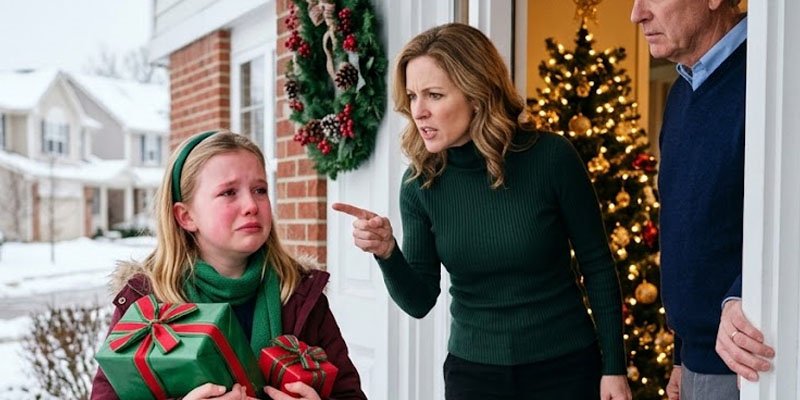
“Mom, come home, please. Grandma won’t allow me to come in.”
My daughter’s voice came faintly through the phone I’d left in my hospital locker, her words rushed and breathless.
“Where are you, Ellie?”
“Back at our house.”
She’d traveled nine blocks alone, holding the Christmas gifts she’d worked on for three weeks. Now she sat by herself in our deserted kitchen.
My parents had promised to look after her during my emergency shift as a nurse.
I called my mother.
“We figured Christmas would be calmer if we handled it this way,” she answered.
“She’s eleven years old.”
“Your brother’s children felt uneasy.”
“About what, exactly?”
“You have a way of making every little thing about that girl.”
I hung up before she could hear the shaking in my voice.
My supervisor found someone to take over my shift.
Twenty minutes later, I opened our front door to find Ellie pressing three gift-wrapped packages tightly against her chest.
“I knocked just one time,” she whispered. “Grandpa told me I was embarrassing him.”
The corner of one parcel was crushed. It held a clay ornament she’d made to look like his dog.
I knelt down next to her.
“You did absolutely nothing wrong.”
That’s when I spotted a message on her phone.
Don’t tell your mother. You already cause her enough problems.
An unfamiliar sense of calm washed over me.
I reached out to my friend Nina, who showed up with food for dinner.
Then I called the attorney who had handled my grandmother’s estate.
My parents lived in the house Grandma had left to me. I paid the property taxes, the insurance, and almost all the utilities. Yet they continued calling it their own home.
“Send me everything you’ve got,” the attorney said.
During the next five hours, I sent screenshots, banking documents, and Ellie’s account of what had happened. I removed my parents’ access to my accounts and canceled transfers that hadn’t gone through yet.
At seven that evening, my father called.
“What did you say to the bank?”
“I asked them to examine the records connected to my property.”
His breathing changed abruptly.
At that moment, my lawyer rang on the other line.
“Claire, an application for a loan has been filed against that property.”
“I didn’t approve any loan.”
“I know. There’s something else attached to the application, though.”
She paused.
“A signed statement accusing you of a.ban.don.ing your child.”
What had happened to Ellie outside that door was devastating enough. But the documents my attorney discovered made me question every promise my parents had ever made—and their sudden desperation to get inside my house.
“Abandoned?” I repeated.
Ellie looked up from the couch. I walked into the hallway to keep her from seeing my face.
“After you reported the application as unauthorized, the bank released the documents supporting it,” my attorney, Rachel, told me. “Your father says he’s caring for Ellie because you’re no longer fit to look after her.”
“I was at work. They agreed to babysit.”
“There’s a letter stating that you regularly vanish overnight. According to her, they require funds to build Ellie a permanent bedroom.”
My knees almost gave way.
“They refused to let her in today.”
“Save all your messages. And don’t confront them yourself, please.”
Just then, heavy knocking erupted at the front door.
My brother Mark stood on the doorstep, with our parents just behind him.
“Open up,” he ordered. “You can’t destroy their retirement over a simple misunderstanding.”
I kept the door bolted.
My mother caught sight of Ellie through the window.
“Darling, tell your mom that leaving was your own decision.”
Ellie retreated behind Nina.
My father held up a file folder.
“All we wanted was to help. Sign the acknowledgment and we’ll get this sorted out.”
“What acknowledgment?”
“The document saying you gave us permission to handle the property.”
I put Rachel on speaker.
“Leave those papers on the porch,” she said. “Claire isn’t signing a thing tonight.”
Mark looked at my phone.
“Are you making a recording?”
“I am as of now.”
My mother burst into tears, her face transforming in an instant.
“We’ve sacrificed everything for this family.”
“Why, then, did you abandon my daughter on Christmas?”
“She was supposed to wait outdoors,” Mark blurted out.
My father shot him a look.
Silence settled over everyone for a moment.
Then Ellie stepped out from behind Nina.
“Uncle Mark said I needed to walk back home.”
Mark’s face tightened.
“He told me Mom might finally get the message.”
Rachel was saying my name, but Ellie wasn’t finished.
“He held his phone up when I left. I think he took a video of me.”
My stomach dropped.
Rachel said, “Claire, does your doorbell camera keep video footage?”
“Yes, it does.”
“Save this afternoon’s recording. Right away.”
Nina went through the footage while I watched my family through the glass.
My father let his folder drop to his side.
Mark moved his hand toward his phone.
The recording captured Ellie struggling up our front steps, still holding all her gifts.
Roughly a minute later, Mark’s pickup rolled slowly past the house.
He’d driven after her.
He knew precisely where she’d ended up.
Nina zoomed in on the footage.
There was another person in the passenger seat.
My mother.
While I’d been calling them in a panic about Ellie, they’d been sitting outside our empty home.
Then a text arrived from a number I didn’t recognize.
I work for your brother’s business. Don’t sign anything, please. Ellie isn’t the first person they’ve done this to.
I sent the message straight to Rachel.
Then I called the police, because Mark had started pulling at the door handle.
An officer showed up before matters got any worse.
My family finally went away after he told them to leave the property.
My father set his folder down outside as casually as if he were dropping off an unpaid bill.
I let the officer retrieve it.
Inside were papers with my name printed over a blank space for a signature.
That night, Ellie slept next to me as I kept a hand softly on her back and listened to her quiet, even breaths.
The woman who’d sent the warning was named Dana.
She handled bookkeeping for Mark’s small home-renovation company.
Two days later, we sat down together at Rachel’s office.
Dana had brought printed emails and copies of invoices she’d been ordered to enter into the books.
“Your brother owes suppliers more than he can pay,” she told us. “Your father promised him that the house would cover those debts.”
The loan application requested $180,000.
It stated that the funds would pay for improvements to the house, among them a bedroom for Ellie.
But the attached invoices listed those very same improvements as work Mark’s company had allegedly completed.
There wasn’t any new bedroom.
No improvements had been made at all.
Rachel spread the documents out on her desk.
One form carried my signature, supposedly authorizing my father to represent me.
I knew that signature the moment I saw it.
It came from an insurance document I’d signed months before, when my father offered to sort through some paperwork for the house.
Someone had copied it onto an entirely different form.
Dana indicated an email Mark had written to her shortly before Christmas.
Need photos of the kid by herself. Mom will see that she gets there. Dad says Claire will sign once she realizes how terrible this looks.
I went over the words again and again, tears blurring my vision.
My relatives hadn’t simply kept Ellie out because they wanted Christmas with my brother’s kids instead.
They’d intentionally arranged an incident they could later hold against me.
Afterward, they intended to offer themselves as the solution.
My holiday nursing shift had given them exactly the opening they needed.
They expected shame and fear to make me give in.
“That letter gives them no custody rights,” Rachel explained. “They hoped it would lend weight to their claims and put pressure on you.”
My parents knew just how afraid I was of people judging me for raising a child alone.
They’d selected the allegation most likely to scare me into keeping quiet.
I finally understood what Dana meant when she said Ellie wasn’t their first victim.
Previously, Mark had billed an older woman for bathroom remodeling that he’d never done.
When she disputed the charge, he told members of her family that she seemed confused about what they’d agreed upon.
Dana wouldn’t alter the bookkeeping records, and afterward she was told not to come back to work.
Luckily, she’d kept the emails addressed to her.
When she came across Christmas pictures on my mother’s public social-media page, she realized the newest scheme was already underway.
One photo showed my family gathered around the dinner table, smiling on Christmas Day.
A decorative centerpiece sat in the spot where Ellie belonged.
Over the next several weeks, the bank investigated the loan request and eventually rejected it.
Rachel helped me report the forged signature and put the evidence together for investigators.
I handed over the messages in which my parents agreed to care for Ellie, her texts, our camera footage, and the schedule showing my hospital shift.
A child-welfare worker also came to our home after my parents submitted a complaint themselves.
I showed her the kitchen where Ellie had sat waiting in her winter jacket.
She spoke gently to my daughter and verified that I’d arranged suitable childcare.
Eventually, the case was closed.
The records my parents had failed to consider disproved their own accusations.
I didn’t insist that they vacate the house on Christmas night.
Rachel reviewed the agreement governing their stay and served the legally required notice to bring it to an end.
I’d spent years paying their bills because they kept telling me family members were obligated to help each other.
From then on, I covered only the costs I was legally responsible for as owner while the proceedings continued.
When my parents finally left, they moved into Mark’s house.
He soon began grumbling that there wasn’t enough room.
I couldn’t help wondering if he saw the irony.
I eventually sold the home my grandmother had given me and reserved some of the money for Ellie’s education.
Months afterward, Mark and my father accepted plea deals in the fraud case.
Their probation and restitution didn’t erase what they’d done, but it mattered to me that the facts were now officially on record.
My mother’s involvement appeared in the investigation files, though she wasn’t charged.
She could no longer credibly insist to the rest of the family that I’d invented everything.
When my aunt called to tell me my parents were ashamed, I said:
“Ellie carried Christmas gifts home while the people they were meant for watched from a parked truck nearby.”
My aunt didn’t answer for a while.
Then she asked if she could take Ellie for ice cream.
That was the first truly considerate thing anyone on that side of the family had done.
The hardest stage of healing had nothing to do with lawyers, courtrooms, or paperwork.
Ellie started checking whether I’d come back whenever I went into a different room.
She stopped making gifts by hand, too.
A counselor helped me understand how to comfort her without promising something impossible, like a future in which no one would ever let her down.
Instead, I made promises I could actually keep.
She would be surrounded by adults she could trust, have reliable arrangements, and know her mother would hear her whenever she asked for help.
One day, Ellie came to me holding the battered gift box.
“Do you think I should throw it out?” she asked.
I gently removed the wrapping from the small clay dog.
The lopsided ears brought tears to my eyes.
“Only if you decide you want to,” I said. “You don’t need to discard something you made out of love.”
The next December, we hung the ornament on our Christmas tree.
Nina came over for dinner, as did my aunt and two coworkers whose kids had already become Ellie’s friends.
I’d organized my shifts long before the holiday.
In the middle of dinner, a knock sounded at the front door.
Ellie went completely motionless.
I looked at the camera feed.
It was only the delivery person arriving with the dessert we’d ordered.
I let Ellie see the screen before opening the door.
Later, she walked around the dinner table with her homemade gifts, waiting patiently for each person to unwrap theirs.
No one mocked the care she’d put into them.
No one made her feel em.bar.ras.sed about showing love.
As bedtime approached, she reached up toward the little clay dog and said:
“Could we have Christmas here every single year?”
“Yes,” I told her. “We certainly can.”
She nestled against my side, and for the first time in months, I felt all the tension leave her body.
My parents had counted on me protecting their image, even at the expense of my daughter’s emotions and well-being.
Within five hours of that first call, I’d taken away their power to dictate my choices.
What came next demanded patience, careful records, and decisions that sometimes hurt.
Yet standing by our Christmas tree, certain that Ellie was cherished and secure in her own house, I knew precisely what had redirected our lives.
When my daughter phoned from the deserted kitchen, I heard her, believed what she told me, and decided to be on her side.




