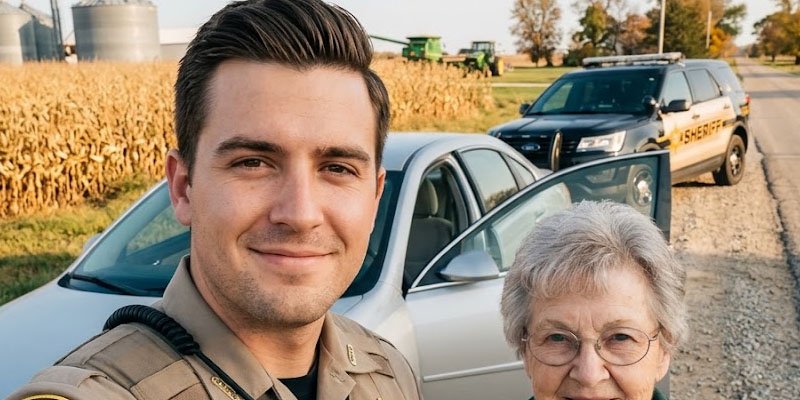
The afternoon sun was scorching on County Road 6 when a young sheriff’s deputy told my 71-year-old mother to get out of her Buick, then left her standing along the roadside for almost forty minutes.
What had she supposedly done wrong?
He suspected that her temporary driver’s license was counterfeit.
Even though she had received it after renewing her license at the courthouse.
When Mom calmly explained what had happened, he brushed her off, challenged her memory, and threatened to write multiple tickets and tow her car.
I sat in the passenger seat, helplessly watching the heat wear her down.
Then my mother, Shirley Hagen, made a request that sounded perfectly ordinary.
“Deputy, would you please say my name over your radio?”
He laughed.
Clearly, he saw it as another chance to humiliate her.
But the moment he said her name, the dispatcher fell silent.
Then a question came over the radio.
“Did you say Shirley Hagen?”
Within seconds, voices from all over the county began coming through the radio.
Deputies.
Firefighters.
Paramedics.
Even a state trooper.
As each person recognized my mother’s name, the young deputy’s confident look slowly faded.
What he didn’t realize was that the older woman he’d left standing in the summer heat had once been the voice that helped save his own father’s life.
It all began on an ordinary Sunday afternoon.
Mom had put on her favorite floral dress for our church’s yearly ice cream social.
I had a tray of homemade lemon bars balanced carefully on my lap.
We were just a little way from home when flashing lights appeared behind us.
Mom guided her Buick onto the shoulder.
A young deputy walked up to the driver’s window.
He introduced himself as Kyle Brandt and requested her license and registration.
Mom passed him her temporary driver’s license.
Her permanent card still hadn’t arrived, but she had recently finished renewing it at the courthouse.
Kyle examined the paper.
Then he frowned.
“Where did you get this?”
“At the courthouse,” Mom replied pleasantly. “They gave it to me to use until the new one arrives.”
He flipped it over.
“This doesn’t look official.”
Mom stayed calm.
“I know it looks different from a regular license, but this is the document they gave me.”
Rather than quietly verifying the details, Kyle grew more and more dismissive.
He instructed her to get out of the car.
Mom did as she was told.
Then he directed her to stand beside the Buick while he went back to his patrol car.
The afternoon sun beat down without mercy.
There was barely any shade along that part of the road.
Mom stood on the gravel shoulder in her Sunday dress while Kyle remained inside his air-conditioned vehicle.
Five minutes went by.
Then ten.
Then twenty.
I watched my mother move her weight from one foot to the other.
She was seventy-one years old.
And although she almost never complained about being uncomfortable, I could tell the heat was taking a toll on her.
At last, I opened my door.
“Officer, would you please let my mother sit in the car while you check her documents?”
Kyle glanced up.
“Ma’am, stay where you are.”
“She’s been standing out in the sun for quite a while.”
“I said stay in the vehicle.”
Mom gave me a comforting look.
“It’s okay, sweetheart. I’ll be all right.”
That was Shirley Hagen through and through.
She had spent her whole life soothing other people, even when she was the one being treated badly.
When Kyle eventually came back, he seemed more intent on interrogating her than settling the matter.
“At your age, are you sure you remember where you got this document?”
Mom met his gaze.
“I’m absolutely sure.”
He gave her a doubtful smile.
“Perhaps you should let someone else take care of your driving.”
I gripped the tray of lemon bars more tightly.
Mom stayed calm.
Kyle said he was considering issuing citations and having the Buick towed until the licensing matter was sorted out.
That was when Mom asked her strange question.
“Deputy Brandt, would you please say my name over your radio?”
He stared at her.
“What for?”
“Just ask if anyone recognizes the name.”
Kyle laughed.
“You think someone at dispatch can make your paperwork legitimate?”
Mom offered a faint smile.
“Please. Just say my name.”
He lifted the microphone on his radio.
“Dispatch, Deputy Brandt here on County Road 6. I have a woman who insists I announce her name.”
He chuckled briefly.
“Shirley Hagen. Does that name ring a bell for anyone?”
The radio fell silent.
Then the dispatcher replied.
“Deputy Brandt, say that name again.”
Kyle frowned.
“Shirley Hagen.”
There was another pause.
“Shirley Hagen? Are you there with Shirley Hagen right now?”
“Yes. Why?”
Before the dispatcher could answer, another voice came through.
“Did someone just say Shirley Hagen?”
Then a different voice.
“Tell Shirley that Miller at Fire Station Three says hello.”
A third voice joined in.
“Trooper Adams here. Is that the Shirley who used to work overnight dispatch?”
I stared at the radio.
Kyle looked bewildered.
Mom simply clasped her hands in front of her.
Then a paramedic recognized her name.
Then another deputy.
Then one more.
One by one, people throughout the county began greeting my mother with genuine warmth.
Some asked how she was doing.
Others remembered the years she had spent serving the community.
One state trooper recalled a dangerous night when her calm voice had helped him make it through an emergency.
The young deputy’s smile had vanished entirely.
Then another voice came on the radio.
It was Sheriff Tom Hanley.
“Deputy Brandt, is Shirley Hagen standing there with you?”
Kyle stood up straighter.
“Yes, Sheriff.”
“How long has she been waiting outside?”
There was silence.
Mom looked at Kyle.
She didn’t interrupt him.
She didn’t try to speak on his behalf.
She simply waited.
At last, he admitted, “About forty minutes, sir.”
The sheriff’s tone turned firm.
“Get her somewhere cool right away. I’m on my way to your location.”
Kyle swallowed.
“Yes, sir.”
But before he could lower the microphone, another voice crackled through the speaker.
And this voice changed everything.
“Is Shirley okay?”
The speaker was Walt Brandt.
Kyle’s father.
I watched Mom turn toward the radio.
A small smile crossed her face.
“Hello, Walt,” she said.
Kyle looked from Mom to the microphone.
“Dad?”
Walt’s voice grew softer.
“Son, do you know who that woman is?”
Kyle said nothing.
And in that moment, I started to realize how much about my mother’s life I had never really understood.
For thirty-four years, Shirley Hagen had worked overnight shifts as a dispatcher at the Kessler County Sheriff’s Office.
While most of the town slept, my mother answered emergency calls.
She spoke with people facing some of the most terrifying moments of their lives.
She coordinated police officers, firefighters, and medical crews.
Whenever someone was frightened, confused, or struggling to stay composed, she became the calm voice helping them through it.
Over the years, she had helped countless people.
During a terrible blizzard, she guided Sheriff Hanley through the unexpected birth of his daughter when emergency help couldn’t reach his family quickly enough.
On another night, she helped a farmer trapped beneath heavy machinery tell rescuers where he was.
She talked frightened children through emergencies.
She helped first responders stay focused in dangerous circumstances.
And she listened to people who desperately needed reassurance that help was coming.
Yet Mom seldom spoke about any of it.
When someone asked what she did for a living, she usually smiled and said, “I answered phones.”
I had grown up thinking that was a fairly ordinary way to describe her work.
Now, standing beside County Road 6, I was learning how deceptive those words had been.
Walt Brandt spoke over the radio again.
“Son, years ago, I was pinned beneath a tractor. I couldn’t move, and I had no idea whether anyone would reach me in time.”
Kyle remained completely still.
“Shirley was the dispatcher who took my call.”
Mom lowered her gaze.
Walt went on.
“She stayed on the line with me for fifty-one minutes.”
His voice became emotional.
“She kept asking me questions to help me stay alert. She asked about my family. About your mother.”
Then he paused.
“And she kept asking about you, Kyle.”
The young deputy looked stunned.
“You were only a little boy. Shirley kept asking what you enjoyed, how old you were, and what kind of father I hoped to be when I got home.”
The radio went quiet.
At last, Walt said, “I don’t know what I would’ve done without her voice that night.”
Kyle slowly turned to look at my mother.
The woman whose memory he had questioned.
The woman he had left standing in the heat.
The woman whose paperwork he had dismissed without understanding her situation.
She was the very person who had helped keep his father calm until rescuers reached him.
A few minutes later, Sheriff Hanley arrived.
He got out of his vehicle and went straight to Mom.
“Shirley, are you okay?”
She gave him the familiar smile he knew so well.
“I’m fine, Tom. Just a bit warm.”
He gently led her toward an air-conditioned vehicle and made sure she had some water.
Then he faced Kyle.
The young deputy stood quietly beside his patrol car.
The sheriff asked him to describe what had taken place.
Kyle stumbled through his explanation.
When he had finished, Hanley removed his badge as part of an immediate temporary reassignment.
“You’ll spend the next month working overnight dispatch,” the sheriff told him.
Kyle looked taken aback.
“Sir?”
“You need to understand what people go through when they call us for help.”
The sheriff went on.
“You’ll listen to emergency calls. You’ll work alongside experienced dispatchers. And you’ll learn why patience and respect are just as important as knowing the rules.”
Then he turned to Mom.
“Shirley, if you want to file a formal complaint, we’ll make sure it’s dealt with.”
My mother shook her head.
“I don’t want that young man’s career destroyed, Tom.”
Kyle looked up.
“But I do want him to learn something.”
She turned to face him.
“Every person you pull over has a story you don’t know. Some are scared. Some are sick. Some are just confused by their paperwork.”
Her voice remained kind.
“They deserve to be treated with dignity while you work things out.”
Kyle lowered his head.
“I’m sorry, Mrs. Hagen.”
Mom nodded.
“Then make sure the next person has a better experience.”
That evening, I went to the dispatch center with my mother’s old headset.
I had found it carefully put away among her belongings years earlier.
It was worn from years of use, but she had never wanted to throw it out.
Kyle was starting his assigned overnight shifts.
He sat beside an experienced dispatcher who had once been trained by my mother.
I watched as a call came in.
The person on the other end sounded frightened.
Their words came quickly and were hard to follow.
The dispatcher leaned toward the microphone.
“It’s okay. I’m here with you. Tell me what’s happening.”
She spoke slowly.
Calmly.
Without judging.
For the first time, I truly understood what my mother had done night after night for more than thirty years.
She hadn’t merely answered phone calls.
She had helped people navigate emergencies when fear made it difficult for them to think clearly.
And she had done it while the rest of us slept peacefully at home.
When I was a child, I sometimes resented her job.
She missed school events.
Family dinners.
Even some of my Friday-night football games.
I remembered looking toward the bleachers, hoping to see her sitting beside Dad.
For years, I had assumed her job simply kept her away.
But later, Mom told me something I had never realized.
Whenever she could, she had listened to broadcasts of every one of those games.
While working in the dispatch room, she kept a small radio close by.
Between emergency calls, she followed the scores.
She remembered the thrilling plays.
The close finishes.
And the nights when our team just barely won.
She had been cheering me on from miles away.
Even when I couldn’t see her.
That discovery affected me more than I expected.
All those years, I had thought of Mom as someone who sometimes missed important occasions.
I had never thought about how hard she tried to stay involved in them.
A few weeks after the incident on County Road 6, Kyle came to our house.
He stood on the porch with his hat in his hands.
Mom welcomed him inside.
He seemed nervous.
“Mrs. Hagen, I wanted to thank you.”
She raised an eyebrow.
“What for?”
“For not giving up on me.”
He said that working in the dispatch center had changed how he viewed his job.
He had listened to frightened parents.
Older people struggling to describe emergencies.
Drivers who felt confused or overwhelmed.
And people who simply needed someone to slow down and listen.
“I thought being a good deputy meant always being in control,” he admitted.
Mom smiled.
“Sometimes, the best thing you can do is listen first.”
Kyle nodded.
“I’ll remember that.”
Eventually, Mom’s permanent driver’s license arrived in the mail.
She slipped it into her wallet without making a fuss.
She never asked anyone to share the story publicly.
Never demanded recognition.
Never used the incident to remind people of her years of service.
She simply went back to her usual routines.
Church on Sundays.
Morning coffee.
Chats with old friends.
And sometimes, listening to the emergency scanner from her favorite chair.
But something changed for me.
I started calling her every Sunday evening.
Not because she needed assistance.
Not because anything had gone wrong.
Simply because I wanted to hear her voice.
She always picked up almost right away.
“Hello, sweetheart.”
And each time, I imagined her sitting at a dispatch desk years before, answering calls from strangers who needed someone to care.
For thirty-four years, my mother had been there for people through some of the hardest moments of their lives.
She listened when they were frightened.
Comforted them when they felt helpless.
And reminded them they weren’t alone.
It took one afternoon on County Road 6 for me to understand how many people still remembered her kindness.
But the most important lesson wasn’t about the deputy or his punishment.
It was about my mother.
After a lifetime of answering calls for help from everyone else, Shirley Hagen deserved to know that someone was calling simply because they loved her.
A Deputy Forced My 71-Year-Old Mother to Stand in 91°F Heat for 40 Minutes—Then She Asked Him to Say Her Name Over the Radio
1,617 views