
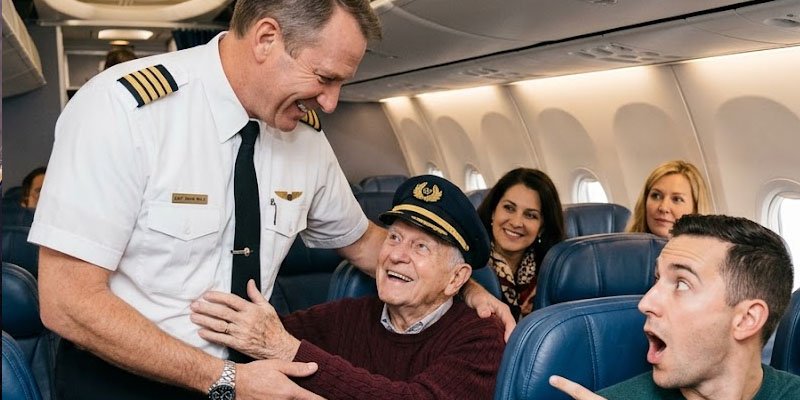
My 81-year-old father was pushed out of the way by an impatient businessman at airport security.
The man chuckled into his phone, describing Dad as a “confused old guy” who had no business standing in the line. Dad chose not to argue. However, when we arrived at our gate, the captain unexpectedly came out of the aircraft, recognized my father, and wrapped him in an emotional embrace, tears filling his eyes.
Then the businessman spotted the tiny silver wings Dad was holding.
When he noticed the number engraved on their back, every bit of color drained from his face.
And the truth my father had kept from our family for almost fifty years finally began to emerge.
Dad had already gotten dressed when I came downstairs at five that morning.
He was sitting at my sister Beth’s kitchen table in his favorite brown jacket, the one Mom had given him for their fortieth wedding anniversary. His suitcase stood beside the front door, while his passport, wallet, and boarding pass lay neatly arranged in front of him.
Our flight wasn’t due to leave until eleven.
“Dad, we have hours before we need to head out,” I reminded him.
“I know, Lauren. I just like to be prepared.”
He carefully adjusted his passport once more.
Beth walked into the kitchen carrying two mugs of coffee. She glanced at him, then exchanged a worried look with me.
We had been exchanging those looks regularly ever since Mom passed away two years earlier.
Dad was eighty-one, yet his mind was still remarkably sharp. He solved challenging crossword puzzles using a pen, drove himself to the grocery store, and consistently beat both of us at cribbage.
Even so, losing Mom had changed him.
He had grown quieter, more guarded, and oddly uneasy whenever he found himself surrounded by crowds.
Airports were particularly challenging for him.
He had never liked flying. When we were children, he would rather drive fourteen hours to visit our grandmother than buy plane tickets.
Mom used to joke that he would drive all the way to the moon if someone built a highway there.
I had always assumed Dad simply liked being in control.
After all, he had taught high school physics for thirty-four years. He appreciated predictability, carefully measured distances, and rules that actually made sense.
Beth offered to let him stay with her for another week, but he politely declined with a smile.
“Ten days is more than enough. You know what they say about fish and houseguests.”
“You’re our father, not a guest,” Beth answered.
Dad smiled warmly, then reached inside his jacket.
He took out a small silver keychain shaped like a pair of airplane wings.
I had seen those wings countless times throughout my childhood.
They were tiny and smooth from years of handling, with a number engraved on the back that had almost worn away.
When I was six, I asked him where he had gotten them.
“An old job,” Dad replied.
Whenever I pressed him for more information, he would change the subject.
Mom did exactly the same thing.
Eventually, I gave up asking.
Now, as I watched him repeatedly run his fingers over those silver wings, my old curiosity returned.
“Dad, are you feeling nervous?”
“Of course not.”
“Then why do you keep fiddling with your keychain?”
He glanced down as if he had only just noticed what his fingers were doing.
“Just thinking about something.”
“About what?”
He slipped the wings back into his pocket.
“Mostly wondering whether Beth has any blueberry muffins left.”
Beth laughed, and the subject was dropped.
That was Dad’s usual way of avoiding questions he preferred not to answer.
By eight-thirty, Beth was driving us toward the airport.
As the terminal came into view, Dad became visibly tense. His hands remained still on his knees, but his jaw tightened.
Before we left, Beth hugged him and whispered to me, “Please stick close to him. He gets confused when things get crowded.”
“I will.”
Once we entered the terminal, the noise seemed almost unbearable.
Suitcase wheels rattled against the polished floor. Children were crying. Announcements echoed from the overhead speakers.
Dad stopped just inside the entrance.
“Are you all right?” I asked.
He took a slow breath.
“Absolutely fine. Let’s keep going.”
We checked in his suitcase and joined the security queue.
I kept his boarding pass within reach and reminded him to take off his belt, empty his pockets, and get his shoes ready for inspection.
He followed each instruction patiently.
Looking back, I wish I had understood how much of his dignity he was quietly giving up simply to keep me from worrying.
We were only three passengers away from the security checkpoint when Dad had trouble slipping his passport back into his jacket.
His fingers were no longer as nimble as they once had been.
The delay lasted perhaps five seconds.
The man behind us let out an exaggerated sigh.
He looked to be in his forties, dressed in an expensive gray suit, with a polished leather briefcase in his hand.
His phone was already in his palm.
“Just a second,” I told him.
He acted as though he hadn’t heard me.
Instead, he stepped forward, forced his way past my shoulder, and knocked Dad hard enough to send him stumbling sideways.
I caught Dad’s arm before he could fall.
“Excuse me! You just shoved my father!”
The businessman paid no attention to me and handed his identification to the security officer.
I was absolutely stunned.
Dad placed his hand on my wrist.
“Lauren, just leave it.”
“But he pushed you!”
“I’m still on my feet, sweetheart.”
A few minutes later, while gathering his belongings, the businessman began talking loudly on his phone.
“Yeah, I went straight past some confused old guy,” he said with a laugh. “He probably doesn’t even know where he’s headed.”
Dad heard every word.
I could tell because his hand suddenly stopped moving.
Anger rose inside me.
But before I could say anything, Dad squeezed my wrist.
“Let it go.”
The businessman carried on talking.
“Flight 2290. Boarding at ten-forty. I’ll be at the office by four.”
I checked our boarding passes.
Flight 2290.
We were on the very same flight.
Perfect.
After clearing security, Dad sat on a bench to put his shoes back on. He struggled with the left shoelace, so I knelt beside him and helped.
He usually insisted on handling even the simplest tasks himself. The fact that he allowed me to help showed just how deeply the incident had unsettled him.
“He’s on our plane,” I muttered.
“I know. I heard him.”
“We’ll have to spend two hours near that horrible man.”
Dad offered me a faint smile.
“Let’s hope we aren’t sitting right next to him.”
Then he got up and asked me to help him find the closest restroom.
The walk to Gate C14 seemed endless.
Dad moved at a slow pace, observing the airport workers and passengers passing us.
When a flight crew walked by, his eyes followed them.
“They still walk together like that,” he murmured.
“Like what?”
“In formation. They always have.”
I found the comment strange but decided not to ask about it.
At the gate, we found two seats next to the window. Our aircraft was waiting outside as ground staff loaded the luggage.
I went to buy Dad a cup of tea.
When I came back, he was holding the silver wings again.
The businessman was sitting across the waiting area.
He was talking about an important presentation and complaining that even a minor delay could cost his company a major account.
Apparently, nobody else at his company was capable of doing the job properly.
I sat beside Dad, still furious.
“How can somebody behave like that and still believe he’s important?”
Dad took a sip of tea.
“Perhaps he’s going through something difficult.”
“That doesn’t justify it.”
“No, it doesn’t,” Dad agreed. “But getting angry won’t change what happened.”
He turned his attention toward the window.
“Everyone carries something, Lauren. Most of the time, we have no idea what it might be.”
I wanted to disagree, but something in his expression stopped me.
Instead, I gestured toward his keychain.
“Are you finally going to tell me where those wings came from?”
He studied them silently for a while.
“They were given to me.”
“By whom?”
“Some people I knew a long time ago.”
“Were they your friends?”
Dad gave me a sad smile.
“They were very good people. Better people than I deserved.”
Before I could ask anything else, the boarding announcement came over the speakers.
Passengers who needed extra time or assistance were invited to board first.
I helped Dad to his feet, collected our belongings, and guided him toward the boarding counter.
We were nearly there when someone hurried past us.
It was the businessman.
His rolling suitcase struck Dad on the hip, forcing him to grab my arm for support.
Without offering an apology, the man walked straight to the gate agent.
“Sir, we’re currently boarding passengers who require assistance,” she explained.
“I’m traveling in first class.”
“First-class boarding will begin afterward.”
“I have an important connecting flight.”
He scanned his boarding pass and continued down the jet bridge before she could respond.
The gate agent apologized to us.
Dad simply nodded.
“Please don’t worry about it.”
I watched the businessman disappear into the jet bridge.
“People like him never change,” I whispered.
Dad looked at me curiously.
“Sometimes they do.”
I had no idea what he meant.
But just seconds later, something extraordinary took place.
The cockpit door was open, and a pilot stepped onto the jet bridge.
He appeared to be in his late fifties, tall, with gray hair.
He glanced toward the boarding area.
Then he stopped.
His eyes fixed on Dad.
For a moment, he seemed completely frozen.
He pressed one hand against the wall, as if he needed something to steady himself.
Then he hurried in our direction.
The businessman had stopped halfway down the jet bridge and turned to look back.
The pilot passed the boarding counter without hesitation.
He walked up to my father, studied his face, and suddenly threw both arms around him.
This was no ordinary greeting.
He held Dad as though he had just been reunited with someone he had believed was gone forever.
“I can’t believe it’s really you,” he whispered.
I stood motionless, unable to find words.
Dad gently patted his back.
“Captain, you have passengers waiting.”
The pilot laughed, tears glistening in his eyes.
“You’re still telling people what to do, Walt.”
“Somebody has to.”
“Walter Hayes,” the captain said, shaking his head. “Thirty years have passed. Why did you stop replying to my letters?”
Dad lowered his eyes.
“I’m sorry, Michael.”
The captain noticed the silver wings in Dad’s hand.
His expression changed instantly.
“You still carry those?”
“Every single day.”
Michael gently touched the little wings.
“I was ten when I gave those to you. I remember being terrified that I’d drop the box.”
“You did just fine.”
The pilot swallowed hard.
Then he asked a question that made my stomach tighten.
“Does your daughter know?”
“Know what?” I demanded.
Dad immediately straightened up.
“Not here, Michael.”
“Dad, what are you talking about?”
But the businessman had returned to the entrance of the jet bridge.
He was staring at the wings.
Suddenly, all the color disappeared from his face.
“Wait,” he said. “What number is engraved on the back of those?”
Nobody responded.
“Is it 417?”
Dad closed his fingers around the keychain.
The businessman quickly pulled out his phone and began searching.
After several frantic seconds, he stopped scrolling.
He stared at my father as though he had just seen a ghost.
“Oh my God,” he whispered. “It’s you.”
Dad’s expression shifted.
For the first time that morning, I saw real fear in his eyes.
The businessman turned his phone screen toward me, but Michael caught hold of his wrist.
“Please put that away,” the captain said firmly.
“Why?” I asked.
Nobody answered.
I looked straight at Dad.
“What happened on Flight 417?”
His eyes filled with tears.
“I should have told you years ago,” he whispered. “Your mother kept encouraging me to talk about it, but I could never find the courage.”
“Tell me now.”
He closed his eyes for a moment.
Then he nodded toward the phone.
“Let her see.”
The businessman reluctantly passed it to me.
An old black-and-white newspaper photograph filled the screen.
The headline read:
MIRACLE IN THE SNOW: 52 SURVIVE FLIGHT 417 CRASH
Below the headline was a damaged aircraft lying in a snow-covered field.
Smoke rose from its shattered fuselage.
In the foreground stood a young man in a torn pilot’s uniform, carrying a small boy wrapped inside an oversized jacket.
The young man’s face was covered in soot.
He was injured and limping.
Yet I recognized him immediately.
I had seen his photograph in our family albums countless times.
It was Dad.
I looked up, unable to speak.
Captain Michael Reyes stood beside him, tears running down his face.
“I was that little boy,” he said quietly. “Your father carried me out of the wreckage.”
The world seemed to come to a standstill.
Eventually, the gate agent reminded Michael that boarding needed to continue.
He nodded and turned toward Dad.
“Please come to the cockpit after we land. There’s something I’ve wanted to show you for decades.”
Dad hesitated before agreeing.
Michael returned to the aircraft.
The businessman quietly took back his phone and boarded.
I remained beside my father, realizing that I knew almost nothing about the life he had lived before becoming my dad.
We took our seats in row fourteen.
I gave him the window seat.
For several minutes, neither of us said a word.
Then I finally asked, “Were you a pilot?”
“First officer,” he replied. “For six years.”
“But you taught physics.”
“I did. For thirty wonderful years.”
“Thirty-four,” I corrected him.
He smiled faintly.
“Yes. Thirty-four.”
“What happened before that?”
He gazed through the window.
“I worked for Northline Airways. I loved flying almost as much as I loved your mother.”
As the engines started, his fingers tightened around the armrest.
I placed my hand over his.
“Please tell me everything.”
He waited until the aircraft was in the air.
During takeoff, I noticed him counting silently.
When the wheels finally left the runway, he let out a long breath.
Then he began his story.
“January 14, 1977. I was thirty-one years old.”
He explained that Flight 417 had left Chicago for Pittsburgh during a severe winter storm.
The aircraft was a turboprop carrying both passengers and crew.
The captain was Frank Dorsey, a highly experienced pilot with twenty-five years of service.
“He was the finest pilot I ever knew,” Dad said. “He always hummed Frank Sinatra during takeoff.”
About forty minutes into the flight, Frank began complaining of discomfort in his chest.
He assumed it was indigestion.
Five minutes later, he collapsed across the controls.
A massive heart attack.
Dad called for the senior flight attendant, Ruth Ellison.
She helped move Frank into the galley and immediately started performing CPR.
Meanwhile, Dad took command of the aircraft.
On his own.
As the weather continued to worsen.
He requested an emergency diversion to Toledo.
Air traffic control gave him clearance to land.
Then the left engine failed.
Investigators later determined that contaminated fuel had allowed ice to form inside the fuel system.
A few minutes later, the right engine began to fail as well.
Dad was flying through a snowstorm over northern Ohio while both engines were losing power.
He knew they would never make it to Toledo.
So he instructed Ruth to prepare the cabin for an emergency landing.
“Did you know where you were going?” I asked.
“Not exactly. I searched for the longest, flattest, darkest stretch of land I could find. No trees. No houses. No power lines.”
He spotted a harvested cornfield buried beneath the snow.
He lined up the aircraft as carefully as he could.
Lowered the landing gear.
And brought the plane down.
For a moment, I thought the worst had passed.
“Did everyone survive?” I asked.
Dad stared down at his hands.
“Fifty-two people survived, Lauren.”
His voice became softer.
“Frank was already gone. Ruth remained beside him until the end. When the aircraft hit a drainage ditch, the front landing gear collapsed. The left wing broke off, and the fuselage split near the galley.”
He swallowed with difficulty.
“Ruth was sitting right there.”
The accident killed her instantly.
For almost fifty years, Dad had wondered whether she had suffered.
“She was only twenty-four,” he whispered. “She had her entire life ahead of her.”
Tears ran down my cheeks.
“Dad, you saved fifty-two people.”
“I know. But for years, whenever anyone mentioned those fifty-two survivors, I could only think about the two people who never made it home.”
He rubbed the little silver wings again.
I asked him about Michael.
For the first time since beginning his story, some warmth returned to Dad’s face.
“Michael Reyes was nine years old. He was traveling alone to visit his grandmother. Ruth gave him a little pair of plastic pilot wings when he boarded.”
After the crash, smoke began spreading through the cabin.
Another flight attendant, Denise, had broken her leg but still managed to open the rear exit and help passengers get out.
Dad made his way through the damaged cabin, directing people toward safety.
He had injured his head and broken two ribs, although the adrenaline kept him from noticing.
When he thought everyone had escaped, he searched the aircraft one final time.
That was when he heard someone crying.
A small boy was trapped underneath a seat.
His safety belt had jammed during the impact.
The smoke was getting thicker.
Dad pulled out his pocketknife, cut the strap, and freed the child.
“He was shaking,” Dad remembered. “He wrapped his arms around my neck and refused to let go.”
Dad took off his uniform jacket, wrapped Michael inside it, and carried him through the snow.
A farmer’s son took a photograph of them.
By the following morning, their picture was appearing in newspapers throughout America.
People began calling Dad a hero.
He despised the attention.
“Every photograph of me reminded me that Ruth wasn’t there to see another morning,” he explained.
Sadly, the rescue was not the end of the story.
Two weeks later, investigators and airline representatives began questioning his decisions.
Why had he chosen that particular field?
Why hadn’t he managed to reach Toledo?
Could the crash have been prevented?
Some newspapers that had previously praised him began suggesting that pilot error was to blame.
Dad found himself at the center of harsh public speculation.
“The fuel supplier was powerful,” he said. “I was just a young first officer. It was easier to blame me.”
What hurt him most was Ruth’s mother.
She attended the investigation hearings, sat in the front row, and stared at him without saying a word.
Dad believed she held him responsible for her daughter’s death.
Fourteen months went by before investigators established the complete cause.
Fuel contamination had affected several aircraft.
Their final report fully cleared Dad and confirmed that he had made the right decisions under the circumstances.
Northline offered to reinstate him.
They even offered him a promotion to captain.
“But I couldn’t go back,” Dad admitted.
He tried.
He put on his uniform, walked through the airport, and took his place inside the cockpit.
Then his hands started shaking.
He couldn’t breathe.
Whenever he closed his eyes, he saw Ruth.
So he left aviation behind for good.
He returned to school and began teaching.
The following year, he met Mom, who taught English at the same high school.
She was the only person who knew the complete story.
“She told me I didn’t have to carry the burden by myself,” he said.
“Then why didn’t you tell Beth and me?”
Dad’s eyes filled with tears.
“Because I didn’t want you to grow up with a newspaper headline for a father. I wanted to be the man who helped you with homework, took you camping, and made pancakes every Sunday.”
He reached for my hand.
“All I wanted was to be your dad.”
“You were,” I whispered. “You always were.”
He told me that, a year after the investigation, the survivors arranged a gathering.
They commissioned a pair of silver wings engraved with the number 417.
Michael, who was ten years old by then, presented them to Dad.
“He said something I’ve never forgotten,” Dad recalled. “He told me that since I’d carried him out of the plane, he wanted to carry the wings to me.”
Dad had kept them ever since.
Michael continued writing letters for years.
Christmas cards. School reports. Updates about his flight training.
Eventually, he became a professional pilot himself.
Dad even attended his graduation, although he sat at the back and left before Michael could notice him.
“I wasn’t brave enough to face those memories,” Dad admitted.
Eventually, he stopped replying.
Several more years passed, and Michael’s letters eventually stopped arriving.
I was still trying to process everything when the captain’s voice came over the aircraft speakers.
“Good afternoon, everyone. We’re approximately forty minutes away from Columbus. The weather looks excellent, and we expect a smooth arrival.”
There was a brief pause.
“Before we begin our descent, I’d like to share something personal.”
Dad immediately stiffened.
“Nearly fifty years ago, I was a nine-year-old boy aboard an aircraft that crashed during a snowstorm. Both engines failed, and the captain suffered a fatal heart attack.”
The cabin fell silent.
“A young first officer managed to bring that aircraft down in a snow-covered field. Fifty-two people survived. I was one of them.”
Dad tightened his grip on my hand.
“Two extraordinary people didn’t survive that night: Captain Frank Dorsey and flight attendant Ruth Ellison. I want to pay tribute to them today.”
Dad shut his eyes.
Tears trickled down his cheeks.
“That first officer carried me out of the smoke. Because of him, I grew up. Because of him, I became a pilot. He is aboard this flight today, but I won’t reveal his identity. He never wanted recognition.”
Michael paused.
“He simply wanted people to reach home safely. Today, I’ll do everything I can to bring you home, just as he once brought me home.”
The announcement came to an end.
For several seconds, nobody moved.
Then someone began clapping.
Soon, applause filled the cabin.
Dad’s lips quivered.
I leaned closer and heard him whispering two names.
“Frank. Ruth. Frank. Ruth.”
About ten minutes later, someone approached our row.
It was the businessman in the gray suit.
His appearance had changed completely.
His tie was loose, and his eyes were red.
“Sir,” he said quietly. “May I speak with you?”
I wanted to tell him to go away.
But Dad nodded.
The man crouched beside our seats.
“My name is Grant Whitaker. And I owe you an apology.”
He struggled to continue speaking.
“My mother is Carol Whitaker. In January 1977, she was seven months pregnant. She was aboard Flight 417.”
Dad went completely still.
“She was sitting in seat 6C,” Grant continued. “She told me that story throughout my entire life.”
He explained that after the crash, Carol had struggled to stand because she was pregnant.
Smoke surrounded her.
She believed she and her unborn child were going to die.
Then a young pilot appeared.
He helped her escape and promised her they were going home.
Dad whispered, “Blue coat.”
Grant stared at him.
“What?”
“Your mother. She was wearing a blue coat. She kept saying she was worried about her baby.”
Grant covered his mouth.
“Yes,” he whispered. “That was her.”
He explained that he had been born six weeks after the crash.
Throughout his childhood, his mother kept the famous newspaper photograph hanging in their hallway.
She often told him that the pilot in the picture had saved both their lives.
“She tried to find you,” Grant said. “She contacted the airline and newspapers. Nobody could tell her where you’d gone.”
“I didn’t want anyone to find me,” Dad replied.
Grant nodded.
“When I saw your silver wings and recognized the number, I searched for the photograph. That’s when I realized who you were.”
He took an unsteady breath.
“And I remembered what I did this morning.”
He looked straight into Dad’s eyes.
“I shoved the man who saved my mother’s life. The man who made my own life possible. I made fun of you because I was impatient about a business meeting.”
Tears streamed down his face.
“I don’t know how to apologize for something like that.”
Dad waited for Grant to finish.
Then he gently rested a hand on his shoulder.
“You didn’t know who I was, son.”
“But that doesn’t excuse what I did.”
“No, it doesn’t,” Dad agreed.
He paused.
“And that’s exactly the lesson.”
Grant looked puzzled.
“You didn’t know my story. And you don’t know the story of anyone else around you. The mother holding her baby, the exhausted traveler at the back, the young woman checking tickets. Every one of them has experienced things you can’t imagine.”
Grant lowered his head.
Dad continued.
“You shouldn’t treat people kindly because they might turn out to be important. You should treat them kindly because they’re already important. Every person matters.”
Grant nodded through his tears.
“I won’t forget that.”
“I believe you,” Dad replied.
Grant then asked whether he could contact his mother.
“She never stopped hoping she’d find you.”
Dad glanced at me.
I squeezed his hand.
“Tell her I’m glad she and her little boy made it home.”
Grant immediately sent her a message.
A reply arrived a few moments later.
He read it before turning the screen toward Dad.
Is it really him? Please tell him I named you after him.
Dad blinked in surprise.
“You named him after me?”
Grant smiled through his tears.
“My middle name is Walter. I hated it when I was growing up. Mom only told me it belonged to someone special.”
Dad covered his face.
I held him as he cried.
A short while later, a flight attendant asked Grant to return to his seat for landing.
Before leaving, he thanked Dad once more.
“For saving my mother’s life,” he whispered. “And for saving mine.”
The aircraft landed safely and smoothly.
Dad watched the runway through the window, paying attention to every movement like someone who still understood them all.
“That was a beautiful landing,” he murmured.
“That boy has become a very good pilot.”
As the passengers began leaving, Dad remained in his seat.
Michael had invited us into the cockpit.
But Dad looked frightened.
“I don’t know if I can do it, Lauren.”
“Why not?”
“The last time I entered a cockpit, I couldn’t stay.”
I took his hand.
“Then this time, you won’t have to go in alone.”
We waited until the cabin had emptied.
At the front, Michael was standing beside the open cockpit door.
His first officer greeted Dad respectfully.
“Captain Reyes has told me about you many times, Mr. Hayes.”
Dad blushed.
Michael offered him the copilot’s seat.
Dad stared at it.
The controls were modern and nothing like the ones he had once operated.
Even so, his eyes moved across the instruments with familiar understanding.
His hands shook as he approached.
At last, he lowered himself into the seat.
I stood in the doorway.
For almost a minute, he remained silent.
Then he gently touched the controls.
“I always thought coming back here would bring everything back,” he whispered.
Michael sat beside him.
“Does it?”
Dad closed his eyes.
For several seconds, all I could hear was his breathing.
Then he opened them.
“No,” he said quietly. “This time, I see a field full of people walking home.”
Michael reached into his pocket.
He took out a tiny pair of plastic wings.
They were faded, chipped, and almost completely worn away.
“Ruth gave these to me when I boarded Flight 417,” he explained. “I was holding them when you found me trapped under the seat.”
He placed them beside Dad’s silver wings.
“I’ve carried them on every flight I’ve flown for thirty-one years.”
Dad stared at them.
Michael’s voice trembled.
“I wanted you to have them. Ruth was part of your crew, and I think she’d want you to know that you finished what she started.”
He swallowed.
“You brought her passengers home, Walt.”
Dad couldn’t find the words to respond.
He sat in that cockpit with both pairs of wings resting in his palm and wept.
Michael placed a hand on his shoulder.
I stood beside them, crying too.
For the first time, I understood that my father hadn’t spent almost fifty years concealing a heroic accomplishment.
He had spent those years trying to forgive himself for surviving.
When we finally left the aircraft, Grant was waiting near the end of the jet bridge.
I was surprised to see him.
Hadn’t he been desperate to get to his meeting?
“I called my boss,” he explained. “I asked him to move the meeting until tomorrow.”
“Could you afford to do that?”
He shrugged.
“Maybe not. But I’ve realized that some things matter more than business.”
Then he offered to carry Dad’s bag.
Dad smiled and handed it to him.
Grant walked beside us through the airport, matching Dad’s slower pace.
Whenever crowds hurried past, he positioned himself between them and Dad to protect him.
At baggage claim, he collected our suitcase.
Then he held up his phone.
“My mother wants to know if she can see you.”
A silver-haired woman appeared on the screen.
She began crying as soon as Dad came into view.
“Mr. Hayes? It’s Carol. Do you remember me?”
Dad held the phone in both hands.
“You were wearing a blue coat.”
Carol laughed through her tears.
“I still have that coat. I’ve kept it all these years.”
They talked for several minutes.
I stepped aside with Grant to give them some privacy.
Then he apologized to me.
I admitted that although Dad had forgiven him, I was still having difficulty letting go of what had happened.
Grant nodded.
“I understand.”
“But you stayed,” I said. “You didn’t have to do that.”
He looked over at Dad.
“I think I’ve spent too many years being the kind of person who never slows down for anyone. I’d like to change that.”
Later, while we were in the airport parking garage, I called Beth.
“Did you land safely?” she asked immediately.
“Yes. Dad’s fine. But Beth, there’s something you need to know.”
“What happened?”
“Did you know Dad used to work as an airline pilot?”
Silence followed.
Then Dad reached for the phone.
“Put me on speaker, Lauren.”
And there, sitting inside our parked car, he told my sister the whole story.
He told her about Frank, Ruth, Michael, the crash, the investigation, and the silver wings.
When he finished, Beth was crying.
“Why didn’t you tell us, Dad?”
“I wanted you to have an ordinary father.”
“You were never ordinary,” she answered. “We just didn’t know your whole story.”
Things began to change after that day.
Not all at once, but little by little.
Michael visited two weeks later with his wife and grown daughters.
They spent hours looking through photographs and exchanging stories.
One of Michael’s daughters had become a pilot herself.
Dad began responding to letters again.
In November, Carol visited with Grant and his family.
She brought along the blue coat she had preserved for almost fifty years.
Grant brought his wife and two young sons.
I watched Dad standing beneath the maple tree in his backyard as the boys played nearby.
He looked happier than I had seen him since Mom passed away.
Grant hadn’t lost his job, either.
His boss rescheduled the presentation, and Grant eventually won the important account.
But he told me something remarkable.
“A month ago, winning that deal would have been the greatest thing that ever happened to me.”
“And now?”
He looked across the yard toward Dad.
“Now I think the best thing was being made to recognize the man I’d pushed aside.”
The following January 14, Dad asked me to drive him to northern Ohio.
We spent five hours traveling through snow-covered fields.
He said very little along the way.
Eventually, we arrived at a small cemetery.
Dad walked slowly between the headstones until he reached one beneath an old oak tree.
The inscription read:
RUTH ANNE ELLISON
1952–1977
SHE STAYED.
Fresh red carnations had been placed beside the stone.
“Her sister still comes here,” Dad explained. “Michael told me.”
He looked down at the ground.
“I’ve never visited before. I was too ashamed.”
I took his arm.
“You have nothing to be ashamed of.”
He nodded.
“I think I finally understand that.”
Carefully, he knelt in the snow.
Then he took the worn plastic wings out of his pocket.
The same ones Ruth had given Michael.
The same ones Michael had carried throughout his career.
Dad placed them beside the flowers.
“You brought them home, Ruth,” he whispered. “You helped bring them home.”
He remained there in silence for several minutes.
When he finally stood, tears shone on his cheeks.
But he was smiling.
“Come on, sweetheart. Let’s go home.”
During the drive back, Dad took out his silver wings.
He studied them thoughtfully.
Then he reached toward my car keys in the cupholder.
“Dad, what are you doing?”
“Keep driving.”
I heard a faint metallic click.
When I glanced over, he had attached the wings to my keyring.
“Dad, those are yours.”
“They’ve belonged to me for forty-nine years. Now I’d like you to have them.”
“Why?”
He watched the snow-covered fields moving past the window.
“Because somebody needs to remember what they stand for.”
“The crash?”
“No,” he replied. “Something far more important.”
He touched the wings.
“You never know who’s standing beside you in a line. The old man who’s taking too long. The woman struggling with her luggage. The frightened child on an airplane.”
He turned toward me.
“You don’t know what they’ve survived. What they’ve lost. Or whose life they might have saved.”
My eyes filled with tears.
“So when someone slows you down,” Dad continued, “be patient. Especially when you’re in a hurry.”
I promised him I would remember.
Dad is eighty-two now.
He still solves crossword puzzles in pen, still wins at cribbage, and still checks the front door twice before going to bed.
But airports no longer frighten him the way they once did.
Last spring, he flew alone to visit Michael.
He called me from the gate, proud that he’d made it through security without any problems.
“Did you tell anyone who you were?” I teased.
“No need,” he replied. “I let the young fellow behind me go first. He seemed to be in a hurry.”
I laughed.
Of course he did.
The silver wings are still attached to my keys.
I carry them with me everywhere.
Sometimes, when I’m waiting in a long grocery store line behind someone counting coins, or standing by while an elderly person struggles with a payment machine, I feel my old impatience returning.
Then I touch those wings.
And I remember.
Nearly fifty years earlier, a young pilot carried a frightened boy out of a smoking aircraft.
He helped a pregnant woman wearing a blue coat reach safety.
He brought dozens of strangers home through a terrible winter storm.
Yet half a century later, that same man was simply an elderly passenger struggling with his passport.
Nobody standing behind him knew what he had done.
And that was the lesson Dad had been trying to teach me all along.
You shouldn’t treat someone kindly because they might be a hero, wealthy, powerful, or important.
You should treat them kindly because every human being has a story you cannot see.
Sometimes, the person holding up the line has spent a lifetime carrying memories heavier than you could ever imagine.
Sometimes, the person you dismiss is the reason someone you love is alive.
And sometimes, the quiet old man standing beside you once carried an entire future out of the darkness.
So now, when a line moves slowly, I don’t complain.
I touch the little silver wings.
And I wait.




