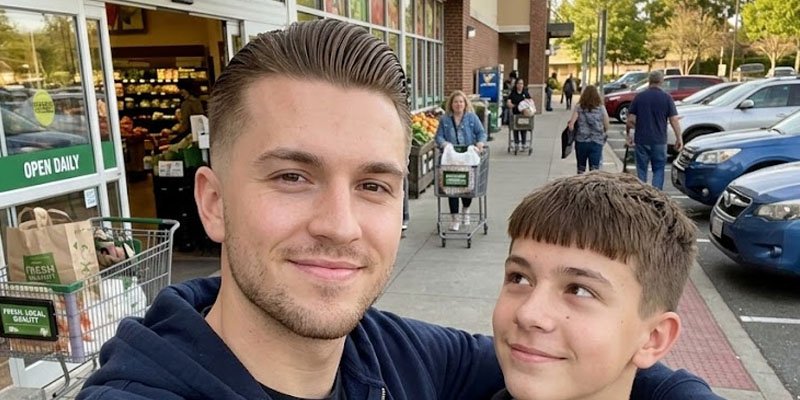
At nineteen, I became the person my autistic younger brother depended on after our parents gave up on him. Six years later, I finally let him go into a grocery store by himself. But when a cashier hurried outside in tears, I feared the independence we had worked so hard to build had ended in disaster.
When Theo was nine, our mother sat me down at the kitchen table and told me he would be “better off somewhere designed for children like him.”
She said it softly, which somehow made it hurt even more.
I was nineteen, looking at her new wedding ring and thinking, Designed? He isn’t a dishwasher.
I said no. Absolutely not.
Over the next six years, I learned everything I needed to know. Medication routines. Sensory triggers. The cereal Theo would eat when the world grew unbearably loud.
By fifteen, Theo knew how to cook eggs, ride the bus with me, and do his own laundry.
But unfamiliar people still scared him.
And other kids picked on him.
A boy named Dylan was the worst of them.
One time, he intentionally pushed Theo until he had a meltdown, then filmed him covering his ears and crying among broken pencils and torn notebook pages.
He posted the recording.
Another boy called Theo “broken.”
It was obvious that our mother wasn’t the only person who thought Theo had no place in the ordinary world.
I was determined to show them they were wrong.
So we practiced and moved forward one small step at a time.
The grocery store on Fourth Street became our favorite place to learn.
We had shopped there for years. Mrs. Bennett, the cashier at register three, had seen Theo go from hiding behind me to paying for his purchases and asking for receipts on his own.
That Saturday, we went to the store for one reason: Theo was going to do all the shopping himself for the first time.
We stopped outside the automatic doors, and I gave him ten dollars.
“Go inside, pick out one chocolate bar, pay at the register, take your receipt, and come straight back. I’ll be waiting right here.”
As usual, Theo repeated the directions twice.
“Chocolate. Pay. Receipt. Come back.”
“You know what to do, buddy.”
He swallowed, visibly nervous.
Then he stood straighter, like a child about to step onto a stage, and walked inside.
I watched him vanish behind the first aisle.
We had practiced the route together for weeks, but I still felt the urge to follow him. I stayed where I had promised to wait, feeling proud and frightened at the same time.
Five minutes went by.
Then ten. I checked my phone, even though it was pointless because Theo didn’t have one yet.
After fifteen minutes, Mrs. Bennett rushed outside, crying.
“Marcus! You’re Marcus, aren’t you?”
My stomach sank.
“Where is my brother?”
“Come inside. Right now. You need to see what Theo has done.”
I ran into the store.
My thoughts raced through every terrible possibility. Someone had mocked him. He’d had a meltdown, shut down, or suffered a panic attack. A security guard had misunderstood him.
I reached the checkout area.
Everyone was standing still.
Theo was in the middle of it all.
My brother was kneeling on the cold tiles, his hands held behind his back. He looked like someone waiting to be arrested, and he was crying.
A few feet away, a woman kept her little girl behind her hip and pointed angrily.
“He’s dangerous!” she kept shouting. “Keep him away from my daughter!”
“Theo…” I whispered. “What happened?”
The customers stared in shock, although none of them seemed afraid.
I crossed the floor and crouched in front of him.
“Hey. Hey, buddy. It’s me.”
He flinched before lifting his head. His eyes were red.
“You can stand up,” I told him gently. “It’s all right. Nobody’s angry with you. Take my hand.”
He didn’t move. “Is she still scared?”
“Let’s get you standing first.”
He let me help him up. I put an arm around his shoulders and felt him shake like a plucked string.
“Can someone tell me what happened?” I demanded, my voice sharper than I meant it to be.
Mrs. Bennett wiped her cheeks.
“Her card was declined, honey. She started putting her groceries back. The little one was crying because of her cereal. And your Theo heard everything.”
“I had ten dollars,” Theo whispered. “I could share.”
I briefly closed my eyes.
“He walked straight over to her, as sweet as could be,” Mrs. Bennett continued. “He held out his money. Then she looked at him and turned as pale as paper. She said she knew who he was.”
I looked more closely at the woman.
My heart sank as I recognized her from a school meeting.
“You’re Dylan’s mother,” I said.
“And you know exactly what your brother can do.” Her voice trembled, but she stood her ground. “I saw the video. I saw him breaking things. He was obviously violent.”
“Your son kept provoking Theo until he had a meltdown,” I replied. “That video shows a child in terrible distress, and your son thought it was amusing.”
“That isn’t what my son told me.”
“Of course it isn’t!”
“My son was the one who was frightened!” she snapped. “He was scared that boy would attack him, and now he’s approaching my daughter!”
“I was protecting my child.” She raised her chin. “I want to speak to the manager. Now. And I’m filing a complaint.”
Theo moved closer against my side.
He said nothing, but I could feel his fingers rapidly flexing, the way they always did when he was upset.
“I wasn’t trying to be bad,” he said. “She was shouting. Everybody was shouting. I thought if she saw my hands weren’t doing anything, she’d understand I wasn’t going to hurt her.”
My fifteen-year-old brother had knelt on a grocery-store floor just to show someone he wasn’t a threat.
I was furious. Part of me wanted to keep fighting back. A hundred different replies came to mind.
But Theo’s breathing was becoming uneven, and every raised voice made him shrink further into himself.
Winning the argument would hurt him more than leaving it.
When the manager arrived and the woman repeated her complaint, I said just one thing:
“I’ll come back tomorrow, and we can talk then.”
Then I took my brother home.
He never got his chocolate. Even worse, his first effort to shop independently had ended in disaster.
That evening, Theo sat on the edge of his bed with a blanket over his knees, his hands still moving restlessly.
“I was helping,” he said. “Why was she angry if I was helping?”
“You did nothing wrong,” I told him. “Not a thing.”
“But I didn’t finish.” His hands moved faster. “Chocolate, pay, receipt, come back. I only did the first part.”
“That wasn’t your fault.”
He nodded, but kept looking at the floor.
Later, when I was alone in the hallway, I blamed myself for letting him go inside. I knew the woman was the one at fault.
Even so, I couldn’t get the picture of him kneeling out of my mind.
The next morning, I went back to the store by myself.
The manager looked tired but had kind eyes. He noticed me as soon as I came in.
“I reviewed the security footage,” he said. “I also spoke with every employee who witnessed what happened.”
My pulse sped up. “And?”
“Your brother offered her his money,” the manager replied. “He didn’t threaten or touch anyone. The footage doesn’t back up her complaint. I’m sorry. You’re both welcome here.”
I should have felt reassured.
Instead, I kept seeing Theo on his knees while strangers stood watching.
The manager had cleared him, but that didn’t undo the incident or the hurt it had caused.
I thanked him and started toward the exit.
That was when Mrs. Bennett came out from behind her register.
“How is he?” she asked.
“Quiet.”
“Poor kid, after working so hard…” She sniffed. “Bring him back on Thursday, if he’s willing. The store should be quiet around this time of the month. I’ll be at register three.”
I wanted to say yes, but trying again wasn’t always simple for autistic children.
“Thank you,” I managed. “I’ll think about it.”
As I walked home, I kept picturing Theo on his knees, desperately trying to make himself look harmless.
He had followed every instruction and tried to help. Neither thing had protected him.
For six years, I had taught him that preparation could help him manage unfamiliar situations. Six years. What was I supposed to tell him now?
My mother’s words came back to me.
Better somewhere equipped.
For a moment, I wondered whether encouraging him to be independent was putting him in harm’s way. The world could be cruel, and I couldn’t make strangers treat him kindly.
When I got home, Theo was sitting at the table, lining up pencils.
“The manager says you did nothing wrong,” I told him. “He watched the recording. We’re welcome to go back to the store.”
He nodded, but I couldn’t tell if he believed me or was worried about returning.
“But you don’t have to go back if you don’t want to. I can do the shopping myself for a while. No problem.”
Theo studied the pencils for a long time.
For two days, I didn’t mention the store.
On Tuesday evening, he appeared in the kitchen doorway, his arms stiff by his sides.
“Did I do it wrong at the store?”
“No,” I said. “No, Theo. You didn’t do anything wrong.”
He thought about my answer, frowning the way he always did when two facts didn’t seem to fit together.
“Then why can’t I go again?”
I couldn’t give him a good answer.
I had started treating a stranger’s cruelty as proof of Theo’s limitations.
“You’re right,” I said. “What do you want to do?”
“Go back,” he said. “I like the store. But I’m scared she’ll be there.”
“Mrs. Bennett said she’ll be there Thursday. What if we do our usual shopping together?”
“Together,” he repeated.
On Thursday, we returned to buy our usual groceries. I felt hopeful until we reached the entrance.
Theo stopped just inside the doors and looked around the store.
“Is she here?” he asked.
I glanced around. “I don’t see her.”
Instead of going ahead to get his cereal, he stayed right next to me.
At the checkout, he kept his eyes on the floor.
“It’s good to see you, Theo,” Mrs. Bennett said, as if this were just another Thursday.
His fingers began to clench and unclench nervously.
I set our groceries on the conveyor belt. Theo usually helped me, but this time he stood so close that our elbows touched.
I paid, and Mrs. Bennett held out the receipt to him.
He stepped behind me.
I took it instead.
Outside, Theo flapped his hands and rocked from side to side.
“I got it wrong. I didn’t do the paying,” he said.
“That’s all right, buddy. You can pay next time.”
“I used to do the paying. And take the receipt.” His face tightened. “I’m sorry.”
I looked straight at him.
“Theo, it’s okay. Honestly. That woman… she made this feel a little frightening for you, didn’t she?”
He nodded.
“So we’ll take it slowly, all right? Remember when we first started shopping, and all you did was take the receipt?”
He nodded again.
“We’ll begin all over again.”
I gave him a reassuring smile, even though my heart hurt. I couldn’t stop wondering if he would ever feel confident enough to go inside by himself again.
A couple of weeks later, Theo was able to take the receipt again. On some days, he even paid.
Then someone from an old school parents’ group sent me a link.
Marcus, have you seen this?
Dylan’s mother appeared in the thumbnail.
The caption said: If you know the young man from the grocery store, help this message reach him.
My stomach tightened.
I shut my bedroom door and played the video.
She was sitting in a parked car, looking into the camera.
“I owe a young man an apology. I recognized him at the grocery store because of a video my son had shared at school.”
She let out a heavy sigh.
“I decided he was dangerous without knowing anything about him. When he came toward me, I screamed before I even listened to what he was saying.”
“I made a complaint. The manager checked the security footage and explained that the boy had offered me his own money to buy cereal for my daughter. He hadn’t threatened either of us.”
She paused and wiped her face.
“I finally asked my son what had happened before he recorded that video at school. Dylan admitted that he and some other boys had made fun of this young man. The clip showed his distress, not what had led to it. I should have asked about it years ago.”
I stared at the screen.
For years, I had told school staff that the recording gave a false impression.
Only after publicly accusing Theo had Dylan’s mother finally heard the truth from her own son.
“I’ve withdrawn my complaint. I’ve told Dylan to delete the video from every account he controls and to stop sharing it. I was wrong to call that young man dangerous.”
She leaned toward the camera and looked directly into it.
“I was wrong.”
“I can’t take back what I did, but if anyone who knows him sees this, please pass along my apology. He doesn’t owe me a reply.”
The video ended.
She had admitted her mistake in public and acknowledged her son’s behavior.
Part of me wanted to show Theo right away. Another part remembered how tightly he had held on to me that Thursday and feared the video might upset him again.
The next day, I asked Theo if he wanted to watch the apology. He said yes.
We sat together. When she first appeared, his fingers started flexing, but as she kept talking, they gradually slowed and finally became still.
“She knows I wasn’t trying to hurt anybody now.” He nodded.
“She knows.”
“That’s what I was trying to tell her.”
For a moment, I couldn’t say anything.
I had wanted him to hear those words for so long. Now that he had heard them, I wasn’t sure they could undo any of the pain.
A few days later, Theo asked if Mrs. Bennett still worked on Saturdays.
“At register three?” he added.
I said she did. He nodded, and I didn’t push him to say more.
Weeks later, he stood near our front door with his shoes on.
“Can we go to the store?”
“Of course,” I said. “I’ll get my keys.”
When we arrived, Theo stopped outside the automatic doors.
“I want to go in alone. I still need to get it right. Chocolate. Pay. Receipt. Come back.”
The memory of him kneeling on the tiles flashed through my mind. Fear swept over me.
“We could go inside together,” I suggested.
“We’ve already done that,” Theo said. “I take the receipts now. Sometimes I do the paying. I want to get it right.”
“Do you feel ready?”
“Yes.”
I wanted more than anything to go in with him, but he had clearly told me what he wanted, and I knew he understood the plan.
So I moved aside.
“Okay. I’ll wait outside.”
This time, I kept watching Theo through the glass. I saw him find the same chocolate bar and take it to Mrs. Bennett at register three.
She smiled. He counted out his money.
He took his receipt.
The automatic doors slid open.
Theo came outside holding his chocolate bar and receipt.
“How did it go?” I asked.
Theo looked at me.
“I got it right.”
A Young Man Let His Autistic 15-Year-Old Brother Enter a Grocery Store Alone for the First Time—15 Minutes Later, a Cashier Rushed Out in Tears, Shouting, “Come Inside! You HAVE to See What Your Brother Has Done!”
311 views