
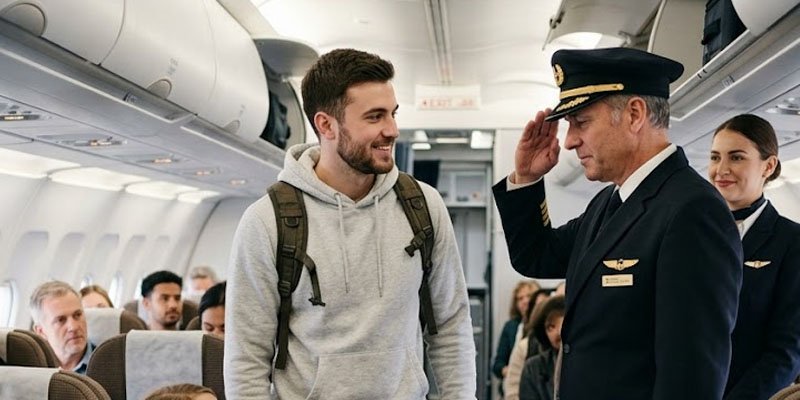
My seven-year-old daughter and I were told to surrender our first-class seats to a wealthy businessman and “go to the back,” as if that was where we belonged.
I didn’t protest.
I took my daughter’s shaking hand, picked up my bag, and began walking down the aisle.
Then the cockpit door opened.
The captain walked out, saw me, and stopped cold.
A moment later, he stood upright and lifted his hand in a precise salute.
the entire cabin went quiet.
Part 1
“Sir, you and your daughter need to move to the rear of the aircraft,” the gate agent told me.
He spoke loudly enough that almost everyone nearby could hear.
What he didn’t realize was that my veteran ID was tucked behind my boarding pass, an old unit challenge coin was attached to my carry-on, and my surname was listed on the passenger manifest beside someone who might recognize what I had once given up.
My daughter Maya looked up at me.
“Daddy, I thought these were our special seats.”
That hurt more deeply than being removed from first class.
My name is Marcus Vance.
I’m forty-one years old, a widower, a single father, and a veteran who came home from my final deployment having lost most of my left leg below the knee.
I almost never discuss my military service.
To most people, I’m simply an exhausted father with a cane trying to keep pace with a seven-year-old who still asks whether her mother can see her from heaven.
That morning, Maya and I were flying to the Carolina coast.
It wasn’t exactly a vacation.
We were going back to the beach where Elena, my wife, and I had fallen in love.
Before cancer took her two years earlier, she asked me for one thing:
Someday, take Maya back there.
Inside my carry-on was a small container I had packed before dawn.
I was bringing Elena back to the ocean.
It had taken almost two years before I could afford those first-class tickets.
On top of our refrigerator sat a coffee can labeled “Mama’s Beach Fund” in Maya’s handwriting.
Some weeks, I managed to put in twenty dollars.
Other weeks, I could spare only a few.
Maya contributed coins from her pink purse, convinced that every coin brought us closer to saying goodbye to her mother.
When we boarded and she saw the spacious seats, her entire face lit up.
“Daddy, are these really ours?”
“They are.”
For ten minutes, I felt as though I had fulfilled my promise.
Then the gate agent came over carrying a tablet.
A man in an expensive navy suit followed behind him.
The businessman had arrived late, but apparently he was an important corporate traveler whose company expected him to sit in first class.
According to the agent, he “required” our seats.
Required.
Not requested.
The agent looked at my cane, my worn boots, and Maya’s old coat.
I could almost watch the conclusion forming in his mind.
We looked like the people least likely to object.
I held out our boarding passes.
“These are our assigned seats. I paid for them.”
The agent responded with a rigid smile.
“I understand, sir, but please don’t make this more difficult than it has to be.”
Maya tightened her grip around my hand.
I could have fought the decision.
I could have told him about the two years of saving.
The coffee can.
Elena’s hospital room.
Her final request.
The ashes in my bag.
But Maya was looking at me.
So I lowered my eyes to her and smiled.
“Maybe the seats in the back will be fun. We’ll get to see the whole airplane.”
She nodded.
But tears were beginning to gather in her eyes.
That nearly broke me.
I didn’t care about first class.
I had slept in places much worse than the last row of an airplane.
What hurt was watching my daughter discover that strangers could decide her father was worth less than someone with more money.
I stood.
Pain shot through my left side as I braced myself against my cane.
I pulled the carry-on against my chest.
To everyone else, it was simply luggage.
To me, it contained something sacred.
Then I took Maya’s hand.
The cabin grew quiet.
Several passengers watched.
Others turned their faces away.
We had gone only a few steps when the cockpit door opened.
The captain stepped into the aisle.
Gray streaked his temples, and his uniform was perfectly pressed.
At first, he didn’t look at the gate agent.
He looked directly at me.
Then his eyes caught my cane.
The challenge coin attached to my bag.
The veteran ID still showing beside my boarding pass.
His expression changed.
Recognition followed.
Not because he knew me personally.
Because he understood what those things meant.
The captain moved closer.
Then he squared his shoulders and gave me a sharp military salute.
The aircraft became completely silent.
For a second, I almost dropped the bag.
For two years, I had been the widower limping through school pickup.
The exhausted father strangers walked past in stores.
The man people ignored because he moved slowly too.
Now, an airline captain was saluting me in front of the entire cabin.
I stood as straight as my body allowed.
Then I returned the salute.
Maya stared at me as though she were seeing her father through different eyes for the first time.
The captain lowered his hand.
“Sir,” he said loudly enough for everyone in first class to hear, “it is an honor to have you aboard my aircraft.”
Then he turned toward the gate agent.
“This man and his daughter are not moving.”
The agent’s face went pale.
The businessman lowered his eyes.
The captain continued.
“They are exactly where they belong.”
Nobody said a word.
Then the captain glanced toward the passenger manifest near the galley.
His expression changed once more.
This time, it carried something beyond respect.
Something personal.
He looked at me.
“Vance?”
A chill ran through me.
The cabin remained silent.
Then I understood that the captain hadn’t saluted me simply because I was a veteran.
He knew my name for another reason.
PART 2:
The captain stared at me for several seconds before coming closer. “Marcus Vance?” he repeated, almost as though he couldn’t believe it. I nodded, trying to figure out how I might know him. Then he whispered, “You pulled my brother from a burning vehicle in Kandahar.”
I froze.
Maya looked from him to me, confused. “Daddy, do you know the captain?” she asked. I swallowed and shook my head. “Not personally,” I said. But the captain’s eyes were already filling with emotion, and suddenly I remembered a night I had spent years trying to push from my mind.
“Your brother was Lieutenant Daniel Hayes,” I said quietly. The captain nodded. “He was.” His voice cracked as he continued, “You carried him nearly two hundred yards while everyone else believed nobody had survived.”
I looked down at my cane. “There were people who needed help,” I said. “That’s all.” The captain shook his head. “No, Marcus. My brother talked about you until the day he died.”
The cabin had become so quiet that Maya’s little voice sounded unusually loud. “Did my daddy save someone?” she asked. The captain crouched down until he was looking directly into her eyes. “Your daddy saved my brother’s life.”
Maya stared at me with wide eyes. For the first time, I saw something new in her expression—not uncertainty about why her father walked differently, but pride. She reached for my hand and squeezed it tightly.
Behind us, the businessman cleared his throat. “Captain, it seems there has been a misunderstanding.” The captain rose and faced him. “There was,” he answered calmly. “The misunderstanding was thinking money gave you the right to take another passenger’s seat.”
The gate agent started apologizing, but I barely registered his words. My thoughts were on Elena, the small container inside my bag, and the promise that had brought Maya and me onto this plane.
Then the captain looked at the carry-on in my hand. “Are you taking someone home to the coast?” he asked.
My heart seemed to stop.
Because somehow, he knew this journey was about more than a vacation.
And before I could respond, he said something that changed everything for me.
“Marcus, I think you should know why Daniel’s name is on the manifest today.”
The captain remained still in the narrow aisle, allowing his words to settle. Around us, the silence continued. Nobody in first class whispered, shifted, or even checked a phone.
I tightened my hold on my battered carry-on. Inside was the carved mahogany urn containing Elena’s ashes. I couldn’t understand how he had connected my destination with my loss.
“What do you mean, Captain?” I asked quietly. My voice felt dry and rough. “Daniel died three years ago at Walter Reed. How could his name possibly be on your manifest?”
The captain took a slow breath, his chest rising beneath the immaculate gold-braided uniform. “I’m Captain Thomas Hayes. My brother never stopped telling me about the men who kept him alive.”
He gently touched the edge of my carry-on. “Daniel knew about your wife, Marcus. He stayed in contact with your former commanding officer until his final breath in that hospice room.”
Maya looked up at him with her large dark eyes. She let go of my sleeve and touched his cuff. “Did you know my mother too, mister? Her name was Elena.”
Captain Hayes lowered himself until he was eye level with my daughter. His expression softened, the stern pilot’s demeanor disappearing. “I never met her, sweetheart, but I knew about her.”
“He left an endowment,” Thomas said, looking back at me. “A trust through a military foundation. For two years, we tried to locate your current address after your discharge records were misplaced during the regional base reorganization.”
“Daniel’s name is recorded under our aircraft’s memorial cargo ledger today,” the captain explained. “Every year on the anniversary of his passing, I fly this route to our family’s hometown near Wrightsville Beach in the Carolinas.”
The gate agent remained frozen near row two, his tablet shaking in his hand. The businessman retreated toward the galley, visibly humiliated.
“Sir,” the gate agent stammered, his face pale. “I swear I had no idea. The system marked the seat as an executive upgrade override. I was simply following company protocol for high-tier members.”
Captain Hayes stood to his full height. His stern expression carried the authority of his years in naval aviation. “Protocol is never an excuse for lacking basic human decency.”
“You saw a wounded veteran with a cane and a child,” Thomas said, his voice carrying through the cabin. “You assumed they had no power. You chose convenience instead of dignity, and there will be consequences for that.”
The businessman cleared his throat, attempting to recover whatever remained of his pride. “Look, Captain, I don’t want any trouble. I’ll take a coach seat. It’s really not an issue. Please let them keep their seats.”
“You will take whatever seat is available in the rear,” Captain Hayes replied coldly. “Or you can wait for the evening flight. At this moment, this veteran and his daughter are going home.”
An elderly woman across the aisle, wearing a floral scarf, began clapping quietly. Within seconds, other passengers joined her, and applause moved through the forward cabin.
My cheeks grew hot, unused to receiving attention in public. For two years, I had disappeared into the background, concealing my limp and my grief.
“Come, Marcus,” Captain Hayes said, motioning toward our original seats in row three. “Allow me to help with the luggage. No one will ever tell you to surrender your place on my aircraft again.”
He took my carry-on with both hands, handling it with the reverence normally given to a folded flag. Then he placed it securely in the overhead compartment above our seats.
“Daddy,” Maya whispered, tugging my arm as I sat down. The soft seat relieved some of the pressure on my residual limb. “Are we really staying here? In the big chairs?”
“Yes, sweetheart,” I said, kissing the top of her head. “We’re staying right here. Just like we planned when you put those shiny pennies into Mama’s beach fund on top of the old refrigerator.”
Maya smiled, her face glowing so brightly that the dark circles beneath her eyes seemed to disappear. She settled into the broad seat, running her fingers over the armrest and entertainment console.
Captain Hayes stepped back toward the cockpit doorway and glanced over his shoulder. “Rest easy, Sergeant Vance. Once we reach cruising altitude, I’d like to speak with you again, if you’re willing.”
“I’d like that, Captain,” I replied. He gave the same crisp military nod before closing the flight deck door to complete the pre-flight checks.
The gate agent disappeared without another word. Another flight attendant, a warm-eyed woman named Sarah, brought Maya a blanket and a pair of wings.
“If you or your little girl need anything during the flight, Sergeant, just press that call button,” Sarah said gently. “It is a genuine privilege to have you flying with us today.”
“Thank you,” I answered, my voice catching. For the first time since Elena’s funeral, the heaviness inside my chest seemed lighter, as though someone else had taken part of it.
The engines vibrated through the fuselage as the plane pushed away from the gate. Maya pressed her face against the window, fogging the glass.
“Look, Daddy! The ground is moving away,” she exclaimed, pointing toward the tarmac. “We’re really going to the beach! Mama’s beach! Do you think she can see us from the clouds?”
“I know she can,” I said, placing my hand over hers on the armrest. “She’s been watching us every day, Maya. And she’s very proud of how brave you’ve been this morning.”
The aircraft accelerated along the runway, powerful thrust lifting us smoothly into the gray morning sky. We climbed beyond the clouds and into golden sunlight.
Maya gasped when she saw the white clouds beneath us. “Daddy, it looks like a giant bowl of vanilla ice cream. Can we touch it after we land?”
“Not exactly, honey,” I laughed, feeling a real smile spread across my face for what seemed like the first time in years. “Clouds are made from tiny drops of cold water, but they certainly look beautiful.”
About twenty minutes into the flight, the seatbelt sign chimed off. Sarah brought Maya apple juice and a snack box containing cheese, crackers, and chocolate.
Maya treated the snack box like a treasure chest, carefully arranging each cracker before eating it. Seeing her happiness made every late shift at the warehouse feel worthwhile.
Before long, the cockpit door opened again. The first officer remained at the controls while Captain Hayes stepped out carrying a manila folder.
He sat in the empty seat across from us and leaned forward. His expression was serious but compassionate, like that of an older comrade.
“Daniel talked about you at every family dinner after he came home,” Thomas began quietly. “He told us about the ambush in the valley, when the fuel tank on his transport vehicle caught fire.”
The memory returned with sudden, painful clarity. Burning diesel. Gunfire bouncing from the canyon walls. Screams coming from the overturned armored truck.
“I didn’t think about it,” I told Thomas, looking at my scarred hands. “I saw a brother trapped inside. Anyone in our unit would have done exactly what I did that afternoon.”
“No, Marcus, they wouldn’t,” Thomas said gently but firmly. “Two men attempted it before you, and the heat forced both of them back. You went into the flames with a fractured ankle and dragged him out.”
“That was when you lost your leg, wasn’t it?” Thomas asked, briefly glancing toward the floor where my denim trousers concealed the titanium and carbon-fiber prosthesis resting against my right boot.
“Shrapnel struck my lower leg while I was running back toward our perimeter,” I admitted. “There was a secondary explosion from the ammunition rack. But Daniel was alive, and that was the only thing that mattered to us.”
“Daniel lived another eight years because of you,” Thomas said, his eyes shining with unshed tears. “He watched his daughters graduate from elementary school. He also had the chance to make peace with our father.”
Maya stopped eating her cracker and listened closely. Children notice more than adults realize; she could sense the connection between me and the pilot.
“Did my daddy get hurt when he helped your brother?” Maya asked, her voice innocent and clear. She placed one hand on my knee above the point where the prosthesis connected to my leg.
“He did, sweetheart,” Thomas answered softly. “Your daddy gave up part of himself so my brother could return to his family. He is the bravest man I have ever had on this aircraft.”
Maya looked at me, her little chest rising proudly beneath her worn coat. “I told the kids at school my daddy was a hero, but Tommy Jenkins said heroes don’t walk with sticks.”
“Tommy Jenkins doesn’t know what he’s talking about,” Thomas replied firmly, giving Maya a wink. “Real heroes carry their battle scars quietly, and sometimes they use canes because they carried other people through the fire.”
I cleared my throat and blinked away the moisture stinging my eyes. “Thomas, why was Daniel’s name on your manifest today? You mentioned a cargo ledger earlier when we were boarding.”
Thomas opened the manila folder he had been carrying. Inside were legal documents, notarized military letters, and a photograph of a smiling man sitting in an oak wheelchair.
“When Daniel died from complications related to his war injuries, he left a specific instruction in his will,” Thomas explained, handing me the top document. “He created the Daniel Hayes Family Assistance Endowment.”
“Its purpose was simple: locate the sergeant who pulled him from that burning vehicle and make certain his family never suffered financial ruin because of his service-connected disabilities,” Thomas continued.
I stared at the papers in disbelief. “Thomas, I can’t accept money. I work at the regional distribution depot. We manage. We have an apartment, and we keep our expenses under control.”
“You shouldn’t have needed to save coins in a coffee can for two years just to take your wife’s ashes to the ocean, Marcus,” Thomas said gently, his voice carrying firm conviction.
“Daniel understood how easily the system forgets wounded veterans after the medals are awarded and the parades are over,” Thomas continued. “He spent his final years establishing this foundation with our family’s estate.”
“We’ve been searching for you for more than fourteen months,” Thomas added. “When your wife became ill, you moved from Georgia to Virginia, and your records became trapped in an administrative processing backlog.”
“I had to sell our house in Georgia to cover Elena’s chemotherapy,” I admitted quietly. “The insurance company rejected three different coverage appeals. We had to start over in a small rental.”
“I know,” Thomas said, placing a hand on my arm. “Last month, investigators working for Daniel’s foundation located the hospital debts. Marcus, every outstanding medical balance belonging to Elena was paid three weeks ago.”
The breath suddenly left my lungs. I stared at him. “You… you paid off her hospital bills? All seventy thousand dollars of the medical invoices that were still outstanding?”
“The foundation paid them exactly as Daniel instructed,” Thomas corrected gently. “He also left enough resources to make sure you and Maya have a fully paid home near the coast whenever you’re ready.”
I covered my face with both hands as sobs suddenly broke through my chest. For two years, collectors had called every day and threatened legal action while I was trying to grieve Elena.
Maya wrapped both arms around my neck, pressing her cheek against mine. “Don’t cry, Daddy. It’s okay. Don’t be sad anymore. We’re going to Mama’s favorite beach.”
“I’m not sad, baby,” I managed to say, holding her tightly against me. “These are happy tears, Maya. Daddy is just very thankful that there are good people in this world.”
Thomas waited quietly and respectfully until I had regained control, then handed me a clean linen handkerchief from his pocket. I wiped my face and looked again at Daniel’s smiling photograph.
“He looked so much like you,” I whispered, studying the strong jaw and kind hazel eyes in the picture. “He made jokes even while we were waiting for the medical evacuation helicopter.”
“That was Daniel,” Thomas said with a soft chuckle. “He always tried to make everyone else comfortable, even when he was suffering badly. Every time our family gathered, he talked about your strength.”
“Where are you staying after we land in Wilmington?” Thomas asked, shifting to our immediate plans. “Do you have a hotel reservation near the oceanfront for the weekend?”
“We reserved a small motel about five miles inland,” I replied. “It was all we could afford after buying the plane tickets. We planned to take the coastal bus to the pier tomorrow.”
Thomas smiled and shook his head. “Cancel that reservation on your phone right now, Marcus. You and Maya are staying at my family’s beach cottage on the southern end of Wrightsville.”
“Thomas, please. You’ve already done more than enough,” I protested, shaking my head. “We’ll be fine at the motel. Maya doesn’t mind taking the bus; she thinks it’s an adventure.”
“This isn’t charity, Marcus,” Thomas answered, his tone leaving no room for argument. “The cottage has a private path leading to the dunes, where the water is peaceful and quiet. You deserve a private place to say goodbye to Elena.”
Maya tugged at my sleeve, her eyes sparkling. “A real beach cottage, Daddy? Where we can hear the waves through the window like Mama used to tell me in her stories?”
I looked from Maya’s excited expression to Captain Hayes’s sincere, steady eyes. I realized that refusing would only hurt his wish to repay an old debt, so I surrendered.
“Thank you, Thomas,” I whispered, nodding. “We would be honored to stay at your family’s cottage. Elena loved Wrightsville Beach more than anywhere else in the world.”
“Then it’s settled,” Thomas announced, lightly slapping his knee before standing. “My wife, Sarah, will meet us at arrivals. She’s already getting the guest suite ready for you both.”
The captain returned to the flight deck to prepare for our descent. The flight attendant brought Maya a warm chocolate cookie and treated her like royalty for the remainder of the journey.
Soon, the blue Atlantic appeared beneath us, bordered by emerald marshes and white sandbars along the Carolina coastline.
Maya pressed both hands against the window, fascinated by the water. “Look, Daddy! The ocean is enormous! Is Mama’s special place somewhere down there near those boats?”
“It certainly is, honey,” I answered, feeling a deep peace settle inside my heart. “Right beside the old wooden pier where Mama and I used to watch pelicans dive for fish at sunset.”
The plane descended smoothly through the coastal air and landed at Wilmington International Airport with barely a shake. Reverse thrusters filled the cabin with sound.
At the gate, Captain Hayes’s voice came through the speakers.
“Ladies and gentlemen, this is your captain speaking,” Thomas announced. “Before we begin deplaning, I would like to take a moment to share an extraordinary honor that occurred on today’s flight.”
“Seated among us in row three is retired Army Sergeant Marcus Vance,” the captain continued, his voice carrying throughout the aircraft. “Fourteen years ago, Sergeant Vance risked his life during combat to pull my brother from a fire.”
“Because of his courage, my brother survived and returned home to his daughters,” Thomas said. “Sergeant Vance sacrificed his own leg during that rescue and represents the finest traditions of American service.”
“He is traveling today with his daughter Maya to honor the memory of his late wife,” Thomas concluded. “Sergeant Vance, on behalf of our entire crew and airline, we thank you for your service and sacrifice.”
the cabin exploded into thunderous applause. Passengers rose from their seats throughout the aircraft, clapping and cheering, while some wiped tears from their faces as they looked toward our row.
Even the businessman at the back of first class stood and applauded with remorse. He caught my eyes, nodded an apology, and placed a hand over his heart.
I stood using my cane and placed my own hand over my heart. Maya smiled brightly, holding my hand while waving.
Captain Hayes came out and picked up my carry-on. He walked along the jetway at the same careful pace I did.
Inside the bright terminal, a kind-faced sandy-blonde woman approached carrying coastal lilies. She smiled at Thomas standing beside us.
“You must be Marcus and Maya,” she said, stepping forward to give Maya a gentle hug before offering me her hand. “I’m Sarah Hayes. Thomas called me on the cockpit satellite phone before takeoff.”
“Welcome to Wilmington,” Sarah said warmly. “Daniel talked about you so often that I feel as though you’ve been part of our extended family for years. We’re incredibly happy that you’re finally here.”
Maya happily accepted the flowers, pressing her little nose into the fragrant blossoms. “Thank you, Miss Sarah! They smell like the garden Mama used to grow behind our old house.”
Sarah wiped a tear from her eye and smiled at my daughter. “Your mama had beautiful taste, sweetheart. Come on. Our truck is outside, and the beach is waiting.”
We crossed the coastal causeway as the morning sunlight glittered across the Intracoastal Waterway. Pelicans flew in formation above the tidal creeks, exactly as Elena had always described them.
The Hayes cottage was a weathered cedar house nestled among sea oats and dunes. A wooden boardwalk stretched from the porch all the way to the shoreline.
Inside, the house smelled of salty air, polished pine, and Sarah’s warm cinnamon rolls. Family photographs decorated the mantel, including one of Daniel in uniform.
Maya raced onto the screened porch and stared toward the ocean. “Daddy! The waves are making music! Listen to how loudly they roar!”
I walked outside to stand beside her, resting my hands on the wooden railing. the rhythm of the surf seemed to wash away two years of exhaustion, grief, and financial anxiety.
“Marcus,” Thomas said as he stepped onto the porch carrying two glasses of iced tea. “Take as much time as you need today. Whenever you’re ready to walk to the water, Sarah and I will be here.”
“I think Maya and I are ready now,” I answered quietly, looking toward the shoreline. “Elena has waited long enough to return to the beach she loved so much.”
I went inside and took the mahogany urn from my bag. Maya held my hand as we walked along the boardwalk through the sea breeze.
Thomas and Sarah remained near the dunes, quietly keeping watch while giving us the privacy we needed.
Cool sand met our shoes at the water’s edge. White foam rolled onto the shore before slipping back into the turquoise Atlantic.
I knelt on my good knee and placed my cane into the sand. Maya knelt beside me, her fingers resting gently on her mother’s carved urn.
“We’re here, Elena,” I whispered, my voice breaking. “I brought our little girl back to the beach, just like I promised you in that quiet hospital room before you went to sleep.”
Maya looked toward the sky, her voice gentle but certain. “We saved our pennies in the coffee can, Mama. And a kind captain Daddy saved in the army helped us come here today.”
“You don’t have to hurt anymore, Mama,” Maya continued, tears sliding down her sunlit cheeks. “Daddy says you can swim with the dolphins and watch over us from the clouds forever.”
I opened the urn. Together, we held the container while the sea breeze carried Elena’s ashes across the breaking waves.
The fine gray ashes spread over the blue water like silver light. They danced across the surface before vanishing into the ocean.
Two dolphins appeared beyond the breakers, their fins arching above the water as though welcoming an old friend home.
Maya gasped with pure excitement and pointed toward them. “Look, Daddy! Mama is already swimming with them! She heard me! She really heard what I said!”
I pulled my daughter tightly against my chest and buried my face in her hair while tears streamed down my cheeks. For the first time, they were tears of release rather than despair.
Elena was finally free from pain, hospital rooms, and illness. She belonged to the sea, the wind, and the sunlight touching our faces.
We remained beside the water, watching the waves as their steady rhythm softened years of sorrow.
When we stood, Thomas and Sarah were waiting at the boardwalk steps. Thomas offered me his hand to steady me on the sand.
“Daniel is at peace too, Marcus,” Thomas said quietly, his hazel eyes full of understanding. “Today, you honored them both. You are a good father and a true brother.”
That evening, we gathered around the large dining table in the cottage and shared a meal of fresh coastal seafood, warm corn muffins, and sweet peach cobbler that Sarah had baked herself.
For the first time in years, Maya laughed without holding anything back. She told Sarah about her school drawings and favorite books, her eyes shining with renewed happiness.
That night, Thomas showed me the foundation documents for the educational trust Daniel had established to cover Maya’s college tuition.
“She will never have to worry about paying for school, Marcus,” Thomas explained. “Daniel wanted the daughter of the man who saved his life to have every opportunity this country could provide.”
“I don’t know how I can ever repay this, Thomas,” I said, shaking my head in quiet amazement at the size of Daniel’s lasting gratitude. “It feels like far too much for something I did in the desert one afternoon.”
“You don’t repay a gift of life, Marcus; you carry the grace forward,” Thomas replied. “Daniel survived, and now his memory is making sure that you and Maya get the chance to truly live too.”
During the next three days, Maya and I explored the shoreline of Wrightsville Beach. We collected pieces of sea glass, built castles in the sand, and watched fishing boats return as the sun went down.
My leg hurt a little less each day, almost as though emotional relief had eased the pain in my body. I depended less on my wooden cane.
On our final afternoon, Thomas drove us into a quiet neighborhood filled with live oaks about two miles from the beach.
He stopped outside a single-story brick cottage with a porch, fenced yard, hydrangeas, and a stone walkway.
“Whose house is this, Captain Thomas?” Maya asked, pressing her face against the truck window as she admired the bright blue front door and white rocking chairs on the porch.
Thomas turned around in his seat with a smile. From his pocket, he pulled out a brass ring holding two keys.
“This house belongs to you and your daddy, Maya,” Thomas said gently, placing the keys into her open hands. “Daniel purchased it through the foundation last year while we were waiting to find you.”
Maya gasped. She stared at the shiny keys, then looked at me in complete wonder. “Daddy? Our house? We don’t have to live in the noisy apartment beside the highway anymore?”
I looked at Thomas, speechless at the generosity. “Thomas… this can’t be real. We can’t simply accept an entire house. It’s too much. It’s so much.”
“Daniel wanted his savior to have a peaceful home where he could raise his daughter, Marcus,” Thomas said firmly, placing a steady hand on my shoulder. “The deed has already been recorded in your name.”
“The property taxes are covered permanently through the foundation endowment,” Thomas added. “All you have to do is live here, raise this beautiful girl, and allow the coastal air to heal your heart.”
We climbed out of the truck and followed the stone path toward the house. Maya unlocked the door, revealing bright rooms filled with sunlight.
Large windows in the living room looked toward the oak trees, and the backyard had enough space for the vegetable garden Elena had always dreamed about.
Maya raced through the empty rooms, her laughter bouncing from the new walls. “Daddy! My bedroom has a window looking at the big tree! Can we get a puppy now? Can we?”
“Yes, baby,” I said through a choked voice, putting my arm around her shoulders as she leaned against me. “We can get a puppy. We can plant a garden. We can have a real home again.”
Captain Hayes stood in the doorway and watched us with satisfaction. The fourteen-year debt his family carried had finally been repaid with grace and love.
“Daniel is smiling down on us today, Marcus,” Thomas said quietly. “He always believed the bravest men were those who came home and continued fighting for their families every single day.”
The following week, Maya and I returned to Virginia only long enough to pack our few possessions, give notice on the small rental apartment, and say goodbye to our old life of silent struggle.
Three weeks later, Maya and I were settled into our new Carolina home. The coffee can that had once been full now sat empty on the kitchen counter.
I found fulfilling logistics work at Wilmington’s veterans’ medical center, helping wounded soldiers navigate benefits and adjust to civilian life.
Maya flourished at her local school and made friends who came over to play with Bella, our adopted golden retriever.
Every Sunday afternoon, Maya and I went down to Wrightsville Beach. We sat near the pier, watched the waves, and felt Elena in the salty breeze.
Thomas and Sarah became part of our family. Whenever Thomas had a layover in Wilmington, he joined us for dinner and watched Maya grow into a happy, secure little girl.
The businessman from the flight also honored his promise. Through the airline board, he made a substantial donation to Daniel’s foundation, helping fund scholarships for children of fallen soldiers.
That morning, the world had seemed cruel when an agent sent us toward the back because of our worn clothing and my injuries.
But that humiliation uncovered a chain of sacrifice, honor, and gratitude that changed our broken world.
One morning, I noticed gray beginning to show at my temples and faint lines appearing around my eyes. Yet the shadows of sorrow were gone.
I still relied on my cane, and my leg ached whenever eastern storms approached. But I no longer lowered my head or tried to disappear from the world.
I was Sergeant Marcus Vance—a man who pulled a brother from a fire, kept his promise to his dying wife, and raised a courageous daughter with an open heart.
One evening, as the setting sun painted the marsh sky in gold, rose, and violet, Maya and I sat together in our porch rockers.
Bella slept across my boots while the coastal breeze stirred the Spanish moss hanging from our live oaks.
Maya rested against my shoulder, holding a framed photograph of her mother smiling on the beach. “Daddy, do you think Mama knows how happy we are now?”
“She knows, sweetheart,” I answered, putting my arm around her and drawing her closer against the evening chill. “She knows we’re safe, she knows we’re loved, and she knows we’re finally home.”
Beyond the dunes, the ocean continued its steady, timeless roar, reminding us that courage is never forgotten, kindness is never wasted, and love never truly leaves us behind.




