
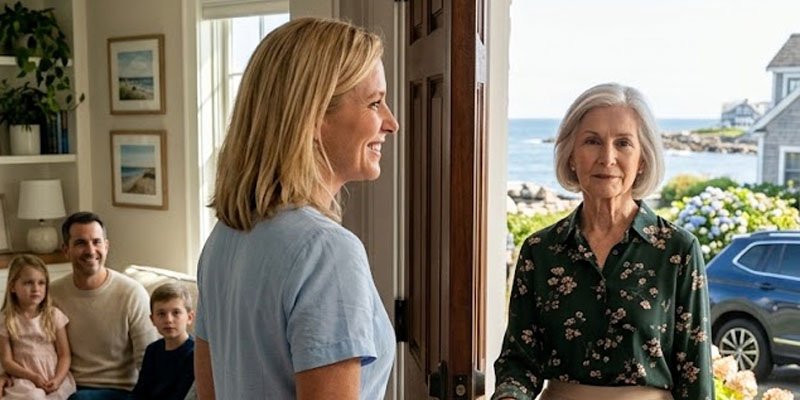
“There’s no space for you here anymore, Rosalind. The house is packed, and we really don’t need any inconvenience.”
Those were the very first words Tiffany said when she opened the front door of my own seaside home.
She did not speak quietly. She did not even try to disguise her statement with embarrassment. She stood in the doorway wearing my embroidered apron, the cream-colored one covered with tiny blue flowers that I had hand-sewn years before, and smiled like someone who had already planned precisely how this moment would play out.
The January wind blowing in from the water was cold enough to sting my cheeks. I had been driving since sunrise from Philadelphia, my overnight bag in one hand and my keys in the other, my back aching after spending far too many hours behind the wheel.
For the last hundred miles, I had pictured only two things.
Quiet and sleep. Sleep in my own bed beneath the sloping ceiling, listening to the Atlantic beyond the dunes rolling in and out like slow, steady breathing.
That house had never been a present.
No one had simply handed it to me.
I had built it the same way I had built every secure thing in my life after becoming a widow: one determined little stitch at a time.
When Winston died, I was fifty years old, carrying bills, grief, a teenage son, and a sewing machine that groaned whenever I pushed it too hard. I took alteration work from anyone who needed it.
Wedding hems. School uniforms. Bridesmaid dresses bought in the wrong size. Broken zippers. Pants that needed loosening after babies or heartbreak.
I worked beside cheap coffee at midnight, pins held between my lips and my fingers aching in February.
Whatever money remained went into an envelope tucked inside a flour tin above the refrigerator.
I called it my small piece of freedom.
Twelve years later, that small piece of freedom had become a weathered cottage along the Rhode Island coast, with damp walls, cracked porch railings, and a garden everyone else in town thought was too neglected to bother saving.
I saved it. I painted the walls until my shoulders hurt. I tore out ruined cupboards. I sanded the floors myself. I changed the locks. I planted hydrangeas and rosemary and one stubborn patch of lavender that survived two vicious winters simply because I refused to let it vanish. I made cushions for the wicker chairs on the rear terrace and stitched my initials into their hems because, for the first time in my adult life, I owned something that was completely mine.
So when I turned onto my street and saw three unfamiliar SUVs along the curb, towels hanging over my wicker chairs, music spilling through my open windows, and a plastic sand bucket lying upside down in my herb garden, my first reaction was confusion.
Then irritation.
Then something much colder than irritation.
Inside, children I had never seen before were running barefoot across my rear terrace with wet feet. My blue throw pillows were scattered over the floor.
A woman I recognized as Tiffany’s sister was stretched across my sofa with her shoes still on, scrolling through her phone. Tiffany’s mother was going through my kitchen cupboards as though she had every right to inspect my dishes.
On the sofa beside the front window, the place where I liked to read, a baby slept in a portable nest surrounded by another family’s possessions.
Then Tiffany appeared. Perfectly composed, smiling, with my apron tied around her narrow waist as though it were part of a costume.
“I told Peter I would be here today,” I said.
She smiled, though her eyes stayed cold. “Well, we’re here now. And honestly, there’s no space for extra guests.”
Extra guests. In my own house.
It was such a deliberately chosen sentence that, for a brief moment, I almost appreciated how sharp it was.
She had rehearsed it.
I could tell. It had not slipped out accidentally. It was intended to communicate something.
Everyone inside had gone quiet.
They were watching. Waiting to see whether the older woman would cry, argue, or beg for her place back like some excessively sentimental widow they assumed nobody needed to take seriously.
I looked down at the keys in my hand.
Then I looked at the muddy footprint across the rug I had once scrubbed on my hands and knees.
“All right,” I said softly.
Relief passed across her face.
“I’ll find another place to stay.”
I gave her a calm smile, despite how little calm I actually felt, picked up my bag, walked down the porch steps, and headed toward my car with my shoulders straight and my heartbeat pounding in my ears.
I drove three miles inland to a modest hotel where you could see part of the water if you leaned far enough over the balcony and ignored the parking lot below.
I set down my bag, sat on the edge of the bed, and let myself become completely still.
I did not cry.
What I felt that evening was clarity. The humiliation at the doorway had been far too polished to have happened spontaneously.
Too deliberate. Too staged.
Tiffany had not merely wanted the house for a week. She wanted me to understand something.
That I was no longer expected to come there.
That somehow, in another person’s mind, my own property had become something that could be negotiated.
And if seventy years had taught me anything, it was that when someone intentionally tries to humiliate you instead of merely inconveniencing you, there is usually another motive underneath.
I made tea with the little kettle in the room and took the cup onto the balcony beneath my coat. I stayed there for a long time thinking about Winston, about Peter, about the boy who had once run ahead along the boardwalk collecting smooth stones and pieces of rope that he believed might be useful someday.
The longer I thought about everything, the less it looked like an ordinary family boundary being crossed.
Peter knew I treated that house almost like a chapel. Peter knew I had texted him three days earlier to tell him I would arrive Friday. He had answered with a thumbs-up.
That question kept me awake until morning.
The next day, I dressed with care. Dark slacks, a wool sweater, and the camel coat Winston used to say made me look like a woman who understood things. I put on lipstick even though I rarely bothered with it during winter.
Then I drove back toward the house.
My key would not go into the front lock.
Not because my hands were shaking. Because someone had changed the lock.
I stood there with the key between my fingers as the new brass cylinder caught the weak morning sunlight, and something inside me hardened.
Changing the lock meant planning. Preparation. Permanence, or at least an attempt at permanence.
I remembered the side gate, made from old cedar, with a latch I had installed myself. The small skeleton key for that gate was still on my key ring. I slipped inside and entered the narrow passage between the house and my neighbor’s fence, heading toward the kitchen window, which had been left slightly open.
Tiffany’s voice drifted outside.
“Once the paperwork gets filed, everything else is easy.”
Her mother answered. “And what happens if she objects?”
Tiffany laughed. “Rosalind? Please. She gives in. Peter says she avoids conflict more than anything.”
My fingers tightened around my key ring until the metal edges pressed into my palm.
Her mother made a hesitant sound. Tiffany lowered her voice, almost impatient now. “By the time she understands what’s happening, the conservatorship petition will already make her look unstable. Peter has examples. The doctor’s appointment. The confusion at the pharmacy. That time she forgot her charger and went back to Philly without it. We don’t need much. Just enough to suggest she’s having memory problems.”
My attention narrowed.
Conservatorship.
Her mother inhaled. “That seems extreme.”
“It seems necessary. The house is worth nearly three times what she originally paid.”
Then Tiffany spoke again in the bright tone she always used when she wanted to sound charming: “After the sale goes through, we can put her somewhere nice. She’ll have a small room, meals, and people around her own age. She should be grateful for that.”
I cannot remember breathing. I remember the cold siding beneath my fingertips, the metallic taste in my mouth, and the sound of a spoon tapping against a mug inside my own kitchen while they discussed moving me aside as though I were an inconvenient piece of furniture.
I waited until their footsteps had moved away.
Then I slipped through the side mudroom entrance, which Tiffany had apparently overlooked and which still had the old lock. My key turned without resistance.
I crossed through the kitchen quietly and walked straight toward the printer in the built-in nook. Four pages were waiting in the tray.
The first was a listing packet from a Newport real estate office, with my property address printed across the top.
The second was a draft describing a transition into a luxury short-term rental.
The third was a preliminary valuation containing a figure that made my stomach tighten.
The fourth made me stop breathing altogether.
Petition for Emergency Temporary Conservatorship of Rosalind Margaret Hale.
My name. My birth date. Wording that claimed recent cognitive decline, disorganized financial judgment, and an inability to independently manage a secondary residential property.
Applicant: Peter Hale, son.
I pulled the papers from the printer, slipped them beneath my coat, gently closed the mudroom door without letting it click, walked through the gate and around the block, and did not stop until I reached my car.
Only after I was sitting behind the steering wheel did I properly examine the documents.
After that, there was nothing left to misunderstand.
There was no room for confusion, polite explanations from family members, or excuses about perhaps meaning well.
Whatever part of me still wanted to protect Peter changed completely in that parking space.
Because Peter’s name was right there. He had not merely been influenced from somewhere on the sidelines. He was participating. Signing it. Helping build it.
I drove directly into town instead of going back to the hotel.
Certain names surface in your mind during moments of real urgency like flares against darkness. One of those names was Mara Quinn. She was a real estate attorney in Newport, ten years younger than I was and as precise as cut glass.
Twenty-two years earlier, when her daughter needed a prom dress altered within forty-eight hours during the most difficult period of Mara’s life, she had arrived at my workroom with panic written across her face. I stayed awake all night and refused extra payment. She had never forgotten it.
She answered on the second ring.
I set my purse on her desk, took out the conservatorship petition and listing papers, and told her everything.
My arrival. Tiffany at the doorway. The changed lock. The conversation outside the kitchen window. Peter’s name on the petition.
Mara examined every page twice. Then she leaned back and slowly breathed out through her nose.
“That little schemer,” she said with remarkable certainty.
She asked questions I should probably have asked myself much sooner. Who held the title? Me, alone. Had I ever given Peter power of attorney? Never. Had I granted anyone permission to list or manage the property? No. Had I discussed conservatorship with anyone? No.
“Good,” she said. “Then what they prepared is not only outrageous. It may also be remarkably foolish.”
She started making calls.
The title company. The bank. A detective named Ruiz who investigated property fraud. A clerk in a judge’s chambers regarding emergency relief.
Then she came with me to the county records office.
The clerk opened the parcel records, frowned, and said, “There’s a recently recorded quitclaim deed.”
From: Rosalind Margaret Hale. To: Peter Winston Hale. Recorded three days earlier.
Three days earlier, I had been in Philadelphia altering a bride’s sleeves at the last minute while my son, somewhere else, was recording a deed that transferred my seaside house into his name.
The signature looked like mine but did not feel like mine. Anyone who had watched me sign enough documents could have reproduced those loops. The notarization was from New Jersey. Notary public: Anthony Bell.
“Tiffany’s cousin,” I said immediately.
There were more documents. A pending home equity line application tied to Peter’s name, with the property listed as collateral. A valuation request submitted through a brokerage.
Nothing had closed yet, but enough had already started to unsettle any sensible woman for years.
Peter had debts. The bank representative, careful but unable to hide the basic outline of the situation, made that clear. A failed investment involving luxury event spaces, personal guarantees, a collapse he had never told me about. My house, completely paid off in a rapidly appreciating coastal market, had become the easiest available source of money for him. He had probably started by telling himself it would only be temporary.
Then reasonable. Then somehow justified.
And Tiffany had added confidence, boldness, and pressure.
The house would not simply be used as collateral. Eventually, it would be sold.
And the conservatorship was their safeguard: if I objected, they could portray me as confused, emotional, or declining.
By late afternoon, Mara had secured an emergency hearing for Monday morning, along with a temporary administrative hold preventing any sale, financing, or transfer. Detective Ruiz had opened a fraud investigation. The bank had frozen the credit line.
That evening, my phone rang. Peter.
I answered.
“Mom,” he said, using the precise tone people use when they realize they have been discovered but still hope familiarity might save them. “I’ve been trying to reach you.”
“I know.”
“Can we please not talk about this over the phone?”
“You recorded a deed taking my house. We can talk about it however you want.”
His breath caught sharply on the other end, clear enough for me to hear.
Did you think I would never find out, I asked. I told him everything I knew. The deed. The petition. The realtor. The conversation I had overheard through the kitchen window.
When I mentioned the conservatorship, the phone went silent for six seconds.
Then he said, so quietly that I almost missed it, “Tiffany found that?”
“I found it.”
He muttered something under his breath.
“You planned to tell a court I couldn’t manage my affairs,” I said.
“It was never supposed to go that far.”
“Your name is on the petition.”
“I know.”
Some heartbreaks are too old for tears. I had not raised a heartless boy. I had raised a child who once gave his allowance to a classmate after someone stole the boy’s lunch money.
Hearing that same son breathe quietly on the phone after attempting to legally push me aside did not feel exactly like grief. It felt like watching a house burn while every room remained perfectly preserved in memory even as the walls slowly darkened.
“Why, Peter?”
He said he had gotten himself too deeply involved. He talked about the failed investment, the tax problems, and Tiffany’s family becoming involved. His voice turned defensive, the same tone I remembered from his teenage years: “You have two houses, Mom.”
I said nothing because if I had spoken, I might have screamed.
He rushed on. “I thought if we sold the place or borrowed against it—”
“Did you know she changed the lock on my front door?”
Silence.
“Did you know she told me I had to leave?”
More silence.
“You were willing to let her pressure me into giving up the house,” I said. “Weren’t you?”
“That isn’t fair.”
“From now on,” I said, “you communicate through my attorney.”
I ended the call.
Sunday morning, Mara called me. The realtor had arranged a private showing with a boutique hospitality investor from Providence, believing Peter had inherited the property.
Because of the administrative hold and the ongoing fraud investigation, the investor had already been told that ownership was disputed and decided not to attend.
Tiffany and her relatives did not know that yet, though, and Peter was driving from Philadelphia to explain everything.
I put on my navy wool dress, pearl earrings, and the silver brooch Winston had given me for our twenty-fifth anniversary, a tiny engraved gull caught in flight.
Not because I enjoy drama, but because some battles deserve to be met with dignity.
At two-forty, we drove toward my house. Mara. Detective Ruiz. A uniformed officer. The locksmith was waiting in his van three blocks away. And me.
Tiffany opened the door when Ruiz knocked. She had dressed carefully for the investors she expected inside my house, wearing cream trousers and cashmere, with candles glowing in the entryway as though taking over a widow’s sanctuary required atmosphere. Her expression passed through several stages when she realized who stood on the porch.
“Rosalind,” she said, recovering quickly. “What is all this?”
“My house,” I replied, “being returned to me.”
Detective Ruiz showed his identification and told everyone who was not authorized to remain there that they needed to gather their belongings and leave immediately.
Her smile came back, noticeably thinner. “My husband owns this property.”
“He does not,” Mara replied. “The recorded deed is being challenged as fraudulent, lending activity has been frozen, title is under review, and you have no authorization to occupy the property.”
Tiffany gave a quiet, incredulous laugh, the kind she often used when she wanted authority to sound unreasonable. “Rosalind, did you really call the police over a family disagreement?”
“A disagreement is choosing the wrong tablecloth,” I said. “This involves a disputed signature.”
The next thirty minutes descended into chaos, though certainly not the kind they had expected me to create. Children rushed upstairs. Suitcases landed heavily on the floor.
Tiffany’s mother complained about the embarrassment while stuffing toiletries into bags. Somewhere, a lamp fell over. The baby kept crying. I stayed inside my own entryway and watched as they dismantled their temporary occupation piece by piece.
At one point, Tiffany passed me and whispered quietly enough that no one else could hear, “You always were dramatic.”
“No,” I answered. “I was patient. That was what you misunderstood.”
She stopped for half a second.
Peter arrived at three-twelve. He saw Ruiz. He saw Mara. He saw Tiffany on the porch surrounded by packed luggage. Whatever hope he had brought with him disappeared from his expression.
He looked exhausted. His face seemed thinner around the mouth, and even his expensive coat could not conceal how overwhelmed he was.
“Mom,” he said.
“Did you sign my deed without my permission?” I asked.
He closed his eyes.
“Did you?”
“Yes,” he said.
The rain, the gulls, the distant traffic—everything seemed to disappear behind that single word.
“I arranged the deed. I had it recorded. I kept telling myself I would undo everything once I solved the problem.”
“When exactly were you planning to reverse the sale of my house?”
He had no answer.
Tiffany stepped closer. “He did what he believed he had to do. We’re family.”
I turned toward her.
“No,” I said. “You crossed a line while pretending that being family made it acceptable.”
Her mouth opened, but nothing came out.
Ruiz calmly told Peter not to discuss the matter further without legal counsel. Peter looked at the detective as though the seriousness of what he had done had only just become real.
He looked back at me, rain running down from his hairline.
“I can fix this,” he said.
I looked at the luggage stacked across the porch. At the damaged planter. At the newly installed lock. At the son I had once believed would never intentionally cause me this kind of pain.
“No, Peter. You can’t.”
Tears appeared in his eyes. Real ones.
“I never meant to hurt you.”
“You wanted to protect yourself from being hurt more.”
“That isn’t the same.”
“It becomes the same when you choose my life to carry the consequences.”
Mara gave him the legal notices and explained what he was prohibited from doing concerning the property. He accepted the papers because his hands seemed to need something to hold.
I spoke one more time before turning away.
“You told your wife that I would give in,” I said. “Look at me.”
He lifted his head.
“This is what you forgot while you were so busy underestimating me. I buried my husband. I raised you alone. I built a business with one sewing machine and hands that hurt from working.
“I bought this house with hems and broken zippers and nights when I barely slept. You were never going to pressure me out of it. You were only going to teach me how little room remains in my life for people who mistake kindness for weakness.”
By four o’clock, they were gone.
The locksmith changed the front lock, then the side lock, then the mudroom deadbolt before giving me three new keys attached to a brass ring that felt strangely heavy in my hand. The patrol car drove away. Mara squeezed my shoulder once before leaving. Ruiz gave me his card. Then everyone was gone.
And suddenly, there was only me, my house, and everything they had left behind.
I stepped inside and closed the door.
The smell was unfamiliar.
Far too much fabric softener mixed with fried food.
Sand covered parts of my floors.
Someone had moved the wicker chair beside my reading corner and had not bothered to return it.
I opened the windows despite the winter cold. I swept sand from the kitchen floor. I carried the abandoned towels into the laundry room, remade my bed, and put the cushions back on the wicker chairs.
Then I walked to the reading corner, sat down, tucked my legs beneath me as I had done countless times beside Winston on rainy afternoons, and looked toward the gray ocean beyond the dunes.
The lavender outside was untouched. It was still there, small, silver-green, slightly worn by the January wind, and every bit as stubborn as I had wanted it to be.
The legal proceedings continued for months. The disputed deed was eventually invalidated. The equity line was never funded. Ruiz’s investigation continued through the proper channels.
Peter, for reasons he could discuss with his own attorney, agreed to a settlement requiring him to surrender any claim to the house and repay specific expenses. Tiffany’s cousin, the notary, separately had to answer questions from authorities about the limits of professional responsibility.
I did not follow every detail closely.
Mara did.
That is one reason good attorneys exist.
Peter sent me a letter eight months later.
Four handwritten pages, careful and deliberate.
He explained the debt, the embarrassment, and the way he had repeatedly persuaded himself that he was merely buying time rather than taking something that was not his.
He admitted that he had allowed Tiffany to handle my arrival because he could not make himself face me, which troubled me more deeply than the paperwork ever had.
He said he had begun therapy. He said he understood that I did not owe him forgiveness according to his timetable, or perhaps ever.
I read the letter twice.
Then I put it inside a drawer.
I still have not answered.
Perhaps someday I will.
Perhaps the only answer is that he has to rebuild himself from the beginning, exactly as I once rebuilt this house, not because someone is standing nearby waiting for the work to be completed, but because choosing to remain inside a ruin eventually becomes a decision of its own.
The house belongs to me again in the way that matters most, which is the quiet way.
Nobody needs to announce it.
The keys hanging from my ring say it.
The clean floors say it.
The lavender still growing says it.
On winter mornings, I make tea beside the reading corner while the Atlantic moves beyond the dunes with the slow, dependable rhythm of something that existed long before us and will continue to exist regardless of what we choose to do with our brief lives beside it.
Winston used to say that this coastline had little patience for appearances.
The weather simply refused to accommodate them.
Storms came.
Tides came.
The ocean reclaimed whatever people carelessly left along its edge.
He was right about that. He was usually right about the things that were worth understanding.
My pearl earrings are back on the bedside table. The gull brooch has returned to the small box where I keep the things that matter. The embroidered apron decorated with tiny blue flowers hangs once more from its hook in the kitchen.
I washed it twice before putting it back.
Some things can be cleaned.
Other things you simply keep because they belonged to you first, remain yours now, and that is ultimately the only accounting that matters.
There is one part of that afternoon I want to explain plainly, because people who hear this story sometimes focus on the confrontation at the doorway, the documents waiting inside the printer, or the words Tiffany and I exchanged on the porch.
Those things happened.
And they mattered.
But what I remember most clearly is standing outside that kitchen window beneath the narrow shadow of the porch overhang, listening as my son’s wife explained how they intended to remove me from the life I had built.
Not physically.
Not through anything that would leave visible evidence.
Simply through the quiet institutional disappearance of an older woman whose inconvenient presence had gradually been redefined as a problem that needed to be managed.
Somewhere comfortable.
A small room.
Meals.
People her own age.
I have often wondered how close their plan came to succeeding.
If I had arrived Saturday instead of Friday, I might never have realized that anything needed immediate attention.
If I had returned to Philadelphia after Tiffany turned me away—which the earlier version of me probably would have done—I would never have stood beneath that kitchen window.
If Mara’s number had not remained in my phone after twenty-two years of mutual gratitude, I might have found myself alone in the county records office, unsure whether I truly understood what those documents were telling me.
And if I had done precisely what Tiffany expected—quietly given in—it might have worked.
That realization stayed with me longer than anything else.
Not the questionable paperwork. Not the deed carrying a signature I had not knowingly given. Not even Peter’s name appearing on a petition intended to suggest that I could no longer responsibly manage my own affairs.
What remained with me was the realization that Tiffany understood my personality well enough to build her plan around it.
She knew I disliked confrontation. She knew embarrassment would make me withdraw instead of argue. She knew I would quietly leave and process my emotions privately rather than cause a scene. She had watched these parts of me carefully over the years.
And she had depended on them.
That is what I mean when I say my patience became my mistake.
Not generosity. Not kindness. Not love.
Patience with behavior that should have encountered boundaries years before.
I had watched Tiffany rearrange my table settings and call it practicality.
I had heard her tell Peter that I made situations uncomfortable and said nothing.
I had listened as she looked at the calluses on my sewing hands and laughed, and I told myself that married couples protect each other even when perhaps they should not, that Peter needed peace in his marriage more than he needed to challenge his wife, and that I was mature enough to absorb small comments without demanding apologies.
But those moments were not as insignificant as I had convinced myself they were.
They were preparation.
Every time I accepted one without responding, Tiffany raised her expectations.
What can she tolerate?
What will she permit?
How far can this continue before she finally objects?
By the afternoon she opened the front door of my own house wearing my apron and told me there was no room for another guest, the answer apparently was: very far.
I do not blame myself for being forgiving.
I blame myself for mistaking forgiveness for permission.
They are not the same thing.
Forgiveness is something you may choose after someone has wronged you.
Permission is what you unknowingly offer before the next wrong takes place.
For years, I had been giving permission while calling it grace.
What that hotel room taught me that first evening, with cold tea beside me and my roofline visible two streets away, was that clarity does not mean cynicism.
You can understand people accurately without hating them.
You can protect yourself without becoming cruel.
You can look at your son’s name on a petition claiming you cannot manage your own affairs and still understand, through the long perspective of a woman who has already buried the person she loved most, that he made a deeply damaging choice and would have to live with its consequences.
And you can understand that it is not your responsibility to manage those consequences for him.
Your responsibility is to remove yourself from them.
I had confused those responsibilities for far too long.
I was seventy years old and still protecting people from the results of their own decisions because I had learned, as many women of my generation had learned, to believe that managing everything was love and continually making myself smaller was virtue.
It was not love.
It was habit.
And habits can change.
The lavender outside continues to grow.
It has survived three winters since that January, and every spring it comes back a little stronger, just as plants do when they are finally given enough room to establish good roots.
I planted another row this past April.
I sewed new cushion covers for the wicker chairs in a blue-gray fabric that matches the winter ocean.
I rehung photographs Winston and I had taken during our drives along the coast before his illness—all those weathered shingles, harbor boats, and steamed-up-window diners he loved photographing.
I now work from this house for three months every year instead of coming only on weekends.
My assistant in Philadelphia manages alteration appointments whenever I am away, and the arrangement suits both of us.
Before breakfast, I take long walks along the boardwalk where Peter once gathered smooth stones and pieces of rope because he believed they might become useful someday.
I think about that little boy with affection.
I think about the man he eventually became with sadness.
Those feelings can exist at the same time.
His letter remains inside the drawer.
Sometimes I take it out and read it again.
The handwriting is careful, the same handwriting that once printed my name in crooked block letters across birthday cards when he was small.
There is genuine regret inside those sentences, not merely the appearance of it.
I know the difference.
I still have not answered.
I do not know whether I ever will.
What I do know is that whatever response I eventually choose, if I choose one at all, will belong entirely to me—written inside a house that belongs to me, within a life that belongs to me, with my initials stitched into the hems just as I once stitched them into those cushions.
Because I am finally a woman who has stopped apologizing for occupying the space she worked so hard to earn.
Beyond the dunes, the sea moves every morning without asking anyone’s permission.
I find that worth remembering.




