
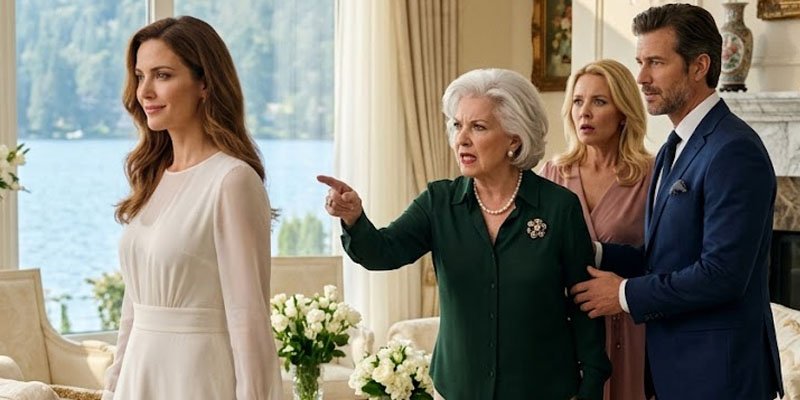
Two weeks after my husband’s funeral, his brother walked into my living room accompanied by a realtor and told me, “You have thirty days to leave.”
I was still wearing David’s wedding ring on a chain around my neck.
His mother stood behind him in black, but she wore a smile that made it seem as if mourning had become a business negotiation.
“This house belongs to the family,” she said. “You were only his wife.”
Only his wife.
I looked around the small blue house David and I had painted together the summer following our miscarriage.
The hallway still held the faint smell of the cedar candles he loved. His boots were still sitting beside the back door because I simply had not been ready to move them.
On the mantel was the last photograph of us at the lakeside cabin, his arm wrapped around me while I rested my face against his shoulder.
They had not asked if I was sleeping.
They had not asked if I was eating.
They had brought documents.
My brother-in-law, Travis, spread papers across my coffee table. “Mom and I talked to a property agent. This house could sell quickly. You can find something smaller.”
“I live here,” I said.
Travis smiled. “You lived here because David let you. He’s gone now.”
His wife, Mallory, entered carrying a tablet. “Don’t turn this into something emotional, Hannah. The market is good. Besides, David would want his mother taken care of.”
That was always the phrase they used.
David would want.
David would want me to ignore the loans they never paid.
David would want his mother to keep the jewelry she borrowed and never gave back.
David would want Travis to continue using his truck “temporarily,” even though three years had passed.
They never talked about what David truly wanted, because none of them had paid attention to him when he was alive.
During his final month, as cancer made his voice weaker, David asked me to make one promise.
“Don’t let them turn my death into their payday.”
So I remained silent.
I did not tell them about the $315,700 he had left me through a private beneficiary account.
I did not tell them about the lakeside cabin he had transferred entirely into my name before the surgery failed.
And I did not tell them that three days after the funeral, I had already moved the most important belongings out of the house.
My clothes.
His letters.
The box of savings bonds from my grandfather.
The deed.
Travis slid a listing agreement across the table toward me. “Sign it, and we can keep this simple.”
For the first time that morning, I smiled.
“You’re too late,” I said.
His mother narrowed her eyes. “Too late for what?”
I picked up my purse.
“To sell a house I no longer own alone.”
Mallory stared at me. “What are you talking about?”
“It means David changed the title before he died,” I said.
Travis’s face hardened. “That’s impossible.”
“No,” I replied. “It was notarized.”
His mother grabbed the documents from the table. “David would never have done that without telling me.”
I met her eyes. “He did several things without telling you after you called his treatment expenses a waste.”
Silence filled the room.
Her face turned red. “I was frightened.”
“You were cruel.”
Travis stepped closer. “Hannah, don’t make this difficult. You have no children with him. You have no real connection to this family. Whatever David owned should come back to us.”
I reached into my purse and pulled out the envelope my attorney had prepared.
Inside was a copy of the amended deed. David had placed the house into a survivorship trust, naming me as the lifetime resident and controlling owner.
If I chose to sell, the proceeds belonged to me. If I stayed, nobody had the authority to remove me. His family had no claim.
Mallory took the document, read it, and quietly said, “Travis.”
But Travis still had another question.
He pointed toward the mantel. “What about the cabin?”
That was when his mother suddenly looked uneasy.
The lakeside cabin was what they actually wanted. David’s grandfather had built it. His mother proudly talked about it at every holiday. Travis had already told his friends that he planned to turn it into a luxury rental.
I pulled out another document.
“David transferred the cabin to me four months ago.”
His mother stepped back. “You took it from him.”
“No,” I said. “He gave it to the person who drove him to every appointment while you were asking about inheritance.”
Travis slammed his hand against the table. “We’ll sue.”
The doorbell rang.
I looked through the window and saw my attorney approaching the porch, a folder tucked beneath one arm.
“Good,” I said. “He brought David’s recorded statement.”
My attorney, Miles Carter, walked in without looking surprised.
He had been expecting them.
David had been expecting them too.
Miles placed a small recorder on the coffee table and pressed play. My husband’s voice filled the room, calm and steady.
If my mother or Travis pressures Hannah after I’m gone, release this statement.
The house is hers. The cabin is hers. The money is hers.
I made these choices while competent because my wife gave me peace when my family gave me invoices.
His mother slowly lowered herself into a chair.
Travis whispered, “He was sick. He didn’t mean that.”
Miles opened the competency letter. “His doctor and two witnesses say otherwise.”
Mallory turned toward her husband. “You told me none of this existed.”
“I thought it didn’t,” Travis answered.
“No,” I said. “You hoped grief would make me careless.”
Miles then handed them formal notice: they were forbidden from entering the house, contacting the realtor, listing the property, or interfering with the cabin.
Any attempt to challenge the trust would also trigger a claim for the money David had loaned Travis and that had never been repaid.
The amount was $89,000.
Travis went silent.
His mother cried then, but her tears were not for her son. She cried over the cabin, the house, the account she had never been able to access, and the future she believed she could claim from my loss.
I opened the door.
“This is still my home,” I said. “But none of you are welcome here.”
They walked away without hugging me.
That was the kindest thing they had done all month.
Three weeks later, I moved into the lakeside cabin.
Not because they had forced me out, but because David and I had planned to grow old there together.
I planted lavender beside the steps, hung his fishing hat near the door, and put his letters inside the cedar chest.
The $315,700 stayed protected.
The house was rented to a nurse and her son.
Travis made one legal threat, then vanished when Miles brought up repayment.
People said I was cold.
I was a widow carrying out my husband’s final wish.
I did not allow them to turn his death into their payday.




