
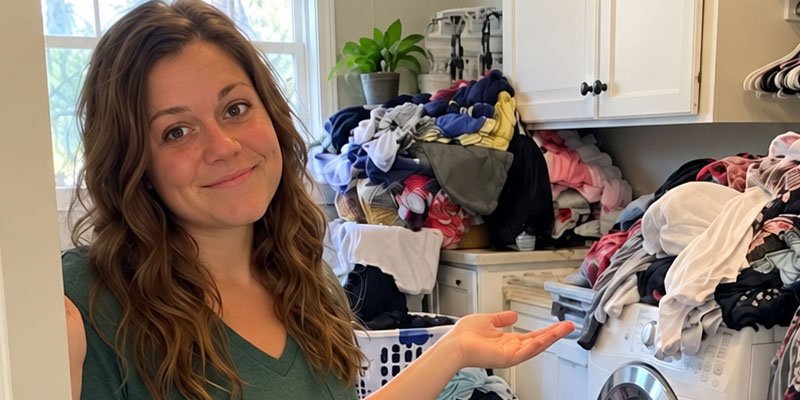
Let me start with the washing machine.
I bought it during the year my husband, Frank, and I moved into our home on Elm Creek Road.
It was an ordinary white top-loading machine with no personality whatsoever.
The sort of appliance you hardly notice because it simply performs the job it is meant to do.
For thirty-one years, laundry was my responsibility.
Not because Frank and I ever formally sat down and assigned household chores.
It simply worked out that way.
He handled the yard, repairs, the car, and everything else outside the house.
I took care of the home.
And I handled the laundry.
Every single week.
For thirty-one years.
Frank’s shirts were washed, pressed, and placed on hangers.
His socks were paired together and folded.
When our son Marcus was born, I took care of washing his clothes too.
Grass stains.
Paint smeared across sleeves.
Socks that somehow went into the machine as pairs and came out mysteriously separated.
I became exceptionally good at doing laundry.
I still am.
But after thirty years of doing it, I discovered something.
Laundry is not simply laundry.
It is a form of attention.
You handle the clothes another person wears directly against their skin.
You see traces of the lives they have lived.
Where they went.
What they spilled.
What kind of work they did.
What they worked around.
What they experienced.
There is something deeply personal about taking care of another person’s clothing.
I had willingly done that for the people I loved.
What I had never agreed to was becoming a free laundry service for anyone who happened to walk into my home carrying a bag.
My name is Dorothy Calloway.
I’m sixty-eight years old.
My husband, Frank, passed away four years ago.
My son Marcus is thirty-seven and works as a structural engineer.
He is exceptionally capable when it comes to his profession.
In his personal life, however, he has always been somewhat less comfortable dealing with difficult situations.
I first noticed that when he was around fifteen.
I kept telling myself that he would eventually grow out of it.
He is still working on that.
His wife, Vanessa, is thirty-four.
She works as a marketing director for a software company.
Vanessa is smart, organized, ambitious, and extremely efficient.
Those were qualities I admired in her.
The problem was that sometimes her efficiency meant finding another person to handle whatever she didn’t have enough time to do herself.
Eventually, that person became me.
It started with a single basket.
Marcus and Vanessa had been married for six years.
They lived roughly twenty minutes away and came to my house most Sundays with their two children.
Lily was eight.
Theo was five.
Sunday dinner at Grandma’s had become a regular part of our family routine.
I loved it.
I absolutely adored those children.
Lily had Frank’s eyes and his habit of genuinely paying attention whenever someone spoke.
Theo had my laugh, which I considered a compliment to both of us.
For those children, I would have done almost anything.
One afternoon, Vanessa brought a laundry basket into the house.
“Would you mind putting these in with yours?”
It seemed completely harmless.
I was already doing a load of laundry.
One additional basket didn’t seem like a big deal.
So I agreed.
The first time, it truly was no big deal.
The second time, there were two baskets.
Again, I didn’t object.
They were busy.
The children had activities.
Life gets hectic.
But by the sixth or seventh occasion, baskets had become bags.
And requests had quietly become expectations.
Before long, Vanessa was arriving every weekend with bags of laundry and setting them beside my washing machine.
Then she would leave with everything washed, folded, and neatly organized.
I began noticing something.
She never helped with the folding.
And she never thanked me in a way that reflected how much work I had actually done.
She would simply say,
“Thanks, Dorothy.”
But she said it in the same tone someone might use while speaking to an employee at a drive-through window.
Efficient.
Fast.
Hardly even looking at me.
I also noticed that Marcus never said a word.
That bothered me even more.
He would sit at my kitchen table eating the lunch I had prepared while his wife carried laundry bags down to my basement.
He knew exactly what was happening.
He simply chose not to say anything.
Silence may not necessarily mean agreement.
But when someone watches another person being treated unfairly and says nothing, that silence can begin to feel very much like permission.
One Sunday, after Vanessa arrived with yet another enormous bag, I finally spoke up.
“Vanessa, I’m sixty-eight. I don’t mind helping once in a while, but I’m not your laundromat.”
I kept my voice intentionally calm.
I wasn’t looking for a fight.
I was simply saying what was true.
Vanessa laughed.
Not in a deliberately cruel way.
More as though she found my complaint slightly unreasonable.
“You’re home all day anyway.”
I looked toward Marcus.
He stared down at his plate.
That moment stayed in my mind.
Vanessa’s remark hurt, but at least I understood what she meant.
In her mind, retirement meant being available.
If I was at home, then naturally I must have plenty of time.
It was selfish thinking, but at least she had made it obvious.
Marcus’s reaction was harder for me to accept.
His wife had dismissed his mother directly in front of him.
And he stared at his plate.
He was thirty-seven years old.
And he stared at his plate.
I thought about Frank.
Frank would never have stared at his plate.
He would have spoken calmly and quietly.
He would have said something like,
“My mother asked you not to bring the laundry anymore. We’ll take it home.”
And that would have settled the matter.
But Frank was gone.
And Marcus had said nothing.
I spent the following week thinking about it.
Not every minute.
But often enough.
Two questions kept coming back to me.
What was I going to do about the laundry?
And what was I going to do about the bigger issue—the belief that because I was retired, my time automatically belonged to anyone who wanted to use it?
I decided to handle the laundry first.
One issue at a time.
The next Saturday, Vanessa arrived carrying four bags.
Four.
It was more than she had ever brought before.
Marcus carried them downstairs and arranged them beside my washing machine.
Apparently, that was where his participation ended.
I looked at the bags.
Then I smiled.
“Leave them downstairs.”
Vanessa looked surprised.
Perhaps she had expected me to argue with her again.
“Are you sure?”
The question sounded almost automatic.
“Perfectly.”
She returned upstairs.
I waited until everyone had settled outside.
The afternoon was pleasant.
Marcus had brought a cooler.
The children were playing in the yard.
Vanessa was looking at her phone.
I went downstairs.
I had already made up my mind about what I would do.
I was going to sort the laundry.
Not wash it.
Sort it.
Vanessa’s clothes into one bag.
Marcus’s into another.
The children’s clothes separated too.
Then I would return everything exactly as it had arrived.
Unwashed.
At first, I planned to leave a note explaining that everyone could now take responsibility for their own laundry.
Simple.
Calm.
No shouting.
No drama.
Just a new arrangement.
I opened the first bag.
There was nothing unusual inside.
Then I started sorting the second one.
That was when I found the shirts.
Men’s dress shirts.
And they definitely did not belong to Marcus.
I knew that immediately.
You might wonder how I could be so certain.
But when you have washed someone’s clothes for the first sixteen years of their life, you learn what belongs to them.
Marcus liked practical clothing.
Good quality, but never flashy.
These shirts were different.
Expensive.
Tailored.
Selected by someone who cared deeply about his appearance.
I put them to one side.
Then I discovered a pair of dark gray dress trousers.
They were too narrow for Marcus.
Too short as well.
There was a tailor’s label sewn inside.
They belonged to someone else.
I placed them next to the shirts.
Then I found three white button-down shirts with dry-cleaning tags still attached.
The cleaner was across town.
It wasn’t the place Marcus and Vanessa usually used.
I knew that because I had once driven Vanessa there to pick up their clothes while her car was being repaired.
I sat down on the basement floor and stared at the pile.
My first instinct was immediate.
Call Marcus.
My phone was in my pocket.
My hand actually reached toward it.
Then I stopped.
I considered what would happen if I called him.
The children were outside playing.
Marcus was sitting in my backyard.
It was an ordinary Saturday afternoon.
And the only fact I actually knew was that I had discovered men’s clothing that did not belong to my son inside Vanessa’s laundry bags.
I had no idea why the clothes were there.
Of course, one explanation immediately entered my mind.
The obvious explanation.
But I did not truly know.
And once certain words are spoken, there is no way to pull them back.
I thought of Frank.
Frank would not have called Marcus from the basement before understanding the entire situation.
He would have asked himself what was his business and what wasn’t.
The laundry was my business.
Their marriage was theirs.
So I continued sorting.
Vanessa’s clothes.
Marcus’s clothes.
The children’s things.
And the unfamiliar men’s clothing went with Vanessa’s items because that was the bag they had come in.
I returned everything to separate bags.
I decided against leaving the note.
I never turned on the washing machine.
Then I went upstairs and began preparing dinner.
Around six o’clock, I called everyone inside.
Vanessa said she wanted to get the laundry first.
I heard her walking down the basement stairs.
Then everything became quiet.
A few seconds later, her voice suddenly became sharp.
“What did you do?”
Then I heard Marcus going downstairs.
The children followed behind him.
I remained in the kitchen.
I could hear voices from below, but I couldn’t make out every word.
Marcus asked something.
Vanessa responded.
Then Marcus spoke again, much more quietly.
I continued setting the table.
Several minutes later, Marcus came upstairs by himself.
He stood in the doorway of the kitchen.
For a moment, he looked like he was twelve years old again.
Confused.
Unsure.
Trying to understand something he had never expected to discover.
“Mom.”
“Dinner is almost ready.”
“What happened with the laundry?”
“I sorted it.”
He stared at me.
“I thought it would be easier if everyone’s things were separated. That way, everyone can take care of their own.”
He remained silent.
Then he said,
“There were clothes down there I didn’t recognize.”
“I imagine Vanessa can explain those.”
He studied my face.
“Did you…”
“I sorted laundry, Marcus. That’s all I did.”
There was another silence.
“She’s upset.”
“I imagine she is.”
“She says the laundry isn’t done.”
“That’s correct.”
I looked straight at him.
“I told her last week that I’m not a laundromat. You heard me.”
His eyes moved toward the floor.
There it was again.
The plate.
The floor.
Anything except facing the uncomfortable conversation.
For a moment, my heart ached for him.
He was my son.
I wanted to protect him.
But he wasn’t twelve anymore.
He was thirty-seven.
There were things he needed to handle himself.
“Go talk to your wife,” I said. “Bring the children upstairs when you’re ready. Dinner will still be warm.”
He went downstairs again.
While I waited, my thoughts returned to Frank.
During the final year of his life, when we both knew where his illness was leading, we often talked about Marcus.
The things we loved about him.
The things that concerned us.
One evening Frank said,
“He avoids conflict.”
“He has your calm temperament,” I told him.
Frank shook his head.
“No. I’m calm because most things genuinely don’t bother me very much. Marcus is different. Things bother him deeply, but he says nothing.”
He paused.
“There’s a difference.”
Frank had been right.
Marcus’s silence wasn’t peace.
It was calculation.
He was constantly measuring the discomfort of speaking against the discomfort of remaining silent.
At work, that probably made him diplomatic.
At home, it sometimes meant small issues were left alone until they became much bigger.
The previous week, he had watched Vanessa dismiss me.
He hadn’t agreed with her.
But speaking up felt more uncomfortable than remaining silent.
I had always believed that calculation was backward.
The temporary discomfort of saying something is usually far cheaper than the long-term price of saying nothing.
That Saturday was about to demonstrate exactly that.
Ten minutes later, they came upstairs.
Lily and Theo came in first.
Both looked confused.
I gave them some water and asked Lily about the book she had been reading.
She immediately relaxed.
Marcus came upstairs next.
His expression was different.
He looked like someone who had discovered that a familiar place wasn’t quite the way he had always believed it was.
Vanessa came last.
She had her purse hanging over one shoulder and all four laundry bags in her arms.
She had carried them herself.
“We’re going home.”
“Stay for dinner.”
“I don’t think—”
“Vanessa.”
I kept my voice even.
“Stay for dinner.”
Something in my tone caused her to stop.
She set the bags down.
Then she looked at me.
“Whatever you and Marcus need to discuss, you don’t have to resolve it right now. Not in front of the children.”
She stared at me.
“You can have dinner. Then you can go home and have whatever conversation you need to have after Lily and Theo are asleep.”
I paused.
“I noticed what I noticed. I’m not going to pretend I didn’t. But I’m also not interested in being the person who destroys your family on a Saturday afternoon.”
The kitchen became completely quiet.
Lily was watching us closely.
“I want dinner with my grandchildren,” I continued. “And my son. And his wife. That’s all I want from tonight.”
Vanessa slowly placed her purse on the chair.
Then she sat.
Dinner was uncomfortable.
I won’t pretend that it wasn’t.
We ate because the food had been prepared and because the children needed something normal.
Lily told me about a science project.
Theo knocked over his water, which somehow became the most ordinary moment of the entire evening.
Everyone reached for paper towels.
Someone laughed.
For a few moments, we were simply a family again.
Marcus spoke carefully.
Vanessa said very little.
Around eight, they got ready to leave.
I hugged Lily and Theo.
Marcus hugged me longer than he normally did.
Then Vanessa stopped on the porch.
“Dorothy.”
“Vanessa.”
She hesitated.
“The clothes you found. I know what you’re thinking.”
“I don’t know what I’m thinking.”
And that was the truth.
“I sorted the laundry. That’s all I know.”
“It’s not what it looks like.”
“Then explain it.”
She looked at me.
“To Marcus,” I added. “Not me.”
I paused.
“Whatever the explanation is, he needs to hear it tonight.”
Her expression shifted slightly.
It wasn’t exactly gratitude.
But it was something close.
“Okay.”
“Okay.”
They left.
Marcus called at 10:30 that night.
I was already in bed reading.
“Mom.”
“Marcus.”
“She was washing clothes for someone from work.”
I waited.
“A man in her office. His wife has been in the hospital for weeks. He’s been handling the house and everything else by himself. Apparently, he said he couldn’t even find the time to get to the laundromat.”
I stayed quiet.
“She started taking his laundry with ours because she wanted to help him.”
“Why didn’t she tell you?”
Marcus sighed.
“She said she thought it would be awkward. And she didn’t think I would understand.”
He paused.
“She does things like this, Mom. She helps people without telling anyone. Last year she helped a coworker pay rent, and I didn’t find out until much later.”
“She’s complicated.”
“Yes.”
I sat quietly with that information.
Then Marcus asked,
“Does that change anything?”
“About what?”
“The laundry.”
I considered the question carefully.
“No.”
He didn’t respond.
“Vanessa helping someone whose wife is sick is kind. But bringing his laundry into my house without asking me was still wrong. Four bags of another person’s clothes were left in my home as though my time belonged to everyone.”
“I know.”
“The clothes just don’t mean what I briefly thought they might mean.”
“No.”
Then Marcus said something I had been waiting a very long time to hear.
“I talked to her about the laundry. All of it.”
I closed my book.
“And?”
“I told her what I should have told her last week.”
I smiled faintly.
“How did that go?”
“She said she honestly didn’t realize it had become a pattern. She thought you didn’t mind.”
“That’s something she needs to work on.”
“Yes.”
“And you too.”
There was silence.
“You didn’t notice either.”
Another silence.
“No. I didn’t.”
“You looked at your plate.”
“Mom…”
“I’m not trying to punish you, Marcus. I’m naming what happened.”
I paused.
“You heard your wife dismiss me and chose not to say anything. Those moments can seem insignificant when they happen, but they build up over time.”
He said nothing.
“Your father never looked at his plate.”
The silence on the phone felt different.
“I know.”
“I don’t expect you to become your father. I expect you to become the version of yourself who speaks when something needs to be said.”
“Even when it’s uncomfortable.”
“Especially then.”
He stayed quiet for a long time.
Then:
“I owe you a real apology. In person.”
“I’ll accept one.”
“And Vanessa is calling you tomorrow.”
“I’ll answer.”
“Mom?”
“Yes?”
“I love you.”
“I know. I love you too. Now go be with your wife.”
He laughed quietly.
“Goodnight.”
“Goodnight, Marcus.”
Vanessa called the following morning at nine.
“Dorothy.”
“Vanessa.”
“I wanted to explain about the clothes.”
“Marcus already told me.”
“Oh.”
There was a pause.
“So you know it wasn’t…”
“I know.”
Another pause.
“I also want to apologize about everything else.”
I waited.
“The laundry. The way it became something I expected.”
She sounded nervous.
“I honestly didn’t think about how much work I was giving you. I thought, you’re home anyway, you have the machine, you’re already doing laundry…”
She stopped.
“And I understand now that it wasn’t my decision to make.”
“That’s correct.”
“That isn’t an excuse. It’s just an explanation.”
“I understand.”
“I should have asked every time.”
“Yes.”
“And I should have helped with the folding.”
That part sounded like something Marcus had specifically discussed with her.
“Yes.”
“I’m sorry, Dorothy.”
Her apology was straightforward.
There were no excuses.
No performance.
I allowed the words to sit there for a moment.
Then I said,
“Can I explain something to you?”
“Yes.”
“You told me I’m home all day.”
She became quiet.
“Retired does not mean available.”
I continued.
“It means I finished one chapter of my working life, and now I get to decide how I spend the next one.”
I read.
I garden.
I attend a painting class on Tuesdays.
I have lunch with my friend Margaret on Fridays.
I visit Frank’s grave every Thursday morning.
“Being home doesn’t mean I’m sitting around waiting for someone to give me a job. It means I’ve earned the right to choose what my time is for.”
Vanessa didn’t speak for several seconds.
“I never thought about it that way.”
“I know.”
Then she surprised me.
“Why didn’t you say something sooner?”
I considered that.
“Because you’re my son’s wife. Because I was trying to be generous. And because I allowed something small to grow into something much bigger.”
Frank used to say resentment was like water building up behind a dam.
A little pressure can be handled.
But when you keep adding more without releasing any of it, eventually something breaks.
“I waited too long. That part is mine.”
“And sorting everything instead of talking again?”
“I wanted to change the arrangement without turning it into another argument.”
I paused.
“What I found while sorting was completely accidental.”
“I know.”
“Marcus told you?”
“Yes.”
Another pause.
“Why didn’t you call him immediately?”
“Because it wasn’t mine to do.”
She went quiet.
“Whatever those clothes meant—and now I know exactly what they meant—it was your responsibility to explain them to your husband.”
“I thought you would use it against me.”
“Why?”
She didn’t answer.
“What would I gain from destroying your marriage?”
I continued.
“Your children are my grandchildren. Your unhappiness doesn’t make my life better. I want Marcus married to someone who is good to him. I want that person to be you.”
I paused.
“But I also want respect.”
“It’s clear.”
“Good.”
Then Vanessa told me more about her colleague.
His name was David.
His wife had been hospitalized for eight weeks.
He was trying to manage his job, his home, and everything else without help.
Vanessa had started helping because that was simply what she did whenever someone needed assistance.
“I’m going to organize something better,” she said. “Maybe a group from work can help with meals and other things.”
“That sounds much more reasonable.”
Marcus came over by himself on Tuesday.
He stood in my kitchen wearing his work clothes.
“I’m sorry.”
“For?”
“For looking at my plate.”
Despite myself, I smiled.
“The plate thing.”
“Yes.”
“Sit.”
I made coffee.
Then I told him something about Frank.
“Your father never failed to support me publicly during our thirty-one years of marriage.”
Marcus listened.
“That doesn’t mean we always agreed.”
We disagreed plenty.
Sometimes loudly.
But we dealt with it later.
Privately.
“In front of other people, Frank never left me standing alone while someone dismissed me.”
Marcus stared into his coffee.
“That’s what I need from you,” I said. “Not for you to agree with everything I say. Just understand that I deserve to be treated with respect.”
I looked at him.
“Vanessa is your wife. I’m not asking you to choose between us. I’m asking you to remember that I’m your family too.”
“You’re right.”
“I know.”
He almost laughed.
“I also know I should have said something about the laundry earlier. I allowed it to become too big. That part is mine.”
“The sorting was pretty effective.”
“It was supposed to be practical.”
“It turned into something else.”
“That part wasn’t planned.”
He looked at me.
“I believe Vanessa about David.”
“So do I.”
“You do?”
“It fits who she is.”
I smiled slightly.
“She helps people. That is a good quality. She simply needs to stop volunteering someone else’s labor while she’s doing it.”
Marcus laughed.
“She told me you said retired doesn’t mean available.”
“I did.”
“She’s been thinking about that.”
“Good.”
Then Marcus said,
“Dad would have liked how you handled this.”
I looked down at my coffee.
“Your father would have handled it faster.”
Marcus smiled.
“He would have said something immediately.”
“Yes.”
“But I think we would have ended up in the same place.”
“What place?”
“Sunday dinner.”
He looked at me.
“Family still together. Necessary things said. People given an opportunity to do better.”
“That was what you wanted?”
“I’m sixty-eight, Marcus.”
I had buried my husband.
I had lived long enough to understand that winning an argument over laundry was not the most important thing.
“What matters is Lily telling me about her science project. Theo spilling water at dinner. All of you sitting around my table on Sunday.”
I looked at him.
“That’s what I was protecting.”
Marcus said nothing.
Then he said,
“I love you, Mom.”
“I know.”
I smiled.
“Bring everybody Sunday.”
And he did.
The Sunday dinners continued.
The first few were a little awkward.
Everyone chose their words carefully.
Eventually, the discomfort disappeared.
Vanessa began helping clear the table.
Then she started helping with the dishes.
Eventually, it stopped feeling like an apology and began to feel like genuine participation.
One Sunday, she asked about my painting class.
The following week, she remembered what I had told her and asked how a particular project had turned out.
She was paying attention.
I noticed.
Eventually, Marcus and Vanessa hired a laundry service that came every Thursday.
It was practical.
Sustainable.
And required absolutely nothing from me.
Exactly as it should.
As for David, Vanessa organized several coworkers to help him properly.
Meals.
Errands.
Practical assistance.
She supported him in a way that didn’t involve quietly shifting the work onto someone else.
I thought about everything that had happened.
Especially those moments in my basement when I had been staring at unfamiliar men’s clothing and constructing a story in my head.
A story that turned out to be completely wrong.
It reminded me how quickly people can become convinced of something when they only have part of the information.
And how much damage I could have caused if I had acted immediately on that assumption.
I was grateful I hadn’t called Marcus from the basement.
Frank would have approved.
Several months later, Lily asked why the laundry bags no longer came to Grandma’s house.
“Your parents hired a service.”
“Why?”
“Because I told them I needed them to.”
She thought about that.
“Did you have to ask a lot?”
“More than once.”
“Was it awkward?”
“For a little while.”
“But now everything is okay?”
“Better than okay.”
Lily thought about that carefully.
“So you just had to keep saying it.”
“Yes.”
“And they had to listen.”
“Exactly.”
She seemed satisfied and went back to her book.
I sat at the table thinking about how simple the truth sounded coming from an eight-year-old.
You say what needs to be said.
If you have to, you say it again.
You find an arrangement that works.
You give people the opportunity to hear you.
And then, if everyone is willing to make some changes, you sit together on Sunday and eat dinner.
The washing machine on Elm Creek Road still works.
Plain white.
Top-loading.
Completely lacking in personality.
It washes exactly what I decide to put inside it.
Nothing more.
Nothing less.
And that is exactly how it should be.




