
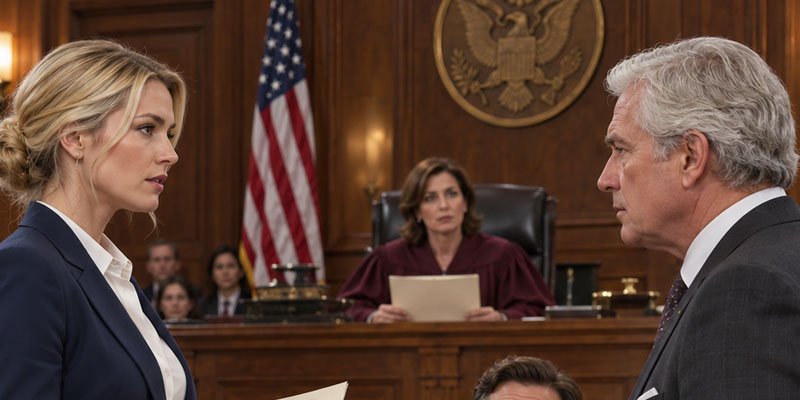
“You will never be someone I’m proud of,” Dad sneered from the courtroom as he sued to take my house. I sat there by myself while his attorney ridiculed me. Then, without saying a word, I handed my file to the judge.
She froze.
Her pen slipped from her hand, and she shot Dad an angry look.
“Tell me, sir, do you know what your daughter is?”
To understand how I found myself in that courtroom, you first have to understand the man sitting opposite me.
My father never merely demanded respect.
He constructed it.
After my mother died when I was nine, he remade himself into the ultimate tragic hero—a self-made businessman who had supposedly sacrificed everything to raise two daughters by himself.
The relatives believed every word.
The neighbors believed every word.
The country club believed every word.
But behind the closed oak doors of our home, he ruled like a dictator.
Our family was his chessboard, and he decided where every piece moved.
From the time my older sister Lauren turned twelve, I watched him mold her into his ideal pawn.
She was gentle, easy to control, and financially dependent on every dollar he chose to hand her.
She became the polished accessory he displayed at country club dinners—the beautiful, compliant daughter who laughed at his jokes and never challenged his choices.
And he rewarded her.
Cars.
Credit cards.
Public praise at family gatherings, where he lifted his glass and called her his greatest achievement.
I was the stubborn pebble lodged inside his shoe.
Throughout my childhood, he worked constantly to isolate me.
At Thanksgiving, he whispered to aunts and uncles that I was cold, ungrateful, and difficult to love.
He told his golfing partners that I had behavioral issues.
He told our church pastor that I was simply going through a rebellious phase he was bravely handling on his own.
Whenever a cousin asked why I never attended Sunday dinners, he shrugged and said, “She preferred being alone.”
It was a carefully constructed lie meant to ensure nobody came looking for me.
His isolation was methodical.
One relationship at a time, he eliminated every possible witness and ally until I could stand surrounded by thirty relatives and still be completely unseen.
Lauren got catered birthday celebrations, new Easter dresses, and a cherry-red convertible for her seventeenth birthday.
I got detailed grocery bills.
Not symbolic bills.
Real paper invoices printed on his company letterhead and slipped beneath my bedroom door every Sunday evening.
He calculated the cost of cereal, milk, bread, and toothpaste down to the last cent.
He even added the tax.
When I turned sixteen, I found a part-time job bussing tables at a diner off Route 9.
Four-hour shifts after school.
Grease burns covering my forearms.
Minimum wage, minus the tips I was required to share with the dishwasher.
Dad’s answer was to charge me thirty dollars every week for my bedroom.
He recorded it in the household budget with my name next to the expense in red ink.
He called it a lesson in responsibility.
Lauren was four years older and lived beneath the same roof, yet she paid nothing.
She ate steak while I ate cereal I had already been charged for.
At Christmas, Dad gave Lauren a jewelry box in front of the entire family.
He handed me an envelope.
Inside was a photocopy of my quarterly grocery bill with a Post-it note attached.
Merry Christmas.
Balance due.
Whenever I accomplished something—made the honor roll, won a track meet trophy, or got accepted into the ROC program—Dad did one of two things.
Either he claimed credit for my achievement in front of relatives, or he acted as though it had never happened.
The trophy vanished into a drawer.
The report card remained unsigned on the counter.
When I secured my military contract at eighteen, he mocked me across the dinner table, lazily swirling his wine with his wrist.
By then, he had already persuaded our extended family that I had chosen the military because I was too incompetent to survive in the corporate world.
In his version of events, I was a low-ranking grunt.
A lackey.
Someone who emptied trash cans on a base and answered telephones.
My graduation ceremony took place on a dirt parade ground at Fort Benning when I was twenty-two.
The sun beat relentlessly down on five hundred starched uniforms standing in perfectly straight formation.
I stood in the third row, accepting my commission as a second lieutenant while a brass band played the same march that generations of graduating classes had heard before us.
Around me, squadmates broke formation to embrace crying mothers and salute proud fathers.
Families poured onto the field carrying flowers, cameras, and handmade signs.
A private two rows ahead lifted his six-year-old son onto his shoulders. The boy grabbed his father’s new officer cap, put it on his own head, and laughed.
I searched the crowd until I found Dad.
He had arrived late wearing a custom navy suit that cost more than my first three months of military pay.
He looked completely out of place and obviously annoyed that he had been made to stand on unpaved ground.
His Italian leather shoes were already coated with red Georgia dust.
Lauren stood beside him, scrolling through her phone with a bored expression.
Dad had not come there to congratulate me.
He had come to make certain I remembered my place.
Standing directly in front of my new commanding officers—a lieutenant colonel, company commander, and senior NCOs who had trained me for four years—he gave a dry, contemptuous laugh.
Then he pointed toward my dusty boots and sneered loudly enough for everyone within fifteen feet to hear.
“She joined the army because a brainless fool would starve in the real world.”
The words cut straight through the celebration.
The officers around me fell silent.
My company commander clenched his jaw so tightly that I could see the muscle twitching beneath his skin.
A lieutenant colonel exchanged a pointed glance with the battalion executive officer.
A sergeant major with thirty years of service and three combat deployments stepped forward, but the XO stopped him with a hand on his shoulder.
These men and women had watched me crawl through mud, run until I vomited, and study law until I could barely keep my eyes open.
Now they had witnessed my father publicly attempt to tear me apart for entertainment.
I tasted copper.
I had bitten the inside of my cheek.
Warm blood gathered against my tongue.
I swallowed it.
I did not cry.
I locked my knees, snapped a precise salute toward the reviewing stand, and stared through my father’s forehead as if he were nothing more than a dirty pane of glass.
That dirt-covered field taught me my first true lesson in survival.
Remove every expectation of love from your enemy.
Never expose your real weapons.
I pivoted on my heel and marched toward the barracks without looking behind me.
During the suffocating heat of my first deployment, only one person kept my sanity anchored.
Gran.
My grandmother on Dad’s side lived on a sprawling estate in Winston-Salem, North Carolina, far outside his poisonous orbit.
She had watched him change from a grieving widower into something calculating and cruel.
And she never believed his performance.
She saw beyond the silk suits.
She looked beneath my combat uniform and recognized what was really there.
Not a fool.
Not a grunt.
But a hard piece of grit the family had tried to crush into dust.
On the morning I boarded a C-130 headed into an active combat zone, my satellite phone beeped.
I crouched behind a concrete barrier as rotor wash from a Black Hawk blew sand into my teeth.
Three words appeared on the screen.
“You are ready. Come back.”
I survived.
I completed specialized training at the Military Law Center and joined the JAG Corps—the Judge Advocate General’s Corps, the legal branch of the United States Army.
I became a federal military prosecutor.
Dad never called.
He sent no card.
He did not even ask what JAG meant.
Gran drove four hours alone.
Leaning heavily on her oak cane, she entered the military auditorium for my insignia ceremony.
When the new rank was pinned onto my lapel, she wiped tears from her cheeks with the back of her hand.
Then she took both of mine in hers.
Her skin was paper-thin.
Her grip was like iron.
She looked at the insignia and whispered, “I see you, Mary.”
Fourteen months later, Gran died.
We sat inside a sterile lawyer’s office in Winston-Salem beneath humming fluorescent lights.
The conference table was polished mahogany, the kind of wood Gran would have admired.
Dad checked his Rolex twice within the first thirty seconds.
He shifted impatiently, already mentally dividing the estate into investment portfolios.
He expected what he had always believed was his.
The enormous property.
The land.
The house.
Everything.
In his world, he was the only surviving son.
Therefore, the money naturally belonged to him.
Lauren sat beside him wearing a black dress, dabbing her eyes with a tissue she had already tucked inside her purse.
Performative grief, delivered right on schedule.
The lawyer was a gray-haired woman with reading glasses hanging from a chain and the composed expression of someone who had spent three decades watching families destroy themselves over property.
She opened the folder.
Then she read Gran’s final wishes.
The entire Winston-Salem property—the house, the land, every square foot—had been left strictly and exclusively to me.
Dad and Lauren were given small cash amounts.
Modest sums.
Intentional sums.
The kind meant to communicate something.
I see you clearly.
And this is what you are worth.
The will had been prepared, witnessed, and notarized with extraordinary legal precision.
It contained a clause specifically stating that Gran was of sound mind when she signed it, confirmed by an independent physician and a government inspector.
She had constructed a fortress around her final wishes because she knew exactly what her son would attempt once she was gone.
The room fell completely silent.
The attorney stopped reading and laid the folder flat on the table.
Dad did not yell.
He did not slam his fist.
He did not even get up.
He calmly lifted the lawyer’s courtesy cup of Earl Grey tea, took a slow drink, and looked across at me.
Then he returned the cup to its saucer without making a sound.
He smirked.
“Your grandmother always had a foolish soft spot when she was scenile. You think you can keep it, little soldier?”
I remained completely still.
Back straight.
Hands flat on the polished table.
Fingers evenly spaced—the same position I used to center myself before cross-examination.
I met his eyes.
“It is a legal decision. It must be respected.”
Dad slowly lowered the teacup.
A chilling smile spread across his face.
He leaned closer.
“We will see.”
It was not an empty threat from an angry old man.
It was the official opening of a scorched-earth campaign.
I returned to my unit and buried myself in work.
I pinned on the oak leaf of a major during a small ceremony attended by my commanding officer, two fellow prosecutors, and a line of empty folding chairs where family should have been.
Eventually, I became a senior prosecutor for the Federal Military Justice Office, specializing in complex federal fraud cases.
I believed the thousand miles separating us would eventually cause Dad to abandon his obsession with the estate.
That was my tactical mistake.
He did not merely file a civil lawsuit seeking to invalidate the will.
He constructed a legal trap intended to destroy me on two fronts simultaneously.
He hired Gerald Foss, a local attorney whose business card could practically have read scorched-earth litigation.
Foss was not simply aggressive.
He specialized in intimidation, procedural games, and exhausting opponents who could not afford to continue fighting.
He had no experience with federal military jurisdiction.
He had never practiced inside a military courtroom.
He barely understood the difference between a JAG officer and a janitor.
Dad chose him because Foss was not interested in the truth.
He cared about winning.
Their strategy was vicious.
They alleged that I had used advanced military interrogation methods to manipulate a dementia-riddled elderly woman into signing her estate over to me.
“Interrogation tactics” was Foss’s phrase.
Vague enough to frighten a civilian jury.
Specific enough to sound like something lifted from a classified manual.
The lie depended completely on nobody inside the courtroom knowing enough about the military to challenge it.
Then Dad turned Lauren into a weapon.
One Tuesday afternoon, he called her into his office and presented her choices with the efficiency of someone explaining a foreclosure.
If she cooperated, his money continued.
If she resisted, it stopped.
Her mortgage.
Her children’s tuition.
Her credit cards.
Her entire life.
Lauren had no savings, no independent income, and no abilities that functioned beyond the world Dad had created around her.
She signed.
Under oath, my own sister submitted a false affidavit claiming I had physically prevented the family from visiting Gran during her final years.
But the civil lawsuit was only the visible blade.
Dad used local political connections, business relationships, a city councilman he golfed with, and a retired judge who owed him favors to launch a second assault.
Anonymous letters started arriving at my base commander’s office.
Plain paper.
No signatures.
Sent from different post offices.
Each accused me of elder abuse and financial exploitation of a vulnerable senior citizen.
The accusations included enough specific detail and insider knowledge of military culture to force an investigation.
The consequences came immediately.
Two military police officers pulled me out of a classified briefing.
They stood on either side of me as an entire room of prosecutors watched in silence.
Nobody spoke.
Nobody needed to.
Being escorted from a secure briefing by MPs sends one message.
You are under investigation.
And your career may already be finished.
The Criminal Investigation Division opened a formal internal review.
My security clearance was frozen.
My access to every active case vanished.
My computer login was disabled.
My office—the one bearing the nameplate Major M. White, Senior Prosecutor—was locked from the outside by the Provost Marshal’s office.
As I stood in the hallway, a junior officer I had mentored for two years walked past carrying a stack of my reassigned files.
He did not look at me.
He could not afford to.
My position as a federal prosecutor was hanging by a thread.
The following morning, my base commander called me in.
He was a full colonel I had served beneath for three years, a man who had personally written my last two outstanding performance evaluations.
His office smelled like burnt coffee and floor wax.
He sat behind his government-issued desk with his hands folded over the blotter, his West Point ring reflecting the fluorescent lighting.
He did not offer me a chair.
Instead, he slid four anonymous letters across the desk.
Each accused me of elder abuse, financial exploitation, and manipulation of a cognitively impaired senior citizen.
I read them while standing.
I recognized Dad’s language immediately.
His syntax.
His emphasis.
The weaponized precision of a man who treated family relationships like hostile acquisitions.
I was caught in a lethal crossfire.
If I lost the civil lawsuit, I lost Gran’s estate—the last remaining proof that someone in my bloodline had loved me enough to protect me after death.
If the military investigation found even a trace of truth in those accusations, I could lose my rank, security clearance, law license, and Army career.
A damaging discharge code could follow me through every future background investigation and employment application.
Dad had engineered a two-sided assault meant to destroy both my professional life and my inheritance at once.
He wanted me psychologically shattered before I ever entered the courtroom.
For weeks, I paced the floor of my quarters late into the night.
At 3:00 a.m., the old floorboards groaned beneath my boots.
His clock was ticking.
I needed a counterattack.
Three months before the federal hearing, an invitation arrived in my mailbox.
Cream-colored cardstock.
Gold-embossed lettering.
Lauren’s youngest daughter’s birthday party.
I understood immediately what it meant.
Not merely a family gathering.
A reconnaissance operation.
Dad wanted to see me.
He wanted to study my face and determine whether his anonymous letters had broken me.
I went.
His sprawling suburban backyard was crowded with forty guests beneath strings of fairy lights.
A bouncy castle occupied one side of the lawn.
Caterers moved through the crowd carrying shrimp cocktails on silver trays.
At the center stood Dad, playing the benevolent grandfather.
He laughed too loudly.
He poured expensive Merlot for relatives who worshipped him.
He put an arm around Lauren for a photograph and squeezed her shoulder while she smiled on command.
I stood near the fence holding a glass of water I never touched.
I counted heads.
I catalogued exits.
I noticed which relatives avoided my eyes and which had obviously accepted Dad’s version of reality.
When everyone moved to the patio for cake, I slipped into the kitchen to refill my glass.
The door closed behind me.
Dad was standing there alone.
The grandfather mask was already gone.
What remained was cold and reptilian.
He stepped into my personal space and backed me against the marble counter.
The stone felt cold against my lower back.
He stood close enough for me to see the tiny blood vessels in his eyes and smell Merlot beneath the same suffocating cologne he had worn for thirty years.
The smell carried me backward.
Invoices shoved beneath my bedroom door.
Relatives being told I was difficult to love.
Years of hearing that I was the defective product in his family.
Then he lowered his voice.
“Has your commander received my letters yet? Sign the paper giving up the house and I’ll withdraw the complaint. If not, I’ll have you court marshaled. Where is a lowly grunt like you going to get the money to fight me?”
He allowed the final question to hang between us.
He wanted me to calculate.
His legal budget against my annual salary.
He wanted me to feel insignificant.
Outgunned.
Trapped.
Twelve years old again, sitting at the dinner table while Lauren received jewelry and I received another bill.
Then I noticed his suit jacket.
The material sat strangely across his chest.
Too stiff.
Too square.
A faint rectangular outline pressed against the inside pocket.
A recording device.
He was wearing a wire.
At his own granddaughter’s birthday party.
He had arrived prepared to provoke me.
He wanted shouting.
Threats.
Anything he could capture and present to a judge as evidence that his daughter was unstable and violent.
This was not a conversation.
It was an interrogation.
The birthday cake and fairy lights were simply camouflage.
My own father was willing to destroy his daughter’s career, honor, and future for a piece of property and his own ego.
He stood there waiting for me to crack.
I looked directly into his eyes.
Swallowed my disgust.
Then allowed a cold, razor-thin smile to touch my lips.
“Thank you for the advice, Mr. White.”
Not Dad.
Mr. White.
The designation removed every trace of familial authority.
For a split second, confusion crossed his face.
He had not anticipated it.
I turned away and walked through the kitchen door.
Across the patio.
Past Lauren slicing cake with a plastic knife.
Past the bouncy castle, catering tables, and relatives who had already been told I was a cold, ungrateful thief.
That night, I sat inside my truck outside my apartment with my forehead against the steering wheel.
Eleven minutes.
I watched the dashboard clock.
The hard plastic pressed a ridge into my skin.
I could survive incoming fire in a combat zone.
I could respond to an ambush, return fire, and stabilize a wounded soldier without my hands trembling.
Betrayal from your own blood was different.
It did not kill quickly.
It hollowed you out from within.
I took one slow breath.
Four seconds in.
Hold.
Eight seconds out.
The tactical breathing pattern drilled into us during survival training.
The same technique used to keep your hands steady when everything around you was exploding.
Emotion could wait.
What I needed now was discipline.
On the morning of the trial, I entered the federal courthouse at 7:15 a.m., forty-five minutes before proceedings were scheduled to begin.
I wore a perfectly tailored charcoal suit, civilian clothing cut with military precision.
I carried a single leather briefcase.
Inside was everything I had spent three months secretly assembling.
Judge Patricia Okafor took the bench at exactly 8:00.
Among federal attorneys, she was known for having zero tolerance for courtroom theatrics.
Three attorneys had faced contempt hearings before her during the previous year alone.
Her reputation was surgical—precise, cold, and merciless toward anyone who wasted her time.
Across the aisle, Dad and Gerald Foss settled behind the plaintiff’s table like men who believed they had purchased front-row seats to an execution.
Dad adjusted his cufflinks.
Foss methodically arranged his documents.
Both carried themselves with the confidence of hunters convinced their prey had already been trapped.
Then their assault began.
Foss walked to the center of the courtroom and presented a thick bundle of medical records.
Every page carried color-coded yellow tabs.
The records had been obtained through Dad’s personal physician, a local doctor connected to him through decades of country club favors and patient referrals.
They highlighted a diagnosis of mild cognitive impairment during Gran’s final two years.
Foss used them to construct his narrative.
A confused, defenseless elderly woman.
A greedy, power-hungry granddaughter.
A military officer allegedly using specialized training to isolate and control her.
He repeatedly used phrases such as undue influence, predatory behavior, and systematic elder exploitation.
Every pause was deliberate.
Judge Okafor frowned while examining the records.
Official-looking stamps.
Physician signatures.
Convincing clinical terminology.
The documents looked authentic.
Then Foss called Lauren to the witness stand.
She crossed the gallery on legs that seemed barely capable of holding her up.
Her heels struck the hardwood unevenly.
Her hands were visibly shaking.
Dad’s stare bored into the back of her head.
She had been coached.
Rehearsed.
Every statement had been scripted by Foss and approved by Dad during private meetings in his home office.
Disobedience was not an option.
She had no independent income.
No savings.
No professional existence outside the financial system Dad controlled.
Lauren placed her hand on the Bible and swore to tell the truth.
Then she faced the judge and forced tears down her cheeks.
Finally, she pointed toward me.
“She isolated Gran. She explicitly threatened me, telling me that if I ever visited the house, she would use her military connections to ruin my husband’s business.”
The lie settled over the courtroom like smoke.
I remained perfectly motionless.
I did not shake my head.
I did not sigh.
I did not look at her with hurt or betrayal.
I watched my sister lie under oath with the same clinical concentration I used when a hostile witness contradicted their own deposition.
Judge Okafor’s expression grew darker.
Dad leaned back in his chair.
Then he smiled at me.
He believed his bomb had exploded exactly as intended.
The medical records.
Lauren’s testimony.
The picture of a predatory soldier manipulating a dying elderly woman.
I calmly opened my briefcase.
The latch clicked once in the silence.
I removed a thick stack of papers and laid them flat on the table.
It was my turn.
I stood, buttoned my jacket in a single motion, and walked toward the clerk’s desk.
My heels struck the hardwood at the same measured pace I used when approaching the bench in a military tribunal.
I submitted a bound folder containing encrypted satellite communication logs taken directly from Department of Defense archives.
Every entry contained a timestamp verified through military encryption protocols that could not be fabricated outside a secure government facility.
Each one was cross-referenced with deployment orders confirming my precise location at the time of every communication.
I turned toward Judge Okafor and spoke in the same controlled tone I used while presenting evidence as a prosecutor.
No raised voice.
No theatrics.
I explained that the logs demonstrated I had maintained regular contact with Gran even while deployed in hostile combat zones on the opposite side of the world.
Every call was logged.
Every encrypted text was archived.
Every welfare check I routed through military channels was documented and countersigned by a communications officer.
The records covered four years.
Four years of verifiable communication creating an uninterrupted chain of evidence.
They destroyed the claim that I had isolated Gran.
In fact, they demonstrated the opposite.
I was the family member who consistently called.
The one who remained in contact.
The one who kept showing up.
I placed the final page on the clerk’s desk and returned to my seat.
Dad refused to back down.
He could not.
The instant Judge Okafor began reading the satellite records, something shifted behind his eyes.
His mask slipped.
The anger he had concealed beneath expensive suits and country club smiles broke free.
Foss saw it coming.
He reached for Dad’s arm.
Dad shook him away.
Then he slammed both palms against the plaintiff’s table.
The crack echoed through the courtroom.
He sprang to his feet, sending his chair backward into the wooden railing.
The chair struck the floor hard enough to make the court reporter jump.
Then Dad put on another mask.
Not the powerful patriarch.
The wounded father.
His chin trembled.
His eyes filled with manufactured tears.
He pointed a shaking finger directly at me.
“Your honor, she is lying. She is just a lowly grunt who mans a switchboard. She stole the unit’s seal to forge these satellite papers. She is deceiving the military to steal my mother’s money.”
Despite having almost no understanding of federal military jurisdiction, Foss immediately followed.
He straightened his tie, stepped forward, and formally asked Judge Okafor to reject my evidence because, as he claimed, there were obvious signs that the military documents had been forged.
Dad looked at me.
A vicious smile twisted across his face.
He truly believed he had won.
He had mocked my military career from the day I signed my first contract.
Now he believed he could exploit that same ignorance to destroy me.
In his mind, I was still a switchboard operator.
A lowly grunt.
A nobody pretending to be a soldier.
The courtroom became completely silent.
Spectators sat motionless.
The court reporter’s fingers hovered above the keyboard.
Even Foss stopped moving.
I did not look at Dad.
Instead, I reached into my briefcase one final time.
I lifted a red-sealed manila folder.
Then I carried it to the bench and placed it on the oak surface.
“Your honor, the plaintiff has just accused me of forging federal documents. I request that the court verify my military identification code on page two.”
I stepped back.
My breathing stayed steady.
My face revealed nothing.
Judge Okafor opened the folder.
Then she froze.
Her fingers stopped halfway down the page.
Her eyes widened as they moved across Department of Defense seals, authorization codes, and classification markings that no ordinary civilian could obtain.
Her pen slipped from her fingers and struck the desk.
She looked sharply upward.
Her entire expression had changed.
“Do you know what your daughter is?”
Dad blinked.
For the first time throughout the entire proceeding, his sneer disappeared.
Judge Okafor waited.
Dad pushed out his chest.
“Yes, your honor. She is a deceitful liar.”
The gavel struck the wood.
The sound tore through the courtroom.
Foss recoiled.
The color drained from his face, changing from arrogant pink to chalky white.
Judge Okafor leaned forward.
“The defendant is not a switchboard operator. She is Major Mary White, senior prosecutor for the United States Federal Military Justice Office. These satellite documents carry the classified authorization of the commanding general of the Army. And you, sir, have just committed perjury and slandered a federal officer right here in my courtroom.”
The words dismantled Dad’s reality one piece at a time.
Major.
Senior prosecutor.
Federal Military Justice Office.
Classified authorization.
Commanding general of the Army.
Perjury.
Slandered a federal officer.
His mouth opened.
Nothing emerged.
The hands that only minutes earlier had gripped the table with total confidence dropped uselessly to his sides.
The same hands that had shoved grocery invoices beneath my bedroom door.
The same hands that had patted Lauren’s shoulder like a trained pet.
Foss staggered backward from the table.
His legal pad slipped from his hands, scattering pages across the aisle.
Whispers spread through the gallery.
The court reporter began typing at rapid speed.
A U.S. marshal near the rear door adjusted his stance and rested one hand near his belt.
I stepped forward once.
No drama.
No noise.
Only the presence of a senior prosecutor who had dismantled fraud networks, cross-examined witnesses in military tribunals, and stood in courtrooms where the stakes were measured in decades of imprisonment.
Dad seemed to shrink.
His shoulders curled inward.
His expensive suit suddenly appeared too large for him.
Then I removed another document from the folder.
Gran’s handwritten letter.
Her handwriting was shaky, written by a woman whose body was failing even though her mind remained clear.
The paper was thin and slightly yellowed.
It carried the faint scent of Earl Grey and the lavender she kept in her dresser.
I read her words into the record.
“I know my son will use every despicable tactic to strip this property. Therefore, this letter was drafted before a government inspector. I leave this land to marry my officer of justice because in this family only she has the strength to shatter her father’s hypocrisy.”
The words settled across the courtroom.
Gran had known.
She had known her son would weaponize the legal system.
She had known he would manipulate witnesses.
She had known he would do almost anything to seize the property.
And she had prepared her defense before she died.
I set the letter down.
Checkmate.
Foss stepped backward from the table as if it were burning.
He grabbed his briefcase and held it tightly against his chest.
He understood perfectly that continuing to support Dad could cost him his law license.
Dad had nowhere else to turn.
The reality he had manufactured had collapsed around him.
The silk-suited patriarch.
The country club king.
The self-appointed family dictator.
Gone.
He pointed at me with a violently trembling finger.
“You You trapped me. You hid your identity to humiliate me. You are an ungrateful child.”
His voice cracked on the final word.
Judge Okafor did not hesitate.
“Enough. All claims are dismissed with prejudice. Furthermore, I am forwarding the transcript of today’s proceedings to the US attorney’s office to review Mr. White for federal perjury charges. Any anonymous letters you sent to the military will now become evidence against you.”
The gavel fell for the final time.
Court was adjourned.
I calmly gathered my files.
Every document aligned.
Every pen capped.
The briefcase latch clicked shut.
Around me, the courtroom dissolved into chaos.
Foss scrambled to gather his papers, but his hands were shaking so badly that several slipped from the table.
His glasses fell.
A glass of water tipped over and soaked his shoes.
He grabbed whatever he could carry and hurried toward the exit without looking at Dad, the judge, or me.
I turned around.
Dad stood motionless in the aisle.
The mask was no longer cracked.
It had disappeared completely.
In under ten minutes, he had lost the lawsuit, his reputation, his control, and potentially his freedom.
His mouth moved, but no words emerged.
His hands opened and closed around empty air as though trying to seize authority that no longer existed.
Lauren sat in the gallery crying openly into her hands.
Not for me.
Not for Gran.
For herself.
The man who controlled her mortgage, her children’s tuition, her credit cards, and her entire identity had just been exposed in public.
Everything she had sacrificed her integrity for suddenly appeared fragile.
Dad took one trembling step toward me.
Not with the commanding stance of a patriarch.
With the desperate reach of a man drowning in water he had poisoned himself.
“Mary, why didn’t you ever tell me you were a major? If I had known I wouldn’t have,”
He could not finish.
Neither of us needed him to.
If he had known I outranked his bluff, he would have selected another strategy.
Not another way to treat me.
Not another way to love his daughter.
Another strategy.
That was the core of who he was.
Every relationship was a transaction.
Every person was a potential source of leverage.
And he had finally discovered that the daughter he had valued at zero had built a life far beyond anything he understood.
I held his gaze.
“because you never asked. You were too busy calculating how to destroy me.”
Then I walked past him.
My shoulder never touched his.
I did not slow down.
I did not look behind me.
My heels echoed through the courthouse corridor at a steady rhythm.
That afternoon, I drove to Gran’s estate.
Gravel cracked beneath my tires as I followed the long driveway beneath oak trees she had planted forty years earlier.
Their branches reached over the road, creating a green tunnel.
During the previous two hours, Foss had begged me for mercy.
First by telephone.
Then face-to-face in the courthouse parking lot, his tie loosened and sweat running down his temples.
“Drop the criminal perjury push. Let the old man keep his business license. Let the family preserve whatever scraps of public dignity they have left.”
He was not begging for Dad.
He was pleading for himself.
The state bar had already been notified.
His own conduct was being reviewed.
I parked and walked behind the main house toward Gran’s old wooden shed.
The hinges groaned as I pushed the door open.
Inside, the air smelled of damp pine, motor oil, and decades of quiet, honest labor.
Rakes hung neatly along the wall, arranged according to size.
Their handles had been polished smooth by her hands.
Her gardening gloves still rested on the workbench, stiff with dried dirt, their fingers curled inward.
Exactly where she had left them the last time she walked out of that shed herself.
I placed my palm against the rough pine wall and let the grain press into my skin.
Then, finally, I allowed myself to feel everything.
Not the anger.
Not the satisfaction.
The cost.
Twenty-three years of surviving a family that treated love like a zero-sum game.
I remembered Gran’s words at my insignia ceremony.
Her message from the combat zone.
And one more sentence.
On the back of her letter, written faintly in pencil, was a private message the lawyers had missed.
One final order from the only commanding officer who had ever genuinely loved me.
“You do not need to forgive them because they deserve it. But leave a space for forgiveness so you can walk forward in peace, my soldier.”
I took out my phone and called my JAG team.
I instructed them to drop the criminal perjury push against Dad.
Not because he deserved mercy.
Not because I sympathized with the man who had tried to destroy me.
Because Gran had asked me to.
The final act of my campaign would not be revenge.
But I demanded one thing.
A permanent, ironclad restraining order preventing him from ever entering Gran’s property again.
He would never step onto that land again.
Never touch the house.
The trees.
The shed.
The soil she had walked across.
That ground belonged to me.
And it was sacred.
After that, the anonymous letters stopped.
The legal threats disappeared.
Dad ended his partnership with Gerald Foss within a week.
Foss had already been informed that the state bar was examining his conduct.
Dad never again spoke to me in that old condescending tone.
His messages became cautious.
Short.
Almost timid.
Six weeks after the trial, I sat on the estate’s porch as the sun dropped behind the tree line.
My phone vibrated against the armrest.
A message from Dad.
“I am thinking about you today. Thank you for showing mercy. I hope you are doing well at your unit.”
I stared at the screen.
For a moment, the letters blurred.
Then they came back into focus.
I read the message twice.
What mattered was not what he had written.
It was what he had left out.
No apology.
No acknowledgment of what he had done.
No admission that he had spent twenty-three years trying to erase me.
Only a cautious probe disguised as warmth.
The twelve-year-old girl who had once sat at the dinner table desperate for a single approving word from the man at its head was gone.
She had vanished somewhere between the dirt parade ground in Georgia, the overseas combat zone, and the kitchen that smelled of vanilla cake.
In her place sat Major Mary White.
I felt no anger.
I felt no sadness.
Only distance.
I typed six words in response.
“I am well. Everything is settled.”
I pressed send.
Then I put the phone away.
I did not wait for an answer.
I climbed into my truck and drove along the quiet road leading away from the estate toward my military base.
April wind carried the scent of pine through the open window.
Both hands stayed steady on the wheel.
I checked the rearview mirror once.
The house.
The oak trees.
The land.
All of it gradually became smaller in the distance behind me.
I had built the defensive perimeter around my own life.
I had survived the most calculated assault my own blood could launch.
And I had honored the only person in my family who had truly earned the word.
The ground beneath my feet was finally quiet.
And it was completely mine.
Family is supposed to be your safe haven, but sometimes surviving them means becoming your own fortress.