
“We put all your furniture in the garage,” Mom texted. “Your uncle’s family needs to use the downstairs while their house is being renovated.”
I stared at the message while sitting in my office parking lot in Raleigh, North Carolina.
The downstairs. She was talking about my downstairs.
The house I had bought three years before.
The house where every mortgage payment, tax bill, insurance cost, repair, and every other unpleasant surprise was entirely my responsibility.
I texted back, “Put everything back.”
Mom answered almost instantly. “They’re already on their way.”
My hands suddenly felt cold.
I called her. No answer. I called again. It went directly to voicemail.
Before I even reached my neighborhood, I had already called a locksmith.
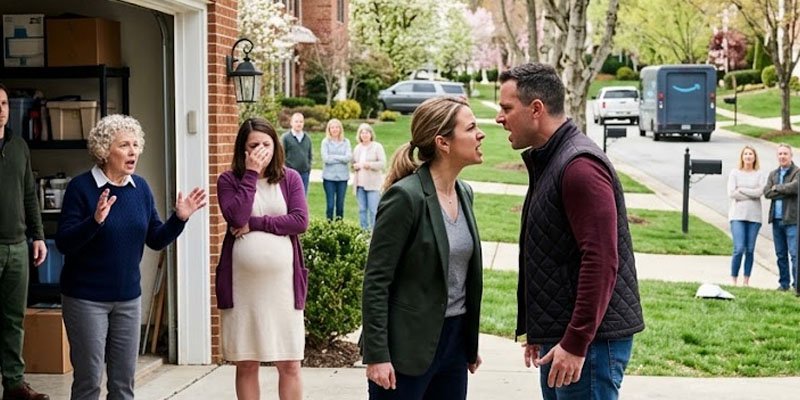
At 6:12 p.m., three vans came down my street.
My uncle Richard was behind the wheel of the first one. His wife, Melissa, was sitting beside him. Their two teenage sons were in the second van, while the third was packed with boxes, luggage, plastic storage bins, and what looked like nearly their entire kitchen.
Richard pulled into my driveway as casually as if he had done it a hundred times.
Then he saw the locksmith.
A man in a navy work shirt was kneeling beside my front entrance, changing the deadbolt. I stood a few feet away with my arms crossed.
Richard slowly got out.
“What exactly is going on?”
“I’m changing my locks.”
He gave a brief laugh. “Very funny. Your mother said the downstairs was ready for us.”
“My mother doesn’t own this house.”
Melissa got out next, already annoyed. “Emily, we drove forty minutes with all this stuff.”
“Then you can drive forty minutes back.”
Richard walked closer. “Don’t turn this into something bigger than it is. We’re family. This is temporary.”
“You moved my furniture without asking me.”
“Your mother said you’d be fine with it.”
“I told her to put everything back.”
His expression hardened. “We have nowhere else to stay tonight.”
“That sounds like something you should have arranged before making plans to move into someone else’s house without permission.”
The locksmith stood up and handed me a new key.
“The front door is done,” he said. “Want me to do the back door too?”
“Yes.”
Richard’s expression changed.
He no longer looked annoyed.
He looked worried.
His eyes moved past me toward the garage, where my sofa, dining chairs, bookshelves, and desk had been pushed against the walls.
Then he lowered his voice.
“You’re really going to do this in front of the boys?”
I glanced toward the vans.
“No,” I said. “You’re the one who chose to do this in front of the boys.”
Another vehicle pulled up behind Richard.
It was my mother.
And when she stepped out looking visibly angry, pointing at me as though I were the one creating the problem, I realized that changing the locks was only the beginning.
Mom rushed across the lawn. “Open that door right now.”
I remained where I was.
Richard glanced at her and suddenly seemed much more confident.
That was when I realized this wasn’t a simple misunderstanding, or even a favor that had been badly arranged.
They had talked about my house, decided what was going to happen, and expected me to accept it afterward.
Mom stopped about three feet from me, obviously irritated.
“Emily, this is unnecessary,” she said. “Richard’s contractor found mold behind the kitchen cabinets. They can’t stay there. Family supports family.”
“I might have considered helping if someone had actually asked me.”
“I knew you would say no.”
The words hit me harder than I expected.
Richard looked away.
Melissa folded her arms. “So that’s it? You’re making four people stay in a hotel because someone moved your couch?”
“No. I’m refusing to let four people move into my house because all of you decided my answer didn’t matter.”
Mom shook her head. “You have three bedrooms. You live by yourself. What difference does it make?”
I almost laughed.
The difference was that she had used the emergency key I had given her after a pipe burst during the previous winter.
The difference was that she had entered my house while I was at work, told Richard to move my belongings, and apparently assured everyone that I had already agreed.
I pulled my phone from my pocket.
“Mom, give me my emergency key.”
Her eyes narrowed. “After everything I’ve done for you?”
“Now.”
She reached into her purse, searched through it impatiently, and then placed the key firmly into my hand.
Richard stepped forward. “Look, Emily, nobody is trying to take your house. We need maybe six weeks.”
“Then find somewhere to rent for six weeks.”
“You know how much short-term rentals cost?”
“I know how much my mortgage costs.”
Mom pointed toward the garage. “At least let them stay tonight.”
“No.”
My younger cousin, Tyler, opened the door of the second van and stepped out. He looked embarrassed rather than angry. His brother, Mason, stayed inside, staring at his phone.
“Dad,” Tyler said quietly, “can’t we just stay at a hotel?”
Richard answered sharply, “Stay out of this.”
The atmosphere immediately changed.
The locksmith, who had been working near the back entrance, came around the side of the house and handed me two more keys.
“All the exterior locks are rekeyed,” he said. “The garage keypad is changed too. You should reset any smart-home access.”
“I will. Thank you.”
Richard looked at him. “How much is she paying you for all of this?”
The locksmith calmly held his gaze. “Enough to finish the job she hired me to do.”
For the first time that evening, I almost smiled.
Mom didn’t.
“You are embarrassing us,” she said.
“No. I’m securing my home.”
She stepped closer. “You think that because your name is on the deed, nobody else matters?”
“My name being on the deed is precisely why you can’t move people into my house without my permission.”
Richard muttered something under his breath.
Then Melissa said something that made me look at her twice.
“Your mother said you were going to sign something tomorrow anyway.”
Silence.
Richard immediately looked at her.
Mom’s expression changed.
“What something?” I asked.
Melissa realized she had said too much.
“Nothing.”
“What was I supposed to sign?”
Mom tried to brush it aside. “It was just paperwork.”
“What paperwork?”
Richard quietly said, “Linda.”
But my attention was already fixed on my mother.
She slowly exhaled. “A temporary occupancy agreement. So everyone would feel comfortable.”
“You prepared an agreement for me to sign after you had already moved them in?”
“It was supposed to protect everyone.”
“Did an attorney prepare it?”
Nobody answered.
I felt an uneasy certainty settle over me.
This wasn’t merely about an empty floor and a renovation problem. Someone had taken this plan much further than that.
“Show me the agreement,” I said.
Mom tightened her grip on her purse.
“No.”
I held out my hand. “Then please leave my property.”
Her mouth fell open in disbelief.
“You wouldn’t really do that.”
“I’m not threatening you. I’m asking you to leave.”
Richard stepped between us. “Emily, calm down.”
“I am calm. Everyone needs to leave.”
For several seconds, nobody moved.
Then Tyler climbed back into the van.
Melissa got in after him.
Richard stayed for another moment, his jaw clenched, before finally turning away.
Mom was the last to leave.
As she passed me, she said, “You’re going to regret treating family like strangers.”
I looked toward the garage, where all my furniture had been displaced.
“You treated my home like my permission didn’t matter.”
That night, once everyone was gone, I reset the alarm, changed every access code, and moved enough furniture back inside so I could sleep comfortably.
At 11:47 p.m., my phone buzzed.
It was a message from Tyler.
A photo.
A three-page document titled TEMPORARY RESIDENTIAL OCCUPANCY AGREEMENT.
At the bottom of the third page was a signature line with my printed name beneath it.
Next to the packet was another page I had never seen.
A handwritten note from my mother:
“If she refuses, remind her what we covered for her after college.”
I stared at those words for a long time.
Because my mother really had helped me after college.
But she had never told the rest of the family what that support had actually consisted of.
What stood out to you most in this chapter? I’m always interested in hearing your genuine reactions.
I barely slept that night.
At seven the following morning, I forwarded Tyler’s photographs to my personal email, backed up Mom’s messages, saved the locksmith’s receipt, and photographed every piece of furniture that was still sitting in the garage.
Nothing looked seriously damaged, although the corner of my desk had a fresh scrape and one of the dining chairs had a cracked spindle.
At eight thirty, I called my employer’s legal-assistance line.
By ten, I had a brief phone consultation with a local attorney named Caroline Hughes.
I explained everything that had happened, including the emergency key, the furniture, the unsigned occupancy agreement, and the fact that nobody had actually spent the night.
Caroline was careful not to overstate anything.
“From what you’ve described,” she said, “the most important point is that you never agreed to this arrangement. Keep all your documentation. Don’t sign anything you don’t completely understand. And if they return and refuse to leave, don’t let the situation turn into a direct confrontation. Contact the appropriate authorities and allow them to handle the immediate situation.”
“What about my furniture?”
“Photograph any damage. If you want reimbursement, request it in writing. But right now, the bigger issue is the family dispute, not the chair.”
She was right.
At 10:16, Mom texted me.
“You embarrassed your uncle. He had to put everyone in two hotel rooms.”
I replied, “Send me the occupancy agreement.”
There was no response.
At 10:31, Richard called.
I let it go to voicemail.
His message was nearly two minutes long.
He started out angry, sounded reasonable in the middle, then became frustrated again toward the end. He said the agreement was “just standard,” that I was “turning something simple into something suspicious,” and that six weeks in a hotel or furnished rental could cost them thousands.
That last part stayed in my mind.
Not because I felt responsible.
Because Tyler had sent me another message.
“Dad had money saved for a rental. Don’t tell him I told you.”
I called Tyler.
He answered quietly.
“Are you at school?”
“No. I’m in the hotel lobby. Dad’s upstairs.”
“You said he had money for a rental.”
Tyler went quiet.
Then he said, “The contractor’s original schedule had us leaving the house for around five weeks. Dad knew in July.”
I sat upright.
It was September.
“What happened to the rental money?”
“I don’t know everything. I heard Mom arguing about the patio.”
“What patio?”
“Our backyard. Dad added pavers and an outdoor kitchen because the contractor was already doing other work.”
I closed my eyes.
“So this wasn’t completely unexpected.”
“The mold part was unexpected,” Tyler said quickly. “That made the kitchen situation worse. But we already knew we couldn’t stay there during part of the renovation.”
“Why did your dad tell me he had nowhere else to stay?”
“I don’t know.”
He probably did know. He simply didn’t want to tell me.
I didn’t push him.
“Tyler, why did you send me the agreement?”
Another pause.
“Because Grandma told Dad you’d eventually agree once we got there.”
That affected me more than anything Richard had said.
Not because it surprised me.
Because it confirmed the strategy.
Show up first. Create urgency second. Make refusing seem unreasonable third.
My mother had known exactly what she was doing.
“Did she say anything else?”
“She said you always act strong, but you don’t like feeling like the bad guy.”
I thanked him and told him not to get himself into trouble because of me.
Then I called Mom.
This time she answered.
“Are you finally ready to apologize?” she asked.
“No. I’m ready to ask why you told Richard I would agree if they arrived before I got home.”
Silence.
Then she said, “Tyler needs to understand that family matters should stay within the family.”
“So it’s true.”
“You’re changing the meaning of everything.”
“Did Richard know in July that he would need temporary housing?”
“That isn’t the issue.”
“It is exactly the issue.”
“The mold changed everything.”
“But they already knew they would have to leave the house.”
Mom sighed as if I were wearing her down.
“Your uncle has expenses. The renovation went over budget. You have extra space. I saw a practical solution.”
“You saw my house.”
“I saw a family helping family.”
“No. Support is something you willingly offer. You offered my home instead.”
Her voice became firmer.
“I supported you when you had nothing.”
There it was.
The note.
“What exactly have you been telling people you did for me after college?”
“I paid your rent. I bought groceries. I helped you stay afloat.”
“For four months.”
“Four months you apparently don’t remember.”
“I remember perfectly. I paid you back.”
She said nothing.
For two years after getting a full-time job, I transferred money to her every month. I still had the bank records. The original amount was $6,400. I repaid $7,000 because she refused to calculate all the smaller expenses, and I wanted the obligation to be unquestionably settled.
Mom had accepted every payment.
But over the years, she had apparently turned those four months into a permanent justification for influencing my decisions.
“I paid you back completely,” I said.
“That isn’t the point. A mother shouldn’t have to keep receipts.”
“You literally wrote a note telling them to bring it up if I refused.”
Her breathing changed.
So Tyler had never told her about the photograph.
“What note?”
“The handwritten one beside the agreement.”
Mom became completely silent.
Then she said, “You weren’t supposed to see that.”
I gave a short, incredulous laugh.
“It was about me.”
“It was private.”
“You entered my house without asking, moved my downstairs furniture, arranged for four people to stay there, and prepared paperwork for me to sign after they arrived. But suddenly the handwritten note is where privacy matters?”
She ended the call.
For the next two days, the family group chat felt like a courtroom with no judge.
My aunt Susan wrote that she couldn’t believe I had “left children without somewhere to stay.”
My cousin Leah pointed out that Raleigh had plenty of hotels and that nobody had actually been left without shelter.
Richard wrote that he had never asked for charity.
I replied with one sentence:
“Then why didn’t you ask me before planning to move in?”
Nobody answered that directly.
Instead, Mom posted a long message about sacrifice.
She said she had helped me through “the most difficult period of my adult life” and had never expected repayment, only appreciation and respect.
The wording was clever.
So I answered with facts.
I posted screenshots of the bank transfers, showing only the dates and amounts, with all account information concealed, and wrote:
“Mom helped me with $6,400 after college. I repaid $7,000 over two years. I have always appreciated what she did. That support did not give anyone permanent control over my home.”
The group chat stayed silent for almost an hour.
Then Aunt Susan wrote, “Linda, you told me you gave Emily the money for her down payment.”
I stared at my screen.
That was something I had never heard before.
Mom left the group chat.
Richard called me again.
This time, I answered.
His voice was quieter than before.
“Did you really repay her?”
“Yes.”
“Everything?”
“More than everything.”
He exhaled.
“She told me she had basically funded your start in adult life. She made it sound like you had that house because of her.”
“My down payment came from my own savings and a first-time homebuyer program. She didn’t put anything toward it.”
Another pause.
Then Richard said, “That changes a few things.”
“Not enough.”
“I know.”
I waited.
Eventually, he explained what had happened.
His renovation had started in August. He and Melissa had originally put money aside for a furnished rental. Then several upgrades pushed the project beyond their budget, including the backyard improvements Tyler had mentioned. Richard decided they could stay in the house longer than the contractor had advised and use a hotel only during the loudest demolition work.
Then they discovered mold.
The contractor told them the kitchen and the adjacent area needed to be opened up further. Their planned two-night hotel stay suddenly turned into several weeks away from the house.
Richard became concerned.
Mom offered my house.
He asked if I had agreed.
Mom told him I “would once she explained everything.”
“And you thought that was enough?” I asked.
“No,” he admitted after a moment. “I thought it would be your mother persuading you to do something you didn’t really want to do. That’s different from what actually happened.”
“Not different enough for you to move my furniture.”
“No.”
For the first time, he genuinely sounded embarrassed.
He offered to pay for the damage to my desk and chair.
Then he asked whether I might reconsider allowing them to stay if he signed a proper agreement and paid rent.
“No.”
He accepted my answer immediately.
That mattered more to me than an apology would have if it had been followed by another demand.
They found a furnished townhouse in Cary the next day.
It cost more than they wanted to spend, but they had a comfortable place to stay, three bedrooms, a kitchen, and no reason to describe my refusal as some kind of housing emergency.
Richard paid $640 to repair my desk, replace the chair, and hire movers to put everything back exactly where it had been.
He came with the movers but remained outside until I invited him in.
That detail mattered too.
While the crew carried the last bookshelf through my front door, Richard stood in my kitchen holding an envelope.
“This is the original agreement,” he said.
I took it.
The document wasn’t particularly alarming on the surface.
Somehow, that made it even more concerning.
It was amateurish, apparently downloaded from somewhere online and edited. It described my uncle’s family as “temporary occupants,” gave them a maximum stay of ninety days rather than six weeks, required no rent, and made me responsible for the utilities.
Ninety days.
I looked at him.
“You told me six weeks.”
“I know.”
“Why ninety?”
“Your mother said contractors are always late.”
“So she planned for three months.”
He rubbed the back of his neck. “Apparently.”
There was also a section saying the occupants could receive mail at the property.
I didn’t need to imagine some complicated legal situation to understand why signing paperwork I had never requested, under pressure, after they had already arrived with their belongings, would have been a reckless decision.
I folded the document and placed it back inside the envelope.
“Did Mom prepare this?”
“She found the template. Melissa added the names.”
“And the note?”
Richard looked uncomfortable.
“Your mother wrote it at breakfast yesterday.”
“Before you came to my house.”
“Yes.”
That answered my final question.
There had been deliberate pressure involved, not merely a chaotic misunderstanding.
Three weeks went by before Mom contacted me personally.
She didn’t apologize.
Instead, she wrote, “I hope you’re satisfied now that everyone thinks I’m dishonest.”
I read the message twice.
Then I replied:
“I told them the truth after you gave them an inaccurate version of my finances. I’m willing to continue having a relationship with you, but you will never have a key to my home again, and you cannot offer my property, money, or time to anyone without asking me first.”
She replied, “So now I need rules just to be your mother?”
“Yes,” I wrote. “These are the boundaries for having access to my life.”
She didn’t speak to me for six weeks.
Thanksgiving was the next time we met.
Aunt Susan hosted that year in Greensboro. I thought about staying home, but I didn’t want my mother’s silence to keep me away from the rest of my family.
When I arrived, Richard was already there.
He greeted me normally.
Melissa gave me a slightly awkward hug and said, “The townhouse is actually nicer than I expected.”
Tyler whispered, “Dad still hates the rent,” and grinned.
Mom arrived twenty minutes later.
She didn’t look at me until dinner.
The conversation stayed painfully polite through turkey, stuffing, and two separate arguments about football. Then Susan asked Richard when his house would finally be finished.
“December fifteenth, supposedly,” he said.
Mom murmured, “Would’ve been easier if certain people had been a little more flexible.”
The table went silent.
Six weeks earlier, that comment probably would have led to another argument.
Instead, Richard put down his fork.
“Linda, stop.”
Mom looked at him in surprise.
He continued.
“Emily didn’t do anything wrong. We never should have moved her belongings. I should have called her myself.”
Melissa nodded.
Mom looked around the table as though she expected someone to support her.
Nobody did.
Finally, she said, “Everyone has decided I’m the bad person here.”
I said nothing.
I had spent enough time defending myself to people who preferred to misunderstand me.
Susan changed the subject.
That was the last public disagreement we had about the house.
My relationship with Mom never returned to what it had been before, but eventually I realized that “returning to normal” would have meant going back to a pattern where she could make decisions for me and describe my objections as disrespect.
We created a different kind of normal. She called before coming over. She waited until I invited her.
When relatives needed help, she asked whether I wanted to participate instead of telling everyone what I would provide.
The first few times, every request sounded formal and unfamiliar.
Eventually, it became normal.
Richard’s family returned home shortly before Christmas.
In January, he invited me over for dinner.
The renovated kitchen looked beautiful. So did the expensive patio that had helped cause the entire situation.
When we stepped outside, he pointed toward the built-in grill.
“There,” he said. “The world’s most expensive reason I almost got locked out of your family forever.”
“You got locked out of my house,” I corrected.
He gave a small smile.
“Fair.”
Before I left, he handed me a small box.
Inside was a brass keychain shaped like a deadbolt.
I looked at him.
“That’s either hilarious or an incredibly questionable choice.”
“Tyler picked it.”
From the kitchen, Tyler called out, “And I still stand by it.”
I laughed despite myself.
I still have that keychain.
But nobody in my family has a key to my house.
Not Mom. Not Richard. Nobody.
The new locks were never really about keeping my relatives out.
They were about making one simple truth impossible to misunderstand:
A relationship can make someone family.
It does not make them an owner.




