
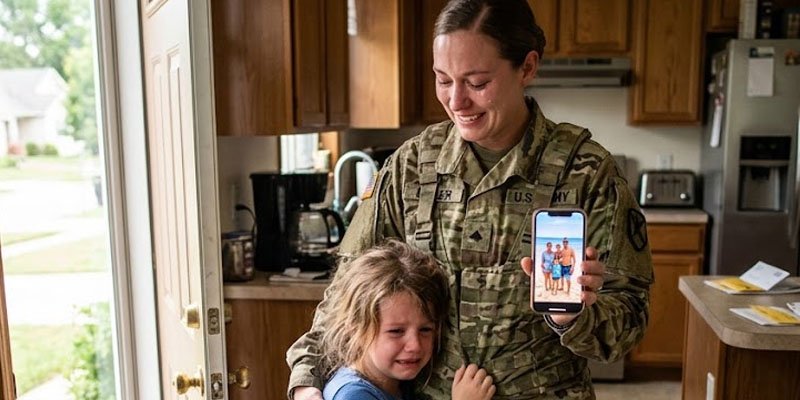
For six months, Staff Sergeant Emily Carter had counted down the days until she could finally be reunited with her eight-year-old daughter.
Her deployment had been exhausting, yet every Friday she transferred most of her paycheck into the joint account she maintained with her husband, Derek.
During their calls, he always comforted her with the same reassurance: “Lily’s doing great. Don’t worry about us.”
When Emily’s unit released her three weeks earlier than expected, she decided not to tell anyone. She wanted Lily to be completely surprised when they reunited.
The house in Fayetteville, North Carolina, looked strangely dark when her taxi pulled into the driveway. Derek’s truck was nowhere to be seen. His mother’s SUV, which was usually parked nearby, was missing as well. Emily unlocked the front door and stepped inside.
“Lily?”
There was no response.
Then a quiet voice came from the hallway.
“Mom?”
Emily froze.
Her daughter was standing barefoot in an oversized T-shirt, with a visibly thinner face and arms far slimmer than Emily remembered. She looked completely different from the happy child Emily had seen during their video calls.
Emily let her bags fall.
“Oh my God.”
Lily ran into her mother’s arms, and Emily immediately noticed just how much weight her daughter appeared to have lost.
“Where’s Daddy?”
Lily looked down. “He went on vacation.”
“With who?”
“Grandma, Grandpa, Aunt Melissa, Uncle Ryan… everybody.”
Emily felt her stomach knot.
“How long have you been here alone?”
Lily hesitated.
“Three days.”
The response almost left Emily unable to breathe.
The kitchen contained barely any food: half a loaf of stale bread, two cans of soup, and a jar of peanut butter. On the counter sat a note written in Derek’s handwriting.
Pizza money is in the drawer. Don’t answer the door. We’ll be back next week.
Emily opened the drawer.
Seven dollars.
Her hands shook as she grabbed her phone. Before she called anyone, she checked their joint account.
The balance was $63.18.
Then she saw the transactions.
A resort in St. Lucia. First-class airfare. Spa services. Excursions. Jewelry. More than eleven thousand dollars had been spent across nine days.
It was money Emily had sent home to cover rent, groceries, Lily’s school expenses, and emergencies.
She did not call Derek.
Instead, she contacted military police, then Child Protective Services, and finally her bank.
By midnight, Lily was lying in a hospital bed receiving fluids and undergoing an evaluation because of concerns about inadequate care. Emily had photographed the nearly empty kitchen, preserved the note, downloaded the bank statements, and recorded every unanswered message Derek had failed to respond to.
At 1:17 a.m., she replaced the locks.
At 1:42, she froze the remaining joint credit line.
At 2:05, she contacted a family-law attorney recommended by her commanding officer.
The next morning, while Derek and his relatives prepared to board a private catamaran under the Caribbean sun, his phone began vibrating.
Missed calls. Voicemails. Bank notifications. And one message from Emily:
Do not come near Lily. My attorney will contact you.
Derek called forty-three times before noon.
Emily answered not a single call.
She stayed beside Lily at Cape Fear Valley Medical Center as a pediatrician explained that her daughter was dehydrated, underweight, and displaying signs that her nutritional needs had not been properly met for an extended period.
The doctor spoke cautiously, but Emily understood what he was suggesting.
This had not happened in three days.
“How long?” Emily asked.
The doctor studied the chart. “I can’t give you an exact timeline yet. But this pattern suggests weeks, possibly longer.”
Something inside Emily suddenly went quiet.
Lily had always been small, but she had never looked this fragile. Before Emily left for deployment, she had been energetic, determined, and perpetually hungry after soccer practice.
During the deployment, Derek had sent carefully composed photographs—Lily smiling under blankets, Lily sitting at a table, Lily waving toward the camera.
Emily now understood that most of those photographs had framed Lily only from the shoulders upward.
A CPS investigator named Carla Mendoza arrived that afternoon. She questioned Emily first and then spoke privately with Lily.
Afterward, Carla returned with a grave expression.
“Your daughter says her father frequently left her with his mother.”
Emily slowly nodded. “That was supposed to happen sometimes.”
“She also says your mother-in-law sometimes restricted food as punishment.”
Emily stared at her.
“For what?”
“Talking back. Leaving toys out. Asking for snacks. Your daughter says she was sometimes given only toast for dinner while the adults ordered takeout.”
Emily clenched her jaw.
Carla continued. “She says your husband knew.”
That information wounded her in a completely different way.
Not confusion. Not negligence.
Awareness.
Emily eventually played one of Derek’s voicemails.
His voice sounded angry rather than worried.
“Emily, what the hell did you do to the cards? We’re stranded here. My card got declined at the hotel, and Mom’s freaking out. Call me right now.”
The second voicemail was even more troubling.
“You can’t just freeze our money because you’re mad. Do you understand how hum!liating this is?”
Our money.
Emily nearly laughed.
Instead, she preserved every voicemail and sent copies to her attorney.
By evening, attorney Rachel Stein had submitted a request for emergency temporary custody and a protective order designed to keep Derek from removing Lily from Emily’s care. The hospital records, photographs, handwritten note, financial documents, and Lily’s preliminary CPS interview offered significant support for the request.
Rachel warned Emily not to communicate with Derek directly.
“Let him talk,” she said. “People who think they’ve done nothing wrong usually give us plenty.”
She was right.
Derek kept leaving messages.
First, he was angry.
Then, he became defensive.
After that, he grew increasingly desperate.
He claimed Lily had refused to eat. He said his mother had been checking on her. He insisted the cruise had been “planned for years.” He accused Emily of using her deployment as a reason to control the household finances.
Then he made a serious mistake.
In one voicemail, he snapped, “She was supposed to stay quiet and follow the rules for one week. She had food. Mom stocked the place before we left.”
Rachel listened to the sentence twice.
“One week,” she said. “He just admitted he intended to leave an eight-year-old without a parent in the home for a week.”
Two days later, Derek’s Caribbean vacation no longer looked nearly as luxurious.
The resort placed a hold on his room after his backup card was declined. His sister Melissa had to put incidental expenses on her own credit card. His father began demanding an explanation for why Derek had assured everyone that the entire trip was already paid for.
Then a sheriff’s deputy called Derek and told him an electronic notice had been issued concerning an emergency custody hearing scheduled soon after his return.
His mother, Patricia, apparently yelled so loudly that Emily could hear her in the background of another voicemail.
“This is ridiculous! We raised that girl while you abandoned her!”
Emily deleted nothing.
When Lily was released from the hospital, she went home with a meal plan, follow-up appointments, and a social worker assigned to her case.
Emily led her through the newly secured front door.
Lily stopped in the entryway.
“Is Dad coming back?”
“Not right now.”
“Is Grandma?”
“No.”
Lily’s shoulders visibly loosened.
That response disturbed Emily more than almost anything else she had discovered.
That evening, Lily ate half a bowl of chicken soup, two crackers, and a spoonful of applesauce. Then she softly asked whether she could have more.
Emily had to look away before responding.
“Yes, sweetheart. You never have to earn food.”
Lily examined her mother’s expression.
“Grandma said food costs money, and you weren’t sending enough.”
Emily turned toward her sharply.
“I sent money every week.”
“I know,” Lily whispered. “I heard Dad tell her you sent a lot.”
The next morning, Rachel called.
“We found something,” she said.
Derek had not merely used deployment-period money for the cruise.
For four months, he had also been transferring money from their joint account into another account Emily had never known about.
The amount totaled nearly thirty-two thousand dollars.
And the account was registered under Patricia’s name.
Rachel cautioned Emily not to draw conclusions too quickly about what the discovery meant.
“An account in Patricia’s name doesn’t automatically prove fraud,” she explained. “But the transfers matter, especially if Derek moved marital funds without your knowledge while telling you the money was being used for Lily.”
Emily sat at the kitchen table with a yellow legal pad in front of her.
For the first time since returning home, the house was entirely quiet. Lily was asleep upstairs. A small night-light brightened the hallway because she had started waking whenever she heard a vehicle outside.
Emily looked over the list she had written.
Mortgage. Utilities. School lunches. Soccer fees. Groceries. Emergency savings.
Every category had a figure beside it. Each amount came from what Derek had told her he needed while she was deployed.
“Can we trace where the money went?” she asked.
“We can request records through the divorce and custody process,” Rachel replied. “And if investigators believe a crime occurred, they have their own tools. Right now, your job is simpler. Preserve everything. Don’t threaten him. Don’t move money you can’t clearly document as yours. Don’t give him an excuse to claim you’re retaliating.”
Emily understood instructions.
She followed this one exactly.
Three days later, Derek and his family arrived in Charlotte.
He called before their plane had even finished taxiing.
“You need to fix this before I get home.”
Emily was sitting in Rachel’s office when the voicemail came through.
Rachel raised an eyebrow. “Home?”
Emily gave a dry smile.
Derek still thought the house belonged to the version of his life that had existed before the cruise.
It didn’t.
A deputy met him later that afternoon and personally served him with the court documents. The temporary order required Lily to remain with Emily until the hearing and limited Derek’s contact according to conditions established by the court.
Those conditions could change after both sides had been heard, but for now, Derek could not simply walk into the house and take his daughter.
That still did not stop him from attempting it.
At 7:26 p.m., Emily received an alert from the doorbell camera.
Derek was standing on the porch carrying two suitcases.
Patricia and his father, Wayne, stood behind him.
Emily did not open the door.
Derek rang the bell again.
“Emily! Open the door.”
Patricia stepped closer to the camera.
“You have no right to keep my son out of his own house.”
Emily stayed in the living room, with Lily safely upstairs and her phone held firmly in her hand.
Rachel had already told her exactly what to do if they appeared.
Do not engage. Contact law enforcement. Record everything from somewhere safe.
Emily followed those directions.
Outside, Derek’s voice grew louder.
“I live here! You can’t do this!”
Patricia added, “She’s trying to tear this family apart because she feels guilty about leaving.”
Emily tightened her hold on the phone.
For six months, those words would have hurt her.
She had carried guilt throughout her deployment every day. Guilt when she missed Lily’s school performance. Guilt whenever a call was disconnected. Guilt when Lily said she wished Mommy were there to tuck her into bed.
Derek had always known exactly how to exploit those emotions.
But Emily had seen the refrigerator now.
She had discovered the seven dollars.
She had watched her daughter ask whether she could have another spoonful of applesauce.
That guilt no longer belonged to Emily.
When deputies arrived, Derek continued arguing from the porch. He claimed Emily had “overreacted” because of a misunderstanding. Patricia repeatedly attempted to intervene until one deputy firmly told her to step back.
Nobody was arrested that night.
They were simply ordered to leave.
For Derek, that almost seemed worse.
He had shown up expecting an argument he could control by raising his voice.
Instead, he was confronted by a procedure.
The emergency custody hearing took place four days later.
Derek arrived in a navy suit with an attorney Emily had never seen before. Patricia sat behind him wearing pearls and an expression of wounded dignity.
Emily sat beside Rachel.
She had spent years working in environments where fear had to remain hidden behind discipline and composure.
This felt different.
Her hands were cold beneath the table.
The judge reviewed photographs of the kitchen, medical records concerning Lily’s condition upon admission, the handwritten note Derek had left, selected financial statements, and preliminary CPS findings. The court was not resolving the entire marriage or settling every accusation that morning.
That was not the purpose of the hearing.
The focus was on the most important issue at that moment.
Where would Lily be safest while everything else was investigated?
Derek’s attorney argued that Lily had access to food, that relatives were supposedly “nearby,” and that Emily’s unexpected early return had provided an incomplete picture of the household’s normal circumstances.
Rachel asked one question.
“Was any responsible adult physically residing in the home with Lily Carter during the three days immediately preceding Sergeant Carter’s return?”
Derek shifted in his chair.
His attorney began to respond.
The judge stopped him.
“I asked about the factual arrangement.”
After a long pause, Derek admitted that no one had been.
Rachel then played the voicemail.
“She was supposed to stay quiet and follow the rules for one week.”
Derek’s expression changed instantly as his own recorded voice filled the courtroom.
Patricia continued staring straight ahead.
The judge maintained temporary primary custody with Emily, ordered Derek’s contact with Lily to remain limited and structured while the investigation continued, and directed both parents to cooperate with evaluations and any additional requirements from the court.
There was no dramatic declaration of victory.
No pounding gavel. No celebration.
Just an order.
For Emily, it felt like she could finally breathe again.
Outside the courtroom, Derek approached her near the elevators.
Rachel immediately stepped between them.
Derek looked past her.
“You’re really going through with this?”
Emily looked directly at him.
“You left her alone.”
“My mom was checking on her.”
“Your mother was on the cruise.”
“She stocked the kitchen.”
“There were two cans of soup.”
“She’s picky.”
“She was underweight.”
His expression became harder.
“You’ve already decided I’m some kind of monster.”
Emily kept her tone steady.
“I don’t have to decide what you are. I only have to decide what I allow around Lily.”
The elevator doors opened.
Emily stepped inside beside Rachel.
Derek remained behind.
The financial records arrived gradually over the next several weeks.
They made the cruise look almost insignificant.
The thirty-two thousand dollars moved into Patricia’s account had paid for much more than a vacation. Some of it went toward Patricia’s credit-card balances. Another portion paid a deposit on a recreational vehicle Wayne wanted. Several thousand dollars went toward jewelry. Records also revealed restaurant charges, resort deposits, and multiple cash withdrawals.
Even more damaging to Derek’s credibility were text messages obtained during the proceedings.
Emily read them while sitting in Rachel’s conference room.
Derek: She sent another 1800.
Patricia: Good. Move 1200 before she checks.
Derek: She never checks while deployed.
Patricia: Keep enough in there for bills so it looks normal.
Another exchange appeared two months later.
Patricia: Lily keeps asking for extra lunch money.
Derek: Tell her no. She needs to stop wasting food.
Patricia: She says there isn’t much here.
Derek: I’ll get groceries this weekend.
The bank records showed that Derek’s largest purchase that weekend had nothing to do with groceries.
It was a $1,460 payment toward the Caribbean resort.
Emily lowered the documents.
For several moments, nobody spoke.
Rachel finally broke the silence.
“These messages are important.”
Emily looked at her.
“He knew.”
“Yes.”
“I kept telling myself maybe he didn’t realize how serious things had become.”
Rachel did not attempt to answer that for her.
There was no need.
Derek had understood enough to hide the money. He had understood enough to carefully stage the video calls. He had understood enough to tell his mother to move funds before Emily could discover them.
Understanding had never been the real problem.
His priorities were.
Meanwhile, Lily slowly began showing signs of improvement.
At first, she hid food around her bedroom.
Emily found granola bars under her pillow, crackers tucked inside a sock drawer, and an unopened pudding cup carefully concealed behind several books.
She never reprimanded her.
Following advice from Lily’s therapist and medical team, Emily created predictable meal times and regular snacks. She placed a basket of shelf-stable foods in an accessible cabinet and told Lily that she could ask for something to eat whenever she was hungry.
For several weeks, Lily kept asking for permission every time.
“Can I have a banana?”
“Yes.”
“Can I have yogurt too?”
“Yes.”
“Even though I already ate breakfast?”
“Yes.”
One Saturday morning, nearly two months after Emily returned, Lily opened the pantry, took a granola bar, and simply walked away without asking.
Emily stood beside the sink and quietly cried into a dish towel.
Not because Lily had taken something to eat.
Because her daughter finally understood that she was allowed to do so.
The investigative process moved more slowly than Emily had expected. Officials interviewed relatives, examined records, and reviewed the circumstances surrounding Lily being left without appropriate adult supervision. Emily quickly learned that actual investigations did not unfold like television dramas. Every allegation needed evidence. Everyone involved had rights. Each agency followed its own procedures.
She stopped trying to predict the outcome.
Instead, she concentrated on the facts.
The family-court proceedings moved faster.
Derek submitted responses accusing Emily of turning Lily against him and using her military service to gain sympathy. He claimed the transfers into his mother’s account were family gifts that Emily had verbally approved.
Emily’s attorney asked him when that approval had supposedly happened.
He could not provide a date.
He argued that Lily’s weight loss had resulted from anxiety related to Emily’s deployment.
Medical records showed Lily’s pediatric weight had remained stable before Emily left and had fallen significantly during the deployment.
He claimed Patricia had cared for Lily every day.
Travel records showed Patricia had accompanied Derek on multiple weekend trips during that same period.
Then Melissa, Derek’s sister, changed everything.
She contacted Emily directly.
Her message contained one sentence.
I need to tell you what really happened before the cruise.
Emily did not respond herself.
Instead, she immediately forwarded the message to Rachel.
With the attorneys involved, Melissa eventually submitted a formal statement.
She explained that she had believed Derek was paying for the Caribbean vacation with a work bonus. She had never known the money came from Emily’s deployment pay. She also remembered family dinners when Lily was denied certain foods for supposedly “being disrespectful.” According to Melissa, Patricia called the practice discipline, while Derek dismissed it.
The most important detail concerned the week of the cruise.
Melissa said she had directly asked Derek who would stay with Lily.
Derek had replied, “She’s eight, not a baby. Mrs. Coleman next door will keep an eye out.”
When Mrs. Coleman was interviewed, she was shocked.
Derek had never asked her to supervise Lily.
He had only mentioned that the family would be traveling and asked whether she could “grab packages if you see any.”
That statement weakened Derek’s final explanation.
There had been no assigned caregiver. There had been no genuine supervision plan.
There had only been a child, very little food, and an empty home.
Months passed.
Emily filed for divorce.
The house, financial accounts, debts, and disputed transfers became part of a much broader legal dispute. Rachel warned her that recovering the missing money could remain challenging despite the extensive documentation. Some funds had already been spent. Certain assets were contested. Legal costs continued to increase.
Emily did not receive some miraculous repayment of every dollar.
What she gained was far more practical.
Control of her own income.
A separate bank account.
Temporary arrangements enforceable by the court.
Documentation showing where much of the money had gone.
And meaningful separation between Lily and the people who had repeatedly treated her basic needs as unimportant.
Patricia eventually stopped leaving angry voicemails after Rachel formally required future communication to go through appropriate channels. Wayne mostly withdrew from the dispute once questions about the recreational vehicle began receiving attention.
Derek continued fighting.
But his communication changed.
The man who had originally called from a Caribbean resort demanding that Emily restore access to his credit cards now sent carefully written messages through a co-parenting platform.
I would like to know how Lily is doing.
I completed the parenting class.
Please confirm whether the next supervised visit is Saturday.
Emily replied only when necessary.
Lily’s relationship with her father became something the court and qualified professionals handled cautiously, rather than something Emily tried to push toward a convenient outcome. Some visits went peacefully. Others ended early when Lily became uncomfortable. Sometimes Derek appeared genuinely sorry. At other times, he blamed Patricia, Emily’s deployment, childcare costs, or the burden of being “left with everything.”
Emily stopped waiting for the perfect apology.
No apology could undo what she had discovered inside that refrigerator.
Almost a year after coming home three weeks early, Emily stood in the same kitchen where she had once found two cans of soup and a jar of peanut butter.
Now the refrigerator held milk, eggs, strawberries, leftovers, vegetables, cheese, and an almost absurd supply of yogurt cups because Lily had decided there was precisely one brand she liked.
A soccer schedule was attached to the freezer door beneath a magnet.
With medical supervision, Lily had returned to a healthier weight. She was back in school full-time and had rejoined her soccer team. She was not quite the same child Emily remembered from before the deployment.
Emily was not quite the same woman either.
Some evenings, Lily still checked the front-door lock twice.
Sometimes she asked exactly how long Emily would be gone whenever her mother drove to the grocery store.
But normal moments had returned.
Homework arguments.
Wet towels scattered across the bathroom floor.
Complaints about broccoli.
Music playing far too loudly upstairs.
Ordinary life had become precious.
One evening, Emily received an email from Rachel containing the latest filing in the case. Derek was contesting part of the proposed financial division and once again claiming that the transfers into Patricia’s account had been legitimate family gifts.
Emily read two pages, closed her laptop, and set it aside.
A year earlier, she might have stayed awake through the entire night trying to understand how someone she trusted could have concealed so much from her.
Now she could hear Lily laughing upstairs while video-chatting with a school friend.
That sound answered the one question that still mattered most.
Emily headed toward the kitchen.
On the counter sat the handwritten note she had discovered on the afternoon she returned home.
Pizza money is in the drawer. Don’t answer the door. We’ll be back next week.
The original was still secured in an evidence folder, but Rachel had given Emily a copy.
Emily looked at it one last time.
Then she placed the copy inside a drawer beneath the court documents.
Not as a trophy. Not as revenge.
As documentation.
Because Derek and Patricia had spent months attempting to portray what happened in different ways.
They called it inadequate care discipline. They called the disputed transfers gifts. They called leaving Lily alone independence.
They called Emily vindictive because she refused to look away.
But documents did not change based on someone’s preferred story.
Bank statements contained figures.
Messages preserved language.
Medical records documented consequences.
And Lily could speak about everything else.
“Mom!” Lily called from upstairs.
“Yeah?”
“Can Ava sleep over Friday?”
Emily smiled.
“We’ll talk about it after you finish your homework.”
An exaggerated groan echoed down the stairs.
Emily opened the refrigerator and began preparing dinner.
Her phone buzzed once on the counter.
Another message from Derek.
She did not immediately pick it up.
She finished chopping the vegetables first.
Then she washed her hands, checked the message, and forwarded anything relevant through the communication channel Rachel had told her to use.
No shouting. No thre:ats. No elaborate revenge.
Only boundaries, documentation, and time.
Derek had once believed the worst thing Emily could possibly do was freeze a credit card while he was vacationing in paradise.
He had misunderstood.
The real consequence was that when Emily walked through that front door three weeks early, everything he had concealed began to surface.
The financial trail became apparent.
His explanations stopped aligning with the records.
His relatives could no longer control the story simply by repeating their version more loudly.
And the daughter they had expected to remain quiet finally had responsible adults prepared to hear her.
Emily had deployed overseas believing her greatest responsibility was returning safely to the family waiting at home.
She came back and discovered that returning home was only the beginning.
She could not erase the difficult months Lily had endured. She could not instantly remove every remaining fear. She could not recover every dollar or make Derek become the father Lily needed.
But she could ensure that her daughter would never again be left alone in a dark house wondering whether she was allowed to eat.
So Emily did exactly that.
And for her, that was enough.
::