
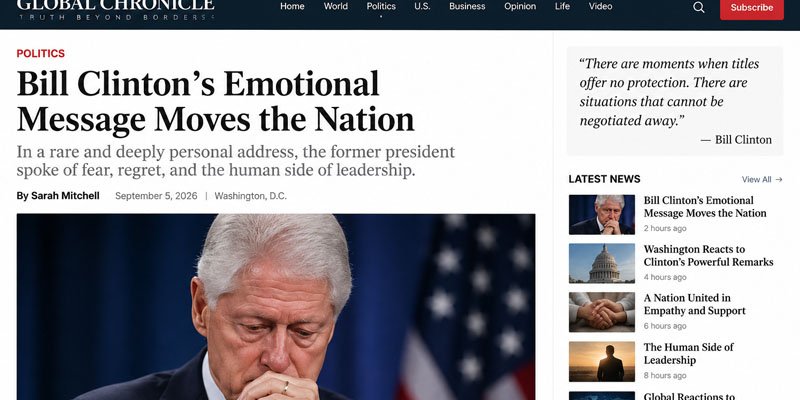
Bill Clinton’s Emotional Moment: When Leadership Meets Personal Pain
For a man who spent decades standing beneath some of the most unforgiving lights in American public life, Bill Clinton was accustomed to controlling the moment.
He had addressed enormous campaign crowds, faced presidential debates, delivered national speeches, and spoken during some of the most difficult periods in the country’s recent history.
He knew how to choose his words.
He knew how to manage a difficult question.
And perhaps most importantly, he knew how to remain composed when millions of people were watching.
That is why a moment of hesitation can sometimes say more than a perfectly prepared speech.
Clinton tried to continue speaking, but for several seconds, the confidence and composure that had defined so much of his public career appeared to give way to something far more personal.
The cameras continued rolling.
Nobody interrupted.
For a brief moment, the former president no longer appeared to be delivering another carefully prepared political message.
He appeared to be a person confronting an emotion that was difficult to hide.
When the Public Figure Became Personal
Clinton briefly lowered his eyes before continuing.
When he looked up again, his expression appeared noticeably heavier.
His remarks began with the uncertainty affecting so many people.
Families were looking for answers.
Communities were trying to understand what might happen next.
Information was spreading quickly, but so was speculation. Anger was growing, and people were struggling to separate confirmed facts from rumors and assumptions.
Yet the tone changed when Clinton moved beyond the broader situation and began speaking in more personal terms.
The issue was no longer something he could simply observe as a former president.
It had reached closer to home.
It had affected someone he cared about.
And that realization transformed the atmosphere.
The polished language associated with political speeches suddenly seemed less important than the emotion behind it.
The Helplessness of Waiting
One of the most difficult experiences for any person is waiting for news when there is nothing they can do to influence the outcome.
Clinton spoke to that feeling in a way that many people could recognize.
There are phone calls that continue late into the night.
There are messages people repeatedly check even though they know nothing has changed.
There are moments when silence itself becomes frightening.
And there are situations in which no amount of influence, money, authority, or experience can produce the certainty someone desperately wants.
That is the uncomfortable reality of being human.
A person may spend decades building a reputation, achieving success, gaining influence, and surrounding themselves with people capable of solving complicated problems.
But some circumstances cannot be solved through power.
Some situations simply require patience.
Some answers arrive only with time.
And sometimes, there are no easy answers at all.
When Power Is Not Enough
Bill Clinton once occupied the Oval Office.
During his presidency, he regularly dealt with world leaders, government officials, advisers, diplomats, military personnel, and some of the most powerful institutions in the United States.
He spent years in an environment where information could be obtained quickly and decisions could be made at the highest levels.
But personal fear does not always respond to political experience.
There are moments when the former president and the ordinary person become difficult to distinguish.
A title cannot eliminate uncertainty.
A position cannot prevent someone from worrying about a loved one.
And influence cannot guarantee that the next phone call will bring good news.
That is what made the emotional shift so striking.
The man who had once been surrounded by enormous political power was confronting a situation in which power itself seemed to have very little meaning.
The Weight of Responsibility
But the message did not stop with fear or personal concern.
The conversation also turned toward responsibility.
Clinton acknowledged an uncomfortable truth about leadership: leaders make mistakes.
Some mistakes become visible almost immediately.
Others may remain hidden for years before their consequences become clear.
Time can change the way decisions are understood.
Circumstances change.
New information becomes available.
And eventually, people are sometimes forced to look backward and ask whether a different decision could have produced a different outcome.
That kind of reflection is rarely comfortable.
For a former president, it can be even more complicated.
Every major decision made in office can affect countless people, and history has a way of preserving those decisions long after the individuals involved have moved on.
The Reality of Regret
Regret is not always public.
Often, it exists quietly.
It can appear in the moments when someone remembers an old decision and wonders what might have happened if they had chosen differently.
It can emerge years later, when circumstances provide a perspective that was impossible to have at the time.
And it can remain even when a decision was made with good intentions.
Good intentions, however, do not automatically erase consequences.
That is one of the hardest lessons of leadership.
A person can genuinely believe they are doing the right thing and still make a decision that produces painful results.
Acknowledging that reality does not necessarily mean rejecting everything that came before.
Sometimes, it simply means accepting that leadership is complicated.
No Perfect Record
There was no need to portray leadership as a flawless journey.
No serious leader can honestly claim to have made every decision perfectly.
Presidents face incomplete information, competing interests, enormous pressure, and decisions where every available option carries consequences.
What matters is how those decisions are eventually confronted.
Instead of presenting leadership as a story filled only with victories, Clinton’s reflections pointed toward something more complicated: accountability, uncertainty, responsibility, and regret.
That approach can make a public figure appear more human.
The audience may disagree with individual decisions.
They may remember history differently.
But an acknowledgment of imperfection can sometimes carry more emotional weight than another carefully constructed defense.
The Difference Between Politics and Humanity
Political life often rewards certainty.
Leaders are expected to sound confident.
They are expected to have solutions.
They are expected to reassure the public even when circumstances are unpredictable.
A politician who openly admits uncertainty can appear vulnerable.
Yet vulnerability is also one of the qualities that can make a public figure relatable.
Behind every title is a person.
Behind every speech is a human being.
And behind every political career are personal relationships, private fears, difficult memories, and moments that never become part of the public record.
That is why emotional moments involving former presidents can attract such attention.
People are not only watching a political figure.
They are watching someone who has spent years appearing almost larger than ordinary life suddenly confront something ordinary people understand immediately.
Fear for someone you love.
The anxiety of waiting.
The inability to control an outcome.
And the realization that even extraordinary careers cannot protect a person from ordinary human emotions.
A Different Kind of Leadership
Perhaps the most important lesson from such a moment is that leadership is not simply about appearing strong.
It is also about accepting responsibility when circumstances become difficult.
It is about recognizing mistakes without pretending they never happened.
It is about understanding that decisions have consequences.
And sometimes, it is about having the courage to admit that there are situations no leader can completely control.
Clinton’s political career has been examined, debated, praised, and criticized from countless perspectives.
His presidency remains part of a complicated historical record.
But moments of visible emotion belong to a different category.
They remind audiences that behind the speeches, elections, policies, controversies, and historical judgments is a human being.
When the Cameras Keep Rolling
The cameras are often present when politicians are at their most controlled.
Every expression can be analyzed.
Every sentence can be replayed.
Every pause can become part of the story.
That creates enormous pressure to remain composed.
Yet sometimes the most memorable moments happen precisely when that control slips.
A pause can communicate uncertainty.
A lowered gaze can reveal emotion.
A change in tone can tell the audience that the subject is no longer purely political.
And when a person who has spent decades mastering public communication suddenly struggles to continue, viewers naturally pay attention.
Not necessarily because they agree with everything that person has said or done.
But because the emotion feels recognizable.
The Human Being Behind the Presidency
Bill Clinton will always be remembered primarily through the history of his presidency and his decades in public life.
But history is not made only through major speeches and political victories.
It is also shaped by personal experiences, difficult choices, relationships, mistakes, losses, and moments of reflection.
For someone who once held the most powerful political office in the United States, acknowledging vulnerability can be particularly striking.
It reminds people that the presidency does not make someone immune to fear.
It does not eliminate regret.
And it certainly does not remove the human instinct to worry about the people we love.
In the end, perhaps that is what makes an emotional moment so powerful.
For a few seconds, the political identity disappears.
The former president becomes simply a person.
A person waiting.
A person remembering.
A person reflecting on choices.
And a person confronting the uncomfortable truth that, regardless of how much influence someone has accumulated, there will always be moments when the only thing left to do is face the uncertainty and continue forward.