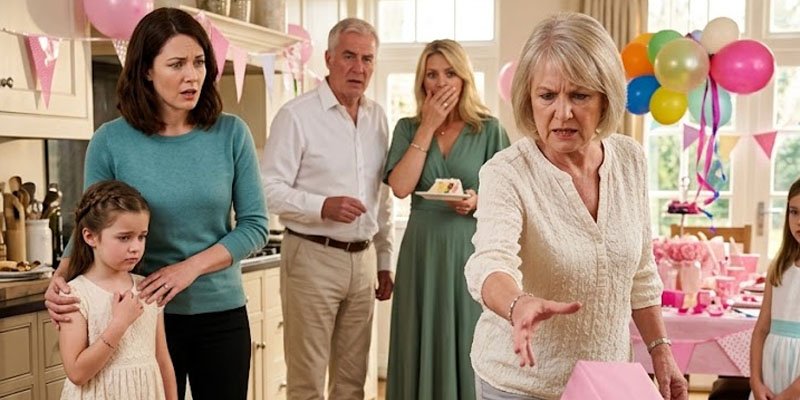
My mother looked straight into my nine-year-old daughter’s eyes, took the glittery pink birthday box from her hands, and threw it into the trash can in my kitchen.
Then she casually brushed her fingers together.
“It’s the old woman’s garbage.”
She said it with such ease that nobody reacted for a moment.
Then I looked at my daughter’s face.
And something in me finally broke.
At the time, I had no idea that the glittery pink box contained $194,000, paperwork pointing to identity misuse, and a secret my family had concealed for years.
By the next afternoon, two police officers would be standing beside me at a bank.
And the person I had suspected first would turn out not to be the person who had disappointed me the most.
Ruby’s ninth birthday had started out wonderfully.
Pink balloons hovered near the ceiling. Wrapping paper covered half the living room. Kids raced up and down the hallway with the kind of endless energy that only birthday cake and sugar could produce.
Ruby had been awake since six that morning.
“Can I open one present before everyone arrives?”
“No.”
“One tiny one?”
“No.”
“What about one that looks emotionally urgent?”
I laughed.
“You’re nine. Nothing looks emotionally urgent.”
She grinned.
That was Ruby.
Naturally funny.
Kind.
The kind of child who would apologize if someone accidentally stepped on her foot.
By two o’clock that afternoon, the house was full.
My sister Rebecca came with her daughter, Isabella. My parents arrived twenty minutes later.
My father hugged Ruby, handed her an envelope, and then quietly took a seat in the corner.
My mother entered the way she usually did—as if the entire celebration had been waiting for its supervisor.
She moved the cake.
Straightened the plates.
Complained that the lemonade was too sweet.
Then she called Isabella over and praised her dress.
Ruby was standing only three feet away.
As usual, I noticed.
For years, I had tried convincing myself that I was imagining the difference.
Isabella always got the first compliment.
The nicer chair. The extra gift. The automatic invitation.
Ruby received enough affection that nobody could fairly accuse my mother of being openly cruel.
Still, somehow, she always got slightly less.
Less excitement. Less patience. Less warmth.
It was easy enough to dismiss.
And obvious enough to hurt.
Then the doorbell rang.
A delivery driver stood outside holding a package.
Ruby’s name was written across the top by hand.
I knew the handwriting immediately.
My grandmother’s.
My father’s mother was ninety-one, and she still wrote every name with care, as though putting someone’s name on paper was an act of respect itself.
“Oh,” I said. “This is from Great-Grandma.”
Ruby nearly bounced across the room.
“Can I open it?”
“Of course.”
My grandmother lived forty minutes away and rarely came to crowded parties anymore because they exhausted her.
But she never forgot a birthday.
Ruby opened the shipping box.
Inside was a glittery pink treasure box.
It looked handmade.
Ruby carefully lifted it.
“Oh my gosh.”
She smiled.
“Mine.”
That was when my mother moved.
Fast.
Far too fast.
“No, no.”
Ruby looked up.
My mother stepped closer.
“You shouldn’t touch that.”
The room wasn’t completely quiet yet, but I could sense the mood changing.
“What?” I asked.
Mom reached toward Ruby.
“It’s probably junk.”
Ruby hugged the box against her chest.
“But Great-Grandma sent it.”
“She sends strange things.”
My mother’s voice was still calm.
Practical.
It was the same voice she had used throughout my childhood whenever she wanted control to sound like nothing more than ordinary common sense.
“She’s ninety-one,” Mom continued. “She doesn’t always know what she’s sending anymore. It could be dirty. There might be something unsafe inside.”
Unsafe.
A glittery pink box sent by a ninety-one-year-old woman.
“Mom,” I said.
But she had already taken it from Ruby’s hands.
Then she turned, walked into my kitchen, lifted the trash lid, and threw the box inside.
Not recycling. Not an empty garbage can.
The trash. Used napkins.
Paper plates smeared with frosting.
Half-eaten pizza.
“It’s the old woman’s garbage.”
The lid snapped shut.
Ruby’s face fell.
She didn’t burst into tears.
That might actually have been easier.
Instead, she only looked at me.
Confused.
As though she were trying to figure out what rule she had somehow broken without realizing it.
The adults stopped speaking.
Rebecca watched us.
Isabella looked toward the trash.
And my father did what he had done for much of my childhood.
He looked away.
I stepped between my mother and Ruby.
“Sweetheart, go show your friends the bracelet Aunt Melissa gave you.”
Ruby didn’t move.
“Go ahead.”
Eventually, she walked away.
I waited until she was far enough away not to hear.
Then I faced my mother.
“Leave.”
She blinked.
“What?”
“You heard me.”
Rebecca shifted uncomfortably.
“Come on. Don’t ruin Ruby’s birthday.”
I looked at her.
“I’m not the one who threw her birthday present in the garbage.”
My mother laughed.
That laugh.
I knew it better than I knew my own reflection.
Whenever I questioned her, I was difficult. Whenever I resisted, I was dramatic. Whenever she took control of something that belonged to me, she called it helping.
“You’re asking your mother to leave over garbage?”
“No. I’m asking you to leave because you em.bar.ras.sed my daughter in her own home.”
Her expression became tense.
For a brief second, something unexpected appeared on her face.
Not anger.
Concern.
Then it v@nished.
“Fine.”
She picked up her purse.
My father stood.
Of course he did.
Before leaving, Mom looked once toward the kitchen trash.
I noticed that too.
But I still didn’t understand why.
That night, after everyone had gone home, Ruby sat cross-legged on her bed.
“Mom?”
“Yeah?”
“Does Great-Grandma not like me?”
My chest tightened.
“Why would you think that?”
“Because Grandma said her present was garbage.”
I sat beside her.
“Great-Grandma loves you very much.”
“Then why did Grandma throw it away?”
There are things adults understand that children should never have to carry.
I couldn’t tell my nine-year-old that sometimes grown-ups let old resentments spill onto children who had nothing to do with creating them.
So I kissed her forehead.
“I’m going to figure it out.”
After Ruby fell asleep, I went downstairs.
The house felt strangely quiet.
I opened the trash.
The pink box was still there.
I pulled it out, wiped frosting from one corner, and carried it to the table.
Then I opened it.
There was no toy inside.
No necklace. No birthday card.
There was a booklet.
Bank documents.
I unfolded the first page.
Ruby’s complete legal name was printed across the top.
My smile v@nished.
I turned to another page.
Account numbers. Investment language. Beneficiary information.
I understood almost none of it.
But suddenly I remembered my mother’s face when Ruby first opened the package.
She hadn’t looked disgusted, confused, or worried.
I barely slept.
The next morning, after dropping Ruby at school, I drove to the bank named in the paperwork.
I went to the counter.
“I found this inside something my grandmother sent to my daughter. Can someone tell me what it is?”
The teller gave me a professional smile.
“Certainly.”
She opened the booklet.
Typed something into the computer.
Then her expression changed.
Slightly.
But I noticed.
“May I see some identification?”
I handed her my driver’s license.
She examined it.
Then looked back at me.
“I’ll be right back.”
She disappeared through a door.
Five minutes went by.
Then ten.
Another employee came over.
They spoke quietly.
A manager appeared.
I sat there gripping my purse tightly in both hands.
Nobody seemed willing to look directly at me.
Then the front doors opened.
Two police officers walked inside.
They looked around the room before coming straight toward me, and my heartbeat aaccelerate.
“Ma’am, could we see some identification?”
“I already gave them my ID—what’s happening?”
One officer sat across from me.
“Where did you get these documents?”
“They were inside my daughter’s birthday present.”
He paused.
I swallowed.
“My mother threw them in the trash.”
Even saying it aloud sounded impossible.
Neither officer reacted.
“Has anyone recently asked you for your Social Security number?”
“No.”
“Copies of your identification?”
“No.”
“Would your parents have access to older financial documents that belong to you?”
I hesitated.
“Yes.”
The answer came more easily than I expected.
Because my mother had always handled paperwork.
When I was little, Grandma sent birthday cards with cash inside.
Mom opened them.
“We’ll keep it safe.”
Bank paperwork?
Mom took care of it.
Tax documents?
Mom kept copies.
Important mail?
Mom organized it.
Rebecca learned to sit beside her.
Take notes.
Write down account information.
Remember confirmation numbers.
Rebecca became the daughter who knew how my mother’s entire system worked.
I became the daughter who learned that asking fewer questions was easier.
The officer exchanged a glance with his partner.
“We’re investigating possible misuse of your identity.”
My mouth went dry.
“Against me?”
“Using information connected to your identity.”
After I gave my statement, the officers left.
The bank manager then escorted me into a private office.
He placed the booklet between us on the desk.
“This account is a 529 education savings plan.”
I stared at him.
“It was established by your grandmother for Ruby.”
“I never knew about it.”
He nodded.
“The current balance is approximately $194,000.”
I actually laughed.
Not because there was anything funny.
Sometimes the brain responds incorrectly when reality becomes too overwhelming all at once.
“One hundred and ninety-four thousand?”
“Yes.”
“For my daughter?”
“Yes.”
My eyes filled with tears.
College.
Graduate school.
A future without crushing debt.
My ninety-one-year-old grandmother had quietly built a future for Ruby.
Then the manager’s face became serious.
“There’s another concern.”
He pushed several printed pages toward me.
“There have been recent attempts to make changes to this account.”
I examined the page.
Failed verification. Denied access. Unapproved request.
Then I saw it.
ATTEMPTED BENEFICIARY CHANGE.
“What does that mean?”
“Someone attempted to replace Ruby as the beneficiary.”
My entire body went cold.
“With whom?”
He pointed.
I followed the line.
The proposed new beneficiary was clearly listed.
ISABELLA.
My sister’s daughter.
For several seconds, I couldn’t hear anything.
Isabella.
The granddaughter my mother had always favored.
Someone had tried to take nearly two hundred thousand dollars from Ruby’s future and redirect it to Isabella.
Suddenly, the glittery box sitting in my trash no longer felt like an insult.
It felt like evidence.
I drove straight to Grandma’s house.
She answered the door in a blue cardigan.
The moment she saw my face, she said,
“You opened the box.”
I stopped.
“You knew?”
“Come inside.”
“Grandma, somebody tried to remove Ruby from that account.”
“I know.”
“You know?”
She closed the door.
Then she slowly walked toward her study.
“I’ve known someone has been trying for months.”
She unlocked the bottom drawer of an old wooden desk.
Inside was a thick folder.
My mother’s name was written on the front.
“Sit down.”
I remained standing.
“What is that?”
“Something I should have shown you years ago.”
Inside were bank letters.
Copies of checks. Withdrawal records. Old birthday cards.
Documents reaching back decades.
Grandma pulled out a yellowed statement.
“When you were seventeen, your grandfather and I sent eighteen thousand dollars for your first year of college.”
I stared at her.
“No, you didn’t.”
“Yes.”
“My parents told me you couldn’t help.”
Grandma’s expression hardened.
“We helped.”
My skin prickled.
“Where did the money go?”
“I asked your mother that very question.”
Another record. Another transfer. Another birthday check.
Thousands of dollars I had never known existed.
“I confronted her years ago,” Grandma said. “She told me the money had been used for family expenses.”
My knees felt weak.
“How much?”
“Over the years?”
She hesitated.
“Enough that eventually I stopped sending money through your parents.”
Then someone pounded on the front door.
My mother.
She entered before Grandma could stop her.
“What have you done?”
She wasn’t looking at Grandma. Her eyes were fixed on me.
“You went to the bank?”
“Yes.”
The color drained from her face.
“You had no business—”
“No business?”
I raised the statement.
“Someone tried to redirect $194,000 that was intended for my daughter.”
“It isn’t taking anything if the money stays within the family.”
Silence.
Grandma stared at her.
I felt something inside me tear open.
“So you did it.”
Mom’s jaw tightened.
“I never said that.”
“You threw away the documents.”
“I was trying to keep this family from falling apart.”
“You mean keeping me from learning the truth.”
“I mean stopping your grandmother from choosing favorites.”
Grandma stood.
“I created accounts for both girls.”
My mother froze.
So did I.
“What?”
Grandma looked directly at her.
“Ruby has an education account.”
Then she looked at me.
“So does Isabella.”
I couldn’t speak.
Mom blinked.
Grandma continued.
“Same contribution schedule. Same structure.”
“How much does Isabella have?” I whispered.
“Just over one hundred ninety thousand.”
The room seemed to move beneath my feet.
Isabella already had a college fund.
Almost the same amount as Ruby.
There had never been any reason to redirect Ruby’s money.
Unless someone wanted access to both accounts.
Mom backed toward the wall.
“I didn’t know.”
Grandma’s voice became almost icy.
“No. You didn’t.”
Something about the way she said those words disturbed me.
Then she turned toward me.
“The attempted change didn’t come from your mother’s computer.”
My heartbeat seemed to stop.
“What?”
Grandma opened another folder.
“I asked the bank to examine the first unsuccessful request six weeks ago.”
“Six weeks?”
“The request contained information from documents your mother kept. Your Social Security number. An older signature. Ruby’s date of birth.”
I looked toward Mom.
She quickly shook her head.
“I didn’t do that.”
I didn’t believe her.
Then Grandma said,
“I don’t believe she did either.”
The front door opened again.
Rebecca walked in.
She looked pale.
“Mom called me.”
Nobody spoke.
Her eyes moved toward the paperwork.
Then toward me.
And for the first time since we were children, I remembered something I hadn’t thought about in years.
Rebecca sitting beside Mom at the kitchen table.
Watching her fill out forms. Writing down passwords. Remembering confirmation numbers.
Learning the entire system.
My stomach tightened.
“Rebecca?”
She began crying before I could finish.
That was my answer.
“No.”
She shook her head.
“It wasn’t supposed to happen this way.”
Mom stared at her.
“What did you do?”
Rebecca covered her face.
“I thought Isabella had nothing.”
Grandma’s voice became sharp.
“So you tried to redirect Ruby’s account?”
“You always favored her!”
“I treated those girls equally.”
“Nobody told me!”
I stepped closer to my sister.
“You used my personal information?”
Rebecca cried harder.
“My husband lost his job. We’re buried in debt. Isabella’s school expenses are taking everything. Mom kept saying Grandma had probably put all the money aside for Ruby because she always cared about you more—”
“I never told you to take it!” Mom shouted.
Rebecca turned toward her.
“You gave me the paperwork!”
My mother went completely still.
There it was.
Not innocence. Not outright responsibility.
Something more complicated.
She had helped make the opportunity possible.
Mom whispered,
“I thought you were checking.”
“You gave me Erin’s old tax documents. You gave me copies of her identification.”
My mother stared at the floor.
And suddenly, everything became clear.
She hadn’t actually submitted the beneficiary request.
But when Rebecca panicked and told her that Grandma had sent something directly to Ruby…
Mom realized what the package might expose.
That was why she grabbed the box.
That was why she threw it among the food and garbage. That was why she kept glancing toward the trash before leaving my house.
My mother hadn’t started the account change.
She had tried to conceal what happened afterward.
For the daughter she always protected.
Again.
I laughed quietly.
Rebecca looked at me.
“What?”
“You were right.”
“About what?”
“Mom always chose you.”
Her face crumpled.
I continued.
“And now she chose you over my daughter.”
Mom moved toward me.
“Erin—”
“Don’t.”
One word.
She stopped.
Then Grandma said something none of us expected.
“I knew Rebecca would try again.”
We all turned toward her.
Rebecca wiped her face.
“What?”
Grandma calmly sat down.
“The account could never actually be changed.”
Silence.
“I disabled online beneficiary-change privileges three months ago.”
My mother stared at her.
Grandma continued.
“The bank had written instructions. Any request involving Ruby’s account had to be made in person, with me present.”
Rebecca looked confused.
“Then why did the website let me submit it?”
Grandma’s expression hardened.
“Because I asked them to leave the request portal open.”
My breath caught.
Rebecca’s mouth opened.
Grandma pointed toward the glittery pink box sitting on the desk.
“That package wasn’t simply a birthday gift.”
A chill ran through me.
“Grandma…”
“The booklet was genuine. The money is real. But I sent those documents because I needed to find out who would try to stop you from seeing them.”
Nobody moved.
Grandma had suspected that someone was attempting to access Ruby’s account.
So she had created a test.
Not to take anything from us. Not to unnecessarily involve Ruby. But to expose the person responsible.
She looked toward Rebecca.
“You exposed yourself.”
Rebecca sank into a chair.
Then Grandma turned toward my mother.
“And so did you.”
A knock sounded at the front door.
Two police officers stood outside.
The same officers from the bank.
Rebecca stared at Grandma in disbelief.
“You called them?”
“No,” Grandma said.
Then she looked at me.
“The bank did.”
The officers entered.
They already had the electronic access records.
They already had the submitted signature.
They already had the IP information.
According to one officer, the failed beneficiary request had been submitted through Rebecca’s home internet connection.
Rebecca finally stopped denying what she had done.
My mother begged the officers not to take her away.
Not herself.
Rebecca.
Of course.
Even then.
Rebecca faced charges related to attempted identity misuse and financial misconduct.
My mother was not taken into custody that afternoon, but investigators later examined the historical records Grandma had saved.
That investigation uncovered something else.
Over twenty-seven years, my mother had deposited or redirected more than $63,000 that my grandparents had originally intended for me.
Some of it had been used for household expenses. Some had covered Rebecca’s expenses. Some could no longer be traced clearly.
My father admitted that he had known.
“Why didn’t you ever tell me?” I asked him.
He lowered his eyes.
“I didn’t want to lose the family.”
I gave a bitter laugh.
“You lost it by staying silent.”
That was the last meaningful conversation we had for a long time.
Three months later, Grandma invited Ruby and me to dinner.
Ruby brought her a drawing.
Three stick figures stood beneath a giant pink heart.
Ruby.
Me.
Great-Grandma.
Grandma studied it for a long moment.
Then she hugged Ruby.
After dessert, she asked me to come into the study.
I immediately noticed something on the desk.
Another glittery pink box.
I groaned.
“Please tell me this one doesn’t involve the police.”
Grandma laughed.
“No police.”
She handed it to me.
Inside were two envelopes.
One said RUBY.
The other said ISABELLA.
I looked at her.
“What are these?”
“Updated trust documents.”
My stomach tightened.
“Grandma—”
“Read them.”
The trust would eventually split her remaining estate equally between the two girls.
Not me. Not Rebecca. Not my parents.
Ruby and Isabella.
I stared at her.
“After everything Rebecca did?”
Grandma nodded.
“Isabella didn’t do it.”
That sentence hit me harder than anything else.
Isabella was ten.
A child.
She had never asked her mother to interfere with Ruby’s account. She had never asked Grandma to favor her. She had never created this conflict.
Neither had Ruby.
Grandma reached across the desk.
“Adults have been turning those girls into symbols in our disagreements for years. I refuse to punish one child for the choices her mother made.”
My eyes burned.
Then Grandma gave me one final piece of paper.
It was handwritten.
I recognized those careful letters immediately.
There is enough hurt in families that gets carried from one generation into the next. Someone has to decide it ends with them.
I read it twice.
Then I started crying.
Not because of the money.
Not because of Rebecca.
Not even because of my mother.
Because suddenly I understood what Grandma had really placed inside that glittery pink box for Ruby.
It wasn’t $194,000. It wasn’t paperwork. It wasn’t revenge.
It was an escape.
A chance for my daughter to grow up without believing love was something she had to compete for.
A chance for Isabella to understand that she didn’t have to repeat her mother’s decisions. A chance for me to stop repeating mine.
One year later, Ruby turned ten.
We kept the celebration small.
Grandma came this time.
She sat beneath a blanket on our patio while Ruby opened her gifts.
Isabella came too.
Rebecca was allowed limited supervised contact with her daughter by then, but Isabella had spent much of the previous year living with her father.
Somehow, the girls had remained friends through everything.
Sometimes children understand lessons adults have difficulty learning.
Toward the end of the afternoon, Isabella handed Ruby a small package.
Ruby opened it.
Inside was a pink, glitter-covered jewelry box.
The adults fell silent.
I stared at it.
Isabella looked nervous.
“I made it.”
Ruby smiled.
“It’s beautiful.”
Then she opened the lid.
Inside were two friendship bracelets.
One said RUBY.
The other said ISABELLA.
Ruby immediately put hers on.
Then she fastened Isabella’s around her wrist.
Across the patio, Grandma started crying.
So did I.
For nearly my entire life, I had believed our family’s story was about who received more.
More attention. More approval. More money. More love.
My mother had lived by that belief.
Rebecca had absorbed it.
And I had spent years noticing every difference because I was afraid Ruby would inherit the same pa!n.
But watching those two girls exchange matching bracelets, I finally understood something.
The true inheritance wasn’t money.
It was the pattern.
And patterns didn’t have to continue.
My grandmother reached over and took my hand.
“You know the funniest part?” she whispered.
“What?”
She smiled.
“I never put the banking documents directly inside the box.”
I stared at her.
“What are you talking about?”
“The paperwork was beneath a false bottom.”
My mouth dropped open.
“There was a false bottom?”
She nodded toward Ruby’s original glittery box, which I had kept on a bookshelf.
“Go look.”
I brought it over.
Grandma showed me a tiny seam beneath the velvet lining.
I lifted it.
Beneath it was a sealed envelope I had never seen before.
My name was written across it.
My hands shook as I opened it.
Inside was one photograph.
My mother, Rebecca, and me.
I must have been around six.
Rebecca was eight.
Mom was young.
The three of us were laughing.
On the back of the photograph was a note written in Grandma’s careful handwriting.
Erin, if you ever discover this, it means something has gone terribly wrong. But before anger convinces you that people are only the worst choices they have made, remember that your mother was once a frightened young girl too. You may need boundaries. You may need distance. You may even decide that walking away is necessary. But never allow what she became to determine who you become.
I could barely breathe.
Grandma had known.
Not every detail. Not exactly how things would happen.
But somehow, she had understood enough to hide one final message where greed would never think to look.
Beneath the money. Beneath the paperwork. Beneath the evidence.
I looked through the patio doors.
Ruby and Isabella were laughing together.
Two girls whose mothers had inherited an old family conflict.
Two girls who had no idea they had just ended it.
I carefully folded Grandma’s note.
Then I placed it back inside the box.
For the first time in my life, I no longer felt like the daughter who had always received less.
I didn’t feel like Rebecca’s sister. I didn’t feel disappointed.
I felt like Ruby’s mother.
And that was enough.
Because my mother had thrown a glittery pink box into the garbage believing she was concealing a secret.
Instead, she had accidentally revealed every secret our family had spent decades burying.
And in the end, the person who changed everything wasn’t the banker.
It wasn’t the police. It wasn’t even my grandmother.
It was a nine-year-old girl who had looked at me through tear-filled eyes and asked one painfully simple question:
“Does Great-Grandma not like me?”
That question made me open the trash.
Opening the trash brought me back to the box.
The box led me to the bank.
The bank led me toward the truth.
And the truth gave two little girls something no amount of money could ever buy.
The chance to inherit a future without inheriting our resentment.