“Mom! LOOK!”
Ethan almost knocked his drink over as he pointed toward the massive screen hanging above the field.
Our 10-year-old son had one simple final wish: to attend one real football game with Mom and Dad.
I looked up.
There we were.
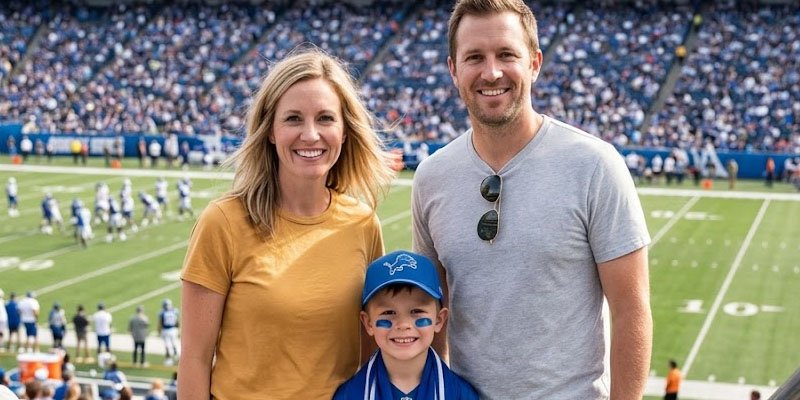
My husband, Chris, was seated on one side of Ethan while I sat on the other. Ethan was squeezed between us in his blue team jersey, smiling so broadly that, for one beautiful moment, he looked like every other 10-year-old boy in the stadium.
I waved.
Chris lifted both hands.
Ethan yelled, “WE’RE FAMOUS!”
The people around us laughed and waved toward the camera.
I had already taken more pictures that afternoon than I could possibly count, but once again, I reached for my phone.
Then the stadium announcer spoke.
“Ethan, we’re so happy to have you here with us today.”
My son stopped bouncing.
His face appeared across the giant screen.
The announcer went on, “But there’s something you don’t know about this trip.”
I looked over at Chris.
He appeared just as bewildered as I felt.
“All three of you,” the announcer said, “please turn around and look behind you.”
Everyone sitting nearby began turning in their seats.
Ethan squeezed my hand.
“What is it, Mom?”
“I don’t know, Captain.”
We turned.
A man was making his way down the stadium steps.
Chris froze.
The color disappeared from his face.
“Leo?”
Behind Leo was Ray from the hospital, carrying Ethan’s battered plastic tabletop football game under one arm.
A nurse from Ethan’s floor followed, along with Cody and his mother.
Ethan’s jaw dropped.
“No way.”
I watched him closely. Whatever he had expected to find when the announcer told us to turn around, it clearly wasn’t this.
Then Ray lifted the battered tabletop game, and Ethan began laughing.
Three months earlier, football had still been an ordinary part of our household.
Sunday afternoons meant Chris shouting at the television, Ethan correcting him, and me pretending I wasn’t interested while complaining even louder than both of them whenever I thought a referee had missed a call.
“Mom,” Ethan once said to me, laughing, “you don’t even know the rules.”
“I know cheating when I see it.”
Chris almost choked on his chips.
Then Ethan’s cancer stopped responding to treatment.
One afternoon, his doctor asked Chris and me to step outside his hospital room.
I remember staring at the tiny cartoon football Ethan had taped to his door while the doctor spoke.
“I’m truly sorry,” he said. “The treatment isn’t working the way we had hoped.”
Chris asked every question.
Was there another trial?
Another medication?
Another hospital?
But I couldn’t get past one sentence.
“We may be looking at much less time than we’d hoped.”
When we returned to Ethan’s room, a football game was playing on the television.
Chris sat down beside him.
Their team scored.
For one second, Chris sprang out of his chair.
“YES!”
Ethan immediately burst into laughter.
Chris quickly leaned toward him.
“You okay, Captain?”
Ethan’s smile faded a little.
“Dad, I laughed.”
“I know.”
“I’m allowed.”
Chris leaned back.
“Of course you are.”
I lifted my phone.
Click.
Ethan looked at me.
“What?”
“Nothing,” I said.
But from that moment on, almost everything became something I felt I had to preserve.
Ethan eating cereal.
Sleeping with one sock on.
The disgusted expression he made at hospital gelatin.
The hours he spent debating football statistics with Chris.
Photos.
Short videos.
Voice recordings.
I told myself I was preserving our life.
I didn’t realize Ethan had noticed.
A few days later, a woman from a wish organization visited his room.
She pulled a chair over.
“If you could do one really special thing, Ethan, anything at all, what would you choose?”
I expected him to name a famous player.
Maybe request a trip.
Something extravagant.
Ethan answered without hesitation.
“A football game!”
He named his favorite team.
Then added, “With Mom and Dad.”
Chris squeezed his shoulder.
“Obviously, Captain.”
The woman laughed.
She worked with Ethan’s medical team to arrange accessible seating, transportation, and everything else necessary to make the day memorable.
We assumed we understood the entire plan.
Apparently, Ethan had made one additional request while Chris and I were out of the room.
He simply hadn’t expected anyone to take him literally.
On game day, I understood why he had chosen the stadium the moment we walked inside.
Ethan stopped at the entrance.
Thousands of voices echoed through the concrete corridors.
Vendors shouted out.
Music thundered from the speakers.
Fans wearing jerseys streamed past us.
Ethan simply stood there.
Chris leaned closer.
“Too much, Captain?”
Ethan shook his head.
“It’s awesome, Dad.”
Then he saw the field.
For months, I had watched my son’s world become smaller and smaller, reduced to hospital rooms, waiting areas, medication schedules, and careful trips home.
Now there was green grass extending in every direction.
Real players.
Real helmets.
Real noise.
Ethan laughed when the crowd booed.
He shouted until his voice grew hoarse.
He ate half a pretzel and then stole three bites of Chris’s hot dog after insisting he wasn’t hungry.
I photographed everything.
At one point, Chris leaned toward him.
“You tired, Captain?”
“No, Dad.”
“Cold?”
“Nope.”
“Need water?”
“Dad…”
“What?”
“Watch the game.”
Chris laughed. “I am, buddy.”
Ethan pointed at him.
“No. You’re watching me watch it.”
Chris stopped smiling for a moment.
Then Ethan turned back toward the field as though he hadn’t said anything important.
I took another picture.
By halftime, Ethan was exhausted but refused to leave.
“Ten more minutes,” he kept bargaining.
“You said that 20 minutes ago,” Chris told him.
“That was a different ten.”
Then the camera found us.
The giant screen.
The announcement.
And Ray.
I knew Ray from the hospital.
He worked in facilities and always seemed to show up whenever Ethan needed a light fixed, a television reset, or somebody willing to argue about football.
Ethan called him “Coach Ray.”
Ray insisted his official title was “Commissioner.”
They had been arguing about it for months.
Ethan also had one ridiculous rule: anyone who entered his room wasn’t allowed to simply stand around and watch.
If you stayed near his table long enough, he would assign you a plastic player.
“Everybody plays,” he would say.
But I had absolutely no idea why Ray was carrying Ethan’s cheap plastic football game through a professional stadium.
Four more familiar faces followed behind him.
A nurse from Ethan’s floor.
A teenage patient named Cody.
Cody’s mother.
And Leo.
Chris saw Leo and looked away.
Months earlier, Leo’s son had been receiving treatment on the same floor.
One afternoon, their family received good news.
Very good news.
Leo laughed in the hallway.
Someone hugged him.
He began crying.
Chris had just come from a meeting where Ethan’s doctors had told us another treatment had failed.
As he walked past Leo, he snapped, “Could you celebrate somewhere else?”
The hallway became silent.
Leo apologized.
Chris regretted it almost immediately, but he never returned to make things right.
Ethan had witnessed the entire thing from his doorway.
Leo had seen him too.
The next afternoon, Leo stopped by Ethan’s room, challenged him to a game on the plastic football field, lost badly, and never once asked Ethan how he was doing.
Ethan liked him immediately.
Now Leo was walking down the stadium steps with everyone else.
Ethan whispered, “Dad, don’t be weird.”
Chris looked at him.
“I’m not weird.”
“You are sometimes.”
Despite everything happening around us, I laughed.
Ray reached our row and held up the tabletop game.
“Captain.”
Ethan groaned. “You snitched.”
“Commissioner,” Ray corrected.
“You cheat.”
“Unproven.”
The people around us laughed.
Ray placed the little football game across Ethan’s lap.
Then the stadium announcer spoke again.
“Ethan told our wish team that if this was going to be his football day, he wanted his hospital league to somehow be part of it too. What he didn’t know was that a few members of that league decided watching from home wasn’t good enough.”
People cheered.
Ethan covered his face.
“I’m never going back to the hospital.”
The nurse leaned toward him.
“You have an appointment Tuesday.”
“Cancel it.”
More laughter.
Then the announcer said, “Ethan has one rule for his league.”
Ray pointed toward Ethan.
Ethan shook his head vigorously.
“Don’t.”
Ray grinned.
The announcer finished anyway.
“Everybody plays.”
The nearby crowd applauded.
I smiled.
Then I looked at Ethan.
He wasn’t smiling anymore.
He was looking directly at me.
Soon, a stadium staff member came over and explained that Ethan could rest in a quieter family room nearby before deciding whether he wanted to return to our seats.
I welcomed the idea.
Ethan had already begun leaning against Chris.
We followed them inside.
After the stadium’s roar, the sudden silence felt strange.
Ray set the tabletop football game on a small table.
One plastic player immediately fell over.
“Cheap equipment,” Ray muttered.
“Bad coaching,” Ethan replied.
Cody laughed.
The adults stayed for another minute, but Ray seemed to understand something before I did.
He looked toward the door.
“Come on, people. Captain’s got a family meeting.”
Ethan’s head snapped up.
“I do?”
“You do now.”
Ray ushered everyone outside.
Leo was the last one out.
Chris looked at him.
For a moment, neither man said anything.
Then Leo gave a small nod and followed the others.
The door closed.
Now there were only the three of us.
Ethan sat on the couch with the tabletop game beside him.
Chris pulled a chair closer.
I sat on Ethan’s other side.
“Captain,” I said, “what exactly did you tell Ray?”
“Nothing, Mom.”
Chris pointed toward the door.
“Nothing? Ray traveled all the way here carrying a dozen plastic football players and one goalpost that hasn’t stood straight since February.”
“They’re players, Dad.”
“Fine. Athletes.”
Ethan tried not to smile.
I waited.
He picked at a loose thread on his jersey.
Finally, I asked, “Why was it so important that they be part of today?”
He shrugged. “Because…”
“Ethan.”
He looked into my eyes.
Then his gaze moved toward the phone that was still resting in my hand.
He said softly, “They’re people from the hospital who still act normal around me.”
Chris blinked. “Weird?”
Ethan immediately looked apologetic.
“I didn’t mean bad weird, Dad.”
“What kind of weird, Captain?” I asked.
He stared down at the plastic field.
“Dad pauses games to check if I’m tired.”
Chris began to respond.
Ethan continued.
“And you take pictures when I’m eating cereal, Mom.”
I looked down at my phone.
Ethan added, “You saved that hospital bracelet from when I threw up on your shoe.”
“That was a memorable evening, sweetie.”
“Mom.”
“Sorry.”
He rubbed his thumb across the plastic scoreboard.
Then he looked at Chris.
“Dad used to yell at football.”
“I still yell at football, buddy,” Chris interrupted.
“No, Dad… now you yell and then look at me.”
Chris went quiet.
Ethan turned toward me.
“And Mom used to yell at referees.”
“Bad referees.”
“All referees.”
I almost laughed.
Then Ethan said, “That’s why I picked football.”
The room became completely still.
Chris leaned forward.
“What do you mean?”
Ethan’s face tightened in frustration, as if we were making him explain something that should have been obvious.
“I wanted you guys to have fun with me.”
He wiped his nose with the back of his hand.
“Everybody keeps acting like everything has to be special now just because I’m going to die.”
I placed my phone facedown beside me.
Ethan looked at it.
Then he whispered the sentence I would remember differently for the rest of my life.
“Sometimes I just want stuff to be stuff.”
Chris stared at him for several seconds.
Then he reached over and covered our son’s hand with his.
“I’m sorry, Captain.”
Ethan shrugged, keeping his eyes fixed on the plastic field.
“I know you’re sad. I’m sad too.”
Chris nodded.
“I know. But you’re still here, Captain,” he said gently. “And I’ve been acting like my job is to watch every second instead of being in it with you.”
Ethan finally looked up.
“So you’re admitting I’m right?”
Chris blinked.
“Absolutely not.”
Ethan grinned.
“Too late.”
A knock came at the door.
Leo stood outside.
Chris hesitated before standing.
“How’s your son?” he asked.
Leo looked surprised.
“Home. Driving his mother crazy.”
Chris smiled. “Good.”
That was all.
Just one piece of good news Chris finally allowed himself to hear.
A few minutes later, I looked at Ethan.
“You ready to go home, Captain?”
He glanced through the glass toward the field.
I caught myself.
“What do you want?”
Ethan thought for a moment.
“Ten more minutes.”
Chris nodded. “Ten.”
We went back to our seats.
No cameras followed us.
No players came over.
Nobody handed Ethan a signed football.
The game simply carried on.
Exactly what he had wanted.
Chris complained about a terrible play.
Ethan told him he had no idea what he was talking about.
Then a referee threw a flag.
“Oh, COME ON!” I shouted.
Ethan burst into laughter.
“Mom, you don’t even know what happened!”
“I know injustice when I see it.”
My hand instinctively moved toward my phone.
I stopped.
Ethan noticed.
“You’re not taking one?”
“No.”
“Why?”
I looked at him. “I’m watching.”
He studied me for a moment, then nodded as though the answer made perfect sense.
Late in the fourth quarter, our team scored.
The stadium exploded.
Chris jumped to his feet.
Ethan grabbed his father’s arm with one hand and mine with the other, laughing so hard he could barely shout.
The tabletop football game slid sideways across his lap.
One tiny plastic player came loose and landed beneath my seat.
I saw it.
For once, I didn’t immediately lean down to pick it up.
Ethan was laughing.
Chris was yelling.
I was yelling too.
And the game was still going on.
Only after the cheering finally died down did Ethan look below.
“Mom! My player!”
I reached underneath the seat and handed it back.
Ethan snapped it into position.
“Everybody plays,” he said.
Then my Captain turned his attention toward the field once more.
So did we.