Mike Pence, Melania Trump, and the Quiet Power of Staying Outside the Spotlight
The room seemed to change the moment Mike Pence entered.
There was no campaign rally, no sea of signs, and no carefully choreographed presidential announcement. Instead, the setting was quieter and far more private—the kind of political gathering that can attract attention precisely because so much of what happens remains outside public view.
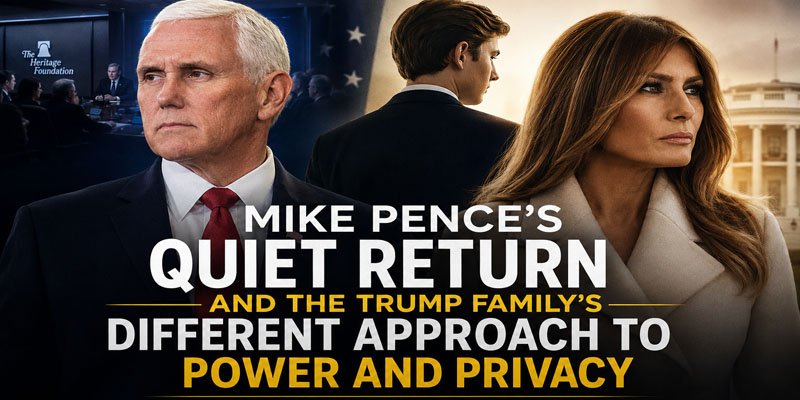
For Pence, whose political future has been the subject of years of speculation, appearances in influential conservative circles inevitably raise questions about what role he hopes to play next. After serving as vice president under Donald Trump and later emerging as one of the former president’s most prominent Republican critics, Pence occupies an unusual position in American conservative politics.
He remains deeply connected to the movement that helped carry him to the White House, yet his relationship with the Trump-dominated Republican Party has changed dramatically.
That makes every significant Pence appearance easy to interpret as something larger.
Is he simply settling into the role of an elder conservative statesman? Is he attempting to influence Republican policy from outside elected office? Or could he be laying the intellectual groundwork for another chapter in public life?
The most dramatic interpretations describe such activity as the beginning of a political comeback—or even something resembling a “shadow presidency.” But those descriptions belong in the realm of political speculation, not established fact.
What is clearer is that influence in Washington does not always require winning an election.
Think tanks, advocacy organizations, donors, policy experts, former officials, and conservative institutions can shape the ideas that eventually become campaign promises and government policy. For someone with Pence’s experience, operating within that ecosystem could offer a different kind of power: influence without the daily demands of a national campaign.
And that distinction matters.
American politics often encourages people to measure power by television appearances, poll numbers, campaign crowds, and social-media attention. Yet some of the most consequential political work takes place far away from cameras.
Pence may therefore represent one version of life after the White House—a former national leader attempting to remain relevant through ideas, institutions, and relationships rather than constant campaigning.
But another member of the extended Trump political story illustrates an almost opposite approach to public attention.
Melania Trump’s Different Approach to Power
While political observers spent years analyzing Donald Trump’s speeches, rallies, controversies, and public appearances, Melania Trump often maintained a noticeably different public profile.
That approach became particularly significant when it came to the couple’s son, Barron Trump.
From the beginning of Donald Trump’s presidency, Barron occupied an extraordinary position. He was growing up inside one of the most recognizable political families in the world while millions of strangers were curious about nearly every aspect of his life.
Yet compared with many members of famous political families, relatively little of his childhood unfolded publicly.
Melania repeatedly emphasized her role as a mother, and her approach appeared centered on giving her son as much normality and privacy as circumstances allowed. Cameras might have been unavoidable at major official moments, but constant access was not.
That created an unusual paradox.
The less the public saw of Barron, the more curiosity surrounded him.
Photographs generated headlines. Rare appearances sparked online discussion. Even ordinary milestones could become subjects of national interest simply because so little of his everyday life was available for public consumption.
But curiosity did not automatically become access.
For much of his childhood, Barron remained outside the relentless cycle of interviews, political commentary, and social-media exposure that surrounds many famous families.
That boundary carried a larger message.
Privacy Can Be a Form of Power
Modern culture often treats visibility as proof of importance.
Politicians compete for airtime. Celebrities document their lives online. Influencers turn private moments into content. Public figures are frequently encouraged to reveal more because attention itself has become a valuable currency.
Barron’s upbringing presented a different possibility.
Sometimes the ability to say nothing, appear rarely, and keep parts of life private can be its own form of control.
For a child born into extraordinary fame, privacy is not simply about avoiding cameras. It can mean having room to develop interests and opinions without every decision immediately becoming part of someone else’s political narrative.
That distinction becomes increasingly important as Barron moves through adulthood.
He may eventually choose a highly public life. He may become involved in business, politics, philanthropy, or something entirely different. He may also decide that public attention is something he would rather keep at a distance.
The important point is that adulthood gives him greater ownership over that decision.
Two Very Different Relationships With the Spotlight
At first glance, Mike Pence and Barron Trump appear to belong to completely different stories.
Pence spent decades deliberately pursuing public office. Barron became internationally recognizable largely because of the family into which he was born.
Yet their stories intersect around a surprisingly similar question:
Does a person need to remain constantly visible to remain significant?
For Pence, the next stage of influence could potentially happen through policy organizations, speeches, relationships, and conservative institutions rather than another presidential campaign.
For Barron, significance may come from having the freedom to determine whether he wants public influence at all.
Melania Trump’s approach to her son’s childhood adds another dimension. In an environment where political families can easily become extensions of a campaign brand, maintaining boundaries can itself become a deliberate choice.
None of this guarantees what happens next.
Pence’s political influence will depend on the institutions, ideas, and alliances he chooses to pursue. Barron’s future will depend primarily on decisions that are ultimately his own.
But both stories challenge one of the assumptions at the center of modern public life: that power must always announce itself.
Sometimes influence operates behind institutional doors rather than from a campaign stage.
Sometimes protection means refusing another photograph or interview.
And sometimes the most meaningful freedom a famous person can possess is the ability to decide when—or whether—to step into the spotlight.
For Mike Pence, the quieter rooms of conservative politics may offer a new arena for influence.
For Barron Trump, years of carefully guarded privacy have preserved something arguably even more valuable: the opportunity to decide for himself what kind of life comes next.
In an age obsessed with visibility, both stories offer the same intriguing reminder.
Being seen everywhere is not the same thing as having power—and sometimes the ability to remain unseen is power itself.