
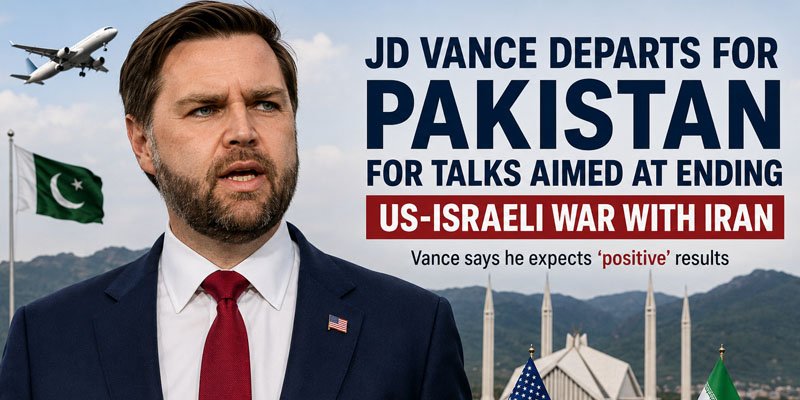
JD Vance Departs for Pakistan for Talks Aimed at Ending US-Israeli War with Iran
ISLAMABAD — United States Vice President JD Vance has departed for Pakistan to take part in diplomatic efforts aimed at bringing an end to the ongoing US-Israeli war with Iran, expressing optimism that the discussions could produce a positive outcome.
Vance spoke briefly to reporters on Friday before boarding a plane for Islamabad, where talks involving Iran were expected to take place on Saturday.
The visit comes as diplomatic efforts intensify to find a way to halt the conflict and prevent further escalation in the region. Pakistan is hosting the discussions as part of broader international efforts to encourage dialogue and explore a possible path towards ending hostilities.
Speaking to reporters before his departure, Vance said he was hopeful about the upcoming discussions and expected the talks to make progress.
The US vice president’s trip to Pakistan is being closely watched because of Islamabad’s role in facilitating diplomatic contacts between the United States and Iran. The talks could provide an opportunity for the two sides to address key disagreements and explore conditions for ending the fighting.
Pakistan Hosts Diplomatic Efforts
Pakistan has sought to position itself as a venue for dialogue amid growing tensions in the Middle East. Islamabad has maintained diplomatic contacts with both Washington and Tehran, giving it a potential role in efforts to reduce tensions.
The planned discussions are expected to focus on ways to stop the conflict and establish conditions that could lead to a broader diplomatic settlement.
For Pakistan, hosting the talks also represents a significant diplomatic undertaking as the country seeks to support regional stability and prevent the conflict from spreading further.
Vance Signals Optimism
Vance’s comments before leaving the United States suggested that Washington remains open to a diplomatic solution.
His expectation of “positive” results from the talks comes as international pressure grows for an end to the fighting. Any breakthrough would depend on the willingness of the parties involved to address outstanding disputes and agree on steps to reduce military confrontation.
The US delegation’s presence in Islamabad is therefore expected to attract significant attention as diplomats assess whether the talks can lead to concrete progress.
Regional and International Stakes
The conflict has raised concerns about wider instability across the Middle East and beyond. A prolonged confrontation could increase regional tensions and create additional economic and security challenges.
Diplomatic efforts in Islamabad could therefore have implications extending beyond the immediate participants. A successful dialogue process could help reduce the risk of further escalation, while failure to reach an understanding could leave the region facing continued uncertainty.
Vance’s visit comes at a critical moment for diplomatic efforts, with governments watching closely for signs that negotiations could produce a ceasefire or pave the way for broader peace talks.
The discussions in Pakistan are expected to provide an important test of whether diplomacy can help bring the conflict to an end.