It began with one unforgettable moment at my grandson’s rehearsal dinner: his fiancée slapped me in front of the entire family. What followed was neither loud nor dramatic, yet it changed our family forever. I quietly made a choice nobody saw coming and removed them all from every event I had arranged.
My name is Margaret Hale, and at sixty-eight, I had learned that the biggest family disasters often start with something so minor that everyone feels justified in overlooking it.
That Friday evening in Charlotte, North Carolina, it started with a place card.
My grandson Ethan was marrying Lauren Whitmore the following afternoon. I had paid for the rehearsal dinner in a private room at a downtown steakhouse, covered the florist’s deposit, and given Ethan ten thousand dollars six months earlier so he and Lauren would not enter married life overwhelmed by credit-card debt.
I wasn’t looking for appreciation.
I was expecting basic respect.
Lauren’s mother, Denise, had spent most of the evening moving people around as though she were organizing a corporate conference. When she shifted my place card from Ethan’s table to the far end beside two distant cousins, I picked it up and returned it to its original place.
“Margaret,” Denise said firmly, “Lauren has a vision.”
“So do I,” I replied. “Mine includes sitting with my grandson at the dinner I paid for.”
Lauren heard me.
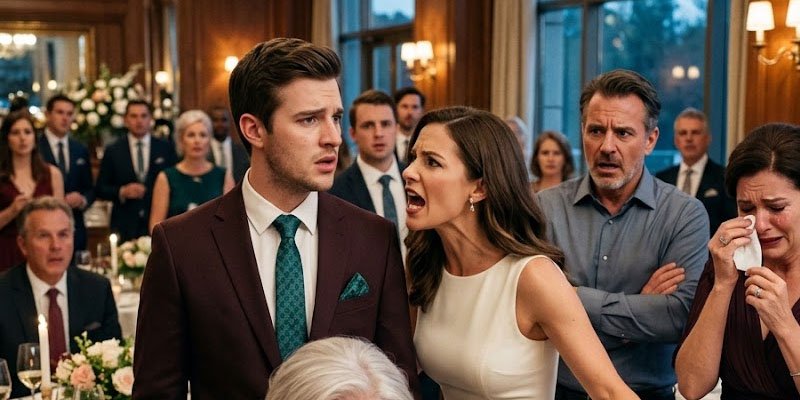
She came across the room in a fitted ivory dress, her cheeks flushed and her jaw clenched.
“You always do this.”
“Do what?”
“Make everything about money.”
I lowered my voice.
“I didn’t mention money until your mother moved me away from my own family’s table.”
Ethan was standing only a few feet away, saying nothing.
Lauren stepped closer.
“You think because you helped him, you own him.”
“No,” I said. “But I do believe I’m entitled to sit beside my grandson the night before his wedding.”
Then she slapped me.
The room immediately went silent.
It wasn’t an accident or some dramatic gesture. Her palm hit my left cheek hard enough to turn my head and loosen one of my earrings.
Ethan whispered:
“Lauren…”
But he didn’t move toward me.
That was the moment I realized the problem was far greater than what she had done with her hand.
I picked up my purse, located the restaurant manager, and paid the rest of the bill.
Then I came back.
“The dinner is over,” I said.
Denise stared at me.
“Excuse me?”
“I am withdrawing from tomorrow’s wedding and every family event associated with it. I am also uninviting anyone who thinks striking me is something that requires discussion, context, or compromise from my home, my holidays, and the anniversary trip I booked for this family in October.”
My son Daniel stood up.
“Mom, don’t do this tonight.”
“Tonight is exactly when I’m doing it.”
Ethan finally looked at me.
“Grandma, please.”
I held his eyes.
“You had one second to decide what kind of man you wanted to be. You used it.”
Then I walked out alone.
By the time I reached the parking garage, my phone was already ringing.
I slept poorly and woke before six to thirty-seven missed calls, fourteen text messages, and a four-minute voicemail from Ethan.
I didn’t listen to it.
Instead, I prepared coffee and sat at my kitchen table while the morning light moved across the backyard.
My cheek still hurt.
The earring Lauren had knocked loose was bent inside my purse.
At 7:15, Daniel showed up without calling first.
My only son was forty-five, a competent accountant who could negotiate six-figure contracts but somehow turned twelve whenever family conflict entered the picture.
“Mom,” he said when I opened the door, “we need to fix this before the ceremony.”
“We?”
He rubbed his face.
“Lauren is hysterical. Ethan is a wreck. Denise says you provoked her.”
I let him come inside.
“What exactly did I do that made being hit justified?”
“I didn’t say it was justified.”
“You came here asking me to fix it.”
He breathed out slowly.
“I’m asking you to be the bigger person.”
“That phrase usually means the person who was hurt is expected to become more convenient.”
Daniel lowered his eyes.
I told him the October trip was canceled.
I had rented a large house near Asheville for twenty-one relatives to celebrate my seventieth birthday a little early.
I had already paid the deposit.
Daniel stared at me.
“You’re punishing everyone.”
“No. I’m simply no longer financing people who watched me get assaulted and then discussed whether my tone somehow caused it.”
His expression became harder.
“Ethan didn’t hit you.”
“No. He watched.”
“He was shocked.”
“So was I.”
Daniel left angry.
At nine, Ethan arrived.
He looked as though he hadn’t slept. His suit was hanging in a garment bag over one shoulder, and for a brief moment he reminded me of the little boy who used to come to my house asking for pancakes.
“Can I come in?”
I moved aside.
He remained standing.
“Lauren says she’s sorry.”
“Lauren isn’t here.”
“She’s afraid you’ll call the police.”
That answer told me more than any apology could have.
“Are you asking me not to?”
His face tightened.
“I’m asking you not to destroy her life over one mistake.”
I studied him.
“Ethan, a mistake is sending the wrong invitation. She raised her hand, crossed the room, and hit me because I wouldn’t accept being moved away from you.”
“She was under pressure.”
“And what happens when she’s under pressure after you’re married?”
He flinched.
I continued.
“Has she ever hit you?”
“No.”
Too quickly.
I didn’t accuse him of lying.
I waited.
His eyes filled.
“She shoved me once,” he said quietly. “After we argued about the apartment. And she threw my phone against the wall. But she never—”
“Never what? Never left a mark?”
He sat down.
For twenty minutes, the wedding was no longer the subject of our conversation.
Ethan told me about arguments he had kept hidden.
Lauren checked his messages.
She demanded his passwords.
She insulted his friends.
She threatened to end the engagement whenever he disagreed with her, and then apologized so intensely that he ended up feeling guilty for making her upset.
I asked one question.
“Do you want to marry her today?”
He stared at the floor.
Finally:
“I don’t know.”
“Then you already know enough not to do it today.”
At 11:30, two hours before the ceremony, Ethan called the venue and canceled the wedding himself.
I didn’t make that call.
I didn’t speak with Lauren.
When Denise texted that I had manipulated Ethan into humiliating her daughter, I replied once:
He told me the truth because someone finally gave him room to speak.
Canceling a wedding sounds decisive when people retell the story later.
In reality, it was chaotic, costly, humiliating, and slow.
By noon, the venue knew.
Fifteen minutes later, Lauren knew.
Soon afterward, everyone in the wedding party knew.
Before one o’clock, relatives who hadn’t spoken to Ethan in years were calling as though they had suddenly formed an emergency committee.
Ethan remained at my house.
After Denise’s fifth call, he shut off his phone and sat on the back porch with his elbows resting on his knees.
I brought him a sandwich.
He didn’t eat it.
At 1:30, someone began pounding on my front door.
Lauren.
Daniel had come back by then.
The three of us stood in the hallway while she yelled from outside.
“Ethan! Open the door!”
He turned pale.
I looked at him.
“Your choice.”
He swallowed.
“I don’t want to see her alone.”
Daniel opened the main door but kept the storm door locked.
Lauren stood on the porch wearing sweatpants and the embroidered bride robe her bridesmaids had given her that morning. Mascara was streaked beneath her eyes.
“You canceled our wedding?” she screamed.
Ethan stepped into sight.
“Yes.”
Her anger disappeared immediately, replaced by tears.
“Baby, please. Your grandmother got inside your head.”
Ethan shut his eyes.
I remained silent.
Lauren put both hands against the glass.
“We can still fix this. Everyone is already there. My dad says the pastor will wait.”
“I’m not getting married today.”
“You’re embarrassed. That’s all this is.”
“No.”
“You love me.”
“I do love you.”
She softened.
Then Ethan continued.
“But I’m afraid of you when you’re angry.”
Lauren became completely still.
Daniel looked at his son.
For the first time, I watched him realize this wasn’t a spoiled-bride tantrum or an ordinary family disagreement that could be smoothed over before the photographs.
Lauren lowered her voice.
“So that’s what she told you?”
“No,” Ethan said. “That’s what I told her.”
Lauren struck the storm door with the heel of her hand.
“You weak little coward.”
Ethan stepped backward.
Even Lauren seemed startled by her own words.
Then she pointed toward me.
“You did this.”
I finally answered.
“No. I refused to hide what was already happening.”
Lauren left after Daniel told her he would call the police if she refused to leave the property.
For three days, the family split into opposing camps.
Some relatives called me cruel because I canceled the October trip.
My younger sister Patricia said innocent people shouldn’t lose a vacation because Lauren had behaved badly.
I told her the trip had never been a constitutional right.
Others concentrated on the canceled wedding.
One of Lauren’s aunts posted online that Ethan had abandoned a devastated bride because of “a controlling grandmother with money.”
I didn’t respond publicly.
Instead, I did something more useful.
I saved every message.
Ethan did too.
Once the initial shock passed, he began showing me texts from the previous year.
Lauren demanded screenshots proving where he was.
She accused him of cheating because he stayed twenty minutes late at work.
She called him “pathetic without me.”
Once, she threatened to tell his employer that he had a drinking problem if he attempted to leave.
He didn’t.
Viewed separately, the messages looked like fragments of a troubled relationship.
Taken together, they revealed a pattern.
Daniel sat with us one evening while Ethan scrolled through them.
“I should have noticed,” he said.
Ethan shook his head.
“I hid it.”
“Why?”
“Because every time I complained about her, someone said marriage was difficult and I needed to stop being dramatic.”
Daniel’s face tightened.
Some of those remarks had come from him.
That was the reckoning I hadn’t anticipated.
Lauren’s slap revealed more than her temper.
It revealed how frequently our family treated discomfort as immaturity, silence as peace, and endurance as evidence of love.
A week after the wedding was canceled, Ethan moved out of the apartment he shared with Lauren.
He didn’t do it alone.
Daniel, two friends, and I went with him during the day.
Lauren wasn’t there.
Her father, Michael Whitmore, was.
He stood in the living room with his arms crossed while Ethan packed clothes, books, computer equipment, and framed photographs.
Michael was a quiet man in his early sixties.
At the rehearsal dinner, he had watched his daughter slap me and said nothing.
Now he looked worn out.
When Ethan carried a box outside, Michael came over to me.
“I’m sorry,” he said.
I waited.
“For what happened at dinner.”
“For what happened only at dinner?”
His jaw tightened.
Then he gave one brief nod.
“No.”
I listened.
Michael told me Lauren had always had a frightening temper.
As a teenager, she punched holes in two bedroom doors.
In college, she smashed a roommate’s laptop during an argument.
Her parents paid for the replacement and persuaded the roommate not to involve campus police.
“Denise said Lauren was sensitive,” he said. “She said consequences would make things worse.”
“And you?”
“I went along with it.”
He looked toward the parking lot.
“I thought keeping the peace was protecting my family.”
I understood that sentence.
“Sometimes keeping the peace simply means deciding who has to absorb the damage,” I said.
Michael nodded.
He never asked Ethan to reconcile with Lauren.
That surprised me.
The practical consequences continued for months.
The venue refunded only part of the wedding expense.
The florist kept its deposit.
The photographer transferred Ethan’s portion into credit for a future family session after learning what had happened.
There were disagreements about furniture, savings, and the beagle Ethan and Lauren had adopted.
Miles stayed with Ethan because his name was on the adoption paperwork.
Lauren sent apologies.
Then accusations.
Then more apologies.
She mailed me a handwritten letter saying she had “reacted emotionally” because she felt judged and hoped I could recognize my part in escalating the situation.
I read it twice.
Then I put it with the other records.
I never replied.
Ethan didn’t suddenly become confident just because the engagement ended.
For weeks, he questioned himself.
“What if I overreacted?”
“What if she really changes?”
“What if nobody else wants me?”
That last question hurt the most.
But I didn’t make promises.
I said:
“Being alone is not the worst thing that can happen to a person.”
He looked at me.
“What is?”
“Learning to disappear inside your own life because someone else prefers you smaller.”
He started counseling.
Daniel did too, separately.
That was his decision.
One Sunday in November, Daniel arrived carrying coffee and a bakery box.
We sat at the same kitchen table where he had once told me to “be the bigger person.”
“I owe you an apology,” he said.
“You already apologized for the dinner.”
“Not for that.”
He looked at me.
“For trying to make you responsible for everyone else’s comfort after you were hit.”
I stayed silent.
“I’ve been thinking about why I did it. I knew Lauren was wrong. I knew it the moment it happened. But if you forgave her quickly, then I didn’t have to confront Ethan, or her family, or myself.”
“That sounds accurate.”
He gave an embarrassed laugh.
“You could make this easier.”
“I could.”
“But you won’t.”
“No.”
This time, we both smiled.
The October trip never took place.
I lost part of the rental deposit, which irritated Patricia more than it bothered me.
A few relatives remained angry for months.
Two stopped speaking to me entirely.
That was their decision.
The following spring, I invited people to Easter dinner.
Not everyone.
Daniel.
Ethan.
Patricia.
Three cousins who had checked on me after the rehearsal dinner without demanding that I forgive anyone.
And Michael Whitmore.
Patricia nearly dropped a serving spoon when he arrived.
Michael brought lemon pie.
He and Denise had separated in January.
I didn’t ask for details.
He only said that after the wedding collapsed, he had stopped agreeing to things simply because disagreement felt uncomfortable.
Lauren was living in Atlanta by then.
According to Michael, she had entered therapy, quit, and then returned.
Ethan had not spoken with her for five months.
He was doing better.
The changes were small but clear once you knew what to notice.
He no longer apologized before expressing a preference.
He stopped checking his phone every few minutes.
He reconnected with a college friend Lauren disliked.
He took Miles hiking on Saturdays.
And he learned to say no without following it with a closing argument.
At Easter, Patricia asked whether I regretted canceling the trip.
I thought about it.
“No.”
“Not even a little?”
“I regret that it became necessary.”
She frowned.
“That sounds like the same thing.”
“It isn’t.”
Ethan looked at me from across the table.
He understood.
A year after the rehearsal dinner, Ethan came to my house carrying a small velvet box.
My first thought was that he was dating someone and had completely lost his mind.
Instead, he opened it.
Inside was my old earring.
The one Lauren’s slap had knocked loose.
The clasp had been repaired.
“I found it in the side pocket of your purse that morning,” he said. “You gave me the purse when you asked me to find your phone charger.”
I touched it.
“You kept it for a year?”
“Yeah.”
“Why?”
He sat across from me.
“Because I hated it.”
I raised an eyebrow.
“Not the earring. What it reminded me of.”
He smiled faintly.
Then he grew serious.
“For months, I thought the worst thing that happened that weekend was Lauren hitting you.”
“It was certainly memorable.”
“But it wasn’t.”
I waited.
“The worst part was that I saw it happen and still needed you to tell me I was allowed to leave.”
I reached across the table and took his hand.
“You were allowed to be confused.”
“I know.”
“And scared.”
“I know.”
He turned the repaired earring between his fingers.
“I’m not scared of that anymore.”
That was the closest we ever came to calling the disaster a gift.
I wouldn’t.
Gifts don’t leave bruises.
But consequences can expose what politeness conceals.
Lauren believed she was striking an older woman who had challenged her in front of a room full of people.
What she expected afterward was familiar.
An apology.
A family discussion.
Some tears.
Then the old machinery of keeping the peace.
Instead, I stopped the machinery.
I stopped paying.
Stopped hosting.
Stopped making my home neutral territory for people who believed neutrality meant asking the injured person to absorb one more insult.
For a while, that made me the villain in several versions of the story.
I could live with that.
Because eventually, the people who mattered stopped asking why I had uninvited everyone.
They started asking why so many of us had needed an invitation to notice what was happening in the first place.