
By the age of sixty-seven, Margaret Hale had learned that she should never beg anyone for an invitation.
Yet, while standing in the frozen-food aisle of a Kroger near Columbus, Ohio, she phoned her only son, Daniel, because Thanksgiving had always been something they shared.
“Pumpkin or apple pie?” she asked, holding two boxes against her coat.
There was a pause.
“Oh,” Daniel replied. “Mom… we celebrated yesterday.”
Margaret raised her eyes toward the fluorescent lights. “Yesterday?”
His wife, Lauren, spoke loudly enough from the background for Margaret to hear. “It was easier without you.”
The line went quiet.
Margaret put the pumpkin pie back. She bought the apple pie because it was already in her cart, then walked into the cold parking lot with no idea where she ought to go.
Near the cart return was a young man in a gray hoodie, his backpack tucked beneath his knees. He looked no older than twenty. Beside him was a cardboard sign that read: WILL WORK. JUST NEED A CHANCE.
Margaret stopped.
“Hungry?”
He cautiously nodded.
She handed him the pie.
He looked at the box and then back at her. “The whole thing?”
“The whole thing.”
A surprised laugh escaped him.
Margaret noticed the grease under his fingernails. “You know engines?”
“My dad did. I worked with him before he d!ed.”
She pointed toward her aging Buick. “Want to change your life?”
His name was Noah Bennett, nineteen. After aging out of foster care and losing his warehouse job, he had been sleeping behind a laundromat for six weeks. Margaret took him to Hale Auto Repair, the shop her late husband had established and Daniel was currently running.
She had not been there in months.
The first thing she noticed was the new sign: DANIEL HALE AUTOMOTIVE.
The second was that her husband’s name had disappeared.
Inside the office, Noah waited while Margaret opened the old accounting cabinet. She was looking for apprenticeship paperwork.
Instead, she found copies of loan documents bearing her signature.
Margaret had never signed them.
There were also six transfers from the shop’s reserve account to a business owned by Lauren’s brother.
Total: $184,000.
Margaret’s hands abruptly stopped shaking.
She called the bank’s fraud department, followed by her attorney and then the shop accountant. As the legal owner, she froze the operating credit line, revoked Daniel’s signing authority, and ordered a review of every electronic transfer.
Noah stayed quietly seated across from her.
“You still want work?” she asked.
“Yes, ma’am.”
“Good. Start by helping me inventory every tool in this building.”
Three hours after the grocery-store call, Margaret’s phone rang.
Daniel was yelling.
“What did you do? The bank froze everything! Payroll is Friday!”
Margaret looked through the office window at Noah counting socket sets beneath her husband’s old sign, which he had found in storage and carefully leaned against the wall.
“No, Daniel,” she said. “What did you do?”
Then she ended the call.
Daniel called another eleven times over the next twenty minutes.
Margaret ignored the first ten.
On the eleventh, she answered because she wanted to find out whether her son would apologize before blaming her.
He didn’t.
“You had no right to freeze that account,” Daniel snapped.
“I own seventy percent of the company.”
“I run it.”
“You were trusted to run it.”
“That money wasn’t stolen.”
Margaret looked at the transfer records spread across the desk. “Then explain why one hundred eighty-four thousand dollars went to Lauren’s brother.”
The silence lasted long enough to answer the question itself.
Daniel lowered his voice. “It was an investment.”
“Into what?”
“Expansion.”
“Hale Auto Repair has one location.”
“We were planning another.”
“Where?”
Silence again.
Margaret closed her eyes.
For years, she had confused Daniel’s impatience with ambition.
After her husband, Robert, d!ed four years earlier, Daniel had taken charge of the daily operations. Margaret retained ownership, but she stopped coming around because every wrench, coffee stain, and battered filing cabinet reminded her of Robert.
Daniel had told her the business was doing well.
He had provided neat quarterly reports.
She trusted him because he was her son.
Now she logged into the accounting software using the password her accountant had reset remotely. The figures underneath Daniel’s polished reports told a different story: personal restaurant charges marked as client meetings, Lauren’s SUV listed as a company vehicle, repeated “consulting fees” sent to her brother Eric, and withdrawals that repeatedly appeared within days of Daniel’s mortgage payments.
Noah came back from the service bays carrying a clipboard.
“Inventory’s strange,” he said.
“How strange?”
“Two diagnostic scanners are gone. The new transmission jack is gone too. But their serial numbers are still listed on the asset sheet.”
Margaret recorded the information.
Noah hesitated. “I’m not trying to get involved in family stuff.”
“You’re not. You’re counting tools.”
He nodded, visibly relieved.
Margaret ordered sandwiches from a nearby deli. Noah ate half of his slowly and wrapped the rest in a napkin.
“You can finish it,” she told him.
“I know.”
His answer told her more than she wanted to know.
At four-thirty, the shop accountant, Denise Parker, arrived carrying her laptop. Denise had worked with Robert for eighteen years, and she already appeared angry before removing her coat.
“I should have called you months ago,” Denise said.
“Why didn’t you?”
“Daniel kept telling me you had approved everything. When I asked to speak with you directly, he said you were having memory problems and didn’t want anyone bothering you.”
Margaret went completely still.
“My memory?”
Denise’s expression changed. “Margaret, I’m sorry.”
That hurt more than the money transfers.
Money could be traced. Tools could be replaced. But Daniel appeared to have invented a version of his mother who was old, confused, and conveniently unavailable.
Denise opened a file filled with emails.
There were messages in which Daniel claimed Margaret had authorized the payments to Eric. Another said she wanted Daniel to take full ownership before “her condition worsened.”
Margaret read each one twice.
At six, Daniel finally came to the shop.
Lauren came with him.
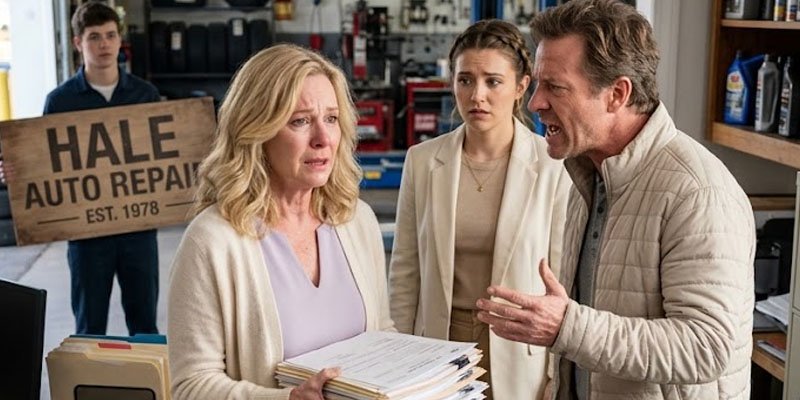
He stormed through the front door, his cheeks flushed from the cold. “You brought a stranger into Dad’s business?”
Noah was sweeping the customer area.
Margaret stood from Robert’s old chair. “His name is Noah.”
Lauren looked him up and down. “You picked up some homeless kid and gave him access to company property?”
“I gave him a broom.”
“This is crazy,” Daniel said. “You’re proving exactly what I’ve been telling everyone.”
Margaret almost smiled. “That I’m confused?”
Daniel’s expression shifted.
Lauren turned toward him. “What is she talking about?”
Margaret slid the printed emails across the desk.
Lauren read the first page and then the next.
“Daniel.”
He pointed at Margaret. “She was never here. I had to make decisions.”
“You told people I had dementia.”
“I said you were forgetful.”
“You wrote ‘cognitive decline.’”
“It was business language.”
“No,” Margaret said. “It was a tactic.”
Daniel’s anger cracked. Fear showed underneath it.
Margaret recognized that fear. Robert used to say numbers made excellent witnesses because they never cared whom you loved.
She placed another folder on the desk.
“This is a notice removing you as general manager while an independent audit takes place. You may not access company accounts, remove equipment, contact vendors on behalf of the company, or enter this building without written permission.”
Daniel stared at her.
“You’re firing me?”
“I’m investigating you.”
“I’m your son.”
Margaret studied him for a long moment.
“That was never permission.”
Daniel did not leave quietly.
He called Margaret heartless. He called the audit an ambush. He said Robert would have been ashamed of her for humiliating their son in front of an employee, an accountant, and “some kid from the street.”
That final phrase made Noah stop sweeping.
Margaret noticed.
“Noah,” she said, “please take the trash outside.”
He understood that she was giving him a way out, and he took it.
After the back door closed, Margaret turned toward Daniel.
“Your father left you employment, training, and a company without debt. I gave you control because I believed you respected what he built. Don’t use his name to protect yourself from questions he would have asked first.”
Lauren gathered the emails and placed them back on the desk.
“Tell me about the money you sent to Eric,” she said to Daniel.
He refused to look at her. “I already told you. Expansion.”
“My brother has never opened an auto shop.”
“He was looking for properties.”
“Where?”
Daniel snapped, “Why is everybody interrogating me?”
Because no one had before, Margaret thought.
That evening, Denise copied the records and left. Margaret changed the alarm code. Daniel surrendered his shop keys after Margaret warned him that refusing would be documented for her attorney.
Lauren went outside ahead of him.
Before following her, Daniel looked toward the old HALE AUTO REPAIR sign Noah had recovered from storage.
“You always loved Dad more than me,” he said.
Margaret felt the accusation land, but she did not chase after it.
“That isn’t true.”
“It is.”
“No. Your father simply never expected me to pretend I couldn’t see what was right in front of me.”
Daniel’s jaw tightened.
Then he walked away.
Margaret locked the door behind them.
For a moment, the shop was completely silent.
Noah came back from the alley carrying the empty trash bin.
“Am I fired too?” he asked.
Margaret almost laughed.
“You haven’t technically been hired yet.”
“Oh.”
“But if you’re still interested, come back Monday at eight. Denise will put you on payroll at entry-level shop wages. Thirty hours a week to begin. You’ll work under a certified technician, not alone. If you show up, learn, and don’t steal my tools, we’ll see what happens.”
Noah stared at her as if she had given him something more frightening than money.
A future.
“I’ll show up.”
“You’ll also need an address for the paperwork.”
His expression dropped.
Margaret had expected that.
She knew about a transitional housing program Robert had supported through the shop. Years earlier, he had repaired the nonprofit’s vans at cost. Margaret called its director from the office. There was no miraculous opening that night, but there was an emergency motel voucher and an intake appointment set for Friday morning.
That was enough for one night.
Margaret drove Noah to a modest motel near West Broad Street.
Before getting out, he placed the unopened apple pie on the center console.
“You should take this back,” he said.
“Why?”
“You bought it for your family.”
Margaret looked at the box.
“I gave it to you.”
He pushed it gently toward her. “Then I’m giving half back.”
They ate Thanksgiving pie with plastic forks inside the parked Buick.
It wasn’t the dinner Margaret had imagined.
It was better than sitting at a table where her absence had been described as convenient.
The independent audit began Monday.
By Wednesday, the first explanation for the $184,000 emerged.
Eight months earlier, Eric had formed a limited liability company called Northline Development. Daniel had moved money from Hale Auto Repair to Northline for “site acquisition consulting.”
Northline had never purchased a site.
Instead, bank records obtained through the company’s attorney showed that Eric had returned part of the money to Daniel through several personal transfers marked “loan repayment.”
Another portion had gone toward a deposit on lakefront property near Buckeye Lake.
The property was not owned by Hale Auto Repair.
It was under contract in Lauren and Daniel’s names.
When Margaret reviewed the paperwork, she was surprised by how calm she felt.
The betrayal now had measurable boundaries.
$184,000 was no longer an undefined wound. It had become dates, account numbers, signatures, invoices, and a property address.
Lauren came to Margaret’s house that evening without Daniel.
Margaret nearly chose not to answer the door.
Lauren stood on the porch holding a thick envelope.
“I didn’t know,” she said.
Margaret said nothing.
“I knew Daniel sometimes used the company card. Dinners. Gas. Things like that. I assumed you knew. I thought the lake house deposit came from his bonus.”
“He didn’t receive a bonus.”
“I know that now.”
Margaret opened the door farther but did not ask her inside.
Lauren handed her the envelope.
Inside were screenshots of text messages between Daniel and Eric.
In one message, Daniel wrote: Once Mom signs over the rest, nobody can question it.
Another said: She doesn’t understand the financial side anyway.
A third discussed moving quickly because Margaret was “getting suspicious lately,” even though she had suspected nothing before Thanksgiving.
“Why are you giving me these?” Margaret asked.
Lauren’s eyes appeared swollen.
“Because he lied to me too.”
“That doesn’t erase what you said on the phone.”
Lauren flinched.
Margaret continued, “You said Thanksgiving was easier without me.”
“I was angry.”
“At what?”
Lauren lowered her eyes. “At you.”
“Why?”
“Because Daniel always came home tense after visiting you. He said you criticized everything he did. He said you never trusted him, never respected our marriage, never believed he was good enough for the business.”
Margaret took in the words.
“And you believed him.”
“Yes.”
“Did you ever ask me?”
“No.”
“That was a choice.”
Lauren nodded.
There was no emotional embrace. No instant forgiveness.
Margaret accepted the envelope.
“Thank you for bringing this.”
Lauren wiped her eyes. “Is Daniel going to jail?”
“I don’t know.”
“You’re his mother.”
“And I’m the majority owner of the company he took money from.”
Lauren looked at her as though she believed those two facts should somehow cancel each other.
They didn’t.
The company attorney advised Margaret that the evidence needed to be handled carefully. Some expenses could be characterized as unauthorized compensation or disputed business costs. Others, especially the allegedly forged loan documents and false statements made to the bank, were more serious. Margaret did not pretend to know what prosecutors would eventually call any of it.
She followed her attorney’s instructions.
Preserve records.
Do not thre:aten. Do not negotiate privately. Do not destr0y evidence. Do not discuss the case with employees who might become witnesses.
That final instruction changed the way she interacted with Noah.
He remained at the shop, but Margaret kept him apart from the investigation. His work became routine and demanding: cleaning bays, organizing parts, checking tire pressure, watching technicians, learning safety procedures, and making mistakes that cost little.
On his fourth day, he arrived seven minutes late.
Margaret pointed at the clock.
“Bus.”
“Then catch an earlier bus.”
He nodded. “Yes, ma’am.”
The next day, he arrived twenty-five minutes early.
Two weeks later, senior technician Luis Ortega taught him the correct way to inspect brake pads. A month later, Noah passed the first module of an entry-level automotive training program that the shop agreed to pay for as long as he maintained attendance.
Margaret did not adopt him.
She did not bring him into her home or give him ownership of anything.
She gave him what Robert had once given Daniel: structure, employment, expectations, and a chance to prove himself with time.
That mattered to Margaret because she had begun to see one of her own mistakes.
Love had made her generous with Daniel.
Grief had made her distant.
Guilt had made her careless.
After Robert d!ed, Daniel told her he could handle everything. She wanted desperately to believe him because she could not bear sitting in the office where Robert’s coffee mug remained beside the adding machine.
So she stopped paying attention.
Daniel had not caused her grief, but he learned how to take advantage of the space it left behind.
Three weeks before Christmas, Daniel asked for a meeting.
Margaret agreed only after her attorney approved a conversation about family matters rather than company evidence.
They met at a quiet diner at two in the afternoon.
Daniel looked exhausted.
Lauren had moved into her sister’s home. Eric had hired his own attorney. The bank had asked for documentation concerning the disputed loans. Daniel’s lawyer had told him to stop contacting Margaret about the investigation.
For the first ten minutes, he complained anyway.
Then he said, “I thought the company would eventually be mine.”
Margaret stirred her coffee.
“That isn’t the same as owning it now.”
“I spent fifteen years there.”
“And you were paid for fifteen years.”
“I built the customer base.”
“You helped build it.”
“Dad promised me.”
“He promised you a place in the company. He never promised you the right to drain it.”
Daniel rubbed both hands over his face.
“I was going to return the money.”
“When?”
“After we refinanced the lake property.”
“With what income?”
He looked away.
Margaret understood then that there might never have been a complete plan. There had only been confidence that tomorrow’s money would cover yesterday’s theft, followed by another tomorrow.
“You know what I can’t get over?” she asked.
“The money?”
“No.”
He stared at her.
“The dementia story.”
Daniel’s expression became defensive.
“I never said you had dementia.”
“You told Denise I was having memory problems. You wrote that my cognitive decline made direct communication difficult. You used my age to stop people from contacting me.”
“I needed space to manage the business.”
“You needed me invisible.”
Daniel’s eyes filled with tears, but Margaret did not rescue him from the silence.
Eventually, he whispered, “I was afraid you’d take it away.”
“So you gave me a reason to.”
He began crying, quietly, with his shoulders hunched.
Margaret loved him.
That was the painful and uncomplicated truth.
She loved the baby who had slept against Robert’s chest. She loved the ten-year-old who once cried after accidentally killing a robin with a baseball. She loved the teenager who rebuilt a lawn mower engine across the garage floor.
She even loved the forty-two-year-old man sitting across from her who had lied about her mind and treated her company as though it were an inheritance he had received early.
Love could not make those documents disappear.
“I want to fix this,” Daniel said.
“You may be able to fix some of it.”
“Will you drop everything?”
“No.”
His expression changed immediately.
There it was again: the belief that love was supposed to protect him from consequences.
Margaret put cash beside her coffee cup.
“If you want a relationship with me someday, it starts with telling the truth when telling it costs you something.”
She stood.
“Mom.”
She stopped.
“I’m sorry.”
Margaret looked at him.
This time, she believed he was sorry.
She still didn’t know exactly what he regretted.
Being caught. Losing the company. Hurting her. Losing Lauren.
Maybe all of it.
“Keep going,” she said. “One apology isn’t the same as making repairs.”
Then she walked away.
By spring, the legal dispute was still unresolved, but the company had stabilized.
Daniel officially resigned as manager. Through his attorneys, he agreed to repay a substantial portion of the disputed funds by surrendering his interest in the lake property and additional assets. The allegedly forged documents remained under review by the appropriate authorities, and Margaret accepted that some outcomes were no longer within her control.
Hale Auto Repair returned to its original name.
The old sign was restored and placed above the front desk.
Margaret hired an experienced general manager rather than trying to run the entire business herself. Denise remained the accountant. Luis became shop foreman.
Noah moved from the motel voucher into transitional housing and then into a shared apartment with another apprentice.
He was still poor. He still rode the bus. He still had difficult days.
But he was no longer standing beside a cart return holding a sign.
On the Wednesday before the next Thanksgiving, Margaret was in the shop office reviewing payroll when Noah knocked on the open door.
He was twenty now, wearing a clean Hale Auto Repair shirt with his name stitched above the pocket.
He carried two pies.
“Important question,” he said.
Margaret looked up.
“Pumpkin or apple?”
For a moment, she couldn’t answer.
Then she laughed so loudly that Denise called from the next room to ask what was wrong.
“Apple,” Margaret said.
Noah placed it on her desk.
“Good. Pumpkin’s mine.”
Margaret’s phone buzzed.
It was a message from Daniel.
Happy Thanksgiving, Mom. I know I haven’t earned dinner with you. I just wanted to say I hope you have a good day.
Margaret read the message twice.
No manipulation. No request. No emergency.
She typed a response.
Thank you. I hope you do too.
She did not ask him to come over.
Not that year.
Instead, Thanksgiving dinner was held in the break room at Hale Auto Repair. Denise brought stuffing. Luis brought tamales because his mother insisted every holiday table needed them. Noah brought the pies. Margaret roasted a turkey that was a little dry, and everyone politely pretended it was fine.
At seven-thirty, after everyone had left, Margaret stood beneath Robert’s restored sign.
The shop smelled of coffee, motor oil, cinnamon, and turkey.
She remembered the phone call at the supermarket from a year earlier.
It was easier without you.
At the time, those words had felt like a door being slammed shut.
Now she understood that they had also pushed another door open.
Not because pain somehow magically improved people. Not because strangers always became family. Not because betrayal came with secret blessings.
Life was more complicated than that.
One cruel sentence had simply made Margaret stop moving in the direction she had been traveling. Then she looked around. Then she noticed a young man with grease beneath his fingernails. Then she entered a building she had been avoiding. Then she opened a cabinet.
Everything afterward came from choices.
Daniel’s choices. Her choices. Lauren’s choices. Noah’s choices.
Margaret turned off the office light and locked the front door.
Outside, Noah was waiting for his bus.
She lowered the passenger-side window.
“Need a ride?”
He grinned.
“Only if there’s pie left.”
“There’s half an apple.”
“Then yes.”
He climbed inside.
As Margaret drove away from the shop, her phone remained silent inside her purse.
For once, she didn’t need it to ring.