The commercial airliner had been cruising over the Atlantic for almost two hours when the captain’s voice suddenly came over the speakers, silencing nearly three hundred passengers.
“If anyone on board has fighter-pilot experience, please identify yourself to a member of the cabin crew immediately.”
Passengers exchanged bewildered, anxious glances.
Nobody understood why a passenger aircraft traveling from New York to Madrid would suddenly require a military pilot.
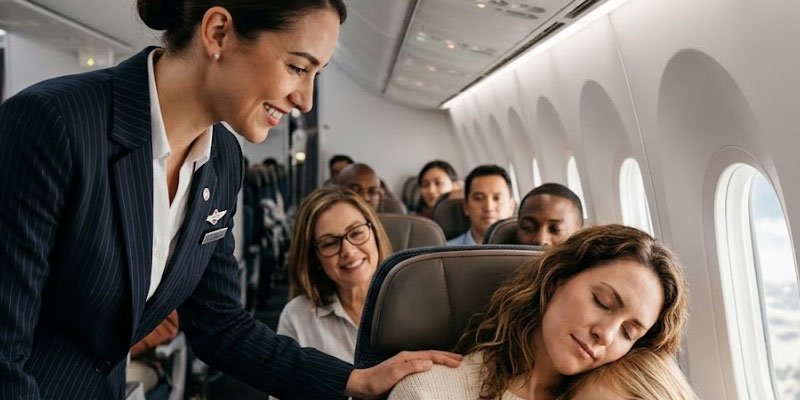
And no one imagined that the quiet woman asleep beside the window in seat 8A could be the only person aboard capable of helping them survive.
The overnight flight had begun without any problems.
The cabin lights had been dimmed, passengers were watching films or attempting to sleep, and the dark Atlantic seemed to stretch forever beneath the plane.
Thirty-eight-year-old Laura Vance occupied seat 8A.
She wore a simple green sweater, had a blanket over her legs, and held a closed book in her hands.
To everyone around her, Laura appeared to be nothing more than a tired traveler hoping to sleep through the journey.
What they did not know was that Laura had once been among the most accomplished fighter pilots in the United States Air Force.
She had flown F-16s on dangerous missions in which decisions needed to be made within seconds.
But eighteen months earlier, a devastating accident had transformed her life completely.
Laura had left the military.
She no longer wanted medals, attention, responsibility, or anyone describing her as a hero.
She wanted to remain anonymous.
That was why she had intentionally selected seat 8A—a quiet window seat where she could vanish among hundreds of unfamiliar passengers.
Then the announcement came once more.
“Ladies and gentlemen, this is your captain. We are experiencing a technical situation that requires immediate assistance. Anyone with military fighter-pilot experience should contact a flight attendant now.”
The atmosphere inside the cabin changed instantly.
Parents drew their children closer.
Couples reached out and held each other’s hands.
Passengers started looking along the rows as if an undiscovered pilot might suddenly reveal themselves.
Laura slowly opened her eyes.
She recognized the tone of the captain’s voice.
Controlled.
Professional.
Yet beneath those words was fear.
She had heard that same tone before during emergencies thousands of feet above the ground.
A flight attendant quickly moved down the aisle, examining the passengers.
Laura looked away.
She had made a promise to herself that she would never return to that life.
Never again would another person’s survival rest on decisions she made.
Then the flight attendant stopped beside her row.
“Excuse me, ma’am. Do you know whether anyone near you has military aviation experience? The captain urgently needs a military pilot.”
Laura looked around.
She saw terrified families.
Children.
People stranded miles above an ocean with no control whatsoever over what was unfolding.
For a moment, she remembered the reason she had left.
Then a principle from her years of service came back to her.
A pilot never abandons people who need help.
Laura slowly inhaled.
“I’m a pilot.”
The flight attendant stared at her.
“Excuse me?”
Laura released her seat belt and sat upright.
Her entire manner had changed.
“I’m a former United States Air Force fighter pilot. I flew F-16s.”
The passenger sitting beside her stared in disbelief.
“You?”
Laura gave a slight nod.
The flight attendant’s expression immediately changed from uncertainty to relief.
“Please come with me.”
Laura rose.
As she made her way toward the cockpit, memories she had spent eighteen months trying to bury returned with every step.
But she had no idea that what awaited her behind the cockpit door was directly connected to the tragedy that had destroyed her former life.
PART 2
The cockpit door opened.
Laura immediately noticed the smell of overheated electronics, coffee, and tension.
Captain Andrew Vance was seated on the left, gripping the controls tightly with both hands.
Beside him, the first officer was unconscious, an oxygen mask covering his face.
Andrew looked at Laura’s casual clothing.
“You have military flight experience?”
“Yes.”
“What aircraft?”
“F-16 Falcons.”
“When did you last fly?”
Laura paused.
“About eighteen months ago.”
The captain frowned.
“I need someone current, not someone depending on outdated experience.”
Before Laura could respond, the entire aircraft suddenly began to shake.
This was not ordinary turbulence.
The movement followed a repeated mechanical rhythm.
Laura’s eyes immediately shifted toward the flight instruments.
“How long has the control column been doing that?”
“About ten minutes.”
“Tell me exactly what happened.”
Andrew indicated several warning displays.
“The autopilot disconnected without warning. Then the flight-control computer began producing conflicting errors. A few minutes later, my first officer said his arm was going numb and then suddenly collapsed.”
Laura looked at the unconscious man.
“Did you both eat the same meal?”
“No. He brought coffee from the airport.”
“Anyone else sick?”
“No.”
Laura examined the instruments.
Her uniform was gone.
Her military career was supposedly over.
Yet the instincts developed through years inside fighter cockpits returned almost instantly.
The aircraft suddenly began drifting to the right.
Andrew pulled against the controls.
“Don’t fight it,” Laura warned.
“I have to stop the bank.”
“No. You’re fighting bad computer input. The system is correcting against you.”
Andrew looked at her.
Laura pointed toward the control system.
“Isolate one of the secondary flight channels.”
Andrew hesitated for half a second.
Then he trusted her.
He disconnected the channel.
The aircraft gave a single violent shudder.
Then the vibration vanished.
Andrew stared at her.
“You were right.”
Laura said nothing.
They still faced larger problems.
A powerful storm covered the radar ahead.
Their fuel reserves were decreasing.
Their first officer was still unconscious.
Then a doctor who had volunteered from the passenger cabin appeared at the cockpit entrance.
“Captain, I examined your first officer. I don’t believe this is an ordinary medical collapse.”
Andrew turned toward him.
“What do you mean?”
“His symptoms are consistent with chemical poisoning.”
Silence settled over the cockpit.
Laura immediately looked toward the center console.
Something was gone.
“Where is his coffee thermos?”
The flight attendant looked around.
“It was here.”
Laura’s stomach tightened.
The damaged flight-control system.
An incapacitated first officer.
And now evidence disappearing from the cockpit.
These were no longer random coincidences.
“Lock the cockpit door,” Laura said.
Andrew looked at her.
“You think someone did this intentionally?”
“I think somebody wanted your first officer unable to fly.”
The aircraft began descending toward an emergency airport in northern Spain.
Then another warning appeared.
Hydraulic pressure controlling the right landing gear was beginning to fall.
Almost immediately afterward, the cockpit keypad sounded.
Someone outside was trying to gain entry.
Andrew checked the camera.
“It’s Richard Sterling.”
“Who?”
“Director of Flight Operations for the airline. He’s traveling in first class.”
The lead flight attendant spoke through the interphone.
“Captain, do not open the door. Mr. Sterling is demanding entry and says his executive position gives him authority.”
Laura’s expression became firm.
Nothing about the situation felt accidental anymore.
A short time later, the flight attendant called again.
“The doctor found a small plastic cap beneath the first officer’s seat. It appears to have come from a vial.”
Andrew turned toward the windshield.
Through the heavy rain, runway lights finally became visible in the distance.
“We land first,” he said.
Laura moved into the unconscious co-pilot’s seat and secured the harness.
“Agreed. Whatever else is happening can wait until we’re on the ground.”
The airliner descended through heavy rain and strong crosswinds.
Andrew lowered the landing gear.
Two green indicators appeared.
The third remained dark.
The right main landing gear had failed to confirm that it was properly locked.
Andrew tightened his jaw.
“If that gear folds when we touch down, we could leave the runway.”
Laura placed her hands on the secondary controls.
“I’ll back you up.”
“You’ve never landed this type of airliner.”
“No.”
Laura looked toward the runway.
“But I know how to keep an aircraft straight when systems start failing.”
The jet crossed the runway threshold.
The wheels touched the pavement.
For one terrifying moment, the aircraft tilted toward the right.
The questionable landing gear groaned under the tremendous weight.
Laura immediately compensated with rudder and asymmetric thrust.
Andrew kept the nose aligned.
Then a loud mechanical clunk sounded beneath them.
The landing-gear lock finally engaged.
Reverse thrust thundered.
The aircraft slowed.
Seconds later, it came to a complete stop.
Behind the cockpit door, almost three hundred passengers erupted in applause, tears, and cheers all at once.
Laura remained quiet.
She knew the emergency was over.
But something far darker was about to begin.
PART 3
Spanish police and emergency vehicles surrounded the aircraft immediately after it left the runway.
Passengers were evacuated while authorities detained Richard Sterling before he could vanish into the terminal.
As officers escorted him past the front section of the aircraft, Sterling noticed Laura.
He stopped.
A strange smile crossed his face.
“Laura Vance,” he said softly. “Of all people, I never imagined you would be sitting in 8A tonight.”
Laura froze.
Captain Andrew stepped next to her.
“You know this man?”
Sterling gave a cold laugh.
“I know quite a lot about her.”
What investigators discovered over the following forty-eight hours shocked everyone.
Sterling had allegedly been involved in a huge scheme involving falsified maintenance records and counterfeit aircraft components.
Millions of dollars had been diverted through the operation.
But an unexpected audit was approaching, and investigators believed Sterling feared that the entire scheme was about to be uncovered.
The emergency during the flight had not happened by chance.
The compromised flight systems had been deliberately designed to fail.
The first officer had been intentionally incapacitated so Captain Andrew would be left struggling alone during the crisis.
Investigators concluded that the plan was for the aircraft, and potentially the evidence connected to the fraudulent components, to disappear in a catastrophic accident.
But another discovery was made.
One that personally affected Laura.
Years earlier, Sterling had worked with a defense contractor responsible for providing aviation equipment to a military logistics program.
That contractor had supplied defective avionics components to Laura’s former squadron.
And one of those failures had been connected to the accident that killed Laura’s wingman and closest friend, Captain Gabriel Torres.
That accident had devastated Laura.
For eighteen months, she had believed Gabriel died because she had failed him.
She had replayed their final mission again and again, wondering which command she should have issued differently and which maneuver could have saved him.
The guilt became unbearable.
Eventually, she resigned from the military and completely disappeared from aviation.
During the new investigation, federal officials recovered classified records concerning Gabriel’s final flight.
One investigator gave Laura a transcript containing Gabriel’s last transmission before his aircraft went down.
Laura slowly read the final lines.
Gabriel had told air traffic control that the controls had locked.
Then he had left one final message.
Laura had done everything correctly.
The failure had not been her fault.
She stared at the page for a long time.
Then the tears finally came.
For eighteen months, she had blamed herself for something she could never have prevented.
Gabriel had never blamed her.
Even during his final moments, he had understood the truth.
Weeks later, Laura traveled to Texas.
She stood outside Gabriel’s mother’s home for several minutes before finally knocking.
When the older woman opened the door and saw her, neither of them spoke.
Then Gabriel’s mother embraced Laura.
“I’m sorry,” Laura whispered. “For so long, I believed I left him behind.”
The woman gently took Laura’s hands.
“You never abandoned Gabriel. You carried him with you every single day. But you don’t have to stop living because he died.”
Those words remained with Laura.
Months went by.
Sterling was eventually convicted on numerous serious federal charges related to the sabotage and fraud scheme.
Laura, however, chose a different path for her future.
She did not return to military service.
Instead, she accepted a position teaching the next generation of pilots at a commercial aviation academy.
On her first morning as an instructor, she placed her old fighter-pilot helmet on the desk.
A room filled with young student pilots immediately fell silent.
They expected stories about combat missions and heroic maneuvers.
Instead, Laura walked to the whiteboard and wrote:
THE AIRCRAFT DOESN’T CARE WHO YOU USED TO BE.
She turned toward the students.
“Past accomplishments won’t save you during an emergency. Ego won’t save you either. What matters is whether you can understand what is happening, make the correct decision, and trust the people flying beside you.”
Over time, passengers continued sharing the story of the mysterious woman from seat 8A who helped save Flight 412.
Laura never liked being called a hero.
In her mind, she had simply responded when people needed someone capable of stepping forward.
Then, one afternoon, a letter arrived at the academy.
It came from a boy who had been sitting several rows away from Laura during that flight.
He wrote that he remembered being terrified after hearing the captain’s announcement.
But when Laura walked toward the cockpit, she had looked at him and calmly nodded.
That small gesture convinced him that somehow everything might be okay.
The final sentence brought a smile to Laura’s face.
He was taking his first flying lesson.
Laura carefully folded the letter and placed it inside a wooden box beside a photograph of Gabriel.
At last, she understood something she had resisted for years.
Pain does not simply disappear.
Loss does not disappear either.
But grief does not have to become a prison.
Later that afternoon, Laura stood beside the airfield as a training jet climbed into the bright blue sky.
For years, the sound of aircraft engines had reminded her of the worst moment of her life.
This time, it was different.
She watched the jet vanish into the distance.
For the first time since Gabriel died, Laura did not look toward the sky and see the past.
She saw everything that was still ahead of her.
And quietly, smiling, she whispered,
“I’m home.”