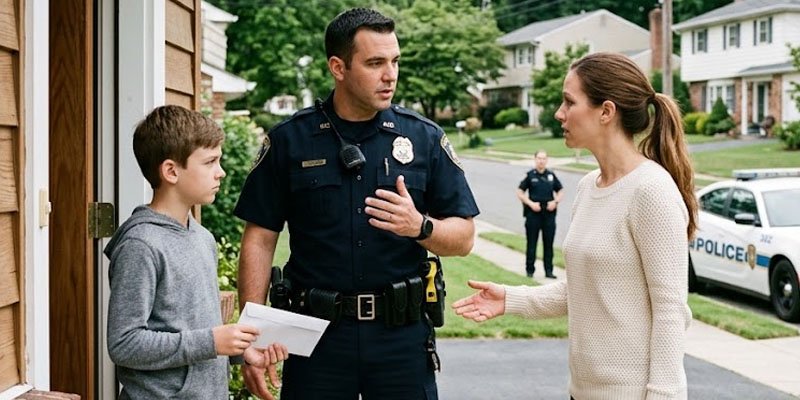
After being left alone for an entire month with only twenty dollars, I finally told the officers that I didn’t feel safe being left alone with my mom.
I kept my arms at my sides as the officer instructed Mom to move toward the other side of the porch.
She immediately attempted to portray my response as nothing more than another childish misunderstanding.
“He’s emotional,” she said. “Give me ten minutes alone with him and he’ll calm down.”
Image
That was exactly what scared me.
Whenever the two of us were alone, I somehow ended up agreeing that I had misunderstood her, expected too much, spent too much, called too often, or made something minor seem far more serious than it really was.
With two officers standing close by, I didn’t have to raise my voice above hers.
I only needed to continue repeating the same truth.
Mom changed her approach.
She offered to buy groceries. She said she would give me more money. She promised that the next morning, I could pick out anything I wanted at the store.
I looked at the crumpled envelope in the officer’s hand.
“I didn’t need more money,” I said. “I needed an adult to come home.”
Mom’s face became harder. “You’re making it sound like I abandoned you.”
I stayed silent for a moment. Then I told the officer about the phone calls—the ones where I said I was nearly out of food, the one where I admitted I was frightened at night, and the final call when Mom told me to stop being dramatic because she was trying to enjoy herself.
Mom interrupted. “I was teaching him independence.”
That was the detail that changed everything: she wasn’t claiming she thought another adult was taking care of me. She wasn’t claiming the trip had unexpectedly become impossible. She was admitting that she had intentionally left me alone because she believed surviving the experience would teach me something.
The officer asked whether I wanted Mom standing beside me while I finished explaining what had happened during the month.
I looked at her.
“No.”
This time, the officers moved her farther away from the entrance, and the front door closed between us.
The sound of the latch should have felt completely ordinary.
Instead, it was the first time in a month that I felt a door was protecting me rather than keeping me trapped inside an empty house.
One officer stayed outside with Mom while the other came into the living room with me.
He didn’t immediately ask another difficult question. Instead, he looked around.
There were no grocery bags waiting to be put away. No adult coat draped across a chair. No half-finished coffee sitting on the counter. Only the normal signs of a house occupied by one child desperately trying not to show how frightened he was.
I had washed every plate as soon as I used it because I was afraid I might eventually run out of clean ones.
I kept lights turned off in rooms I wasn’t using because I wasn’t sure whether the electricity could somehow run out as well.
At eleven years old, there were plenty of things I understood just enough to make them frightening.
The officer asked me to show him where I had kept my food.
I opened the kitchen cabinet.
There wasn’t much left. A little bread. Part of a jar of peanut butter. Two cans I had been saving because I had decided canned food was emergency food, even though nobody had ever actually taught me that.
Afterward, he looked inside the refrigerator.
Then he turned to me.
“Is this what you’ve been eating?”
I nodded.
I felt ashamed by the question, which seems strange to me now.
None of this had been my choice, but shame has a way of settling on the person with the least control in the room.
I started explaining that I had tried to be careful. I told him I knew twenty dollars wasn’t much, so I had purchased the cheapest food I could find. I said maybe I could have handled things better if I had planned everything differently.
He stopped me before I could keep defending myself.
“You don’t have to explain your grocery strategy to me.”
I looked down at my sleeves.
From outside, Mom’s voice came through the closed front door.
“He had food!”
The officer beside me ignored her. He asked whether there had been any nights when I was sick, injured, or afraid that someone might try to get into the house.
That question brought up a memory I hadn’t intended to share.
Around the middle of the month, sometime after dark, someone knocked hard on the front door.
I didn’t answer.
The knocking came again.
Then the person outside tried the handle.
It shifted slightly before stopping against the lock.
I had sat on the floor behind the couch with a kitchen chair pushed against the door, holding my breath until the sounds outside finally disappeared.
I never found out who it was.
Maybe someone had simply mistaken our house for another one. Maybe there had been nothing dangerous about it at all.
But I was eleven, alone, and there was no adult I could call who I knew for certain would come.
“Did you tell your mom?” the officer asked.
I nodded.
“What did she say?”
I hesitated because I could still hear her voice exactly as she had said it.
“She told me to make sure the doors were locked and stop getting myself worked up.”
The officer wrote something down.
Outside, Mom went silent.
That frightened me more than her yelling ever did.
Her anger was easy to understand. Her silence usually meant she was figuring out what she planned to say next.
A few minutes later, the officer went outside to speak with his partner.
I stayed in the living room, close enough to hear parts of their conversation through the door.
Mom continued insisting that I was exaggerating how little food was left.
She said I knew how to make sandwiches. She said our neighborhood was safe. She said she checked on me. Then she said something that immediately made me straighten.
“He does this whenever he wants attention.”
For thirty days, I had rationed slices of bread, counted coins, and slept with every downstairs light turned off because I was trying not to cause problems.
Now, according to her version, the entire month was something I had done to her.
I moved toward the doorway before I could talk myself out of it.
The officer opened the door just enough for me to stand behind him.
Mom saw me immediately.
“See?” she said. “He needs to be involved in everything.”
For one second, that familiar instinct came rushing back.
Apologize.
Stay quiet.
Make her calm down.
Then I looked at the envelope in the officer’s hand.
MAKE IT LAST. EMERGENCIES ONLY.
Those words had controlled my entire month.
I had treated hunger like an emergency I wasn’t allowed to have.
Fear like an emergency that didn’t matter enough.
Loneliness like something I was supposed to deal with privately.
So instead of apologizing, I said, “Can you ask her what I was supposed to do if the twenty dollars ran out?”
Mom looked directly at me.
The officer repeated the question.
Her answer came instantly.
“I would’ve sent more if he actually needed it.”
“How?” I asked.
She frowned. “What do you mean, how?”
“I called you and told you I was running out.”
That was the first time she didn’t have an immediate answer.
She turned toward the officers instead of looking at me.
“Kids say things. He wasn’t going hungry.”
One officer asked how much money she believed I still had when I made that call.
Mom said she couldn’t remember.
I could.
Four dollars and some change.
I remembered because I had counted it three times at the kitchen table.
The officer asked whether she had sent me anything after that conversation.
“No,” she said. “Because I knew he could handle it.”
There it was again.
Not a misunderstanding. Not a delayed flight. Not a relative who had forgotten to show up.
A decision.
Mom had decided that asking for help meant failing a test she had created for me.
The officers spoke quietly to one another for a moment. Then one told Mom that I would not be left alone with her that night while they arranged a safe temporary place for me.
Mom’s expression changed.
Not because she had suddenly understood why I was frightened.
Because, for the first time, her explanation was no longer controlling what happened.
“You cannot be serious,” she said.
She pointed at me.
“He is my son.”
The officer calmly explained that nobody was disputing that. The immediate concern was whether I had somewhere safe with an adult while everything was being reviewed.
Mom tried moving closer again.
The officer stayed where he was.
She looked around him at me.
“Tell them you want to stay here.”
It sounded like a command rather than a question.
My stomach tightened.
A month earlier, I probably would have obeyed just to make the tension disappear.
But something had changed when I said no the first time.
The word hadn’t destroyed our home.
The world hadn’t collapsed.
Two adults had simply listened.
So I said it again.
“I don’t want to stay here tonight.”
Mom’s eyes became hard.
“Fine,” she said. “Then leave. Since you think everyone else will take better care of you.”
I remember that sentence more clearly than almost anything else because it was designed to hurt enough that I would change my mind.
Instead, it answered a question I had been carrying through that entire month.
I had kept wondering what would happen if I eventually needed more than she was willing to give.
Now I knew.
She would make needing something feel like betrayal.
The officers didn’t argue with her about what kind of mother she was. They didn’t give speeches. They focused on figuring out what needed to happen next.
I was asked whether there was an adult relative or trusted person I would feel safe staying with.
There was.
Everything afterward felt strange because adults were suddenly asking me questions and waiting for my answers instead of deciding those answers for me.
Did I want my backpack?
Yes.
Did I need clothes?
Yes.
Was there anything important in my room?
I thought about it.
Then I said, “My school stuff.”
Mom laughed from the porch when she heard that.
“Of course. He thinks he’s moving out now.”
I stopped halfway down the hallway.
The officer beside me quietly said, “Just take what you need for tonight.”
That sentence mattered because it made the next step small enough for me to handle.
Nobody was asking eleven-year-old me to decide what would happen for the rest of my life.
I was choosing where I would sleep for one night.
I packed two shirts, a pair of jeans, socks, my school supplies, and the hoodie I was already wearing.
Then I stood in my room, wondering whether there was anything else I was allowed to take.
My attention went back to the kitchen envelope, which the officer was still holding.
For an entire month, that envelope had seemed like my only emergency plan.
Twenty dollars had meant food, safety, permission, emergency, and failure all at once.
Now it was merely a piece of paper containing a few bills and my mother’s handwriting.
When I returned to the front room, the officer asked whether I wanted him to hand it back to me.
I looked toward Mom through the open doorway.
She was looking at the envelope too.
“Yes,” I said.
He handed it to me.
Mom immediately said, “That money belongs to me.”
I almost handed it back.
That old instinct returned that quickly.
Then I remembered every time I had opened that envelope at the kitchen table, trying to decide whether being hungry was serious enough to justify spending another dollar.
I folded it once and placed it inside my backpack.
“You gave it to me,” I said.
Mom shook her head as if I were proving something awful about myself.
But she didn’t take it back.
That night, I slept somewhere with another adult inside the house.
The first thing that surprised me was the noise.
Cabinet doors closing.
Water running.
Someone walking through the hallway.
Normal sounds.
For thirty days, every unfamiliar noise had meant I had to decide on my own whether it was dangerous.
That night, I heard footsteps and didn’t have to get out of bed.
Someone else was awake.
That was enough.
The next morning, breakfast came without me having to calculate anything.
I remember staring at the food longer than necessary.
Nobody told me to save half for later. Nobody asked whether I had earned it by behaving responsibly.
There was simply enough.
What happened with Mom afterward wasn’t a single dramatic event where everything suddenly became clear and everyone agreed about what she had done.
She kept defending herself.
For a while, she continued describing the month as a lesson that had gone too far because I had pan!cked.
Sometimes she accused the officers of overreacting. Sometimes she blamed me for putting our family business out in public. Sometimes she discussed the twenty dollars as though the amount itself were the issue and argued that if she had left more money, none of this would have happened.
But that was never the real issue.
The real issue was that she heard an eleven-year-old say he was afraid and decided fear was something he should deal with alone.
She heard that the food supply was getting low and treated it as bad planning.
She knew there was no adult sleeping in that house and called it independence.
No amount of additional money could turn those decisions into supervision.
When adults later asked me to describe the month, I found myself repeating the same details again and again because they were the clearest ones.
The almost-empty kitchen. The phone calls. The knocking at the door. The day she promised she would come home. The envelope.
I stopped trying to make the story sound worse than it had been because eventually I realized I didn’t need to.
The basic facts were enough.
That became one of the strangest changes inside me.
Before that, I had always thought I needed a perfect explanation before I was allowed to object to something.
Afterward, I learned that sometimes you can simply describe what happened and let the facts remain simple.
I was eleven.
She was gone for a month.
There was no adult with me.
She left twenty dollars.
I told her I was scared.
She stayed away.
Nothing else I could say afterward made those facts any more real.
My relationship with Mom didn’t suddenly heal.
For a long time, every conversation felt like she was waiting for me to admit that I had misunderstood the entire month.
I stopped giving her that answer just to end the argument.
When she said, “You know I would never hurt you,” I didn’t accuse her of intending to.
I said, “I told you I needed you, and you didn’t come back.”
When she said, “I was trying to teach you independence,” I said, “I was eleven.”
When she said, “You had money,” I said, “I needed an adult.”
The sentences became shorter because I no longer needed to win every part of the conversation.
I only needed to stop giving up the part I knew was true.
Eventually, the envelope stopped living in my backpack.
For a while, I kept it in a drawer.
I couldn’t really explain why I saved it.
Maybe throwing it away felt like pretending that month had never happened.
Maybe keeping it reminded me that eventually I had asked someone for help.
Years later, I found it again while going through old belongings.
The paper had become soft along the folds.
The handwriting was still visible.
MAKE IT LAST. EMERGENCIES ONLY.
At eleven, I had understood those words as instructions about money.
Years later, when I looked at them again, I realized I had applied them to myself too.
Make the food last. Make the fear last. Make your courage last.
Don’t ask for anything unless the situation becomes serious enough to justify bothering someone.
That was the lesson I needed to unlearn.
I didn’t have to make every need into an emergency before I was allowed to speak.
I didn’t have to become easier to neglect just to prove that I was independent.
And I didn’t have to keep shrinking the truth until someone else felt comfortable hearing it.
I never forgot the officer’s question on that porch because nobody had ever asked me anything like it before.
Not whether Mom loved me. Not whether she meant well. Not whether I could survive one more night.
Whether I felt safe.
And then he waited for me to answer.
That was the real turning point.
Not the police car outside. Not the twenty dollars. Not even the month itself.
It was being asked one straightforward question and realizing I was allowed to answer honestly even if my mother disliked the answer.
For thirty days, I had treated that envelope as evidence that I was supposed to manage everything by myself.
Eventually, I stopped keeping money inside it.
I kept it only long enough to remember what happened when I finally refused to follow the instruction written across its front.
I did not make it last forever.
I asked for help.