Two days before seventh grade started, my twelve-year-old son called me to say he wasn’t coming home.
That statement alone would have frightened me.
But then Noah said something that made my stomach sink.
“Jessica is better than you, Mom. We can finally be a real family here.”
And somewhere in the background, I heard his stepmother quietly whispering.
My ex-husband, Matt, and I had been divorced for six years, and Noah had lived with me for most of that time.
Our house wasn’t fancy, but it belonged to us.
Friday nights were for pizza.
Sunday mornings were for pancakes.
I tucked silly yellow notes into his lunch bag, which he always insisted were embarrassing, yet somehow he never threw any of them away.
That summer, we had spent weeks preparing for middle school.
His brand-new sneakers were waiting beside the front door.
His notebooks were arranged neatly on his desk.
I had even purchased the cinnamon cereal he had reminded me about twice.
Noah had spent the last two weeks of summer vacation at his father’s home with Matt and his wife, Jessica.
Nothing about the visit had seemed unusual.
He called me nearly every night.
Three days before school began, he had even asked if I had washed his favorite blue hoodie.
So when my phone rang that Saturday afternoon, I answered in a cheerful voice.
“Hey, kiddo. Are you packed yet?”
Silence.
Then his voice came softly through the phone.
“Mom…”
Something in his voice made me straighten in my seat.
“What happened?”
“I’m not coming home.”
For a few seconds, I simply stared at the cereal box sitting on the kitchen counter.
“What do you mean?”
“I want to stay with Dad.”
I honestly thought I had misunderstood him.
“School starts Monday.”
“I know.”
“You were asking me about your hoodie three days ago.”
“I changed my mind.”
I made myself stay calm.
“Okay. Then tell me what changed.”
Another pause followed.
Then Noah said something I never saw coming.
“Jessica is better, Mom.”
My grip tightened around the phone.
“Better at what?”
“Everything.”
“Noah…”
“We can be a real family here.”
That statement hurt more deeply than I wanted to acknowledge.
For six years, I had worked hard to make certain my son never felt that our home was somehow incomplete simply because his parents were divorced.
“Honey, did someone tell you that?”
“No.”
He replied far too quickly.
Then I heard Jessica speaking somewhere nearby.
“Give me the phone, sweetheart.”
“Noah, wait—”
The phone rustled.
Then Jessica spoke.
“Rachel.”
“Put Noah back on.”
“Please don’t make this harder than it needs to be.”
I went still.
“Make what harder?”
“He wants to stay here.”
“Since when?”
“Since he realized he has another choice. We’ve already begun looking at schools in our district.”
I rose so quickly that my chair scraped loudly against the kitchen floor.
“You’ve been searching for schools without talking to me?”
“Matt agrees.”
“Then let me speak to Matt.”
“He’s busy.”
“Jessica.”
“Noah needs stability.”
I looked across the kitchen toward my son’s backpack.
“He already has stability.”
Jessica sighed.
“Not the kind I’m talking about.”
Then she ended the call.
I called Matt immediately.
He answered after several rings.
“Rachel.”
“What is happening?”
“Can you lower your voice?”
“No. Your wife just told me you’re planning to transfer Noah to another school.”
“It’s what he wants.”
“Since when?”
“He likes it here.”
“He was perfectly happy living with me three days ago.”
“Things change.”
“Not this dramatically in seventy-two hours.”
Matt fell silent.
“Put Noah on.”
“Not right now.”
“Why?”
“Because you’re upset, and I don’t want you pressuring him.”
My anger rose.
“I’m his mother.”
“And I’m his father.”
“Then tell me what suddenly changed.”
“We’ll talk later.”
The call ended.
I remained standing in my kitchen for perhaps ten seconds before taking my keys.
Normally, I was someone who planned everything.
Forms were filled out the very day they arrived.
Vacations came with schedules.
I even kept extra pencils in my glove compartment because Noah somehow managed to lose six or more in a single week.
But that afternoon, there was only one thought in my mind.
Something was wrong.
Halfway to Matt’s house, I called Noah.
Voicemail.
While stopped at a red light, I sent him a message.
I’m close. Can you come outside?
His response arrived almost instantly.
Please don’t make Dad mad, Mom.
I read the message three times.
Then I parked a little way from Matt’s house and called him once more.
“Bring Noah outside.”
“Rachel, you can’t just show up.”
“He just texted me asking me not to make you angry.”
Silence.
“What exactly does he think you’re going to do?”
“Nothing. He’s just sensitive.”
“Since when does a twelve-year-old have to manage your moods?”
“I’m hanging up.”
“Matt—”
The call ended.
I stepped out of my car.
By the time I reached the front path, I was angry enough to pound on the door.
Then voices reached me through an open window.
Jessica.
“You’ve spent six years complaining that you barely get to be his father.”
I stopped.
Matt responded sharply.
“That doesn’t mean you get to tell him Rachel’s house isn’t a real home or that she isn’t enough of a family.”
I caught my breath.
Jessica answered, “I told him he deserves one home.”
“No. You told him what you needed him to believe.”
“I’m tired, Matt.”
“Keep your voice down.”
“I’m tired of every good weekend ending with you miserable because he leaves. I’m tired of arranging my life around your guilt.”
“So Noah is supposed to fix that?”
“Maybe if he lives here, you’ll finally stop acting like part of you is always somewhere else.”
A long silence followed.
Then Matt asked something that suddenly made everything make sense.
“Does Noah know that’s why you want him here?”
Jessica’s voice became quieter.
“I told him how much you need him.”
“You told him I fall apart when he leaves?”
“Because you do.”
“You made him responsible for me.”
“I’m trying to save our marriage.”
My hands began trembling.
I lifted one hand, ready to knock.
Then I remembered Noah’s text.
Please don’t make Dad mad.
If I stormed inside in anger, Jessica wouldn’t need to convince Noah that I was an angry mother trying to take him away.
I would be proving her point for her.
So I lowered my hand.
And returned to my car.
For the first time that afternoon, I stopped reacting.
I waited.
About fifteen minutes later, Matt came outside.
When he noticed me standing beside my car, he stopped.
“You heard us.”
“I heard enough.”
He rubbed his hands across his face.
“Rachel…”
“Does Noah know he’s apparently responsible for repairing your marriage?”
“Don’t put it that way.”
“How would you like me to put it?”
“Nobody is using him.”
“He just told me that you and Jessica are his ‘real family’ and that I’m not.”
Matt looked away.
“Where did that come from?”
“He likes being here.”
“That wasn’t what I asked.”
“He likes having both of us around.”
“Matt, why does our son think you’ll fall apart when he leaves?”
His jaw tightened.
“He’s sensitive.”
“I want to talk to him.”
Matt hesitated, then nodded toward the side yard.
Noah was sitting by himself on the patio steps.
I walked over and sat next to him.
“Did Jessica tell you your dad gets upset after you leave?”
His expression immediately became guarded.
“So now you’re blaming her?”
“I’m asking you something, sweetheart.”
“She cares about Dad.”
“I know.”
“And she cares about me.”
“I never said she didn’t.”
Eventually, he looked at me.
“Dad needs me.”
My answer came too quickly.
“Noah, you’re twelve. Your father doesn’t need you to repair his life.”
Something shifted in his expression.
“Maybe you don’t need me either.”
“That isn’t what I meant.”
“Just leave me alone.”
He stood and went inside.
I remained on those steps, staring at the closed door.
I had correctly understood what was happening.
And somehow, I had still managed to make things worse.
So I went home.
But I wasn’t prepared to give up.
I simply needed to ask a different question.
Later that night, I went into Noah’s bedroom.
Inside one of his notebooks, I discovered an old yellow note I had written months before.
Don’t forget your math packet, genius.
Despite everything, I smiled.
Then I thought about the phrases Noah had been repeating.
Real family.
Dad needs me.
One home.
Those weren’t phrases Noah had created himself.
Whenever my son became overwhelmed, he often picked up language from the adults around him.
And suddenly, I understood something.
I had been asking the wrong question.
The next afternoon, I went back to Matt’s house.
This time, I hadn’t prepared an argument.
I found Noah sitting outside.
“Can I sit with you?”
He shrugged.
I sat down beside him.
“I’m going to ask you one question. Whatever you say, I promise I won’t argue.”
He looked suspiciously at me.
“Okay.”
“What do you think will happen to your dad if you come home with me?”
Noah stared down at the ground.
“He’ll be alone again.”
“Jessica is there.”
“He gets really quiet when I leave.”
“Who told you that?”
He picked at the edge of his sneaker.
“Jessica.”
“What exactly did she tell you?”
“That Dad waits all week for me to visit. Then when I leave, he barely talks.”
My heart sank.
“Did she tell you anything else?”
“She said maybe if I stayed here, Dad could finally be happy all the time.”
And there it was.
Jessica had never outright told Noah that he had to stay.
Instead, she had built a simple equation inside the mind of a twelve-year-old.
Dad is unhappy.
Noah can stay.
Therefore, Dad will be happy.
“I have to help him,” Noah whispered.
I turned toward him.
“You’re allowed to love your dad. You’re allowed to miss him. And you’re allowed to want more time with him.”
He looked at me.
“But you are not responsible for making him happy. Your father is an adult. His emotions belong to him.”
“Was Jessica lying?”
I nearly answered yes.
Instead, I carefully chose my words.
“I think Jessica told you things about your dad’s feelings that you should never have been expected to carry.”
“So Dad isn’t sad when I leave?”
“He probably is sometimes.”
His face fell.
“And so am I,” I added. “I hate when you leave too. I miss you. The house feels quieter when you’re gone.”
He stared at me.
“But that is my feeling to handle, not yours.”
He remained quiet for a moment.
“So what am I supposed to do?”
“Be twelve.”
He almost smiled.
“Let the adults deal with adult problems.”
Then he asked the question I had quietly been dreading.
“What if I really do want to spend more time with Dad?”
The easiest answer would have been no.
Instead, I said, “Then we talk about giving you more time with him.”
His eyebrows rose.
“You’re not mad?”
“I’m angry about the way all of this happened. But I’m not angry because you love your father.”
I stood.
“Come with me.”
“Where?”
“To talk to him. And this time, you don’t have to manage the conversation alone.”
Matt was standing in the driveway.
Jessica came outside when she noticed us.
“We need to talk,” I said.
Jessica folded her arms.
“I think we’ve talked enough already.”
“No. The adults have spent enough time talking around Noah.”
I turned toward Matt.
“Noah thinks that if he comes home with me, you’ll become miserable.”
Matt looked at our son.
“Buddy…”
“Did you know he believed that?” I asked.
Matt looked at me.
His hesitation gave me the answer.
Noah noticed it too.
“Dad?”
Matt exhaled.
“Sometimes you ask me whether I’m sad when you leave.”
“And what do you tell him?” I asked.
“That I miss him.”
“Did you ever correct Jessica after she made him think staying here would make you happy?”
Matt said nothing.
Jessica stepped forward.
“I never told him he was responsible for Matt.”
“You told him his father shuts down after he leaves.”
“That’s true.”
“You told him that living here could make his father happy.”
“I wanted one home, Rachel. One schedule. One family that wasn’t constantly waiting for another goodbye.”
“You had an adult problem,” I said calmly.
Her expression changed.
“And you gave it to a child.”
“I was trying to save my marriage.”
“Then you talk about your marriage with your husband.”
I looked at Matt.
“And you allowed it.”
He stared at the pavement.
Finally, he said quietly, “Do you know what it feels like to be the parent he leaves?”
“Yes.”
Matt looked up.
“Every fever you missed. Every first day of school. Every ordinary Tuesday when you weren’t there. I know exactly what it feels like.”
“That’s different.”
“No, Matt. The difference is that I never asked Noah to make me feel better about it.”
His face tightened.
“You didn’t just want more time with him,” I continued.
Matt looked at me.
“You wanted him to choose you.”
Noah turned toward his father.
Matt closed his eyes.
When he opened them, he crouched down in front of our son.
“Your mom is right.”
Noah swallowed.
“I love having you here. And yes, I hate it when you leave. But that’s my feeling to handle.”
“Then why didn’t you tell me?”
Matt looked ashamed.
“Because part of me liked believing you needed me.”
Noah stared down at the ground.
I moved closer.
“Look at me, Noah.”
He did.
“You didn’t cause any of this. You are not responsible for fixing your dad’s marriage to Jessica, and you aren’t responsible for repairing what happened between your dad and me.”
“What if someone gets upset about what I choose?”
“Then they’re allowed to be upset.”
I glanced at Matt.
“And they handle those feelings themselves. That’s part of being an adult.”
Matt slowly nodded.
“So I don’t have to make anyone happy?” Noah asked.
“No.”
“You only have to tell us what you actually feel.”
For the first time that entire weekend, the tension left his shoulders.
“What happens now?”
“For now, school starts tomorrow. You stay at your current school, and we keep your routine unchanged.”
He nodded.
“And after things settle down, if you still want more time with Dad, we’ll sit down and talk about it properly.”
Matt looked surprised.
Jessica did too.
Noah stared at me.
“Really? We can talk about it?”
“Absolutely.”
Then I looked at the other two adults.
“But decisions about where Noah lives will be discussed by the adults first. Nobody uses him to resolve anyone’s emotional problems.”
Matt nodded.
Jessica slowly dropped her arms.
“Okay.”
For the first time since that phone call, Noah looked genuinely relieved.
Before we left, Matt stopped him beside the car.
“I meant what I said.”
Noah turned around.
“You don’t have to stay here to prove that you love me.”
Noah nodded.
Then we headed home.
For several minutes, he silently watched the view through the passenger window.
Finally, he spoke.
“Can we still have pizza on Friday?”
I kept my eyes on the road.
“Obviously.”
“And I can still see Dad more?”
“If that’s still what you want once everything settles down.”
He nodded.
A minute later, he reached over and turned the radio up.
Neither of us needed to say anything else.
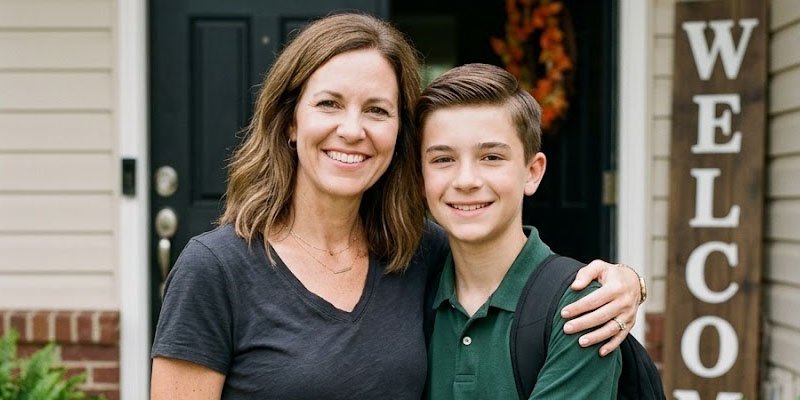
Monday morning, Noah came downstairs wearing his new sneakers and carrying the backpack he had spent almost an hour deciding on.
He reached the front door and suddenly stopped.
“Aren’t you forgetting something?”
I looked around.
“Your lunch is already in your backpack.”
“The picture, Mom.”
I smiled and reached for my phone.
Before I could pull it out, Noah opened his lunch bag.
Inside was another yellow note.
Seventh grade. Please don’t become unbearable.
He looked at me with obvious offense.
“Seriously?”
“Extremely serious.”
He carefully folded the note and put it into his pocket.
Then he headed toward the front door.
“Okay,” he said. “Take the picture.”
I raised my phone.
He stood there doing his best not to smile.
For years, I had believed that protecting Noah meant shielding him from every unpleasant adult emotion.
That weekend showed me something else.
Sometimes protecting your child isn’t about carrying every burden for them.
Sometimes it means removing the burden from their hands—and returning it to the adults who put it there.