PART 1
Four days before Thanksgiving, my mother called me with a strange request.
“No children this year, Daniel. Your father and I just want a peaceful dinner.”
I looked across the kitchen at my eight-year-old son, Noah, who was sitting at the table carefully picking marshmallows out of his cereal with the focus of a surgeon.
“No kids at all?” I asked.
“Adults only,” Mom answered. “No screaming, no toys, no children running through the house. We want one quiet holiday.”
Something about her request felt wrong, but I pushed the thought away.
“Okay.”
I was thirty-three, divorced, and raising Noah for most of the week.
He was energetic, but he wasn’t badly behaved. He loved dinosaurs, hated mashed potatoes, and had recently discovered knock-knock jokes, which meant I listened to dozens of them every day.
My mother, however, had always been much harder on him than she was on my sister Vanessa’s three children.
Vanessa had always been the favorite.
Nobody ever admitted it directly.
They didn’t need to.
The favoritism appeared in the little things.
Vanessa’s graduation included balloons, a restaurant reservation, and an expensive cake.
Mine was pizza at home because Dad had to work early.
When Vanessa bought her first house, Mom spent two weeks helping her decorate.
When I moved after my divorce, Mom simply told me:
“You’re independent. You’ll figure it out.”
For years, I believed that was meant as praise.
Eventually, I understood it was an excuse for giving me less.
The evening before Thanksgiving, I called Mom again.
“Just confirming. No kids tomorrow, right?”
She laughed.
“Yes, Daniel.”
“So Vanessa’s children won’t be there either?”
There was a tiny pause.
Barely noticeable.
Then she repeated:
“It’s an adults-only dinner.”
So I hired Rachel, Noah’s usual babysitter.
When I told him he would be staying home, Noah grinned.
“Can we order pepperoni pizza?”
“On Thanksgiving?”
“That makes it special.”
I laughed and promised him pizza.
Before leaving the next afternoon, I kissed the top of his head.
“You good without me for a couple of hours?”
“Dad, I’m eight.”
“Right. Basically middle-aged.”
He rolled his eyes.
I drove toward my parents’ house feeling unexpectedly hopeful.
Maybe without children around, we could actually have a conversation.
Maybe Dad and I could watch football.
Maybe Vanessa and I could make it through dinner without competing.
My parents’ house looked exactly as it always had.
White siding.
Green shutters.
A wreath hanging on the front door.
Warm light shining through the windows.
For a moment, it felt like home.
Then I stepped onto the porch.
Before my hand reached the doorknob, I heard footsteps racing around inside.
Then laughter.
Children’s laughter.
I froze.
The door swung open.
A little boy in socks nearly ran straight into me.
“Uncle Daniel!”
It was Vanessa’s oldest son.
Behind him, his brother raced down the hallway holding a plastic sword.
Then I heard their sister happily screaming somewhere near the kitchen.
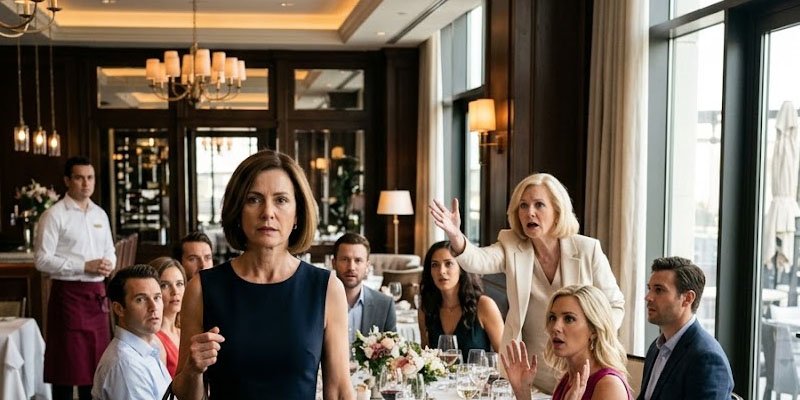
All three children were there.
At the supposedly child-free Thanksgiving dinner.
Then I saw Vanessa standing behind them with a glass of wine.
She looked straight at me.
And smiled.
Not nervously.
Not apologetically.
Smugly.
That was when I understood.
The rule had never been “no children.”
The rule had been no Noah.
PART 2
I stood in the entryway without even taking off my coat.
One of Vanessa’s sons ran past me yelling about pirates.
Another slammed a toy sword against the wall.
From the kitchen Mom called:
“Daniel? You’re here!”
I walked toward her.
The entire house smelled of turkey, stuffing, cinnamon candles, and homemade gravy.
Normally, those smells would have reminded me of childhood.
That afternoon, they made me feel sick.
Mom stood beside the stove.
Dad was carving the turkey.
Vanessa casually leaned against the doorway.
Three children’s cups were sitting near the sink.
Three small coats hung by the entrance.
Three additional chairs had already been placed around the table.
Nobody had been caught off guard by their presence.
“Mom.”
She looked back.
“Oh, good. Dinner’s almost ready.”
“You told me no children.”
Her spoon paused for half a second.
Then she went back to stirring.
“Yes, well…”
“Why are Vanessa’s kids here?”
Mom finally turned around.
She didn’t look guilty.
She looked irritated that I was challenging her.
“Daniel, please don’t start.”
“Start what?”
“It’s Thanksgiving.”
“I’m aware.”
Vanessa took another drink of wine.
Mom sighed.
“We decided it was easier for Vanessa to bring them.”
I stared at her.
“You decided that after making me hire a babysitter for Noah?”
“Daniel—”
“I called you last night.”
Dad placed the carving knife down.
“Let’s not turn this into a whole thing.”
I looked at him.
“A whole thing?”
Vanessa cut in.
“Relax. My sitter canceled. What did you expect me to do?”
“You could’ve called me.”
Mom shrugged.
“We didn’t think it mattered.”
That hurt more than I expected.
“You didn’t think it mattered that I paid someone to watch my son because you specifically told me children weren’t invited?”
“You’re making it sound ugly.”
“I’m only describing what happened.”
At that exact moment, one of Vanessa’s sons slammed into a dining chair and nearly knocked over a glass.
Mom gave him a sweet smile.
“Careful, sweetheart.”
I laughed.
Mom frowned.
“What?”
“You wanted a quiet dinner.”
Her face turned red.
“Vanessa’s children know how to behave.”
I stared at her.
“What did you just say?”
“Her children behave.”
Another crash came from behind me.
Then loud, excited laughter.
“You cannot be serious.”
“Noah is a wonderful boy,” Mom said, “but he can be… a lot.”
“He’s eight.”
“He interrupts. He gets excited.”
“And Vanessa’s kids don’t?”
Vanessa rolled her eyes.
“God, Daniel. You’re so sensitive.”
Dad stepped between us.
“Can we just sit down and eat?”
That was always my family’s solution whenever something became uncomfortable.
Ignore it.
Sit down.
Eat.
Pretend nothing happened.
Dad quietly asked:
“Does Noah know why he isn’t here?”
“No. He thinks this is adults only because that’s what I told him.”
Dad looked away.
Somehow, that tiny movement told me everything.
He knew it was wrong.
But knowing and doing nothing were basically the same thing.
I pictured Noah sitting at home eating pizza while his cousins played inside his grandparents’ house.
Then I imagined him asking me tomorrow how Thanksgiving went.
I would have to lie.
That thought made my choice easy.
I reached into my pocket and pulled out my car keys.
Mom blinked.
“What are you doing?”
“Going home.”
“Daniel, don’t be ridiculous.”
“I have no reason to stay.”
“Oh, stop being dramatic.”
That word almost made me laugh.
I looked around the room.
Nobody apologized.
Nobody said I had a point.
Nobody admitted they had deliberately excluded my son.
Mom was simply angry because I refused to pretend.
I opened the front door.
Behind me she called:
“You’re really going to ruin Thanksgiving over this?”
I stopped.
Then I answered:
“No. I’m going home to my son.”
And I left.
I didn’t know it then, but that would be the last time I walked into my parents’ house believing I had to tolerate mistreatment simply because we were related.
Two days later, Vanessa asked me for money.
And that was when everything truly changed.
PART 3
When I arrived home, the living room was dark except for the television and the Christmas lights Noah had insisted we put up weeks early.
Rachel was sitting on the couch.
Noah was asleep beside her.
An empty pizza box rested on the coffee table.
One of his socks was missing.
“How was Thanksgiving?” Rachel whispered.
I looked at my sleeping son.
“Short.”
She must have seen something in my expression because she didn’t ask anything else.
After she left, I carried Noah upstairs.
He stirred as I tucked him into bed.
“Dad?”
“Yeah?”
“You got home early.”
“I did.”
“Did Grandma burn the turkey?”
Despite everything, I laughed.
“No.”
“Good.”
He fell asleep again.
I stood there looking at him.
At my parents’ house, I had been furious.
Standing beside Noah’s bed, that anger became something different.
Shame.
Not because I had walked away.
Because for years, I had quietly taught my son that it was acceptable for my family to treat us differently as long as they called themselves family.
The next morning, Mom texted.
Hope you’ve cooled down.
Not an apology.
Dad sent:
Call when you’re ready to talk calmly.
Apparently, leaving quietly instead of yelling still wasn’t considered “calm.”
I ignored both.
The weekend passed peacefully.
Noah and I went to the park.
We made grilled cheese.
We watched one of his superhero movies for what seemed like the hundredth time.
Then Sunday morning, Vanessa messaged me.
Random question. Can you loan us some money? Things are tight this month. I’ll pay you back.
I stared at my phone.
Then laughed.
The audacity was almost impressive.
Vanessa asking me for money wasn’t unusual.
Over the years, I had paid utility bills, helped with car repairs, bought groceries, and even contributed to her children’s activities.
She always promised to pay me back.
Sometimes she did.
Usually, she didn’t.
I had always told myself it didn’t matter.
Family helped family.
But forty-eight hours earlier, she had happily watched while her children enjoyed Thanksgiving in the same house where my son had been deliberately excluded.
So I typed:
Vanessa, I can’t help this time.
Her reply came immediately.
Why?
That one word annoyed me more than it should have.
As though Thanksgiving had never happened.
I answered:
Because you knew Mom excluded Noah while allowing your kids to come. You stood there and watched it happen. I’m not lending you money after that.
Her response arrived seconds later.
Seriously? You’re punishing my children because you’re mad about Thanksgiving?
There it was.
She had immediately turned herself into the victim.
I replied:
I’m not punishing your children. I’m refusing to be treated like an outsider and then treated like family whenever you need money.
She wrote:
We’ve always helped each other.
I sat up straighter.
Then I scrolled through years of messages.
Almost every conversation involved Vanessa asking me for something.
Can you watch the kids?
Can you cover this?
Can you drive Mom?
Can you help Dad?
Can you lend me money?
Then I searched for moments when she had helped me.
Almost nothing.
After my divorce, she had texted:
That sucks. Let me know if you need anything.
When I actually asked her to watch Noah while I met my attorney, she was busy.
When I moved, she had a headache.
When Noah had the flu and I was trying to manage work alone, she never checked in.
So I sent one final message.
No, Vanessa. We haven’t always helped each other. I’ve helped you. There’s a difference. Figure this one out yourself.
Then I put my phone down.
It buzzed again.
Then Mom started calling.
Eventually, I answered.
“What?”
“Daniel, what’s happening? Vanessa is extremely upset.”
Of course she was.
“She asked for help.”
“Then you help her.”
Silence.
Mom’s voice became softer.
“You know your sister is struggling.”
“And?”
“We’re family.”
I gripped the counter.
“Was Noah family on Thanksgiving?”
Silence again.
Longer this time.
“We already apologized,” Mom finally said.
“No, you didn’t.”
“Well, we’re sorry you’re upset.”
I almost smiled.
The classic apology from someone who regrets the consequences but not the behavior.
“I have to go.”
“You’re blowing this completely out of proportion.”
I looked into the living room.
Noah was sitting on the floor building something with plastic blocks.
He looked up and smiled.
Something inside me became completely still.
“No,” I said. “I think I’ve spent my whole life pretending it was smaller than it really was.”
For the first time, I could see the pattern clearly.
And once I saw it, there was no going back.
PART 4
Mom called again that evening.
This time I answered because I wanted the conversation to be over.
“We’re worried about you,” she said.
“Why?”
“You’re cutting your entire family off because of one dinner.”
“One dinner?”
“What else is this about?”
Her question genuinely stunned me.
Not because I didn’t have examples.
Because I had too many.
“Remember my high-school awards ceremony?”
“What about it?”
“You left early because Vanessa had dance rehearsal.”
“That happened years ago.”
“My college graduation? You said you couldn’t afford a hotel, so you left immediately after the ceremony. When Vanessa graduated six months later, you stayed all weekend.”
“The situations were different.”
“They always are.”
Then I reminded her about my divorce.
I had asked to stay at my parents’ house temporarily while I searched for an apartment.
Mom said Dad needed peace.
One year later, Vanessa renovated her kitchen and moved herself, her husband, and all three children into my parents’ home for six weeks.
Mom defended herself.
“Vanessa had three kids.”
“And I had Noah.”
“You’ve always been more independent.”
There was that word again.
Independent.
The word they used to justify giving me less.
“So because I learned to survive without your help, you decided I didn’t deserve any?”
“That isn’t fair.”
“No, Mom. It wasn’t.”
She went quiet.
Then she used her favorite phrase.
“You’re being dramatic.”
Normally, that would have led to another argument.
This time, it only exhausted me.
“I’m done.”
“Oh, Daniel.”
“No. Listen.”
My voice stayed calm.
“I’m finished competing with Vanessa for basic respect. I’m done being useful whenever someone needs money, childcare, transportation, or help moving furniture—and invisible whenever something good happens.”
“Nobody treats you like that.”
“You excluded Noah from Thanksgiving and invited all three of her children.”
“We had reasons.”
“You lied.”
“We changed our minds.”
“And didn’t tell me because you knew I’d bring Noah.”
Mom said nothing.
That silence was more truthful than anything else she had said.
Then she warned me:
“You can’t walk away from family.”
“Watch me.”
I hung up.
My hands shook afterward.
Then Noah walked in wearing astronaut pajamas.
“Dad?”
“Yeah?”
“Are you mad?”
“No.”
“You sound mad.”
I crouched beside him.
“I’m handling some grown-up stuff.”
“Grandma?”
Children hear more than adults realize.
“Yeah.”
He studied my face.
Then he asked something that broke my heart.
“Am I in trouble?”
“What? No.”
“Because I couldn’t go to Thanksgiving.”
My throat tightened.
“You didn’t do anything wrong.”
“Then why couldn’t I go?”
I could have told him everything.
Instead, I chose the simplest truth.
“Grandma made a decision that wasn’t fair. I’m talking to her about it.”
He thought for a moment.
Then asked:
“Did my cousins go?”
I paused too long.
His expression changed.
“Oh.”
That single word hurt worse than every insult my mother had thrown at me.
“Noah…”
“It’s okay.”
“No. Come here.”
I pulled him into my arms.
Eventually he squirmed.
“Dad, you’re crushing me.”
I let him go.
He started toward the stairs, then stopped.
“I don’t want to go somewhere if people don’t want me.”
He said it calmly.
Like it was simply a fact.
That night, I blocked Vanessa’s number.
Then I muted my parents.
It wasn’t revenge.
It was the first time I stopped begging people to value my son and me.
PART 5
One week later, Mom showed up at my house.
She hadn’t called.
When I opened the door, she looked exhausted.
“Can I come inside?”
“No.”
Her expression immediately changed.
“Daniel.”
“You should’ve called.”
“You don’t answer.”
“That doesn’t mean you can show up whenever you want.”
For years, her disappointed expression would have made me apologize.
Not anymore.
“I don’t understand what happened to you,” she said.
“What happened is I stopped pretending.”
“We’re your family.”
“You keep saying that as though it excuses everything.”
“It should mean something.”
“It does. It means I expected better.”
Her eyes filled with tears.
“Your father barely sleeps. Vanessa keeps crying. Everyone is miserable.”
“Is anybody upset about Noah?”
“Of course.”
“Has Vanessa apologized to him?”
Mom hesitated.
“She’s dealing with a lot.”
I nodded.
“That answers my question.”
Mom accused me of punishing everyone.
I explained that I wasn’t punishing anyone.
I was removing myself from something unhealthy.
Then she said:
“I love you.”
My chest tightened.
“I love you too.”
Relief crossed her face.
Then I continued.
“But loving you doesn’t give you unlimited access to me.”
Her relief disappeared.
“You’re going to regret this.”
“Maybe.”
“You’ll wake up and realize you lost your family.”
I glanced behind me.
Noah had built a cardboard fort in the living room.
His shoes were abandoned beneath the coffee table.
His toys covered the floor.
My family was already inside the house.
“No,” I answered. “I’m protecting the family I’m responsible for.”
Mom stared at me.
“You’re choosing Noah over us?”
The fact that she could even ask erased whatever doubt remained.
“Yes.”
She blinked.
“Every single time.”
Then, after all the tears and speeches, she finally revealed why she had really come.
“Vanessa needs help.”
I stepped backward.
“This is about money?”
“She has children to support.”
“So do I.”
“You’re doing well financially.”
“I worked for that.”
Mom believed that because I could survive, my resources should remain available to Vanessa.
I disagreed.
“Go home, Mom.”
“Daniel—”
“I’m not giving Vanessa money. I’m not apologizing for leaving Thanksgiving. And I’m not showing up at Christmas pretending none of this happened.”
Her face went pale.
“What about your father?”
“He knows my number.”
“What about me?”
“If you want a relationship with me, stop defending what happened and start understanding it.”
For several seconds, she stood there silently.
Then she turned and walked down the driveway.
Part of me wanted to call her back.
The old version of me.
The son who had spent decades trying to earn approval.
I let that part hurt.
Then I closed the door.
Noah appeared halfway down the stairs holding two controllers.
“Was that Grandma?”
“Yeah.”
“Is she mad?”
“Probably.”
He held up one controller.
“Want to play?”
I smiled.
“Absolutely.”
PART 6
The first month was more difficult than I expected.
Not because I regretted my decision.
Because silence leaves room for memories.
Without constant family emergencies, I started remembering everything.
Birthdays when Vanessa received twice as much.
School events Mom forgot.
The time Dad missed Noah’s first baseball game because Vanessa needed help assembling patio furniture.
Each memory seemed insignificant by itself.
Together, they created a pattern stretching back more than thirty years.
Dad occasionally sent messages about forgiveness.
Mom sent family photographs.
Vanessa switched between fake apologies and insults.
Sorry you misunderstood.
You’re selfish.
The kids miss you.
Hope you’re happy destroying the family.
Eventually, I blocked her completely.
And life became wonderfully boring.
Friday became movie night.
Sunday became pancake morning.
Noah decided he wanted to learn how to cook.
We burned bacon.
Ruined cookies.
Used way too much syrup.
And laughed.
Really laughed.
I also realized how much time I had previously spent mentally managing my family.
Even when I was physically with Noah, part of my attention had always been somewhere else.
Fixing Vanessa’s problems.
Responding to Mom.
Worrying about Dad’s opinion.
Preparing for the next family conflict.
Without that noise, I became more present.
Three months after Thanksgiving, an envelope arrived.
Dad’s handwriting was on the front.
Inside were three handwritten pages.
No accusations.
No demands.
No guilt.
For the first time, my father admitted the truth.
He wrote that he and Mom had treated Vanessa differently.
They always convinced themselves she needed more.
More reassurance.
More help.
More money.
More attention.
And because I seemed capable, they assumed I needed less.
Then Dad wrote one sentence I read repeatedly:
We confused your ability to survive without our support with not needing our support.
It didn’t erase the past.
But finally, someone had named the real issue.
Favoritism.
Dad apologized to both me and Noah.
Then he promised he wouldn’t contact me again unless I wanted him to.
Two weeks later, I called him.
The conversation wasn’t dramatic.
Mostly awkward silence.
But he apologized again.
“I should’ve stopped your mother that Thanksgiving.”
“Yes.”
“I knew it was wrong.”
That hurt.
“Why didn’t you?”
“I didn’t want a fight.”
“So you let me take the hit.”
“Yes.”
Oddly, his refusal to defend himself meant something.
Before hanging up, he asked:
“Can I call again sometime?”
I stared outside.
“Maybe.”
It wasn’t forgiveness.
It was a door opened one inch.
And this time, I controlled how far it opened.
PART 7
Dad respected my boundaries.
He called occasionally.
Sometimes I answered.
Sometimes I didn’t.
He began asking about Noah’s baseball games and school projects.
Once, he mailed Noah a dinosaur book.
There was no guilt attached.
No request for a visit.
Just the book.
Mom struggled more.
She wanted everything restored without doing the work necessary to rebuild it.
She wanted family dinners.
Christmas photographs.
Normal holidays.
She wanted to jump directly from “we hurt you” to “everything is fine.”
I refused.
Eventually, however, something changed.
She stopped demanding.
She started asking.
Could she call Noah on his birthday?
Could she mail him something?
Would I meet her for coffee?
Sometimes I said yes.
Sometimes I said no.
Eventually she learned that “no” was a complete answer.
Vanessa learned nothing.
According to Dad, she still blamed me for her financial problems.
Apparently, because I had always helped before, she assumed I always would.
She wanted Dad to convince me to unblock her.
I asked one question.
“Has she apologized to Noah?”
Silence.
“Then no.”
I didn’t hate Vanessa.
Hatred required energy I no longer wanted to waste.
I simply stopped trusting her with access to my life.
Months passed.
Then Thanksgiving approached again.
One evening, I saw frozen turkeys stacked inside the grocery store.
For a second, I remembered standing in my parents’ hallway hearing my nieces and nephews laughing.
But this time the memory felt far away.
And suddenly I realized something.
Leaving my parents’ Thanksgiving hadn’t meant losing Thanksgiving.
I could create my own.
So Noah and I invited people who might otherwise spend the holiday alone.
My friend Marcus.
Noah’s best friend and his mother, Leah.
Our older neighbor, Mr. Bennett, whose wife had died earlier that year.
Thanksgiving morning became chaos.
Wonderful chaos.
The turkey took too long.
Noah spilled flour while making biscuits.
Marcus brought a pie that looked like it had survived a traffic accident.
Kids ran through the living room.
Someone spilled juice.
Music filled the kitchen.
At one point, Noah and his friend laughed so loudly I could hear them upstairs.
I stood beside the stove remembering Mom’s original words.
No kids.
We want a quiet dinner.
I looked around my noisy house.
And smiled.
Because noise had never been the problem.
The problem had always been whose children were allowed to make it.
PART 8
Dinner was crowded.
Our table was too small, so Marcus unfolded a cheap card table beside it.
Nothing matched.
Mr. Bennett’s folding chair squeaked whenever he moved.
Noah argued with his friend over the biggest dinner roll.
Leah dropped a spoon.
Marcus nearly spilled the gravy.
It was loud.
Messy.
Imperfect.
And one of the best Thanksgivings of my life.
Halfway through dinner, Noah leaned toward me.
“Dad?”
“Yeah?”
“This is better than pizza.”
I pretended to look offended.
“Last year you said pizza was perfect Thanksgiving food.”
“I was younger.”
“That was twelve months ago.”
“I’ve changed.”
I laughed.
Later, as everyone was leaving, Mr. Bennett stopped at the doorway.
“Thank you.”
“For dinner?”
“For making sure I didn’t spend today alone.”
After everyone left, my house looked destroyed.
Dirty plates covered the counters.
Crumbs filled the floor.
Half a pie remained untouched.
Toy cars were underneath the couch.
Then my phone buzzed.
Dad.
Happy Thanksgiving. Hope you and Noah had a good day. Love you both.
That was all.
No guilt.
No manipulation.
No mention of Vanessa.
I answered:
Happy Thanksgiving. We had a great day. Hope you did too.
Mom also texted.
Please tell Noah I love him.
I replied:
I will.
Nothing more.
Months earlier, I would have felt obligated to call.
To reassure her.
To make everything comfortable.
Now I understood something different.
Kindness didn’t require surrender.
That evening, I found a construction-paper turkey Noah had made for school.
Each feather listed something he was thankful for.
Pizza.
Video games.
Friends.
Our house.
And on the biggest feather:
Dad.
I stared at it longer than I expected.
For most of my life, I had wondered whether I was good enough for my parents.
Helpful enough.
Successful enough.
Patient enough.
Forgiving enough.
I had compared myself to Vanessa so often that I barely noticed anymore.
Then Noah appeared at the bottom of the stairs.
“You found my turkey.”
“I did.”
“It’s good, right?”
“The greatest turkey ever created.”
I pointed toward the largest feather.
“You put me.”
He looked confused.
“Obviously.”
“Obviously?”
“Yeah. You’re my dad.”
He said it as though that explained everything.
Maybe it did.
The following year, Dad slowly became part of our lives again.
Not like before.
I didn’t want the old normal.
He asked before visiting.
He occasionally took Noah to breakfast.
I remained cautious.
Because trust isn’t rebuilt simply by saying “sorry.”
It is rebuilt when better behavior becomes consistent.
Mom changed more slowly.
Whenever she slipped into old comparisons, I ended the conversation.
Not angrily.
Firmly.
Eventually she began learning.
Vanessa and I never reconciled.
Relatives occasionally told me life was short.
That siblings shouldn’t stay angry.
That I should “be the bigger person.”
My answer remained the same.
“I wish Vanessa well. That doesn’t mean she gets access to me.”
Eventually, everyone stopped asking.
I didn’t need Vanessa to understand my boundary.
She only needed to respect that it existed.
And I never again allowed anyone to treat Noah like the lesser grandchild while expecting me to smile through dinner.
That entire change in my life began with one sentence:
“No kids. We want a quiet Thanksgiving.”
For years, I believed family meant endurance.
Swallow the insult.
Accept the favoritism.
Show up anyway.
Help everyone.
Forgive quickly.
Keep the peace.
Now I understood something else.
Love without respect eventually becomes obligation.
Family without fairness becomes hierarchy.
And peace that requires you to make yourself smaller isn’t peace at all.
The second Thanksgiving night, after everyone left and Noah went to sleep, I stood alone in my kitchen.
The house was finally quiet.
But it wasn’t the cold silence I had felt after leaving my parents’ house the year before.
This silence was warm.
Safe.
Mine.
I hadn’t destroyed my family.
I had simply stopped participating in the version of it that required my son and me to accept less.
Dad chose to rebuild something healthier.
Mom slowly learned that access came with responsibility.
Vanessa chose not to change, so she remained outside my life.
And eventually, I became comfortable with all three outcomes.
Before going to bed, I checked on Noah.
He was asleep diagonally across the mattress with one foot sticking out from beneath the blanket.
I pulled the blanket over him.
Then I remembered that first Thanksgiving.
The babysitter.
The drive to my parents’ house.
Children laughing behind the door.
Mom insisting Vanessa’s children behaved better.
My sister smiling.
And me walking away.
For months, I wondered whether leaving that house had cost me my place in the family.
Eventually, I understood the truth.
I never needed to beg for a place where my son and I were treated as optional.
I didn’t lose my seat at their table.
I stopped begging for one—and built a better table of my own.
THE END.