
I drove to Lake Norman on a gloomy Tuesday morning after the porch roof of my late wife’s cabin began leaking.
Margaret had been gone for three years. The cabin was the one place I had left almost untouched. Her coffee mug still sat beside the sink. Her blue raincoat was still hanging on the hook near the mudroom.
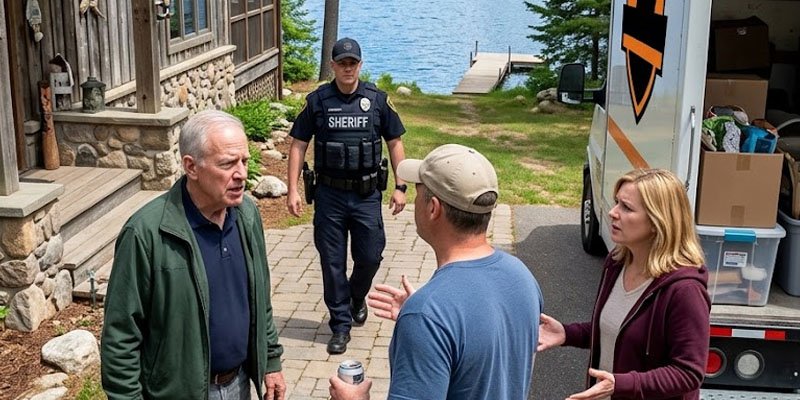
So when I turned onto the gravel driveway and spotted a U-Haul backed up against the porch, I thought I must have pulled into the wrong property.
Then I saw my son-in-law’s parents carrying boxes through the front door.
Ron Mercer put down a lamp, cracked open a beer, and smiled.
“Morning, Tom.”
“What are you doing inside my house?”
His wife, Linda, stopped in place with a box labeled KITCHEN.
Ron took another sip.
“Derek gave us the entry code. This cabin is going to be ours anyway.”
I looked at him.
“My daughter’s husband gave you permission to move into property that he doesn’t own?”
Ron simply shrugged.
“Claire inherits it. Derek says they’re transferring everything over. We’re retiring up here.”
I walked over to the keypad.
The code had been changed from Margaret’s birthday to the final four digits of Derek’s phone number.
That was when I stopped trying to argue.
At 10:26 a.m., I called the Iredell County Sheriff’s Office and reported unauthorized people occupying my property.
Ron laughed.
“You’re actually calling the police on family?”
“No,” I said. “I’m calling them about trespassers.”
Eleven minutes later, a sheriff’s SUV pulled into the driveway.
Deputy Aaron Mills told everyone to step outside.
I showed him my driver’s license, the property-tax statement, and the certificate for the Hale Family Trust.
Margaret and I had transferred the cabin into the trust twelve years earlier.
I was the only trustee.
Claire would receive the property only after my death.
Linda looked over at Ron.
Ron stopped drinking.
Then he took a folded document from his pocket.
“Your son-in-law said this proves the cabin belongs to them.”
Deputy Mills examined it and frowned.
It was a quitclaim deed transferring the cabin from the Hale Family Trust to Derek and Claire Mercer.
My signature appeared at the bottom.
So did Margaret’s.
I stared at the date.
Margaret was supposedly listed as having signed it six months earlier.
She had been dead for three years.
My phone rang.
It was my attorney, Rebecca Shaw.
“Tom,” she said, “don’t let anyone leave with those documents. We have a much bigger problem.”
Rebecca arrived before Derek did.
She photographed the deed, forwarded a copy to the county recorder, and asked Deputy Mills to preserve Ron’s copy as evidence.
Then she pulled me aside.
“Someone recorded this deed last Friday. Yesterday, a lender received an application to take out a loan against the cabin.”
“How much?”
“Three hundred twenty thousand dollars.”
For a moment, the only sound I could hear was the water moving against the dock.
Derek arrived twenty minutes later with Claire.
My daughter stepped out of the car in tears.
“Dad, please don’t do this with everyone watching.”
I raised the deed.
“Did you sign this?”
She glanced at Derek.
That told me enough.
Claire admitted that Derek had given her a stack of papers two weeks earlier. He told her they confirmed she would eventually inherit the cabin. She signed an affidavit without reading the attachments.
“I thought it was for estate planning,” she whispered.
Rebecca faced Derek.
“And Margaret Hale’s signature?”
He crossed his arms.
“Margaret wanted Claire to have the cabin.”
“That’s not what I asked.”
Deputy Mills asked Derek whether he had changed the keypad code.
He admitted that he had because his parents needed access “for maintenance.”
Maintenance did not explain a sectional sofa, three suitcases, and an entire U-Haul.
Then Rebecca’s phone buzzed.
The lender had stopped the $320,000 loan before any money was released.
But the title package contained something even worse.
A trustee certification stated that I had resigned because of cognitive decline and that Derek had been appointed in my place.
Attached to it was a letter supposedly written by a physician.
I recognized the doctor immediately.
Dr. Steven Marks had been Margaret’s oncologist.
He had died eighteen months earlier.
Claire put a hand over her mouth.
Derek said, “I didn’t prepare that.”
Rebecca opened her laptop.
“The metadata shows it was created on your office computer.”
Then Linda turned toward her son.
“Tell them why you needed the money.”
Derek’s expression hardened.
“Mom.”
“You told me it was temporary until the development deal went through.”
Rebecca looked at her.
“What development deal?”
Linda pulled a glossy brochure from her purse.
A luxury lakefront developer had offered $1.8 million for the cabin and the adjoining acreage.
The closing was set for the following Monday.
The seller named in the contract was not me.
It was Derek Mercer, Trustee.
Then Claire showed me a message Derek had sent Ron that morning:
Get moved in today. Once Tom sees people living there, he’ll be easier to pressure into signing.
The next message from Ron read:
If he refuses, we use the competency papers.
I had expected arrogance.
I had not expected them to have a scheme designed to erase me from my own life while I was still alive.
The sheriff did not arrest everyone right away.
He separated us, collected statements, photographed the U-Haul, copied the documents, and instructed Ron and Linda to leave with their belongings.
They were gone before sunset.
Derek did not leave with Claire.
She came home with me.
The next morning, Rebecca filed an emergency action to invalidate the deed and prevent any sale or lien.
The county recorder placed a flag on the title.
The lender preserved the loan application, emails, identification records, and electronic signatures.
Within a week, investigators searched Derek’s office.
They discovered draft versions of Margaret’s signature, the fraudulent physician’s letter, the false trustee certification, and emails exchanged with the notary who had stamped the deed.
They also uncovered messages between Derek and Ron discussing how older homeowners could be declared incompetent if relatives “documented enough confusion.”
That part stayed with me.
They had not merely wanted the cabin.
They were constructing a narrative that I was too old to remain in control of my own property.
The notary admitted Derek had paid him $6,500 to certify signatures he had never actually witnessed.
Ron admitted he knew the development contract could not close without my consent.
He claimed that moving into the cabin was only intended to “encourage a family discussion.”
The forged deed was canceled.
The $320,000 loan was never funded.
The $1.8 million development deal fell apart because Derek had no legal authority to sell the property.
Derek pleaded guilty to forgery, attempted real-estate fraud, identity theft, and conspiracy. He received prison time, probation following his release, restitution, and legal costs.
Ron pleaded guilty to conspiracy and attempted fraud. He received probation, community service, and restitution.
Linda was not charged after investigators determined that Derek had deceived her about who actually owned the property.
Claire filed for divorce before Derek was sentenced.
But our relationship did not magically heal.
She had signed documents without reading them because trusting Derek had felt easier than coming to me with a difficult question.
For months, I struggled to separate her mistake from the scheme he had created.
We began counseling.
Slowly, Claire learned that saying sorry did not mean forgiveness had to come immediately.
And I learned that protecting myself did not mean I had to punish her forever.
I kept the cabin.
The following spring, Claire came up by herself and helped me repair the porch roof I had originally driven there to fix.
When we finished, she found Margaret’s old blue mug and set it on the table between us.
“Mom would hate what happened here,” she said.
“Yes.”
“She’d hate it even more if we let them take this place from us twice.”
That was when I decided to keep it within the family.
I rewrote the trust.
After I’m gone, the cabin will pass into a family trust for Claire and any future grandchildren, overseen by an independent trustee.
Not because I stopped loving her.
Because love and protection can both be written into the same document.
People remember Ron standing in my driveway with a beer, telling me the cabin would belong to them anyway.
They remember the sheriff arriving eleven minutes later.
They remember Margaret’s forged signature, placed on a document three years after her death.
But the moment that stayed with me most happened months later, when I stood on Margaret’s repaired porch and listened to the lake moving through the trees.
An inheritance is not something you claim simply because you expect to receive it.
It is something another person deliberately chooses to leave behind.
Until that day, the cabin was still mine.
The deed was still mine.
And the door code was still mine.