
Part 1:
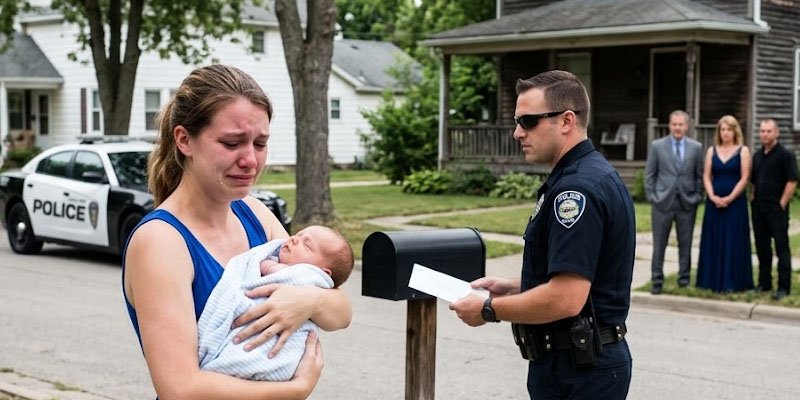
I became a widow while I was still carrying my baby. Three days after giving birth, I brought my newborn daughter home—and discovered that my entire house had been painted black.
Then a police officer found an envelope inside my mailbox.
My daughter’s name was written across the front.
What it contained changed everything I believed about my husband’s death.
I was seven months pregnant when Daniel died.
One evening, we were laughing and arguing about baby names, joking about how stubborn we both were.
The following evening, a state trooper appeared at my front door and told me there had been an accident.
I barely remember the funeral or the weeks that followed.
Everything became a blur.
People brought meals.
Relatives embraced me.
Someone took care of the flowers.
Someone else discussed insurance.
I nodded whenever anyone spoke because I had no energy left to do anything else.
Only one thought kept me going.
I had to survive for my baby.
When my daughter was finally born two months later, she became the reason I managed to get out of bed each morning.
The hospital released us after three days.
I remember sitting in the passenger seat with her tiny body secured in the car seat beside me, thinking about how strange it was to take her home without Daniel.
He had spent months getting that house ready for her.
He painted the nursery.
Put the crib together.
He even repaired the porch columns himself because he wanted everything to be perfect before his daughter arrived.
But as I turned onto our street, something immediately felt wrong.
Neighbors were standing outside their homes.
Nobody waved.
Nobody smiled.
Every one of them was staring toward my house.
Then I saw it.
The entire front of my house was black.
The porch.
The door.
The railing.
Even the white columns Daniel had spent an entire summer sanding and repainting.
Every surface had been coated overnight with thick black paint.
I stopped breathing.
For a moment, I genuinely thought I had somehow turned onto the wrong street.
Then my daughter started fussing behind me.
I got out of the car and held her against my chest as tears filled my eyes.
Who would do something like this?
My husband had been dead for two months.
I had just given birth.
Someone had deliberately waited until the very day I brought his daughter home to ruin the front of the house he loved.
There was no message on the walls.
No shattered windows.
Nothing had been taken.
Only black paint.
The neighbors had already contacted the police.
Two officers arrived within minutes.
One began speaking with me while the other went around the property.
Then the second officer stopped beside my mailbox.
“Ma’am?”
Something about his tone suddenly changed.
I walked over to him, still holding my daughter against my chest.
Inside the mailbox was a small white envelope.
No stamp.
No address.
Only one name, carefully written across the front.
Nora.
My daughter’s name.
She was only three days old.
Almost no one even knew what I had chosen to name her.
The officer looked at me.
“I think you should open that.”
My hands trembled so badly that I could barely get a finger beneath the flap.
I didn’t recognize the handwriting.
That scared me more than anything else.
Who writes the name of a three-day-old baby on an envelope and leaves it outside her mother’s vandalized home?
Inside was a single folded sheet of paper.
I unfolded it.
The officer remained beside me.
The message started:
I am sorry about your house.
I continued reading.
I didn’t know another way to make you stop before it was too late.
My heart began racing.
Then I reached the sentence that made my knees go weak.
Daniel did not die in an accident.
I pulled Nora closer.
The rest of the message was even more terrifying.
Do not sign anything.
Do not trust the man who is coming to your house with papers.
I painted your house black so everyone on this street would look at it—and at you—when he comes.
He will not do in front of witnesses what he planned to do in private.
I am watching too.
You are not alone.
Trust your neighbors. Trust the officer reading this beside you.
And then came the final warning:
Do not trust family.
There was no signature.
I read the message twice.
When I finally raised my eyes, the officer’s entire expression had changed.
He was no longer treating this as a simple vandalism report.
He looked alert.
Worried.
Serious.
“Ma’am,” he said quietly, “I need you and the baby to sit in my patrol car for a few minutes. I’m going to make some calls.”
Part 2:
I stared at him.
His voice became gentler.
“And I want you to understand something. From this point forward, you are not dealing with this by yourself.”
I didn’t understand what was happening.
But I understood those words.
So I followed him.
His name was Officer Reyes.
Sitting in the back seat with Nora in my arms, I tried to figure out what the note could possibly mean.
Daniel was supposedly killed in a single-car accident.
Late at night.
On a rural road.
His vehicle had gone off the pavement and crashed into a tree.
That was the story I had been given.
Yet even then, something about it had never felt right.
Daniel was the most cautious person I knew.
He wore his seat belt even when moving the car from our driveway into the garage.
He never drove after drinking.
He hardly ever sped.
And no one had ever explained why he was on that particular road at eleven o’clock at night.
Whenever I asked, Daniel’s older brother Marcus always gave me the same uncertain response.
“He was probably running an errand.”
Marcus had taken control of everything after Daniel’s death.
The funeral.
Insurance conversations.
Estate documents.
Bank paperwork.
At the time, I was thankful.
I was heavily pregnant and barely able to function.
Marcus repeatedly told me:
“Don’t worry about any of this. You focus on the baby.”
So I did.
He brought documents for me to sign.
He called them formalities.
Things that had to be completed so Daniel’s estate could move forward without problems.
And I signed some of them without carefully reading them.
Now that fact terrified me.
Do not sign anything.
Do not trust family.
Officer Reyes returned about fifteen minutes later and got into the front seat.
He turned around to face me.
“I need to tell you some things,” he said. “I’m going to do my best not to frighten you unnecessarily, but I’m not going to keep information from you either.”
I nodded.
“I pulled your husband’s accident report.”
My stomach tightened.
“There are things in it that concern me. Apparently, the officer who responded had questions as well, but the case was closed very quickly.”
He stopped for a moment.
“Was there life insurance?”
“Yes.”
“How much?”
“A lot. Daniel and I both bought policies after I became pregnant. He said that if something happened to either of us, the surviving parent and the baby needed to be protected.”
“Who is Daniel’s beneficiary?”
“Me. Then Nora.”
Officer Reyes became completely still.
“And if something happened to you before Daniel’s estate was settled, who would manage that money for your daughter?”
I opened my mouth.
Then I stopped.
The answer came to me before I wanted it to.
“Marcus.”
My whole body went cold.
“He’s been handling everything.”
Officer Reyes listened without saying anything.
“He had me sign papers. I don’t even know exactly what I signed.”
My voice started trembling.
“If something happened to me and he had guardianship…”
I couldn’t finish the sentence.
Officer Reyes leaned closer.
“Breathe. You and the baby are safe right now.”
Then he asked me to tell him everything Marcus had done since Daniel died.
So I told him.
Every document.
Every visit.
Every reassurance.
Every strange moment I had dismissed because grief had left me too exhausted to question anything.
When I finished, Officer Reyes looked even more troubled.
He made another phone call.
This time, a detective was on the way.
He instructed me not to sign anything else.
Not to allow Marcus inside the house.
Not to be alone with him.
And under no circumstances was I to let him near Nora unless someone else was present.
Then, that afternoon, Marcus showed up.
Exactly as the anonymous message had predicted.
His car stopped in front of my house.
He got out carrying a leather folder.
From inside, I watched him take in the scene.
My house covered in black paint.
Neighbors gathered outside.
A police cruiser in the driveway.
Officer Reyes inside.
And now Detective Alvarez, who had arrived to examine the situation.
Marcus stopped walking.
Only for a moment.
But I noticed.
He had expected to find a grieving woman, only three days after giving birth, sitting alone inside a quiet house.
Instead, he found an audience.
Then he composed himself, walked to the door, and knocked.
Officer Reyes answered.
Marcus sounded surprised.
“What happened here?”
“Active investigation,” Reyes replied.
“Is she okay? I came to see my sister-in-law and the baby.”
“She’s resting.”
“I only need a few minutes.”
Marcus raised the folder.
“There are some documents she needs to sign. Time-sensitive estate issues.”
From the next room, I felt nauseated.
He kept talking.
“If she doesn’t sign today, she could lose certain protections. I’m only trying to take care of her and the baby.”
Time-sensitive.
Today.
For her protection.
Those were exactly the kinds of expressions he had used during the previous two months.
Only now, I heard them in a completely different way.
Detective Alvarez went outside and spoke with him.
Marcus eventually left.
But he took the leather folder with him.
That was important.
Detective Alvarez returned and sat across from me.
“I asked him to leave the documents so we could examine them.”
“He wouldn’t?”
“No.”
She paused.
“I did see the first page.”
I pulled Nora closer.
“What was it?”
“A guardianship and financial authority designation.”
My stomach sank.
“Naming Marcus.”
“Yes.”
She leaned toward me.
“And he wanted your signature today.”
I couldn’t say anything.
Detective Alvarez continued carefully.
“I don’t want to frighten you unnecessarily. But based on what we know right now, someone may have saved your life by painting this house black.”
I stared at her.
“And I don’t think you and your daughter should stay here tonight.”
The police arranged a hotel room under another name.
That night, Nora slept in a bassinet beside my bed while I stared at the ceiling.
Who had written that message?
Who knew Marcus was coming?
Who knew about the paperwork?
Who knew enough to believe that I was in danger?
And why paint the house?
Why not call me?
Why not knock on the door?
It took months before I learned the complete truth.
Daniel’s accident was reopened.
And once investigators examined it closely, the original explanation began to collapse.
Investigators found evidence that another vehicle had struck Daniel’s car from behind before it left the road.
There was paint transfer that had previously been missed.
Damage that did not match a straightforward accident.
Then detectives obtained Daniel’s phone records.
Two hours before his death, Marcus had sent him a text.
He asked Daniel to meet him on that rural road.
Late at night.
To talk about money.
That was when everything began falling into place.
Marcus was drowning in debt.
Daniel knew about it.
Apparently, Daniel had helped his brother in the past, but shortly before his death, he had finally refused to keep saving him.
Marcus knew about Daniel’s life insurance.
He knew I was the beneficiary.
He knew Nora was next after me.
And once Daniel died, Marcus immediately inserted himself into our financial affairs.
He became the helpful brother.
The person handling paperwork.
The man telling the pregnant widow to rest.
Little by little, he moved toward gaining control of the estate.
All he needed was one final document granting him guardianship and financial authority.
And after that, only one person would have stood between him and everything Daniel had left behind.
Me.
The anonymous message had warned:
He will not do in front of witnesses what he was going to do in private.
Someone had understood exactly what Marcus was preparing.
And they had transformed my house into a public spectacle so he could no longer act in secret.
Marcus was arrested.
Investigators assembled the case through phone records, financial evidence, vehicle damage, accident reconstruction, and the documents he had tried to get me to sign.
Eventually, he was charged with Daniel’s murder, fraud, and several related offenses.
But one question continued to haunt me.
Who had painted my house?
Months into the investigation, I finally learned the answer.
Her name was Eleanor.
She lived directly across the street.
She was an elderly woman I had known for years in the ordinary way neighbors know one another.
We waved.
Talked about the weather.
Sometimes talked about her flowers.
Nothing more.
Then one afternoon, after Marcus had already been arrested, Eleanor came to my house.
By then, I had painted the house white again.
She sat at my kitchen table and told me everything.
Eleanor suffered from insomnia.
“I’m old,” she told me. “Old people don’t sleep much.”
Most nights, she sat in a chair near her front window with a cup of tea.
She had lived on that street for forty years.
Watching the neighborhood had become part of her nighttime routine.
After Daniel died, Eleanor began noticing Marcus.
He came to my house at unusual times.
Once, while I was at the hospital because doctors thought I might go into early labor, Eleanor watched Marcus unlock my front door around midnight.
He remained inside for nearly two hours.
When he came back out, he was carrying a box.
She found it strange.
But just like me, she blamed grief.
Then, three days before I returned home with Nora, Eleanor saw something that genuinely frightened her.
At around two in the morning, Marcus parked across from my house.
He didn’t leave the vehicle.
He simply remained inside.
Watching.
For a long time.
Eleanor couldn’t explain precisely why, but she became convinced that he intended to hurt me.
She had no proof.
Only an instinct.
And she knew the police probably couldn’t do anything because an elderly neighbor felt uncomfortable about a man’s behavior.
So Eleanor spent two nights trying to decide what she could do.
Then she thought of something extraordinary.
She couldn’t make the police accept her suspicion.
But she could make the entire neighborhood pay attention.
If something dramatic happened to my house, everyone would look.
Neighbors would come outside.
Someone would contact the police.
And Marcus would arrive expecting privacy, only to discover dozens of witnesses.
So, during the night before I returned home, eighty-year-old Eleanor crossed the street carrying black paint.
She painted my porch.
My door.
The railings.
Even Daniel’s beautiful white columns.
She worked for hours.
She told me that she cried while doing it because she was terrified she was making a terrible mistake.
“What if I’m wrong?” she kept thinking.
“What if I destroy this poor widow’s house because I’m just a paranoid old woman?”
But she continued painting.
Then she wrote the message.
She addressed it to Nora because she knew a new mother would immediately open anything bearing her newborn’s name.
She left her name off it.
If she had been wrong, she was too ashamed for me to know that she had vandalized my home.
But if she had been right?
The paint would be irrelevant.
And Eleanor had been right.
Detective Alvarez later told me directly that the black paint had probably saved both my life and Nora’s.
Everything investigators eventually uncovered suggested that Marcus planned to gain control first.
Then another “accident” would happen.
Mine.
I sat across from Eleanor at my kitchen table as she apologized through tears.
“I’m so sorry about those columns,” she said. “Daniel worked so hard on them.”
Something inside me broke.
I stood.
Walked around the table.
And hugged her.
She continued apologizing.
I held her even tighter.
“Daniel spent one summer making those columns white,” I told her.
My voice broke.
“But I’ll spend the rest of my life being grateful that you painted them black.”
Because Daniel’s white columns were something my husband had built.
Eleanor’s black paint was something that protected his daughter.
There was nothing for me to forgive.
Nora is four years old now.
And there is one strange coincidence I still think about.
I chose her name by myself while lying in a hospital bed.
I had no idea that Nora was also the name of Eleanor’s mother.
When Eleanor discovered that, she cried.
She called it a sign.
I’m not sure I believe in signs.
But I believe in elderly women who can’t sleep and choose to trust their instincts.
Eleanor is Nora’s godmother now.
She still lives across the street.
Nora runs to her house almost every afternoon.
Eleanor always has cookies waiting.
Part 3:
The two of them often sit together in the same chair beside the window where Eleanor once watched Marcus sitting in the darkness outside my home.
An eighty-four-year-old woman.
A four-year-old girl.
Watching the street together.
And honestly, I can’t imagine a safer place for my daughter.
Marcus is in prison.
He will remain there for the rest of his life.
I attended every day of the trial.
By the end, I expected to feel hatred.
Instead, I felt something colder.
Pity.
I pitied a man who could place money above his own brother.
A man who could sit in the darkness watching the home of a pregnant widow and calculate how much she was worth if she died.
I do not forgive him.
Daniel’s murder is not mine to forgive.
But eventually, I released my hatred.
Hatred is another house you have to keep repainting.
I would rather spend that energy raising my daughter.
Sometimes I still think about the afternoon I returned from the hospital.
I remember turning onto the street.
I remember seeing my neighbors outside.
I remember seeing Daniel’s beautiful white house covered completely in black.
At that moment, I thought someone had done the cruelest thing imaginable to me.
A widow had brought her newborn home, and someone had vandalized the last place that still made her feel connected to her husband.
It looked like cruelty.
It looked like hatred.
It looked like the world attacking someone who was already down.
But it was precisely the opposite.
That black paint was one of the greatest expressions of love anyone has ever given me.
Because sometimes protection does not look gentle.
Sometimes love is desperate.
Sometimes it doesn’t come with perfect words or perfect tools.
Sometimes love looks like an eighty-year-old woman standing outside at three in the morning with a paintbrush, terrified that she might be wrong but even more frightened of what could happen if she chose to do nothing.
So if there is one lesson I took from everything that happened, it is this:
Look again.
Before deciding what something means, look again.
The frightening thing may actually be protecting you.
The stranger you barely notice may be the person quietly watching over you.
And something that seems like cruelty may ultimately be the reason you survived.
Someone painted my home black on the day I brought my newborn daughter home from the hospital.
I thought it was hatred.
It turned out to be love.
And because one sleepless old woman was courageous enough to trust what she saw, my daughter still has a mother who can walk across the street every evening and call her home for dinner.