PART 1
I knew Margaret was ill when we first met, but at twenty-seven, I never really believed her condition would eventually take her life.
She suffered from a rare autoimmune disease, yet somehow she made hospitals seem almost ordinary. She joked with the nurses and even gave her IV pole the name Stanley. Three weeks after we started dating, I accidentally typed “Margarine” instead of Margaret, and somehow the nickname stayed.
As her health declined, I became her driver, companion, and caregiver. I remained by her side through appointments, treatments, and everything in between.
Eighteen months after we met, I proposed while we were eating Chinese takeout on the floor of my apartment after one of her hospital stays.
Margaret cried.
I assumed that meant yes.
Instead, she quietly said, “No.”
She told me she loved me too much to marry me. If she died, she was afraid I would be left with medical bills, debt, and the burden of becoming a widower before I even turned thirty.
I told her we could talk to lawyers.
She still said no.
Six months later, I proposed again, and then once more on our third anniversary.
Each time, her answer was no.
Eventually, I stopped asking—not because I loved her any less, but because loving her also meant honoring her choice.
By thirty-one, her illness dictated almost every part of our lives. I cut back my hours at work, canceled trips, and used most of the savings I had intended for a house.
“You’re spending your future on me,” Margaret told me once.
“You are my future.”
Four years after we met, doctors recommended a risky surgery that could potentially improve her condition dramatically.
A week before the operation, Margaret reached for my hand from her hospital bed.
“Daniel. Marry me.”
I just stared at her.
After all those years of turning me down, she was proposing to me.
“What changed?”
She lowered her eyes toward our hands.
“I might not survive the surgery. If I don’t, I want to die as your wife, not your girlfriend.”
I told her she was going to make it.
“And if I do,” she replied, “then we’ll already be married. Efficient.”
I laughed, then started crying.
Three seconds later, I said yes.
PART 2
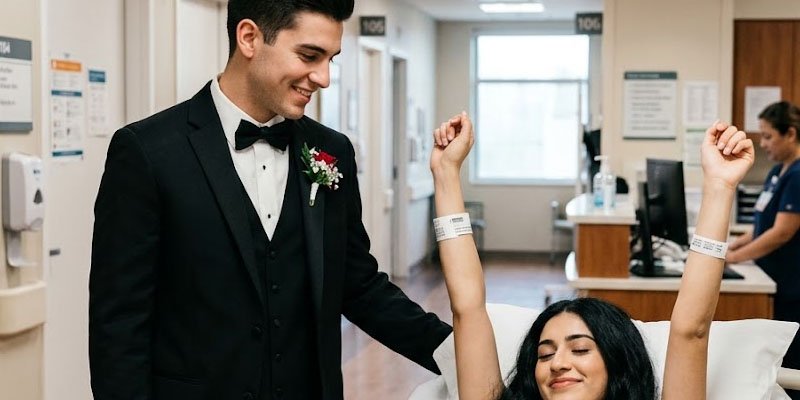
Our wedding was tiny, hurried, and absolutely perfect.
Our parents, closest friends, and several members of the hospital staff were there. One of the nurses tied a white ribbon around her bed rail. My mother showed up with a grocery-store cake covered in bright blue icing.
Margaret wore a white cardigan over her hospital gown. I wore the only suit I owned.
When I told her she looked beautiful, she looked down at her compression socks.
“Very bridal,” I teased.
“Shut up.”
When I placed the ring on her swollen finger, she smiled.
“My husband.”
“My wife.”
For those few minutes, she wasn’t a patient, and I wasn’t her caregiver.
We were simply newlyweds.
Six days later, Margaret entered surgery with that ring still on her finger.
“I’ll see you afterward,” I told her as they wheeled her away.
“You better.”
Those were the last words we ever said to each other.
The surgery went terribly. One complication led to another. Margaret was thirty-one when she died.
She had been my wife for six days.
A few weeks afterward, her family lawyer, Walter, called me.
“I think you should sit down.”
Margaret had prepared a will before the surgery.
Walter began reading.
“To my husband, Daniel, who spent years trying to give me more time when there was none left to give, I leave everything that remains of mine.”
Then he told me about Margaret’s secret.
Her grandfather had established a family trust. Margaret inherited an interest in it after her father died, but most of the money remained protected. She couldn’t simply take it out to cover her medical expenses.
If she died unmarried, her remaining share would go back to other relatives.
But if she had a legal spouse, that spouse could inherit it.
Her remaining share, together with a survivorship benefit, came to a little over $400,000.
I was stunned.
Then I was furious.
“She watched me drain my savings,” I said. “I sold my car. I worried about paying rent.”
Walter told me to keep listening.
Margaret had anticipated my anger.
“I didn’t tell you because you would have done something stupid and noble,” she had written. “You would have turned every dollar into another treatment.”
She was right.
PART 3
Walter kept reading.
Margaret mentioned the car, the house fund, and even the promotion in Chicago that I had turned down because she couldn’t leave her doctors.
“There is no later for me,” she wrote. “But there is for you.”
Then came her instructions.
“Buy the house. Not some practical condo you secretly hate. Buy the old house with the porch you’ve always wanted. Repair the floors. Get the dog I said we couldn’t have because I was allergic. Take the job if another one comes along. Travel somewhere without a hospital cafeteria.”
Then Walter read:
“And please eat something that isn’t instant ramen.”
I looked at the unopened ramen packet in my hand and began crying.
Margaret finally explained why she had always refused me. She had believed saying no to marriage was her way of protecting me. But before surgery, she realized she had spent years deciding which sacrifices I was permitted to make, just as I had decided which sacrifices were worth making for her.
“Yes, I wanted to die as your wife,” she wrote. “But I also wanted my final decision to give something back to the man who gave me everything he could.”
She said six days was hardly much of a marriage, but I had been her family long before any certificate officially made it so.
“Use what I left you to build the life I couldn’t stay for. That isn’t abandoning me.”
Her final sentence made me laugh even while I cried.
“I love you. I’m sorry. And yes, Margarine still isn’t funny.”
For several days, I was angry.
“You should have told me!” I yelled at her memory.
Eventually, I understood.
Margaret hadn’t been hiding money that we could have freely spent. Most of the trust had never been accessible. And the survivorship benefit became mine only because I was legally her husband.
She hadn’t married me to make me wealthy.
She married me because becoming my wife no longer meant leaving me with nothing except grief and financial hardship.
It meant she could leave me with a future.
I didn’t touch the money for nearly a year.
Then I found an old house for sale with peeling paint, crooked shutters, and a ridiculous porch that wrapped around the front.
I could almost hear Margaret saying, “Absolutely not.”
Three months later, I bought it.
I repaired the floors, painted the kitchen, and adopted a shelter dog with one floppy ear. I named him Stanley, after Margaret’s IV pole.
Four years have gone by.
Her wedding ring still rests beside mine.
Sometimes people learn that we were married for only six days, and they don’t know how to respond.
But we weren’t together for six days.
We were married for six days.
There is a difference.
For years, I believed I had been the one taking care of Margaret.
Only after she died did I realize that she had been taking care of me, too.
The greatest thing she left behind wasn’t $400,000.
It was permission.
Permission to continue living without feeling that moving forward meant leaving her behind.
Sometimes, when something breaks in the house, I still talk to her.
“You wanted me to buy this dump,” I’ll say.
And inside my head, I can hear her reply:
“No, Daniel. You wanted the stupid porch.”
She’s probably right.