
PART 1
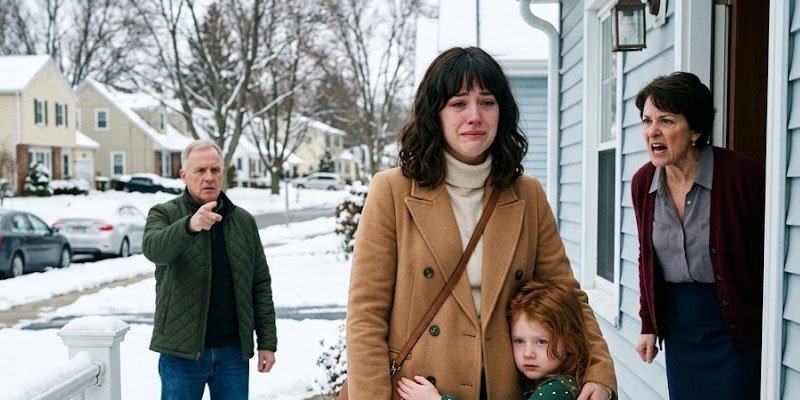
“We’re finished raising your mistake. Leave—and don’t come back.”
My mother said those words as my five-year-old daughter, Lily, stood just a few feet away in her purple pajamas.
For a moment, I thought Mom would realize just how cruel she sounded.
She didn’t.
My father, Richard, pulled open the front door of their Madison, Wisconsin, home. Snow blew across the porch, and the temperature had already dropped below twenty degrees.
“Dad,” I said, looking at the storm outside. “Lily doesn’t even have her boots.”
“You should have considered that before disrespecting us.”
And what exactly had I done that was supposedly so disrespectful?
I had refused to let my parents control Lily’s child-support payments.
That was all.
Mom threw my coat at me. Dad hurled Lily’s small backpack onto the snow-covered porch.
“Go.”
I didn’t plead.
I didn’t fight.
I zipped Lily into my coat against my body, wrapped my scarf around her feet, picked up her backpack, and walked into the storm.
The door slammed shut behind us.
“Mommy,” Lily whispered against my shoulder, “are Grandma and Grandpa angry?”
“Yes, sweetheart.”
“Are we bad?”
That question almost shattered me.
“No. We’re just leaving.”
What my parents didn’t realize was that I had spent the previous six weeks getting ready in case something like this happened.
I had taken photographs of documents.
Saved messages.
Copied bank records.
And most importantly, I had secretly gotten back in touch with my older brother, Ethan—the son my parents had spent years declaring was “dead to the family.”
Four blocks from the house, a police cruiser pulled up beside us.
Officer Daniel Hayes immediately brought us inside after seeing Lily.
Within twenty minutes, we were at a warming center.
Lily was given dry clothes, hot chocolate, and a blanket.
I gave the officer my statement.
Then I made one phone call.
At exactly 10:17 that night, about three hours after my parents had sent us into the snow, someone knocked on their front door.
Dad answered it.
Two police officers stood outside.
Next to them was a woman wearing a dark coat and carrying a thick legal folder.
Behind her stood Ethan.
My mother saw my brother.
Then she saw the police.
Then she saw the paperwork.
She began screaming.
The woman standing beside Ethan was Claire Donovan.
My attorney.
And the documents in her hands weren’t just about what had happened that night.
They involved what my parents had been doing for YEARS.
After my divorce, Lily and I moved into my parents’ home because I thought I needed their support.
But gradually, their “help” turned into control.
Mom insisted on having access to my accounts.
Dad opened my mail.
They questioned every purchase, every person I talked to, and every dollar I made.
When Lily’s father started paying court-ordered child support, my parents insisted that THEY needed to control the money because they claimed I was irresponsible.
When I refused, their behavior grew worse.
Then Ethan reached out to me.
His first message contained only:
They did the same thing to me.
Over the next several weeks, he showed me records proving that our parents had taken more than $38,000 from him before he finally left the family.
They claimed they were “saving” his money.
Instead, much of it had been used for their mortgage, credit-card bills, and Dad’s failed investments.
That was why Ethan had vanished.
And when he discovered that Lily and I were living under the same roof, he returned.
Not for our parents.
For me.
That night, my parents unknowingly gave us the final evidence we needed.
Forty minutes before throwing us out, Dad had sent a text:
Transfer the child-support account tonight or find somewhere else to live.
Now the police had that message.
And Claire had another piece of evidence.
Several credit accounts had recently been opened under MY NAME.
Accounts I had never created.
One already carried an overdue balance.
Another had more than $11,000 in debt.
Both were connected to my parents’ address.
When officers questioned Dad about them, his expression changed.
Mom started yelling that everything had been done “for the family.”
Ethan looked at her.
“You said the same thing when you stole from me.”
That night, nobody was arrested.
Not yet.
But for the first time, my parents understood something that mattered.
Lily and I were not coming back.
And this time, they would have no control over what happened next.
PART 2
The next morning, Ethan picked Lily and me up from a hotel Claire had arranged.
He brought Lily a pair of pink snow boots.
She hugged him as though she had known him her whole life.
While Lily ate pancakes, Claire set a folder down in front of me on the table.
Inside were three credit applications.
Each one had my name.
My Social Security number.
And electronic signatures I had never made.
The oldest account had been opened FOUR YEARS earlier.
That was before I had even moved back into my parents’ house.
Then Ethan showed me another document.
A $24,600 bank transfer from an account in my name into an account controlled by Dad.
I recognized the account.
Before she died, my grandmother had left money for me.
My parents had always claimed that nearly all of it had been used for my education.
They had lied.
Claire studied me carefully.
“The question now is whether you’re prepared to find out how much they really took.”
I looked across the room.
Lily was laughing while Ethan piled far too much whipped cream onto her pancakes.
For years, I had believed that losing my parents would mean losing my entire family.
That morning, I understood that I had already lost them.
I just hadn’t realized it yet.
The investigation continued for eleven weeks.
Claire hired Victor Ramirez, a forensic accountant and former bank-fraud investigator.
My father’s obsession with keeping paperwork turned out to be his greatest mistake.
He kept everything.
Statements.
Applications.
Passwords.
Transfer records.
Old tax forms.
Printed emails.
Victor eventually discovered seven financial accounts tied to my Social Security number that I had never authorized.
Three credit cards.
Two personal loans.
An investment account.
A savings account.
The total loss was more than $96,000.
My parents had been using my identity as though it were their own personal line of credit.
And Ethan’s situation turned out to be even worse than we had realized.
Investigators found nearly $61,000 in unauthorized transfers connected to him.
One of the loans had been opened while Ethan was serving overseas with the Army.
He stared at the documents.
“I was in Afghanistan when they signed this.”
For years, my parents had told everyone that Ethan had abandoned THEM.
The truth was that they had been using his identity while he was thousands of miles away.
When relatives learned about the investigation, many of them initially defended my parents.
Mom told everyone Ethan had manipulated me.
She claimed I was unstable.
She said Claire was trying to destroy our family because of money.
My aunt Melissa called.
“Your mother says you’re trying to put them in prison.”
“I reported accounts that were opened in my name.”
“She says you knew about those.”
“I didn’t.”
“She says you’re lying.”
“Did she show you the documents?”
Silence.
“No.”
“Then ask her.”
Melissa never called me again.
Meanwhile, Lily and I moved into a small temporary apartment.
It had one bedroom, so Lily slept there while I slept on the couch.
She loved it.
And not once did she ask to go back to Grandma and Grandpa’s house.
That hurt.
Because my five-year-old daughter had recognized something I had spent decades refusing to acknowledge.
Mom’s criticism wasn’t concern.
Dad’s control wasn’t protection.
And fear wasn’t love.
Then, two months after the snowstorm, a financial-crimes detective called me.
Police had secured a search warrant for my parents’ home.
They searched Dad’s office.
What they discovered changed everything.
There were folders marked with my name and Ethan’s.
Inside were copies of our Social Security cards, banking information, passwords, tax records, and handwritten notes keeping track of balances.
Then investigators discovered an unfinished credit application.
Lily’s name was on it.
My FIVE-YEAR-OLD DAUGHTER.
They had not successfully opened an account yet.
But Dad already had her Social Security number written on a yellow legal pad next to a list of banks.
Any last doubt I had vanished.
They weren’t merely desperate parents who had made horrible financial choices.
They were getting ready to use Lily just as they had used Ethan and me.
Three weeks later, my parents were charged.
Dad faced multiple charges related to identity theft, fraudulent transactions, and forged documents.
Mom faced fewer charges, but prosecutors said she had knowingly taken part in several applications and transfers.
Suddenly, relatives who had accused me of exaggerating stopped talking.
My aunt sent one message:
I didn’t know it was this serious.
I didn’t respond.
PART 3
My parents hired an attorney and immediately attempted to settle the civil case.
Their opening offer was $20,000.
Ethan actually laughed when Claire read it aloud.
“Can we frame that?”
We turned it down.
Their next offer was $45,000.
Rejected again.
Eventually, their attorney proposed something my parents had never imagined they would be forced to do.
Sell their house.
That house had been at the heart of their identity for almost thirty years.
Every Christmas picture.
Every birthday.
Every family argument.
Every speech Mom made about everything they had “provided” for us.
Now they needed the equity from it to repay money they had taken from their own children.
I expected the thought to feel satisfying.
It didn’t.
I was exhausted.
Claire noticed.
“You don’t have to enjoy winning,” she told me.
“I don’t feel like I’m winning.”
“You’re not trying to win. You’re trying to stop the damage.”
She was right.
The civil case eventually reached a settlement.
My parents sold the house and repaid a substantial portion of what they had taken from Ethan and me.
The banks removed the fraudulent debts from my credit history.
Insurance and fraud protections covered additional losses.
It took months of affidavits, disputes, phone calls, and paperwork.
But gradually, my financial identity became mine again.
The criminal case took longer.
Dad eventually pleaded guilty to several felony charges.
Mom pleaded guilty to lesser offenses.
Dad received prison time followed by supervised release.
Mom received a shorter custodial sentence along with probation.
During sentencing, Dad told the judge that everything he had done was meant to keep the family financially stable.
Ethan and I looked at each other.
Neither of us responded.
Some people can admit their actions without ever understanding what they destroyed.
After sentencing, Mom approached me in the courthouse hallway.
“Sarah.”
I stopped.
Ethan was standing beside me.
Mom looked straight at me.
“You really did all this.”
There it was.
Not:
We hurt you.
Not:
We were wrong.
Just:
You did this.
I answered quietly.
“You threw Lily into a snowstorm because I wouldn’t give you her child-support money.”
“We were angry.”
“You opened accounts in my name.”
“We were going to fix them.”
“You stole from Ethan.”
“We supported him for years.”
Then I said the one thing she could not explain away.
“You wrote Lily’s Social Security number beside a list of banks.”
Mom went silent.
Finally, she whispered:
“You don’t understand how difficult things were.”
Years ago, that sentence would have worked.
I would have apologized.
Explained myself.
Tried to fix everything.
This time, I simply said:
“Goodbye, Mom.”
And walked away.
A year after the snowstorm, Lily and I moved into our own two-bedroom apartment near her school.
It wasn’t luxurious.
The kitchen cabinets were outdated.
The water pressure was terrible.
But it belonged to us.
Ethan came over for dinner every Thursday.
Sometimes he brought food.
Sometimes he cooked.
Lily preferred it when he brought food.
“Uncle Ethan, your chicken is dry,” she told him once.
He nodded solemnly.
“Thank you for your feedback.”
“You should buy pizza.”
“Excellent advice.”
So he bought pizza.
Two years went by.
Then three.
Mom sent me letters.
I ignored the first two.
Eventually, I read one.
Most of it described her childhood, her fears, Dad’s financial problems, and her belief that children were supposed to support their parents.
Only one paragraph contained anything close to an apology.
Even that ended with:
We never meant for things to go this far.
I never replied.
Five years after the night my parents forced us out, Lily was ten.
One January evening, we were driving home from Ethan’s house when snow began to fall.
Lily watched the flakes spread across the windshield.
“Mom?”
“Yeah?”
“Do you remember when we walked through the snow when I was little?”
My hands tightened around the steering wheel.
“I remember.”
“I remember your coat.”
I glanced at her.
“My coat?”
“You put me inside it.”
I had always believed she had forgotten.
She hadn’t.
“Were you scared?” she asked.
“Yes.”
“Really scared?”
“Yes.”
Lily thought for a moment.
Then she smiled.
“You didn’t look scared.”
That sentence affected me more deeply than anything anyone had said in court.
Because I had been terrified that night.
Terrified of freezing.
Terrified of becoming homeless.
Terrified of losing my family.
Terrified of what would happen next.
But Lily hadn’t seen a frightened mother.
She had seen me continue walking.
Five years earlier, my parents had opened their door and pushed us into a snowstorm because they believed fear would make me obey.
They assumed I would become desperate.
They assumed I would come crawling back.
Three hours later, police officers, my attorney, and the son they had already driven away were standing on their doorstep.
That was when my parents finally understood their greatest mistake.
It wasn’t throwing me out.
It was believing I would ever come back.
I never did.
And neither did Lily.