“You’re turning into a problem!” my son told me the morning I cleared his driveway. That very week, I called off their $14,000 trip to Portugal. Four tickets to Lisbon? Canceled. What happened afterward even shocked me.
“You’re becoming a problem, Dad.”
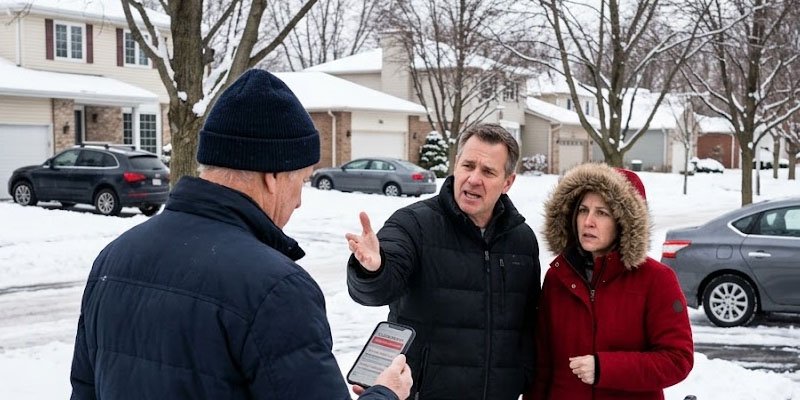
My son said it as I stood in his driveway with a snow shovel in my hands.
It was 7:18 on a January morning in Madison, Wisconsin. Snow had covered the neighborhood overnight, and Rachel—my daughter-in-law—had messaged me before dawn to ask whether I could clear enough of the driveway so the kids could get to the school bus.
So I drove twelve miles over roads coated with ice and began shoveling.
Daniel came outside while I was halfway through the job.
Rather than thanking me, he looked at the cleared pavement and spoke quietly.
“You’re always showing up. Rachel says you’re getting too involved in everything.”
I looked at him.
“Rachel asked me to come.”
“That’s not the point.”
Apparently, at sixty-nine, I was useful whenever they needed something and intrusive whenever I expected even basic respect.
For four years after my wife, Susan, passed away, I had quietly helped Daniel’s family whenever they were struggling.
Most months, I put $1,800 toward their mortgage.
I paid for my grandchildren’s summer camps.
When Daniel’s contracting business went through a difficult year, I paid their property taxes.
And for Christmas, I had planned something far more generous.
Four round-trip tickets to Lisbon.
Eleven nights in Portugal.
Hotels.
Airport transfers.
Several tours.
Total cost: $14,263.
Daniel knew I was covering it.
Rachel knew as well.
Standing there in the snow, I asked, “Am I a problem when the bills come due?”
His expression became hard.
“Don’t turn everything into a money issue.”
That sentence followed me all the way home.
At 10:04 a.m., I opened the travel booking.
Everything could still be refunded for another forty-eight hours.
So I canceled it.
Flights.
Hotels.
Transfers.
Four Lisbon seats disappeared from the itinerary.
Refund: $13,816 after cancellation fees.
I made myself a coffee and waited.
Daniel called eleven minutes later.
Then Rachel.
Then Daniel once more.
By noon, I had twenty-three missed calls.
Finally, Rachel sent a message:
YOU PROMISED THE CHILDREN. YOU CAN’T PUNISH THEM BECAUSE YOUR FEELINGS GOT HURT.
I answered with a single sentence.
You said I was becoming a problem. I’m taking the problem away.
I thought that would be the end of it.
At 2:37 p.m., my financial adviser called.
“Martin,” he said cautiously, “did you authorize Daniel to be added to your investment account this morning?”
I stood up.
“No.”
There was a long silence.
“Then we need to talk immediately.”
His voice became quieter.
“Because whoever submitted the request also sent us a power of attorney claiming you’re no longer capable of managing your own money.”
PART 2
Forty minutes later, I was seated in my adviser’s office.
Michael Reed set several documents down between us.
The power of attorney was legitimate.
Or, more accurately, it had been legitimate at one time.
Five years earlier, before undergoing heart surgery, I had temporarily given Daniel authority to pay my bills if anything happened to me.
Eleven months later, I revoked that authority and sent written notice to every bank and brokerage account I owned.
Daniel had submitted the old document as if it remained valid.
Attached to it was a request to move $86,000 into an account tied to his contracting company.
But that wasn’t all.
A typed letter stated that I had demonstrated “increasing confusion, impulsive financial behavior, and difficulty remembering agreements.”
My choice to cancel Portugal was cited as evidence.
I laughed once.
There was nothing amusing about it.
My son had taken the first significant financial decision I had made for myself and presented it as proof that I supposedly could no longer make financial decisions.
Thankfully, Michael had already frozen the request.
The following morning, I met with attorney Rebecca Shaw.
She contacted my doctor, who confirmed that he had never diagnosed me with dementia or questioned my mental capacity.
Then Rebecca discovered another document Daniel had submitted to a title company.
It concerned the Lake Michigan cabin Susan and I had purchased thirty-one years earlier.
Susan adored that place.
Before she died, we had agreed that it would eventually be placed into a trust for our grandchildren, Owen and Sophie.
Daniel knew that.
Yet someone had approached a realtor about putting the cabin on the market for $625,000.
That evening, I drove to Daniel’s house.
Rachel answered the door.
Two suitcases were sitting in the hallway.
The same ones they had purchased for Portugal.
Daniel came downstairs.
I set copies of the documents on the kitchen island.
“Explain.”
He stared at them.
Then he said the sentence that permanently changed the way I saw him.
“You have more than you’ll ever spend.”
Rachel started crying.
Daniel kept talking.
“The cabin just sits there. Your investments are nothing but numbers on a screen. We have kids, a mortgage, a business. What good is family money if you won’t help your own family?”
“I’ve helped you for years.”
“That’s different.”
“No,” I said. “You simply got used to it.”
Then my fourteen-year-old grandson, Owen, appeared on the stairs.
He looked scared.
“Grandpa?”
Daniel told him to go upstairs.
Owen stayed where he was.
Instead, he unlocked his phone and handed it to me.
“I think you need to see this.”
It was a screenshot from the family iPad.
A message Daniel had sent Rachel:
Once Dad signs the competency forms, we can move the cabin before he changes the trust.
Beneath it, Rachel had responded:
And don’t tell Owen. He tells Grandpa everything.
I looked at Daniel.
For the first time, my son had no response.
And suddenly, I understood.
Canceling Portugal had never really been the important decision.
It had simply made them expose what they intended to take next.
PART 3
I didn’t shout.
That appeared to frighten Daniel more than yelling ever could.
I photographed Owen’s screen, emailed the image to Rebecca, and handed the phone back to my grandson.
Then I told Daniel, “Tomorrow morning, everything changes.”
And it did.
Rebecca prepared new paperwork revoking every remaining financial authorization associated with Daniel.
My brokerage firm implemented enhanced identity verification.
The title company was formally notified that Daniel had no authority over the lake cabin.
The realtor removed the listing before it was ever made public.
I also completed an independent cognitive evaluation.
Not because Daniel deserved evidence.
Because I wanted a clear medical record in case he attempted it again.
The doctor’s conclusion was straightforward:
No evidence of cognitive impairment.
My financial decisions were mine.
Rebecca referred the attempted $86,000 transfer and the misuse of the revoked power of attorney to the bank’s elder-financial-abuse department.
Because the money was never transferred and the cabin was never sold, prosecutors ultimately declined to pursue criminal charges.
But Daniel was permanently prevented from acting on my accounts, and the entire episode became part of the official record.
Then I made the decision that surprised even me.
I stopped rescuing him.
No more monthly mortgage contributions.
No more emergency funds for his business.
No more insurance premiums quietly paid whenever work slowed.
I continued putting money directly into Owen and Sophie’s education accounts because those commitments were for them, not their parents.
Daniel called it punishment.
It wasn’t.
Punishment is intended to inflict pain.
A boundary simply prevents someone from continuing to hurt you.
The first three months were awful.
Rachel messaged that they might lose the house.
Daniel accused me of putting money ahead of my grandchildren.
Several relatives called and told me to “be the bigger person.”
I asked every one of them how much they intended to contribute toward Daniel’s mortgage.
The calls stopped.
Daniel sold his boat and a newer pickup truck.
Rachel went back to working full-time.
They refinanced several debts and moved the contracting business into a less expensive building.
Nothing disastrous happened.
They simply began paying for their own lives.
Six months later, Daniel asked me to meet him at the lake cabin.
He came alone.
For once, he brought no documents.
“I kept thinking Mom’s money would eventually become mine,” he admitted. “Then somewhere along the way, I started behaving as if eventually meant now.”
I appreciated his honesty.
I didn’t instantly forgive what he had done.
Instead, I changed my estate plan.
An independent trust company—not Daniel—would oversee what Susan and I left for the grandchildren.
The cabin could not be sold until Owen and Sophie became adults.
Daniel was still my son.
He was no longer my financial representative.
Those were two entirely different roles.
And Portugal?
Eight months after canceling those four tickets, I bought one.
For myself.
I flew to Lisbon alone.
I drank coffee beside the Tagus River.
I rode the old yellow tram through streets I had previously seen only in photographs.
I spent an afternoon in Belém without looking at my phone to find out whether someone back home needed money.
On my final night, Owen called.
“Are you lonely, Grandpa?”
I looked across the river at the lights shimmering over the water.
“No,” I said. “I think I’m finally understanding the difference between being alone and being used.”
The following winter, Daniel shoveled my driveway.
He came before I woke up.
There was no speech.
No grand apology.
Just a cleared driveway and a shovel leaning against my garage.
I stood there longer than I expected.
Maybe relationships aren’t repaired by one dramatic gesture.
Maybe they heal when people finally realize that love isn’t an endless line of credit.
My son once told me I was becoming a problem.
Canceling Portugal taught me something I should have realized years earlier:
I was never the problem.
My inability to say no was.