
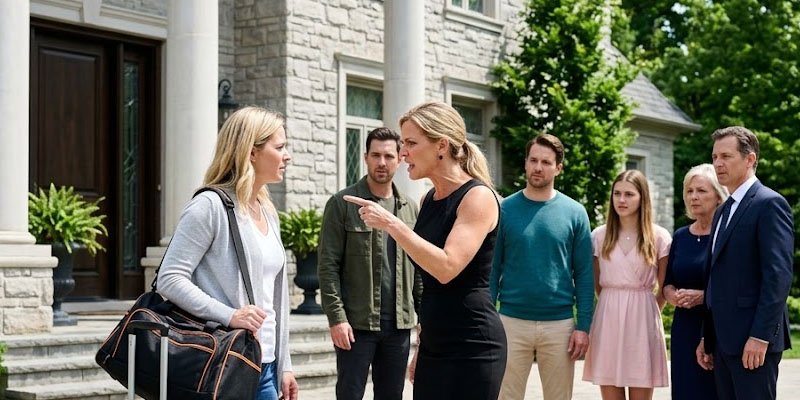
The day my father died, I said nothing about the $28 million inheritance—or the Manhattan skyscraper already placed in my name. That very night, my stepmother shouted, “Pack your bags, you’re not staying here!” I only replied, “Okay.” Then I made one decision that left her completely speechless.
The night my father died, my stepmother set my suitcase down on the marble floor and ordered me to leave before the funeral flowers had even arrived.
“Pack your bags,” Vivian said. “You’re not staying here.”
I was thirty-nine and still wearing the black sweater I had slept in beside Dad’s hospital bed. His watch was in my coat pocket because a nurse had given it to me after they turned off the machines.
I still couldn’t bring myself to say the word dead without feeling something inside me shatter.
So I looked at Vivian and said, “Okay.”
She mistook my exhaustion for submission.
What she didn’t know was that three hours earlier, Dad’s attorney, Samuel Price, had brought me into a private conference room at the hospital and asked me to sign two receipts.
The first confirmed that I had received an inheritance of approximately $28 million in cash and securities.
The second acknowledged that Harrison Tower, a forty-two-story office building in Manhattan, had already been transferred eighteen months earlier into a trust carrying my name.
Dad had kept everything confidential because he feared exactly this kind of situation.
Vivian’s son, Caleb, stood against the staircase while I closed my suitcase.
“You heard her,” he said. “This is her house now.”
I stopped.
Dad had purchased the Connecticut estate before he married Vivian. I knew his current will gave her the right to live there.
What I hadn’t examined closely was the condition attached to that right.
Samuel had.
I called him from the foyer and put him on speaker.
“Vivian wants me to leave tonight,” I said.
There was a brief silence.
“Tonight?” he asked.
“Yes.”
Vivian rolled her eyes. “Tell your lawyer she’s an adult. I’m not operating a hotel.”
Samuel’s voice immediately became serious.
“Mrs. Pierce, Robert’s will grants you a life estate in the property under one condition: his daughter must be allowed to occupy the guest suite for ninety days following his death while the estate is being administered.”
Vivian’s face went completely blank.
“If Hannah is removed before those ninety days are over,” Samuel continued, “your life estate ends.”
Caleb stood upright.
Vivian whispered, “That’s absurd.”
I picked up my suitcase.
Then I said the words that made her freeze.
“I was planning to leave quietly anyway. But since you’ve made it a legal matter, Samuel, please enforce Dad’s will exactly as he wrote it.”
Vivian stared at me.
Samuel replied, “I already am.”
Then the doorbell rang.
An overnight courier was standing outside with a certified envelope addressed to my stepmother.
PART 2
Vivian tore open the envelope in the foyer.
The first page was a formal notice from the executor outlining the ninety-day occupancy provision. It stated that any attempt to remove me, change the locks, or dispose of Dad’s belongings could result in immediate court review.
“You knew about this,” she said.
“No. I found out tonight.”
Caleb grabbed the documents. “Dad would never put something this humiliating in writing.”
Samuel was still on speaker.
“Your stepfather signed the will eleven months ago in the presence of two independent witnesses.”
Vivian directed her fury at me.
“So this is what you were waiting for? For him to die so you could take everything?”
That accusation finally broke through my numbness.
For four months, I had driven from Boston to Connecticut every weekend while pancreatic cancer slowly destroyed Dad’s health.
I handled his medications, battled the insurance companies, and slept in hospital chairs.
Vivian came too, but she disliked hospitals and almost never stayed for long.
“I didn’t take anything from you,” I said. “Dad decided how everything should be divided.”
She gave a bitter laugh.
“And I’m supposed to believe you got nothing?”
I could have told her right then.
About the $28 million.
About Harrison Tower.
About the trust Dad had established after Caleb repeatedly pressured him to guarantee loans for his business.
Instead, I said nothing.
The following morning, the family met at Samuel’s office for the formal reading of the estate documents.
Vivian arrived wearing Dad’s diamond anniversary bracelet.
Caleb sat beside her with a legal pad covered in calculations.
Samuel began with the smaller gifts and charitable donations.
Vivian received Dad’s retirement accounts, the household furnishings, and a $3.2 million marital trust.
She also received the conditional right to remain in the Connecticut house.
Her shoulders visibly relaxed.
Then Samuel looked toward me.
“To my daughter, Hannah Pierce, I leave the remainder of my financial estate, currently valued at approximately twenty-eight million dollars.”
Vivian’s pen stopped.
Samuel continued.
Eighteen months earlier, Dad had transferred every ownership interest in Harrison Tower Holdings into the Hannah Pierce Irrevocable Trust.
The Manhattan building was not part of probate because the transfer had already been completed.
Caleb sprang to his feet so quickly that his chair slammed against the wall.
“That building is worth more than the cash.”
Samuel looked at him.
“By a considerable amount.”
Vivian looked at me as if she were staring at a completely different person.
Then Samuel opened one final sealed letter from Dad.
The first line was addressed directly to her.
“Vivian, if you are hearing this after attempting to send Hannah away, then you have answered the final question I was too afraid to ask while I was alive.”
Nobody moved.
Samuel looked at me before reading on.
What Dad wrote next revealed why he had concealed the tower—and why Vivian’s right to stay in the house was suddenly in danger.
PART 3
Dad’s letter wasn’t filled with anger.
Somehow, that made it even more painful to hear.
He explained that during the final two years of his illness, Vivian and Caleb had repeatedly pushed him to refinance Harrison Tower and use the proceeds to save Caleb’s struggling real-estate company.
Dad refused.
After that, Vivian began asking what would happen to the building “when he was gone.”
Dad never accused her of intending to commit a crime.
He simply stopped trusting the question.
So, while he was still healthy enough to personally sign the necessary documents, he transferred Harrison Tower into my irrevocable trust.
Independent attorneys examined the transaction.
He kept the remaining $28 million separate because he wanted me to decide for myself, without anyone influencing me, what kind of life I wanted after losing him.
Then Samuel reached the section concerning the Connecticut house.
Dad never wanted Vivian to become homeless.
Her life estate was legitimate.
But the ninety-day provision existed because he knew I would be grieving and wanted me to have enough time to organize his papers, handle his affairs, and say goodbye without being treated like an unwelcome visitor.
“If Vivian cannot show my daughter ninety days of kindness after my death,” he wrote, “then I do not want my home rewarding that cruelty for the rest of her life.”
Vivian covered her mouth.
Caleb said, “He was manipulated.”
Samuel folded the letter.
“By whom?”
No one responded.
Vivian challenged the condition in probate court.
Her attorneys argued that grief had caused an emotional confrontation and that one demand for me to leave should not be enough to strip her of her housing rights.
Then the judge reviewed the security footage from the foyer.
And the text messages Vivian had sent Caleb that same afternoon.
One said:
As soon as Robert is gone, Hannah goes. I want her out before she starts asking questions.
Another read:
Once she leaves, we control the house and can deal with the tower later.
The court ruled that Vivian had intentionally violated the occupancy condition.
Her life estate was terminated.
Under the alternate provision in Dad’s will, the Connecticut property was sold, and the proceeds were donated to the cancer center that had treated him.
Vivian kept her $3.2 million marital trust and the rest of her personal inheritance.
She was not left penniless.
She simply lost the house.
Caleb received $250,000.
Within a year, his development company filed for bankruptcy.
I did not save it.
Harrison Tower remained inside my trust.
I hired an independent management company, retained the existing employees, and turned one floor into subsidized office space for nonprofit organizations serving veterans and cancer patients.
Dad had been both.
The $28 million frightened me at first.
That amount of wealth didn’t feel like freedom.
It felt like an obligation.
I paid off my Boston condo, established a scholarship in Dad’s name, and kept most of the money invested.
Six months later, Vivian reached out to me.
There was no apology.
Your father would hate what you did to this family.
I replied only once.
“I followed the documents he created while he was alive. You made your choice before you knew what they contained.”
Then I blocked her.
A year after Dad’s death, I stood in the lobby of Harrison Tower beneath a brass plaque carrying his name.
For months, people had called the inheritance my victory.
It never felt that way.
I would have surrendered every dollar for one more afternoon with my father.
But grief had temporarily hidden something that money eventually revealed.
Vivian believed her power began the instant Dad stopped breathing.
Dad had made certain mine did not.
That night she told me, “You’re not staying here.”
She was right.
I left.
I simply didn’t leave with empty hands.