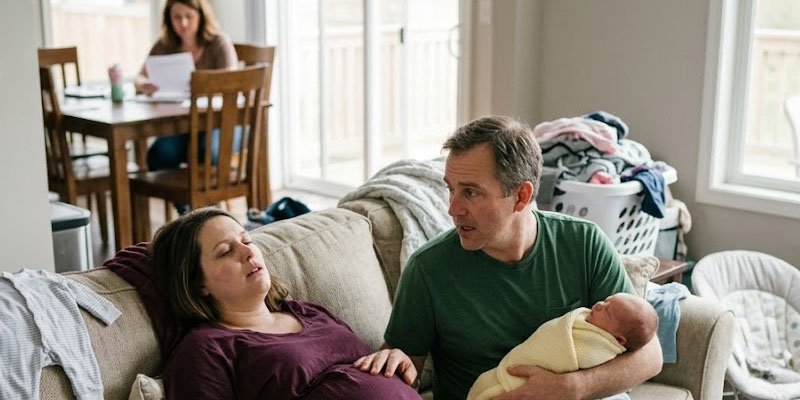
Liam was crying helplessly in his bassinet.
Then I noticed Alina lying unconscious on the floor beside the sofa. A partly peeled potato and a kitchen knife were lying nearby. She had collapsed from sheer exhaustion.
Ten feet away, Eleanor sat at the dining table, peacefully eating the meal Alina had cooked.
She rolled her eyes and dismissed Alina as being dramatic.
Something inside me snapped.
I checked Alina’s pulse, lifted her into the car, then went back inside for Liam and the diaper bag.
Eleanor finally got to her feet.
“David, what are you doing? Dinner is almost ready.”
I left without saying a word.
As I drove away, an alert appeared on my phone from our security camera. Eleanor was heading toward the drawer where we kept our passports and Liam’s birth certificate.
The danger wasn’t over.
It had simply taken a different form.
PART 1: THE HOUSE THAT WASN’T SAFE
The deception started with a casserole.
That was how my mother, Eleanor, inserted herself into our lives—bringing warm food, offering assistance, and disguising every intrusion as an act of love. My wife, Alina, and I lived in Ashburn, Virginia, with our newborn son, Liam. I worked long hours as a software engineer, while Alina was struggling with exhaustion and recovering from childbirth. When Eleanor offered to stay in our guest room for a few months, I believed she was helping us.
I never imagined I was handing her control of my home.
At first, everything appeared perfect. But I failed to see the emptiness in Alina’s expression or the way her body stiffened whenever my mother walked into the room.
Eleanor never criticized her when I was there. She waited until I was gone.
One Tuesday morning, Alina was in the kitchen making Liam’s bottle. She had hardly slept for three days. Her hands were shaking, and dark circles showed beneath her eyes.
Before leaving, I kissed her forehead.
“Mom will look after you,” I said. “Try to get some rest.”
As soon as the door shut behind me, Eleanor’s warmth disappeared.
She shoved a recipe book across the counter and told Alina that I expected a traditional roast for dinner.
“If you were a competent wife,” she said, “I wouldn’t have to remind you how to take care of your husband.”
Alina was far too exhausted to fight back.
At the office, I could not concentrate. Around one that afternoon, an uneasy feeling settled over me. I canceled my meetings and drove home.
The moment I pulled into the driveway, I heard Liam screaming.
I hurried inside.
Liam was crying desperately in his bassinet.
Then I saw Alina unconscious on the floor beside the sofa. A half-peeled potato and kitchen knife lay nearby. She had collapsed from complete exhaustion.
Ten feet away, Eleanor sat at the dining table, calmly eating the food Alina had prepared.
She rolled her eyes and said Alina was being dramatic.
Something inside me broke.
I checked Alina’s pulse, carried her to the car, and went back for Liam and the diaper bag.
Eleanor finally stood.
“David, what are you doing? Dinner is almost ready.”
I walked out without responding.
As I drove away, my phone displayed an alert from our security camera. Eleanor was moving toward the drawer containing our passports and Liam’s birth certificate.
The danger had not ended.
It had merely changed shape.
PART 2: CUTTING HER OUT
I drove to a hotel several towns away. Alina stayed unconscious for almost two hours while I looked after her and rocked Liam.
When she finally woke, she immediately panicked and reached for the baby.
“He’s safe,” I assured her. “You’re both safe.”
Then she started crying.
Alina finally told me everything.
Eleanor had verbally attacked her every day, forced her to handle exhausting chores, separated her from her friends, and made her believe she was failing both as a wife and as a mother.
The worst of it involved Liam.
Whenever Alina finally managed to get him asleep, Eleanor would enter the nursery and intentionally wake him. Then she would accuse Alina of resting while her baby was crying.
“She wanted you to believe I was unstable,” Alina whispered. “She wanted to destroy me.”
Whatever loyalty I still had toward Eleanor vanished.
I opened my laptop and started removing her from our lives. I canceled the additional credit card connected to my account, revoked her access to the house, and contacted an attorney about legally ending her stay. I also preserved copies of the security footage.
Through the cameras, I watched Eleanor realize that her control was slipping away.
By midnight, she stared directly into one of the cameras and silently mouthed three words:
“I have it.”
The following morning, I returned with police officers present for protection.
Eleanor was waiting in the foyer. As soon as she saw the officers, she began screaming.
“I am the head of this family! Bring that ungrateful woman home to apologize!”
I placed the legal notice at her feet.
“You are not the head of this family,” I said. “You are a guest who put my wife and child in danger.”
She argued that being Liam’s grandmother gave her rights.
I told her she had twenty minutes to pack a single suitcase. Movers would put the rest of her belongings into storage.
Her expression hardened with rage.
“You are throwing away your own mother for that woman?”
“If you go near Alina or Liam again,” I answered, “I will give the recordings to the police and to everyone whose opinion matters to you.”
The possibility of being exposed finally silenced her.
Twenty minutes later, Eleanor left in a taxi.
But when I checked the guest room, I discovered that Alina’s wooden keepsake box had been forced open. The diamond necklace she had inherited from her grandmother was missing.
Eleanor had taken one final piece of our family with her.
PART 3: THE LIFE WE DEFENDED
Weeks later, Eleanor began a public campaign against us.
From a motel, she published a lengthy message online, portraying herself as a devoted mother abandoned by a cruel son and his manipulative wife. She tagged relatives and friends.
I refused to argue.
Instead, I posted one security recording.
It showed Alina collapsing while Liam cried and Eleanor continued eating as if nothing were happening. I added another recording that supported Alina’s account of Eleanor intentionally waking the baby at night.
The response was immediate.
Relatives deleted their messages of support. Friends stopped returning Eleanor’s calls. The people who had believed her finally saw what had really been happening inside our home.
The police also recovered Alina’s necklace. Confronted with the evidence, Eleanor returned it rather than risk facing serious charges.
Meanwhile, our house slowly began to feel like home again.
With Eleanor gone, Alina finally started sleeping, and the fear in her eyes gradually faded.
One afternoon, I watched her sitting on the rug with Liam, helping him stack wooden blocks. His laughter filled the room.
I still carried guilt over failing to recognize her suffering sooner, but I knew we had made it through. I had lost the illusion of having a loving mother, but I had protected my wife and son.
Soon, envelopes began appearing in Eleanor’s familiar handwriting. Inside were apologies mixed with accusations, threats about grandparents’ rights, and demands that I remember everything she had done for me.
At first, every letter made my heart pound.
Eventually, they no longer had any power over me.
Two years later, we celebrated Liam’s second birthday in the backyard. Friends gathered outside, while Alina stood beside the cake, pregnant with our daughter.
She looked peaceful and full of life.
Near the fire pit, I held another stack of Eleanor’s unopened letters. I no longer felt anger, fear, guilt, or obligation.
I dropped them into the flames.
The pages curled, blackened, and turned to ash.
Then I returned to Alina and put my arms around her. Liam was nearby, happily smearing chocolate cake across his face.
“We built a beautiful life,” Alina whispered.
“We did more than build it,” I said. “We protected it.”
As the sun disappeared over our backyard, I finally understood that sharing blood does not mean anyone must accept cruelty. Loyalty to the past should never come at the cost of destroying the future.
Sometimes, the most loving and safest choice a person can make is to shut the door on the life that hurt them—and refuse to open it again.