
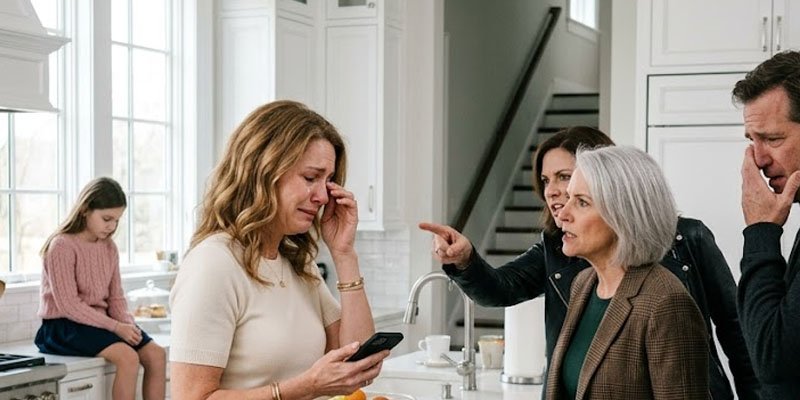
At the mall, my 11-year-old suddenly grabbed my hand and whispered, “Mom—quickly, behind that pillar. Don’t move.” I followed her gaze and froze when I saw my mother-in-law. What she was doing made my blood run cold. I said nothing, acted quietly—and by the next morning, they both went pale.
At Lakeside Mall outside Chicago, my eleven-year-old daughter, Emily, suddenly seized my hand so firmly that her nails dug into my palm.
“Mom—quickly, behind that pillar!”
Before I had a chance to ask what was happening, she tugged me toward a marble column beside a jewelry kiosk that was closed. Then she lowered her voice to a whisper.
“Don’t move.”
I leaned around the pillar just enough to see what had alarmed her.
And stopped cold.
My mother-in-law, Margaret Hayes, was standing near the escalator with a man I had never seen before.
She was supposed to be across town attending a cardiology appointment.
Instead, she had sunglasses on indoors and was carrying a thick envelope.
The man opened it.
Cash.
A large amount of it.
Then Margaret handed him two other items—a silver key and a folded sheet of paper.
Emily whispered, “That’s Grandma. Why is she giving him our house key?”
My stomach clenched.
Three months earlier, my husband, Daniel, had persuaded me to give Margaret a spare key “for emergencies.”
Only Margaret, Daniel, and I knew the alarm code.
The stranger tucked the key into his jacket.
Margaret nervously looked around.
“Tomorrow morning. They’ll both be gone by eight. The girl has school, and Laura works downtown.”
My breath stopped.
The man asked, “And your son?”
“He leaves at six-thirty. You’ll have at least two hours.”
Emily’s face went pale.
I gently placed my hand over her mouth before she could gasp.
Then Margaret spoke the words that changed everything.
“Take the documents from the office. The blue folder, the passports, and the jewelry box upstairs. Don’t touch anything else. It has to look like a normal burglary.”
The man nodded.
Margaret went on.
“Once I have the originals, Laura can’t stop the sale.”
Sale?
Daniel and I owned our house together.
We had never talked about selling it.
But I didn’t confront Margaret.
I didn’t call Daniel.
I remained quiet and took action.
From behind the pillar, I captured twenty-seven seconds of their conversation on my phone. Then I snapped two pictures of the man and another of Margaret giving him the key.
Emily and I quietly left through an exit by the department store.
That afternoon, I contacted the police non-emergency line.
Then our bank.
Our attorney.
And the alarm company.
I changed every code, transferred our passports, deed, insurance documents, and jewelry into a bank safe-deposit box, and took anything valuable or important out of the house.
Before Emily went to sleep, I duplicated the recording and photographs in cloud storage and emailed everything to myself.
I wanted nothing important to exist only on my phone.
Then I made one last call.
Daniel’s older sister, Claire.
She listened to the recording twice.
Then she said softly, “Laura, I know who that man is.”
The next morning, when Margaret and Daniel entered our kitchen, both of them went pale.
PART 2
Claire arrived at our house at 6:45 the next morning, fifteen minutes after Daniel was supposedly already at work.
Except Daniel hadn’t actually left.
At 7:10, he returned through the garage, noticed Claire sitting at our kitchen table, and froze.
Five minutes later, Margaret showed up at the front door.
She tried the spare key she still assumed would work.
The lock refused to open.
I answered the door myself.
That was when both she and Daniel went pale.
Margaret was the first to recover.
“What is this?” she demanded.
I stepped out of the doorway.
“Come inside.”
Daniel looked at Claire.
“Why are you here?”
Claire crossed her arms.
“Because Laura called me.”
Margaret’s expression shifted at once.
I set my phone on the kitchen island and played the recording.
No one said a word as Margaret’s own voice echoed through the kitchen.
“Tomorrow morning. They’ll both be gone by eight.”
Then the stranger asked:
“And your son?”
And Margaret answered calmly:
“He leaves at six-thirty.”
When the recording finished, Daniel looked from his mother to me.
“You followed her?” he asked.
“No,” I replied. “Emily spotted her at the mall.”
That landed harder than anything else.
Daniel shut his eyes.
Margaret snapped, “You recorded a private conversation?”
Claire let out a brief, bitter laugh.
“That’s what you’re going with?”
I looked straight at Daniel.
“Who is the man?”
He remained silent.
Claire answered for him.
“His name is Victor Hale. He used to arrange private property purchases for Mom’s boyfriend, Richard Cole.”
I had met Richard only twice.
He was sixty-eight, wealthy, arrogant, and always talking about “off-market opportunities.”
Claire explained that Victor specialized in arranging quick property sales when owners were desperate, going through divorces, or buried in debt.
Sometimes, she said, he secured buyers before homeowners even knew a deal was being prepared behind their backs.
A cold weight settled in my chest.
“What deal?” I asked.
Margaret finally lowered herself into a chair.
“Your house has nearly doubled in value. You two are drowning in expenses. Daniel told me.”
I slowly turned to my husband.
“What did you tell her?”
Daniel dragged both hands across his face.
“I told her we were stretched. That’s all.”
Claire immediately interrupted.
“That’s not all.”
She reached into her bag and removed a folder filled with printed emails.
Margaret suddenly lunged for it.
Claire yanked the folder out of her reach.
“I found these last night in the family business account,” Claire said. “Mom forgot that I still have administrator access.”
The emails revealed months of discussions between Margaret, Richard, Victor—and, twice, Daniel.
They had talked about creating a forged authorization to make it appear that Daniel and I had agreed to privately list our house.
They needed the original documents to copy signatures, verify title information, and satisfy a buyer’s attorney long enough to move the transaction forward before I could stop it.
I stared at Daniel’s name.
“You knew.”
His voice broke.
“I knew she was trying to refinance something. I didn’t know about the burglary.”
I pointed at the emails.
“That is not what those say.”
One message from Daniel read:
If Laura sees paperwork, she’ll shut everything down. Do not contact her directly.
Emily was upstairs getting ready for school.
I was thankful she couldn’t hear any of this.
Then my phone suddenly buzzed against the kitchen counter.
The alarm company.
A motion sensor had been triggered at the rear patio door.
Everyone went silent.
Margaret glanced at the clock.
7:58 a.m.
Victor had come anyway.
PART 3
The alarm dispatcher was still talking when a low metallic knock came from the rear of the house.
Victor was checking the patio door.
I had expected him to realize that the front-door key no longer worked.
What I hadn’t expected was for him to walk around the house searching for another way inside.
“Police are already on their way,” the dispatcher told me. “Do not approach the person outside.”
I switched the call to speaker.
Daniel shot to his feet so quickly that his chair scraped loudly against the tile.
“I’ll go tell him to leave.”
“No,” I said.
For the first time that morning, my voice stopped him immediately.
Claire moved in front of Daniel and blocked the hallway.
“Sit down.”
Margaret stared toward the family room, where the patio doors led into the backyard.
“You called the police?” she asked.
“I called them yesterday.”
Her expression hardened.
And suddenly, I understood something.
Margaret had been expecting a confrontation.
Tears.
Accusations.
Maybe threats of divorce.
What she hadn’t expected was for me to make preparations before confronting anyone.
Another knock came from outside.
Then a security-camera alert appeared on my phone.
Victor was standing outside in a baseball cap, carrying a canvas tool bag.
He tested the handle, peered through the glass, and then stepped back.
He pulled out his phone.
Margaret’s phone began ringing.
Nobody moved.
It rang three times.
I looked at her.
“Answer it.”
She shook her head.
The ringing stopped.
A few seconds later, Daniel’s phone vibrated on the counter.
Daniel reached toward it.
“Leave it,” I said.
He stopped.
That was all the proof I needed.
Victor had Margaret’s number.
And Daniel’s.
Daniel knew far more than he had confessed.
Claire understood it too.
“Oh, Danny,” she said. “What did you do?”
He sank back into his chair.
Outside, Victor walked toward the side gate.
Less than a minute later, two police cruisers pulled up.
Through the camera feed, I watched one officer stop Victor near the driveway while another came toward our front door.
When I opened it, I handed them my phone, the mall recording, the photographs, screenshots of Claire’s emails, and the incident number from my call the day before.
Victor was not immediately arrested for attempted burglary.
The officers explained that simply entering the property and testing a door did not automatically prove an intent to burglarize.
But the recording changed the situation.
So did the key they found in Victor’s pocket.
Inside his tool bag were latex gloves, an empty document envelope, a small pry bar, and two blank property forms.
Margaret began explaining before anyone had even accused her.
First, she claimed Victor had misunderstood.
Then she insisted their conversation at the mall had been “hypothetical.”
Then she said she only wanted copies of financial documents because she was concerned about Daniel.
Each explanation contradicted the one before it.
Daniel barely said a word.
After the officers separated us to take our statements, I learned why.
He had been helping Margaret for six weeks.
He insisted it wasn’t because he wanted our home stolen, but because he had created a financial disaster he was too ashamed to tell me about.
Eight months earlier, Daniel had invested $85,000 in one of Richard Cole’s real-estate ventures.
The money hadn’t come from our savings.
It had come from Margaret.
Daniel promised her he could pay it back quickly because he expected to gain access to the equity in our house.
He had even suggested that, if necessary, he could persuade me to refinance.
Then the investment collapsed.
Margaret wanted her money back.
Daniel didn’t have the money.
Richard offered another way out.
If Daniel could persuade me to sell our house quickly to one of Richard’s buyers, the equity could repay Margaret while still leaving us enough money to buy something smaller.
Daniel knew I would say no.
Our mortgage rate was low.
Emily’s school was close by.
And my late father had helped us with the down payment.
I had told Daniel again and again that I had no desire to move.
So persuasion turned into deception.
At first, Daniel claimed he thought they were only preparing paperwork to “show me what the offer would look like.”
The emails revealed something completely different.
One message from Richard asked whether my signature could be copied from an old refinancing package.
Daniel replied:
Probably. Mom has access to the office if we need originals.
That sentence ended my marriage.
I read it twice while sitting at the kitchen table after the police left with Victor for questioning.
Daniel stood roughly ten feet away.
“Laura, I never meant for anyone to hurt you.”
“You arranged for a man to enter our house while your daughter and I were supposed to be gone.”
“I didn’t arrange that part.”
“You gave them our schedule.”
He looked down.
“You told them when Emily leaves for school.”
“I was trying to fix this before you found out.”
“That was your solution?”
He started crying.
I didn’t.
By noon, my attorney, Melissa Grant, was sitting beside me in that same kitchen.
Margaret had gone with Claire.
Claire refused to let her drive because she was too shaken.
Daniel stayed only long enough to gather clothes, medication, his laptop, and toiletries under Melissa’s supervision.
I told him he could stay with Margaret or get a hotel.
He asked whether he could hug Emily before leaving.
I told him that choice belonged to Emily.
She had heard more than I realized.
She slowly came downstairs and stopped beside the staircase.
Daniel opened his arms.
Emily didn’t move.
“Did you know Grandma was sending that man here?” she asked.
Daniel swallowed.
“I knew he might come by.”
“To steal our stuff?”
“No. Not like that.”
Emily looked at me, then turned back to him.
“You always tell me that hiding part of the truth is still lying.”
Daniel’s face crumpled.
There was nothing I needed to say.
He left five minutes later.
The investigation continued for months.
And the complete story turned out to be even uglier than what Emily and I had seen at the mall.
Richard had been using financially distressed homeowners and private investors to put together below-market property deals.
Some of the transactions were legitimate.
Others involved heavy pressure, deceptive paperwork, or sellers who didn’t fully understand what they were signing.
Our house was supposed to be one of Richard’s easiest acquisitions because Daniel was already on the inside of the family.
Richard had located a buyer willing to pay $610,000.
Our estimated market value was closer to $760,000.
The proposed deal would have sent a significant portion of the proceeds toward fees, debt repayments, and a private settlement with Margaret.
By the time I discovered what they were doing, I could have been trying to undo a completed sale while another buyer claimed legal ownership.
They weren’t criminal masterminds.
Somehow, that made it even worse.
They were ordinary people who kept convincing themselves that every dishonest choice was only temporary.
Daniel lied because he wanted to conceal his failed investment.
Margaret lied because she wanted her money returned.
Richard lied because rushed property deals meant profit.
Victor agreed to enter our house because he was being paid.
Each of them believed the next step would fix the problem created by the previous one.
Instead, they created a chain of lies.
And Emily happened to witness one link at the mall.
Victor eventually cooperated with investigators.
His attorney handed over emails and text messages in exchange for consideration in his case.
Those messages confirmed that Margaret had instructed him to take the blue folder, passports, and jewelry box.
The jewelry had nothing to do with the property deal.
That detail had bothered me from the beginning.
When questioned, Margaret admitted she had added the jewelry because she wanted the break-in to look genuine.
My wedding necklace.
My mother’s earrings.
And the bracelet my father had given Emily before he died.
All three were supposed to become props.
That led to the final conversation Margaret and I ever had without lawyers present.
She called one evening.
“I was going to give everything back.”
I answered, “You were going to make my daughter believe a stranger had broken into her home.”
Silence followed.
Then she said, “I panicked.”
“So did Emily at the mall. The difference is that she protected me.”
I ended the call.
The criminal cases didn’t conclude with the dramatic courtroom scene people expect from television.
Charges were negotiated.
Evidence was examined.
Attorneys argued over conspiracy, fraudulent documents, attempted entry, intent, and the precise point at which preparation became criminal conduct.
Richard faced the most serious financial consequences because investigators uncovered unrelated transactions tied to his business.
Victor pleaded guilty to charges connected to our incident and another property case.
Margaret accepted a plea deal involving conspiracy and attempted fraud-related conduct.
She avoided a lengthy prison sentence but received probation, restitution requirements, and restrictions concerning financial transactions.
Daniel faced separate charges for his part in the document scheme.
His attorney stressed that he had never physically entered our house or personally forged my signature.
Prosecutors pointed to his emails, his disclosure of our schedule, and his knowledge that the original documents would be taken without my permission.
His case ended with a negotiated plea involving probation, community service, and financial penalties.
Our divorce took longer.
At first, Daniel asked me to reconcile.
Then he wanted counseling.
Then he asked me to stay married until his criminal case was over because getting divorced would “make everything look worse.”
That request proved he still didn’t understand.
I wasn’t divorcing him to influence a legal case.
I was divorcing him because I no longer knew what any promise from him was worth.
Eventually, we sold the house.
But not to Richard’s buyer.
And not because anyone pressured us.
Eighteen months after Victor appeared at our patio door, Emily and I moved into a townhouse in Evanston.
I chose it because it had a little garden, a bright kitchen, and a bedroom with a window seat that Emily immediately claimed as her reading spot.
Our old house sold on the open market for $782,000.
After paying the mortgage, legal expenses, and the amounts required by the divorce settlement, I had enough left to start over without debt.
During our first week in the new house, Emily asked whether we should hide a spare key somewhere outside.
“No,” I said.
She grinned.
“Good answer.”
Then her expression turned serious.
“Do you still think about the mall?”
“Sometimes.”
“I do too.”
I sat beside her on the front steps.
She told me the scariest part wasn’t seeing Margaret with Victor.
It was hearing her grandmother casually explain our daily routine.
“She knew when I left for school,” Emily said. “She knew when you left for work. It was like she was using ordinary things against us.”
I understood exactly what she meant.
For months, I replayed that moment behind the pillar and wondered what might have happened if Emily hadn’t looked across the mall at precisely that moment.
Victor might have gotten into our house.
He might have found the folder.
The fraudulent transaction might eventually have failed anyway.
But we would have discovered the betrayal later, after even more damage had been done.
Instead, an eleven-year-old noticed that something was wrong and trusted her instincts.
She didn’t confront Margaret.
She didn’t run toward her.
She pulled me out of sight and whispered:
“Don’t move.”
That small decision gave me twenty-seven seconds of evidence.
Twenty-seven seconds exposed six weeks of lies.
A year after we moved, Daniel began seeing Emily regularly under the parenting schedule established by the court.
Their relationship remained cautious and imperfect.
I never asked Emily to forgive him.
And I never asked her to remain angry.
I let her decide for herself what trust meant.
Claire stayed close to us.
She severed her financial ties with Margaret and helped investigators untangle the family business accounts.
Once, she apologized for not recognizing what her mother was doing sooner.
I told her none of us had seen it.
Emily had.
On the second anniversary of the mall incident, we happened to drive past Lakeside Mall after Emily’s dentist appointment.
She pointed through the windshield.
“Want to go shopping?”
I glanced at her.
“Seriously?”
“Sure. I need sneakers.”
So we went inside.
The jewelry kiosk beside the marble pillar had reopened under a different name.
People moved through the mall carrying shopping bags and drinks.
A toddler cried near the escalator.
Two teenagers laughed at something on a phone.
Nothing about the mall felt threatening anymore.
Emily stopped beside the pillar.
“This one,” she said.
I noticed a small scratch in the marble around waist height.
For a moment, neither of us spoke.
Then Emily smiled.
“You know what I remember now?”
“What?”
“You bought me pretzel bites afterward.”
I laughed.
“That’s what you remember?”
“They were good.”
We continued toward the food court.
For two years, I had believed the most important moment in that mall was watching Margaret hand Victor our key.
It wasn’t.
The most important moment happened seconds earlier.
My daughter recognized danger before I did and trusted me enough to pull me into hiding beside her.
The second most important came immediately afterward.
I stayed quiet.
I watched.
I recorded.
And instead of giving the people who betrayed me time to invent a better story, I made certain that by the next morning, the truth was already waiting for them.